
On This Page – Quick Medical Summary
Your lab’s range and another lab’s range can both be right
Two laboratories can test the same blood and print different verdicts. Neither report is wrong.
Your TSH reference range comes from a population your laboratory selected, measured on the analyser it bought. Change either and the printed range changes. For the numbers first, see a full TSH chart by age.
ℹ️ Medical Disclaimer: This explains how reference ranges are built, not what your result means. Diagnosis, treatment, and medication decisions belong with a board-certified endocrinologist or primary care clinician who reads your number alongside your symptoms and other thyroid values.
What a reference range actually measures
A reference interval is not a health threshold. It is the middle 95% of a group a laboratory selected as healthy, cut at the 2.5th and 97.5th percentiles.
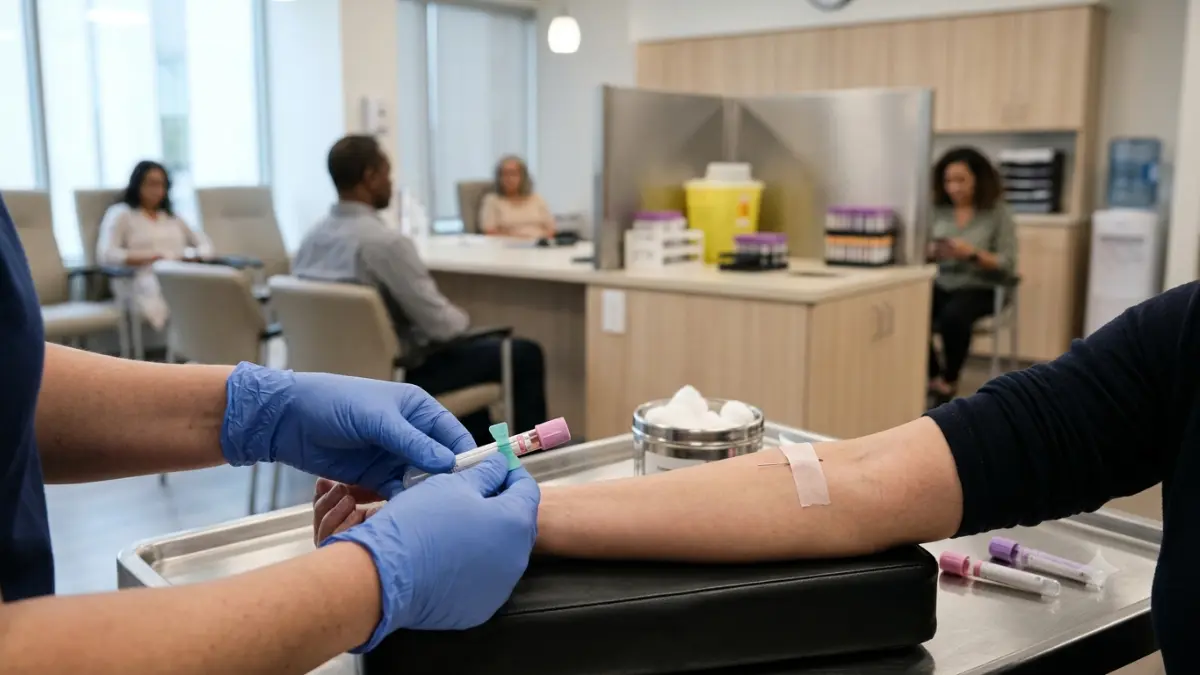
The middle 95%, not a health cutoff
Five in every hundred healthy people fall outside their own laboratory’s range by definition. It shows where most people sit, not where health begins.
Where the most-cited numbers came from
📊 Clinical Data Point: In the NHANES III reference population of 13,344 people, TSH ran 0.45 to 4.12 mIU/L between the 2.5th and 97.5th percentiles — Hollowell et al., JCEM, 2002.
That population excluded anyone pregnant, on sex hormones, carrying thyroid antibodies, or already showing thyroid disease. Every laboratory makes those choices itself.
Three reasons two labs report different ranges
Ranges differ for three reasons: the analyser, the reference population, and what each laboratory decides the range is for.
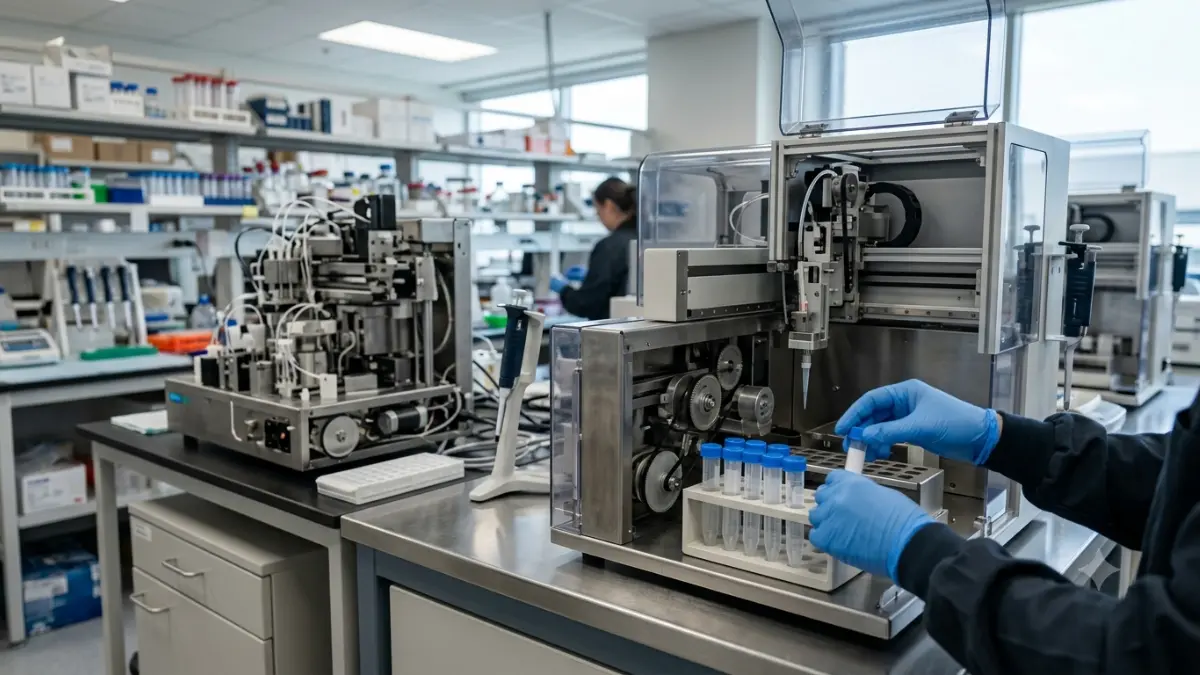
The assay platform changes the number
🔬 How It Works: A TSH immunoassay catches the hormone with antibodies. Manufacturers raise those antibodies against different parts of the TSH molecule, so identical blood gives a different signal on different machines.
Each lab picks its own reference population
Even laboratories running the identical analyser disagree.
| What varies | Published spread | Key clinical detail |
|---|---|---|
| Assay platform | Up to 50% difference | Same blood, different machine |
| Labs on one analyser | Upper limits 4.00–6.00 mU/L | Neither miscalibrated |
| Age band | 97.5th percentile 3.56 → 7.49 mIU/L | One range under-fits both ends |
Neither lab is wrong
Both describe different populations on different instruments. A discrepancy is not evidence anyone erred with your health.
The argument over where the upper limit belongs
The upper limit is contested rather than arbitrary.
The case for a lower cutoff
In 2003 the National Academy of Clinical Biochemistry lowered the recommended upper limit from 5.5 to 4.1 mU/L, noting that over 95% of healthy people without thyroid disease sit between 0.4 and 2.5 mU/L. That observation, not a cutoff, is where the circulated 2.5 figure originates.
The case for leaving it alone
Others published the opposite case in 2005: the thyrotropin reference range should remain unchanged.
🩺 Editor’s Note: The 2012 AACE/ATA hypothyroidism guideline states the performing laboratory’s own range sets the upper limit for a third-generation assay, with 4.12 mIU/L where no age-based limit exists.
What this means near the line
No US guideline directs treatment on the 2.5 figure. What a mildly raised TSH means turns on subclinical hypothyroidism criteria applied alongside your other values.
✅ Patient Action: Ask your primary care clinician or endocrinologist: “Given my free T4 and TPO antibody status, does this need a repeat or a referral?”
Why normal moves with age and in pregnancy
The general adult range fits the middle of the adult population, not its edges.
TSH rises with age
📊 Clinical Data Point: In NHANES III the 97.5th percentile was 3.56 mIU/L at ages 20–29 and 7.49 mIU/L at 80 and over — Surks & Hollowell, JCEM, 2007.
The distribution shifts upward with age. That is narrower than calling a raised result in an older adult harmless, and what a high TSH means still depends on the rest of the picture.
Pregnancy shifts the range down
The 2017 American Thyroid Association guidelines recommend an upper limit near 4.0 mU/L from weeks 7 to 12 where trimester-specific ranges are unavailable, returning gradually toward the non-pregnant range.
✅ Patient Action: If pregnant, ask your obstetric provider which trimester-specific range your laboratory uses.
Why your own TSH changes between two blood draws
Your own TSH moves through the day, by more than most people expect.
Time of day moves the number
📊 Clinical Data Point: In 20 women with subclinical hypothyroidism, median TSH was 5.83 mU/L at 8–9am and 3.79 mU/L at 2–4pm — Sviridonova et al., Endocrine Research, 2012.
Twenty people is a signal, not a settled number. TSH runs higher overnight and lower by day.
Your personal range is narrower than the printed one
📊 Clinical Data Point: In 16 healthy men sampled monthly for a year, the index of individuality for TSH was 0.49 — Andersen et al., JCEM, 2002.
So each person has a narrower personal range: a result can sit inside the printed range and still be off your baseline.
Supplements can distort the result
⚠️ Clinical Warning: High-dose biotin pushes TSH falsely low and T4 falsely high, per the FDA’s biotin warning. Tell your laboratory if you take it.
For a comparable next result: same laboratory, morning draw, biotin held, repeat before acting. The TSH test guide covers the draw.
What to do with a result that sits near the line
Use the range on your own report
If your TSH sits just outside your laboratory’s range:
- Use the range on your own report, not another laboratory’s or a chart online.
- Repeat on the same assay, in the morning.
- Ask for free T4 and TPO antibodies alongside the repeat.
When to raise it with your clinician
✅ Patient Action: Ask your primary care clinician: “Can we repeat this on the same assay, with free T4 and TPO antibodies, before deciding anything?”
Inside the range but still unwell? Raise that too. The MedlinePlus explainer on the TSH test covers what it does not show; you can check your symptoms first.
Common questions about TSH reference ranges
1. What is the normal TSH reference range?
The NHANES III reference population ran 0.45 to 4.12 mIU/L, but your own report’s printed range governs.
2. Why does my lab’s TSH range differ from another lab’s?
Different analysers and reference populations. Assay platform alone can shift a TSH result by up to 50%.
3. Which range should I use, my lab’s or one online?
The one printed on your own report. It matches the analyser and population your blood was measured against.
4. Is a TSH of 4.5 normal?
It sits at or near many laboratories’ upper limit and is read alongside free T4. Ask your clinician.
5. Should the upper limit of TSH be 2.5?
Proposed and disputed since 2003. No current US guideline directs treatment decisions on the 2.5 figure.
6. Does the normal TSH range change with age?
Yes. The NHANES III 97.5th percentile was 3.56 mIU/L at ages 20–29 and 7.49 mIU/L past 80.
7. What is a normal TSH in pregnancy?
The 2017 ATA guidelines suggest roughly 4.0 mU/L from weeks 7–12. Ask your obstetric provider which applies.
8. Does the time of day affect my TSH result?
Yes. One study found median TSH of 5.83 mU/L in the morning versus 3.79 mU/L that afternoon.
9. Can biotin supplements change my TSH result?
Yes. High-dose biotin interferes with many immunoassays and can push a TSH result falsely low, per FDA.
10. Why did my TSH change when nothing else did?
Circadian rhythm and biological variation. Your own 95% range is roughly half the width of the population’s.
11. What should I do if my TSH is just above the range?
Repeat on the same assay in the morning with free T4 and TPO antibodies. Discuss results with your clinician.
The range that applies to you
The range that applies to you is the one on your own report, produced by the analyser that measured your blood against the population your laboratory chose. A number from a different laboratory is not a second opinion on the same scale. Take your report to your clinician and ask what its range means.
About this content
How this article was put together: researched from recognised health sources, drafted with the help of AI tools, and edited by hand, with sources linked throughout.

Sameer Patel is the founder and editor of My Medicine Advisor. He is not a doctor or medical professional — before starting this site he worked in banking,…
Medical disclaimer
The content on MyMedicineAdvisor is provided for general informational and educational purposes only and is not a substitute for professional medical advice, diagnosis, or treatment. Health information on this website should not be used to diagnose, treat, cure, or prevent any condition without guidance from a qualified healthcare professional. Always seek the advice of your doctor, physician, or another licensed healthcare provider with any questions you may have regarding a medical condition, symptoms, medications, or treatment decisions.