

Medicine Dosage Calculator
See the US label dose for a child's weight next to a weight-based (mg/kg) estimate for acetaminophen or ibuprofen, convert mg to mL for your bottle strength, or convert a prescribed amoxicillin dose into mL.
Inputs
Results
Results appear after you click Calculate.
Safety status
Dose schedule
| Area | Value | Meaning |
|---|
How the numbers were worked out
| Area | Value | Meaning |
|---|
Follow-up notes
Good to know
Guide
How to use this tool
- Choose the medicine and age group first.
- For children 2 to 11, enter body weight in kg. The label dose for that weight band appears first.
- Type the bottle strength exactly as printed (for example 160 and 5 for "160 mg per 5 mL") to convert mg into mL.
- For amoxicillin, enter the dose in mg from the prescription and how often it was prescribed.
- Use Download CSV to save the result and show it to your pharmacist or doctor.
When to ask a doctor or pharmacist first
- The child is under 2 years or under 24 lb.
- A baby under 3 months has a rectal temperature of 100.4°F (38°C) or higher.
- Pregnancy, kidney disease, liver disease, or a known allergy to the medicine.
- More than one product might contain the same ingredient.
- You are not sure which strength is in the bottle.
On This Page – Quick Medical Summary
The calculator turns a dose in milligrams into the milliliters to measure from your bottle, using the strength printed on its label. For children 2 to 11 it shows the dose from the US children’s label first, and for children under 2 it shows no dose at all, because US labels say to check with a doctor at that age.
It covers acetaminophen (sold as paracetamol outside the US), ibuprofen and prescribed amoxicillin. Choose the medicine and age group, add the weight for a child and the bottle strength, then press Calculate.
How milligrams become milliliters
One division does the work: the dose in mg divided by the mg in each mL of your bottle. Children’s acetaminophen liquid is labeled 160 mg in each 5 mL, so every mL holds 32 mg (DailyMed label for Children’s Tylenol).
A prescription for 200 mg of a liquid dispensed at 400 mg per 5 mL works out the same way. That bottle holds 80 mg per mL, and 200 ÷ 80 = 2.5 mL.
In adult mode the tool shows the usual adult range and the 24-hour ceiling instead of a single number. For acetaminophen, the adult maximum is 4,000 mg a day across every product taken. The limit printed on your own box comes first, and so does any lower limit your doctor has set.
Why does the tool show two numbers for children?
US children’s labels sort children into weight bands, and every child within a band gets the same volume. The calculator shows that label dose first. Next to it sits an estimate built from a fixed mg/kg rule, which follows the child’s weight to the decimal.
The two can differ, most often for a child near the top or bottom of a band. When they do, give the label dose, or the dose a doctor or pharmacist set for the child.
The estimate never goes above the adult single dose or the adult daily maximum. Above the heaviest weight on the children’s chart, the tool switches to adult directions.
One mL holds a different amount in each bottle
| Product | Strength on the label | Medicine in 1 mL | Labeled for |
|---|---|---|---|
| Children’s acetaminophen liquid | 160 mg per 5 mL | 32 mg | Ages 2–11 years |
| Infants’ ibuprofen drops | 50 mg per 1.25 mL | 40 mg | Ages 6–23 months |
Source: DailyMed labels for Children’s Tylenol and Infants’ Motrin drops.
Amoxicillin liquid also comes in more than one strength, and the strength is printed on the pharmacy label. A volume worked out for one bottle is wrong for any other.
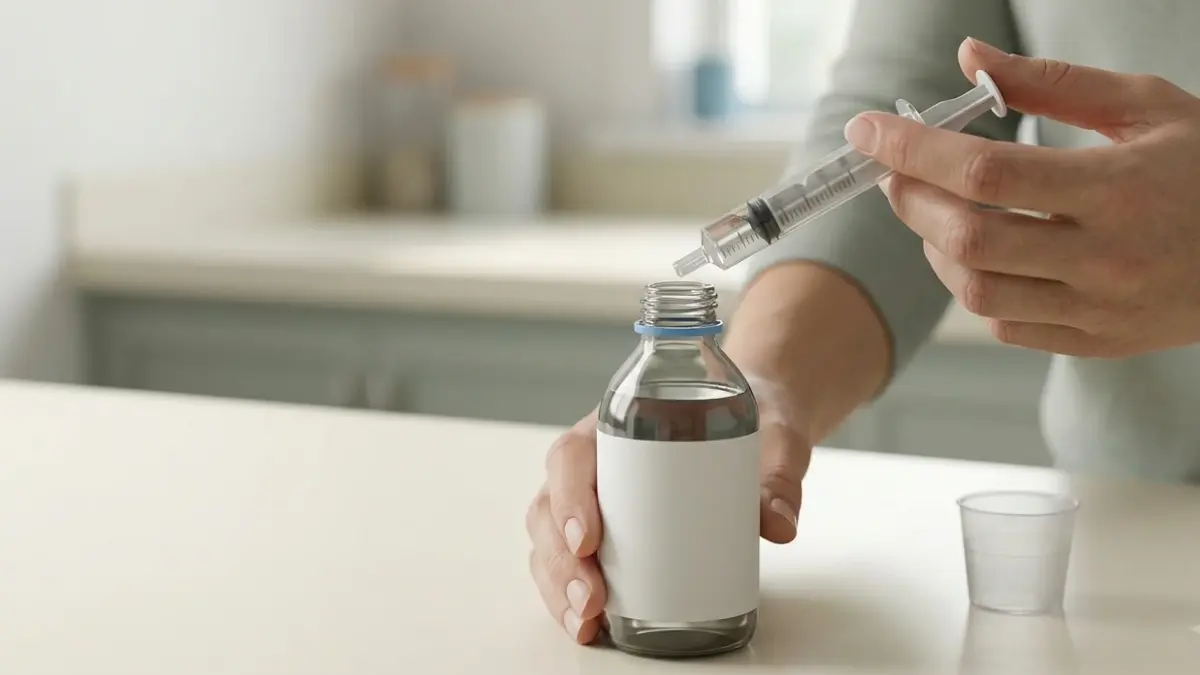
Measure only with the cup or syringe packed in that box; both labels rule out using any other device. Then type the strength into the calculator exactly as printed, with the mg in the first box and the mL in the second.
3 months, 6 months, 2 years: age limits on these labels
Before age 3 months, a rectal temperature of 100.4°F (38°C) or higher needs a call to the child’s provider, and the provider should be contacted before any medicine is given (MedlinePlus on fever in babies). Ibuprofen is not used in children younger than 6 months.
The children’s acetaminophen label lists “ask a doctor” for children under 2 years or under 24 lb. That is why the calculator shows no dose for this age group. If a baby under 2 needs medicine for fever or pain, ask the child’s doctor which product to use and how many mL to give from the bottle you have at home.

Pregnancy and some long-term conditions also stop the calculator from showing a number. Ibuprofen and other NSAIDs are not used from 20 weeks of pregnancy onward unless a clinician specifically advises them. People with liver disease, or who have three or more alcoholic drinks a day, should talk with a clinician before taking acetaminophen.
Kidney disease with ibuprofen, or a known allergy to either medicine, also holds back the dose. The result explains why in one line.
Many cold and flu medicines also contain acetaminophen
Acetaminophen sits in many cold, flu and pain products, and in prescription pain medicines that combine it with codeine, oxycodone or hydrocodone. Prescription labels do not always spell the name out in full. The FDA advises against taking more than one over-the-counter product that contains it, and the 4,000 mg adult limit counts every source together. Children’s labels carry the same rule: no other drug containing acetaminophen at the same time.
The calculator only knows the one product you entered. If a cold medicine is also in use, add up the mg from both labels before the next dose.
Ibuprofen carries a similar risk. Stomach bleeding becomes more likely when a child taking it also takes another NSAID such as aspirin or naproxen.
Too much acetaminophen harms the liver first. The early signs are covered in acetaminophen liver damage symptoms, and the blood test side is in why AST can rise even at a label dose of Tylenol.
Get emergency care now if:
- Someone took more acetaminophen than the label allows in 24 hours, took two acetaminophen products together, or a child swallowed medicine meant for someone else. Call Poison Control at 1-800-222-1222 right away, even if the person seems fine.
- Nausea, vomiting, belly pain, confusion, or yellow skin or eyes appear after a large dose of acetaminophen, since these are signs of overdose.
- The person is unresponsive, has a seizure or is struggling to breathe. Call 911.
- The overdose may have been intentional. Call 911, or call or text 988 for the Suicide & Crisis Lifeline.
Amoxicillin prescriptions
The calculator doesn’t create an amoxicillin dose. Enter the mg written on the prescription, how many times a day it was prescribed and the bottle strength, and it converts the dose into mL. Add a child’s weight and it also shows the mg per kg per day, a figure to bring to the pharmacist if it looks unusual.
If the pharmacy label already gives the dose in mL, that is the dose. More on the medicine itself is in what to know about amoxicillin, and Augmentin uses and side effects covers the amoxicillin-clavulanate combination, which is dispensed in its own strengths.
Before you change a medicine: ask the prescriber or pharmacist before changing a prescribed dose, switching to a different bottle strength or stopping a course early.
Compare the result with the label before the first dose
Three details on the box decide the dose: the active ingredient, the strength in mg per mL, and the dose chart or adult directions. Enter the strength into the calculator and set the result beside the label.
If the two match, follow the label. If they differ, or the box gives no dose for this age or weight, call the pharmacist before giving anything and read out the product name and strength.
The Download CSV button saves the result, so the numbers can go with you to that call or to the next appointment.
Can acetaminophen and ibuprofen be given together?
Ask the child’s doctor before combining or alternating them, and ask for the schedule in writing. The two are different medicines with different spacing between doses and separate daily limits on their labels, so a written plan stops doses from being counted twice.
Does the calculator work for tablets or chewables?
It converts liquids only. For tablets and chewables, the strength of each piece is printed on the label, and the dose chart on that same box is the one to follow.
Found this helpful? See more of our guides on Google.
Want to see our guides first on Google?
Found this helpful? See more of our guides on Google.
About this content
How this article was put together: researched from recognised health sources, drafted with the help of AI tools, and edited by hand, with sources linked throughout.

Dr. Pooja Sahu, MBBS, is a medical reviewer for MyMedicineAdvisor. She is a clinical physician whose experience includes serving as a Junior Resident in Nephrology at Dr. Ram…
Medical disclaimer
The content on My Medicine Advisor is provided for general informational and educational purposes only and is not a substitute for professional medical advice, diagnosis, or treatment. Health information on this website should not be used to diagnose, treat, cure, or prevent any condition without guidance from a qualified healthcare professional. Always seek the advice of your doctor, physician, or another licensed healthcare provider with any questions you may have regarding a medical condition, symptoms, medications, or treatment decisions.