
On This Page – Quick Medical Summary
Augmentin (amoxicillin/clavulanate) is a prescription antibiotic that combines amoxicillin with clavulanic acid to fight bacterial infections that resist standard penicillin treatment. It treats sinusitis, ear infections, pneumonia, UTIs, bronchitis, and skin infections. This guide covers exactly what Augmentin does, correct dosage for adults and children, side effects ranked by severity, critical drug interactions, and what most medical websites still get wrong.
What Is Augmentin and How Does It Work?
What Is Augmentin?
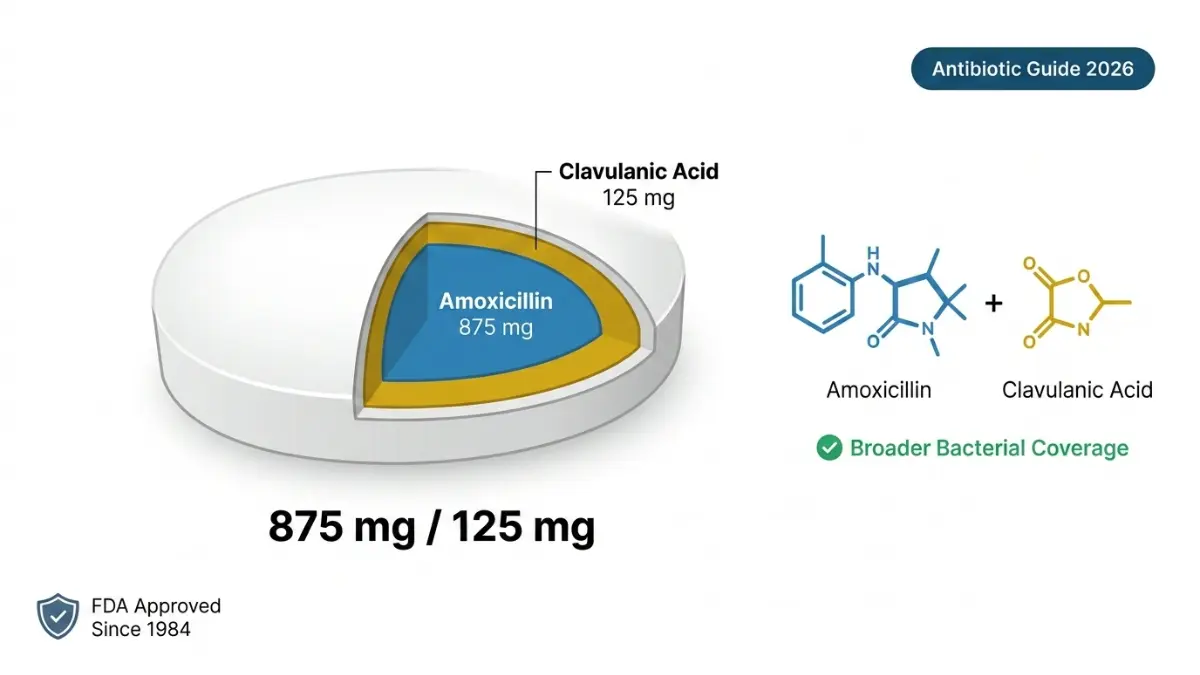
Augmentin is a broad-spectrum combination antibiotic containing two active ingredients: amoxicillin (the infection fighter) and clavulanic acid (the resistance blocker). It belongs to the penicillin class of antibiotics and has been FDA-approved since 1984.
According to the National Institutes of Health, approximately 10 million Augmentin prescriptions are filled every year in the United States alone — making it one of the most commonly prescribed antibiotics in outpatient and emergency care settings.
You may also see it listed on your prescription as amoxicillin/clavulanate, amox-clav, or co-amoxiclav. The generic version is therapeutically identical to brand-name Augmentin and costs significantly less.
The “Soldier and Bodyguard” Mechanism — Explained Simply
Here is what actually happens inside your body when you take Augmentin:
- Amoxicillin attacks bacteria by destroying their protective cell walls, killing them before they can multiply.
- Some bacteria have evolved a counter-attack: they produce an enzyme called beta-lactamase, which breaks down amoxicillin before it can work.
- Clavulanic acid blocks that enzyme entirely — acting as a shield that protects amoxicillin and lets it do its job.

Think of it this way: amoxicillin is the soldier. Clavulanic acid is the bodyguard who disarms the enemy’s weapon first.
This is precisely why doctors prescribe Augmentin instead of regular amoxicillin when they suspect beta-lactamase-producing bacteria — such as in persistent sinus infections, complicated ear infections, or dental abscesses.
What Infections Does Augmentin Treat?
Augmentin is FDA-approved to treat the following bacterial infections:
- Sinusitis (acute bacterial rhinosinusitis — first-line per IDSA guidelines)
- Ear infections (acute otitis media, especially persistent or resistant cases in children)
- Pneumonia (community-acquired, mild to moderate)
- Bronchitis (acute bacterial exacerbation)
- Urinary tract infections (UTIs, including those caused by E. coli)
- Skin and soft tissue infections (cellulitis, wound infections)
- Tonsillitis and pharyngitis

Doctors also prescribe Augmentin off-label for dental abscesses, animal bite wounds, diabetic foot infections, and COPD exacerbations.
Important: Augmentin only works against bacterial infections. It has zero effect on viruses like the common cold, flu, or COVID-19. If you’re unsure whether your symptoms are bacterial or viral, our free Symptom Checker can help you identify warning signs before your doctor’s appointment.
Is Augmentin the Same as Amoxicillin?
No — and this distinction matters clinically.
| Feature | Amoxicillin | Augmentin |
|---|---|---|
| Active ingredients | Amoxicillin only | Amoxicillin + Clavulanic acid |
| Beta-lactamase resistance | ❌ None | ✅ Blocks it |
| Bacterial spectrum | Narrower | Broader |
| GI side effects | Milder | More frequent |
| Best use | Simple, uncomplicated infections | Resistant or complex infections |
For a deeper comparison, read our full guide on what doctors want you to know about amoxicillin.
Augmentin Dosage — Adults, Children & Special Populations
Adult Augmentin Dosage Chart (2026)
Your Augmentin dose depends on the type and severity of your infection. Below are the standard adult dosages based on FDA prescribing information:
| Infection | Standard Dose | Frequency | Duration |
|---|---|---|---|
| Mild–moderate (UTI, skin, ear) | 500 mg/125 mg | Every 8 hours | 7–10 days |
| Moderate–severe (sinusitis, pneumonia) | 875 mg/125 mg | Every 12 hours | 7–14 days |
| Severe (community-acquired pneumonia — XR form) | 2,000 mg/125 mg | Every 12 hours | 7–10 days |
The numbers refer to mg of amoxicillin / mg of clavulanate. Always follow your doctor’s specific prescription — do not self-adjust the dose.
Augmentin Dosage for Children — Weight-Based Guide
Pediatric Augmentin dosing is based on body weight, not age. The following chart reflects current FDA prescribing guidance:
| Infection Severity | Dose (Amoxicillin component) | Frequency |
|---|---|---|
| Standard infections | 25–40 mg/kg/day | Every 12 hours |
| Severe / resistant (sinusitis, AOM) | 40–45 mg/kg/day | Every 12 hours |
| Infants under 3 months | Physician-determined only | — |
- Children weighing over 40 kg receive adult dosing
- Oral liquid suspension is preferred for children — easier to dose accurately
- Dosing every 12 hours (vs. 8 hours) has been shown to cause significantly less diarrhea in children
Parent note: If you’re tracking your child’s health during treatment, our Pregnancy Weight Gain Calculator and Fetal Growth Percentile Calculator are also available for pregnancy-related monitoring.
5 Rules for Taking Augmentin Correctly
Most side effects from Augmentin happen when people take it incorrectly. Follow these five rules:
- Take it at the START of a meal — not mid-meal or on an empty stomach. This improves absorption and cuts diarrhea risk significantly.
- Never crush extended-release (XR) tablets — swallow them whole. Crushing destroys the time-release mechanism.
- Shake liquid suspension thoroughly before every dose.
- Complete the full course — even if you feel better after 2–3 days. Stopping early allows resistant bacteria to survive and rebound.
- Space doses evenly — if prescribed every 12 hours, take at 8am and 8pm. Consistent timing maintains effective blood levels.
Special Populations
Pregnancy: Augmentin is FDA Pregnancy Category B — animal studies showed no fetal harm. However, it should only be used during pregnancy when clearly necessary and under direct medical supervision.
Kidney disease: Patients with a creatinine clearance below 30 mL/min should not use the extended-release (XR) tablet form. Standard tablet dosing may also require adjustment — your nephrologist or prescribing doctor will advise.
Elderly patients (65+): Age-related kidney changes can slow Augmentin clearance. Elderly patients are more susceptible to GI side effects and should be monitored more closely, particularly for signs of liver stress.
Patients managing type 2 diabetes alongside a bacterial infection should monitor blood glucose carefully during antibiotic treatment, as illness and medication can both affect levels. Our Blood Sugar Converter provides a quick reference tool for glucose unit conversions.
Augmentin Side Effects — Ranked by Severity
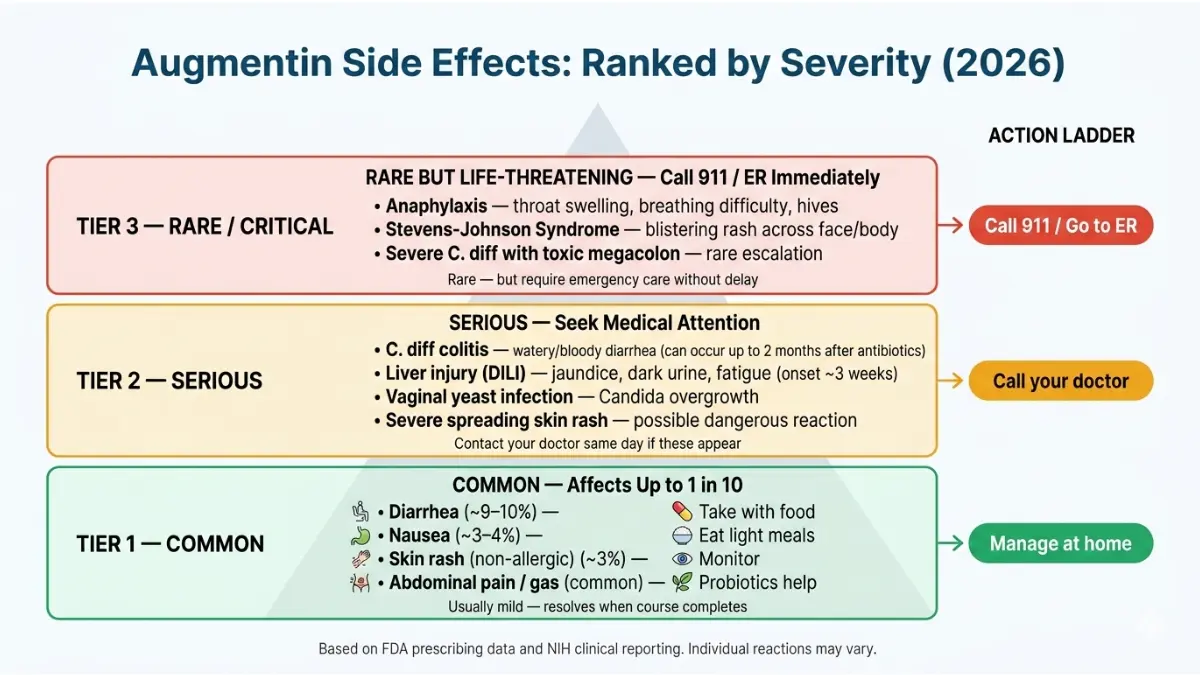
Common Side Effects (Affect Up to 1 in 10 People)
Most Augmentin side effects are mild and resolve once the course is complete.
| Side Effect | Approximate Frequency | Management |
|---|---|---|
| Diarrhea | ~9–10% | Take with food; use probiotics 2 hrs after dose |
| Nausea | ~3–4% | Take at start of meal; try ginger tea |
| Vomiting | ~1–2% | Stay hydrated; contact doctor if persistent |
| Skin rash (non-allergic) | ~3% | Monitor; see doctor if spreading or blistering |
| Abdominal pain / gas | Common | Eat light meals; avoid spicy and fried foods |
| Headache | Less common | Usually mild and short-lived |
Why Does Augmentin Cause MORE Diarrhea Than Regular Amoxicillin?
This is the most-asked question about Augmentin — and no competitor explains it properly.
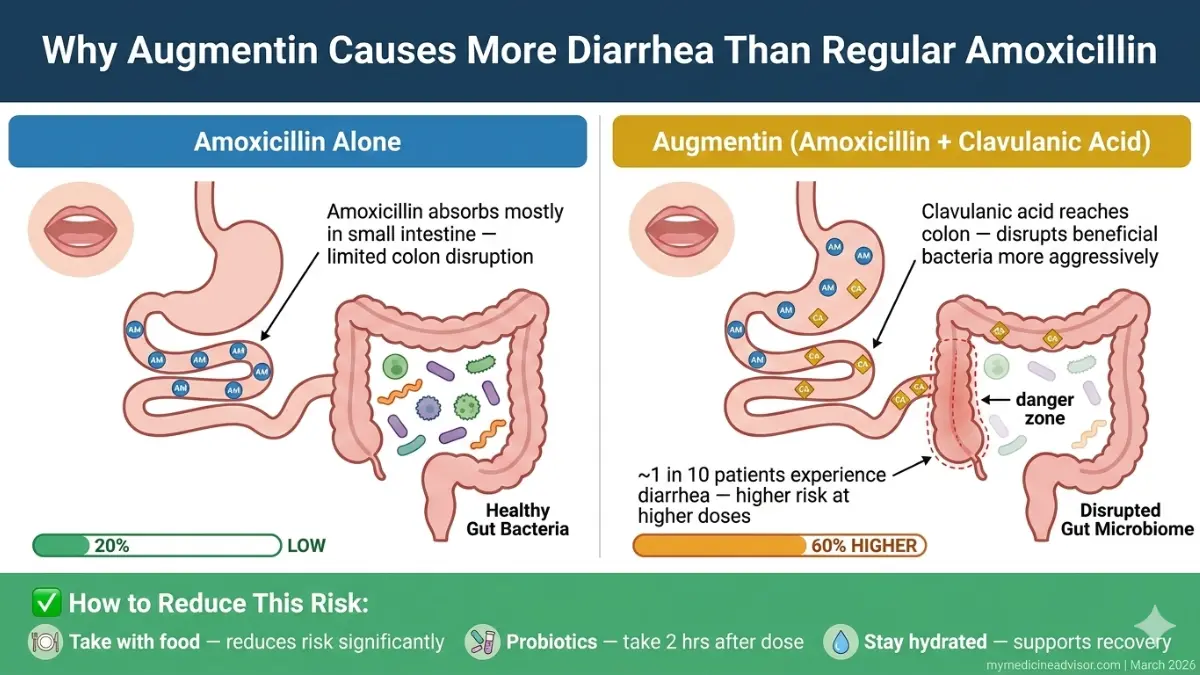
Here is the science in plain English:
- Amoxicillin alone disrupts gut bacteria to a moderate degree.
- Clavulanic acid travels further into the digestive tract than amoxicillin and reaches the colon, where it disrupts a larger population of beneficial bacteria.
- This broader disruption of the gut microbiome triggers looser stools and diarrhea in approximately 1 in 10 patients.
- The colon also becomes temporarily more vulnerable to Clostridioides difficile (C. diff) overgrowth — a potentially serious complication (more on this below).
How to minimize Augmentin diarrhea:
- ✅ Take Augmentin with food (the single most effective prevention strategy)
- ✅ Use a probiotic — at least 2 hours after your Augmentin dose, not at the same time
- ✅ Best probiotic strains for antibiotic diarrhea: Lactobacillus rhamnosus GG and Saccharomyces boulardii (both supported by clinical evidence)
- ✅ Best foods during treatment: yogurt, bananas, oatmeal, cooked vegetables, plain rice, toast
- ❌ Avoid: alcohol, spicy foods, excessive fatty food, carbonated drinks
Serious Side Effects — When to Seek Immediate Help
These are rare but require urgent medical attention:
🚨 Severe Allergic Reaction (Anaphylaxis) Signs: hives, throat or tongue swelling, difficulty breathing, rapid heart rate. Call 911 immediately. People allergic to penicillin are at higher risk.
🚨 Stevens-Johnson Syndrome Signs: painful blistering rash spreading across face and body, fever, burning eyes. Go to the ER immediately. Extremely rare but life-threatening.
🚨 C. difficile Colitis Signs: severe watery or bloody diarrhea, cramping, fever — appearing up to 2 months after finishing Augmentin. Contact your doctor immediately — do not treat with anti-diarrheal medication, as this can worsen the condition.
🚨 Drug-Induced Liver Injury (DILI) — The Warning Most Sites Miss
According to NCBI LiverTox (updated January 2026), amoxicillin-clavulanate is the single most common cause of clinically apparent drug-induced liver injury in both the United States and Europe.
Key facts every patient must know:
- Liver injury onset is typically 3 weeks after starting Augmentin — and often appears after the course is already finished
- Early warning signs: fatigue, nausea, abdominal pain
- Later signs: jaundice (yellow skin or eyes), dark urine, clay-colored stools
- Risk is higher with repeated courses of Augmentin
If you notice jaundice or dark urine after taking Augmentin, contact your doctor the same day or go to urgent care.
Side Effects Specific to Women
Women taking Augmentin have one additional risk: vaginal yeast infection (vulvovaginal candidiasis). The antibiotic disrupts the natural vaginal flora, allowing Candida to overgrow. This is manageable with over-the-counter antifungal treatment, but consult your doctor for diagnosis first.
Drug Interactions & Who Should NOT Take Augmentin
Key Drug Interactions You Must Know
| Drug | Interaction | Risk Level |
|---|---|---|
| Hormonal birth control pills | May reduce contraceptive effectiveness | Moderate — use backup method during course |
| Methotrexate | Augmentin raises methotrexate blood levels — toxic risk | High — requires medical monitoring |
| Probenecid (gout medication) | Increases amoxicillin concentration in blood | Moderate — dose adjustment may be needed |
| Live vaccines (e.g., typhoid, cholera) | Augmentin may neutralize live bacterial vaccine strains | Avoid live vaccines during and 2 weeks after treatment |
| Warfarin / blood thinners | May increase bleeding risk and affect INR | Moderate — INR monitoring recommended |
For a comprehensive reference on medication interactions, see our dedicated drug interactions list.
Who Should NOT Take Augmentin
Do not take Augmentin if you have:
- A known allergy to penicillin or cephalosporin antibiotics (e.g., amoxicillin, cephalexin, cefdinir) — risk of severe cross-reactive allergic reaction
- A prior history of liver problems or jaundice caused by Augmentin specifically — do not retake under any circumstances
- Severe kidney impairment (CrCl <30 mL/min) — the XR extended-release tablet is contraindicated
- Phenylketonuria (PKU) — the liquid suspension contains phenylalanine
Always give your doctor a complete list of current medications, supplements, and known allergies before starting any antibiotic course. For a broader understanding of antibiotic options your doctor may consider, our guide on ciprofloxacin side effects and warnings provides useful context on the fluoroquinolone class.
Can I Drink Alcohol While Taking Augmentin?
Direct answer: Alcohol does not chemically reduce Augmentin’s antibacterial effectiveness.
However, alcohol:
- Increases the risk of nausea and vomiting
- Places additional stress on the liver, which is already being taxed by Augmentin
- Causes dehydration, which slows your body’s recovery from infection
The clinical recommendation for US patients is: avoid alcohol for the duration of your Augmentin course. It is not worth the added GI and liver stress during an active infection.
Augmentin vs Amoxicillin — The Clinical Decision Guide
When Do Doctors Choose Augmentin Over Amoxicillin?
This is one of the top People Also Ask questions — and the answer matters for understanding your prescription.
| Clinical Scenario | Doctor’s Choice | Reason |
|---|---|---|
| Simple strep throat, first episode | Amoxicillin | Beta-lactamase unlikely; simpler drug preferred |
| Acute sinusitis (uncomplicated, first episode) | Either | IDSA recommends amoxicillin-clavulanate as first-line |
| Sinusitis after failed amoxicillin course | Augmentin | Resistant bacteria strongly suspected |
| Persistent ear infection in child | Augmentin | Beta-lactamase-producing organisms more common |
| Dental abscess | Augmentin | Polymicrobial infection — needs broader coverage |
| Animal bite wound | Augmentin | High risk of Pasteurella and mixed anaerobic organisms |
| Uncomplicated UTI (first occurrence) | Amoxicillin | Sufficient for susceptible E. coli |
| Recurring UTI | Augmentin | Resistance more likely in recurring cases |
The key principle: Doctors follow antibiotic stewardship — using the narrowest effective antibiotic first to prevent resistance. Augmentin is reserved for cases where that narrower option has failed or resistance is clinically expected.
3 Situations Where Augmentin Is Always the Right Choice
- Previous amoxicillin course failed — the infection persisted or returned within 30 days
- Beta-lactamase-producing bacteria confirmed or suspected — such as H. influenzae, M. catarrhalis, or S. aureus (MSSA)
- Polymicrobial infection — dental abscess, animal bites, complicated skin infections involving both aerobic and anaerobic bacteria
What This Means For You: If your doctor prescribed Augmentin instead of plain amoxicillin, it is a deliberate clinical decision — not an arbitrary one. They are anticipating bacterial resistance based on your infection history, the type of infection, or local resistance patterns in your area. Take it with food, complete the full course, and trust the clinical judgment behind the prescription.
Taking Augmentin Safely — The 2026 Patient Action Guide
How Fast Does Augmentin Work?
Most patients notice measurable symptom improvement within 48 to 72 hours of starting Augmentin.
If your symptoms are not improving after 72 hours, contact your doctor — the infection may require a different antibiotic, or a bacterial culture may be needed to confirm the organism and its sensitivities.
Full infection clearance requires completing the entire prescribed course (typically 7–14 days), even if you feel completely better after day 3. Stopping early leaves surviving bacteria in your system. Those bacteria are, by definition, the ones that partially resisted treatment — and they will rebuild the infection stronger.
The Augmentin Food & Recovery Guide
During your Augmentin course, eat and drink strategically:
✅ Foods that help:
- Plain yogurt with live cultures (take 2+ hours after Augmentin dose)
- Bananas — easy on the GI tract, restore potassium
- Oatmeal and plain rice — low-irritation, gut-soothing
- Cooked vegetables — easier to digest than raw
- Plenty of water — supports kidney clearance of the drug
❌ Foods and habits to avoid:
- Alcohol — increases liver and GI stress
- Spicy, fried, or heavily processed food — worsens nausea and diarrhea
- Taking probiotics simultaneously with Augmentin — space them at least 2 hours apart
Staying well-hydrated during antibiotic treatment supports kidney clearance and helps manage GI side effects considerably. Use our Water Intake Calculator to determine your optimal daily fluid intake based on your body weight and activity level.
Generic vs Brand-Name Augmentin: Is There a Difference?
No clinically meaningful difference.
Generic amoxicillin/clavulanate is FDA-bioequivalent to brand-name Augmentin — same active ingredients, same dosage, same clinical effectiveness. The difference is cost:
| Form | Estimated US Cost (2026) |
|---|---|
| Brand-name Augmentin | $100–$300+ (cash price) |
| Generic amoxicillin/clavulanate | $10–$45 (cash price) |
| Generic with GoodRx / discount coupon | $9–$25 |
| With insurance (Tier 1 generic) | $0–$15 copay |
Most US insurance plans cover generic amoxicillin/clavulanate as a Tier 1 generic — no prior authorization required. Ask your pharmacist for the generic version when filling your prescription.
Antibiotic Resistance: Why Completing Your Course Matters for Everyone
When patients stop antibiotics early, they contribute to a public health crisis: antibiotic resistance.
The CDC’s antibiotic stewardship program reports that at least 2.8 million antibiotic-resistant infections occur in the US every year, resulting in more than 35,000 deaths. Every incomplete antibiotic course makes this worse.
Completing your full Augmentin course is not just good for your personal recovery — it is a direct contribution to preserving antibiotic effectiveness for future patients.
If you are taking Augmentin for a respiratory infection and want to understand related antibiotic options your doctor may discuss, our guides on azithromycin (Z-Pack) dosage and side effects and doxycycline — what doctors won’t tell you provide useful context for those antibiotic classes.
Frequently Asked Questions — Augmentin
1. What is Augmentin used for?
Augmentin treats bacterial infections including sinusitis, ear infections, pneumonia, UTIs, bronchitis, skin infections, dental abscesses, and animal bite wounds caused by beta-lactamase-producing organisms.
2. Is Augmentin the same as amoxicillin?
No. Augmentin contains amoxicillin plus clavulanic acid. The clavulanic acid blocks bacterial enzymes that destroy regular amoxicillin, giving Augmentin a broader range against resistant bacteria.
3. How long does Augmentin take to work?
Most patients feel meaningful improvement within 48–72 hours. However, the full prescribed course — typically 7 to 14 days — must be completed to fully clear the infection and prevent resistance.
4. Why does Augmentin cause diarrhea?
The clavulanic acid component travels further into the colon than amoxicillin and disrupts a larger population of beneficial gut bacteria. Taking Augmentin with food and using a probiotic (2 hours after each dose) significantly reduces this risk.
5. What is the standard Augmentin dosage for adults?
The most common adult dose is 875 mg/125 mg every 12 hours or 500 mg/125 mg every 8 hours, depending on infection severity and type. Always follow your doctor’s specific prescription.
6. Can I drink alcohol while taking Augmentin?
Alcohol does not chemically stop Augmentin from working, but it significantly increases nausea, liver stress, and dehydration — all of which slow recovery. Clinical guidance is to avoid alcohol for the full course duration.
7. Does Augmentin affect birth control pills?
Yes — Augmentin may reduce the effectiveness of hormonal oral contraceptives. Use a non-hormonal backup contraceptive method (such as a condom) throughout your Augmentin course as a precaution.
8. Is Augmentin safe to take during pregnancy?
Augmentin is FDA Pregnancy Category B — no harm was demonstrated in animal studies. It should only be used during pregnancy when the clinical benefit clearly outweighs any potential risk. Always consult your OB-GYN.
9. What medications interact dangerously with Augmentin?
The most significant interaction is with methotrexate (used for cancer and autoimmune conditions) — Augmentin raises methotrexate to toxic blood levels. Blood thinners, probenecid, and live bacterial vaccines also interact. Inform your doctor of all current medications before starting.
10. Can I stop Augmentin early if I feel better?
No. Stopping early allows surviving — and partially resistant — bacteria to rebound, often producing a worse second infection. Always complete the full prescribed course regardless of how you feel.
11. What are the most serious Augmentin side effects to watch for?
Yellow skin or eyes (jaundice), severe diarrhea appearing weeks after completing the course (C. diff colitis), blistering or spreading skin rash, and throat or tongue swelling. These require immediate medical attention — call your doctor same-day or go to urgent care.
Reviewed and fact-checked against NIH StatPearls — Amoxicillin-Clavulanate (2026) and FDA Official Augmentin Prescribing Label (2024).
About this content
How this article was put together: researched from recognised health sources, drafted with the help of AI tools, and edited by hand, with sources linked throughout.

Sameer Patel is the founder and editor of My Medicine Advisor. He is not a doctor or medical professional — before starting this site he worked in banking,…
Medical disclaimer
The content on MyMedicineAdvisor is provided for general informational and educational purposes only and is not a substitute for professional medical advice, diagnosis, or treatment. Health information on this website should not be used to diagnose, treat, cure, or prevent any condition without guidance from a qualified healthcare professional. Always seek the advice of your doctor, physician, or another licensed healthcare provider with any questions you may have regarding a medical condition, symptoms, medications, or treatment decisions.