

On This Page – Quick Medical Summary
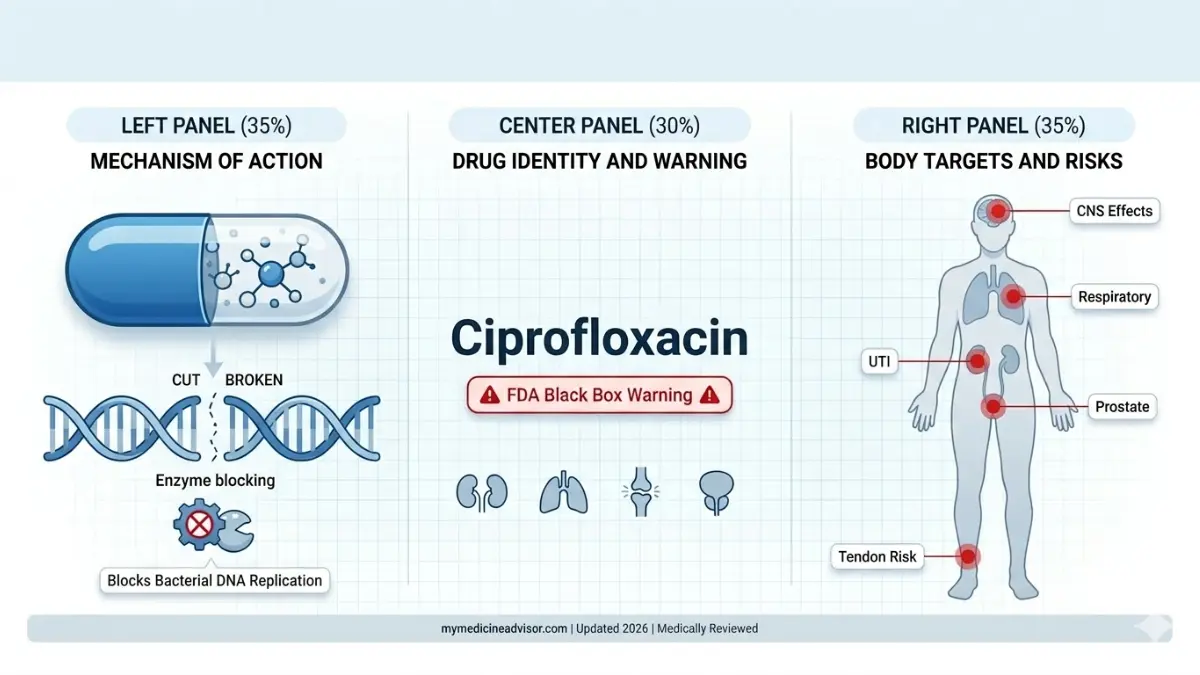
Ciprofloxacin — sold under the brand name Cipro — is a powerful broad-spectrum fluoroquinolone antibiotic used to treat over a dozen serious bacterial infections. It works by disrupting bacterial DNA replication, stopping the infection from spreading. But here’s what most patients are never told at the pharmacy counter: ciprofloxacin carries an FDA Black Box Warning — the most severe safety label the agency issues.
Marcus, a 38-year-old teacher from Ohio, was prescribed Cipro for a routine UTI. Three weeks later, he couldn’t lift his arm above his shoulder. His Achilles tendon had partially torn — a known, documented, and preventable side effect. His doctor never mentioned it.
If you’ve just been prescribed ciprofloxacin — or are trying to understand your results — use our Symptom Checker to help guide your next conversation with your doctor.
⚠️ Disclaimer: This article is for educational purposes only and does not constitute medical advice. Always consult a qualified healthcare professional before starting, changing, or stopping any medication.
What Is Ciprofloxacin (Cipro) Used For?
Ciprofloxacin is one of the most widely prescribed antibiotics in the United States — over 3 million prescriptions were written in 2023 alone. It belongs to the quinolone antibiotic drug class and is effective against a wide range of gram-negative and some gram-positive bacteria.
FDA-Approved Uses of Ciprofloxacin
The FDA has approved ciprofloxacin for the following bacterial infections:
- Urinary tract infections (UTIs) and complicated kidney infections (pyelonephritis)
- Prostatitis (chronic bacterial)
- Lower respiratory tract infections including pneumonia
- Skin and soft tissue infections
- Bone and joint infections
- Gastrointestinal infections including typhoid fever and salmonellosis
- Sexually transmitted infections — gonorrhea and chancroid
- Anthrax (post-exposure prophylaxis) — used during the 2001 bioterror attacks
- Plague (bubonic, pneumonic, and septicemic)
- Intra-abdominal infections (combined with metronidazole)
- Malignant external otitis (severe ear canal infection)
🔑 Key Takeaway: Ciprofloxacin only destroys bacterial infections. It has zero effect on viral infections like COVID-19, the flu, or the common cold. Taking it for viral illnesses contributes to dangerous antibiotic resistance.

Ciprofloxacin Formulations: Which One Are You Taking?
| Form | Brand Name | Route | Common Use |
|---|---|---|---|
| Tablet (immediate-release) | Cipro | Oral | UTI, skin, bone infections |
| Tablet (extended-release) | Cipro XR | Oral | UTI only |
| Oral suspension | Cipro | Oral | Children, anthrax |
| IV infusion | Cipro IV | Intravenous | Severe/hospital infections |
| Eye drops/ointment | Ciloxan | Ophthalmic | Bacterial eye infections |
| Ear drops | Cetraxal | Otic | Swimmer’s ear |
If you’re unsure which tablet you’ve been given, our Pill Identifier tool can help you confirm the medication before taking it.
Ciprofloxacin Dosage — How Much Should You Take?
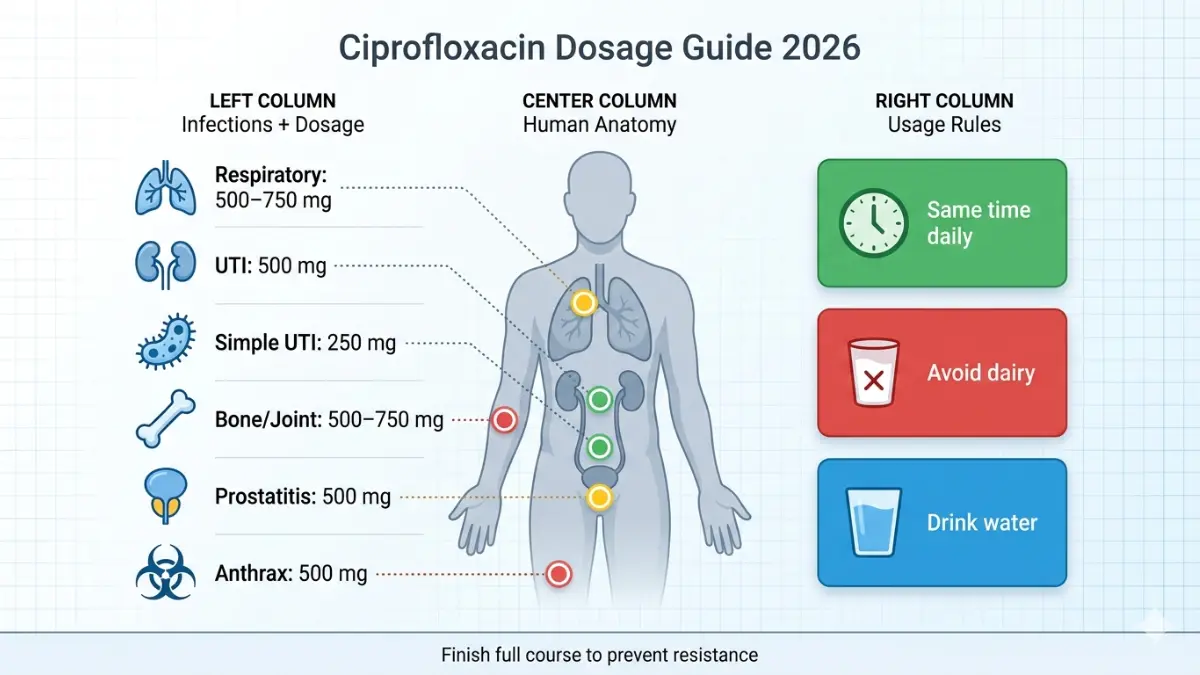
Getting the ciprofloxacin dosage right is critical — both for treatment success and for minimizing serious side effects. Dosage depends on the type of infection, its severity, and your kidney function.
Standard Adult Ciprofloxacin Dosage by Infection Type
| Infection Type | Standard Dose | Duration |
|---|---|---|
| Uncomplicated UTI | 250 mg twice daily | 3 days |
| Complicated UTI / Pyelonephritis | 500 mg twice daily | 7–14 days |
| Chronic Bacterial Prostatitis | 500 mg twice daily | 28 days |
| Lower Respiratory Infections | 500–750 mg twice daily | 7–14 days |
| Bone & Joint Infections | 500–750 mg twice daily | 4–8 weeks |
| Anthrax (post-exposure) | 500 mg twice daily | 60 days |
| IV (severe infections, hospital) | 200–400 mg every 8–12 hours | Per physician |
Source: Mayo Clinic — Ciprofloxacin Prescribing Information
Special Dosage Adjustments
- Kidney disease: Dosage reduction is required when creatinine clearance drops below 30 mL/min. Patients on hemodialysis take 250–500 mg every 24 hours (after dialysis only).
- Elderly patients (65+): No automatic dose reduction is needed — but age-related kidney decline requires close monitoring. Elderly patients face significantly higher tendon rupture risk.
- Children under 18: Ciprofloxacin is not a first-choice drug for most pediatric infections due to joint toxicity risks. It is used in children only for anthrax exposure and complicated UTIs.
How to Take Ciprofloxacin Correctly
- ✅ Take at the same time each day — consistency maintains therapeutic blood levels
- ✅ Take with or without food (except Proquin XR — take with the evening meal)
- ❌ Do NOT take alone with dairy (milk, yogurt) or calcium-fortified juice — this blocks absorption
- ✅ Drink plenty of water — prevents crystalluria (drug crystals forming in urine)
- ✅ Complete the full course — even if symptoms resolve in 2 days
🔑 What This Means For You: Stopping ciprofloxacin early because you “feel better” is one of the leading drivers of antibiotic resistance globally. According to the CDC, antibiotic resistance kills over 35,000 Americans every year. Finish your full course.
For patients managing blood sugar while on ciprofloxacin (the drug can affect glucose levels), our Blood Sugar Converter helps you track and convert your readings easily.
Ciprofloxacin Side Effects — Common, Serious & FDA Black Box Warnings
This is the section every patient deserves to read before taking their first tablet. Competitors bury this information. We’re putting it front and center.
Common Ciprofloxacin Side Effects
These occur in fewer than 5% of patients in FDA clinical trials across 49,038 patients:
- Nausea — 2.5% of patients
- Diarrhea — 1.6% of patients
- Headache and dizziness
- Elevated liver enzymes (usually temporary)
- Skin rash
- Restlessness or mild agitation
Most common side effects resolve after completing the course. Taking ciprofloxacin with food (not dairy) can reduce nausea.
Serious Ciprofloxacin Side Effects — Stop and Call Your Doctor
If you experience any of the following, stop ciprofloxacin immediately and contact your doctor:
- Tendon pain, swelling, or stiffness — especially in the Achilles heel, shoulder, or hand
- Numbness, tingling, burning, or weakness in arms or legs (peripheral neuropathy)
- Confusion, hallucinations, paranoia, severe anxiety, or depression (CNS effects)
- Severe allergic reaction — throat swelling, hives, difficulty breathing (call 911)
- Irregular heartbeat or palpitations (QT interval prolongation)
- Severe, watery, or bloody diarrhea — may signal C. difficile colitis
🚨 FDA Black Box Warning: The Timeline Every Patient Must Know
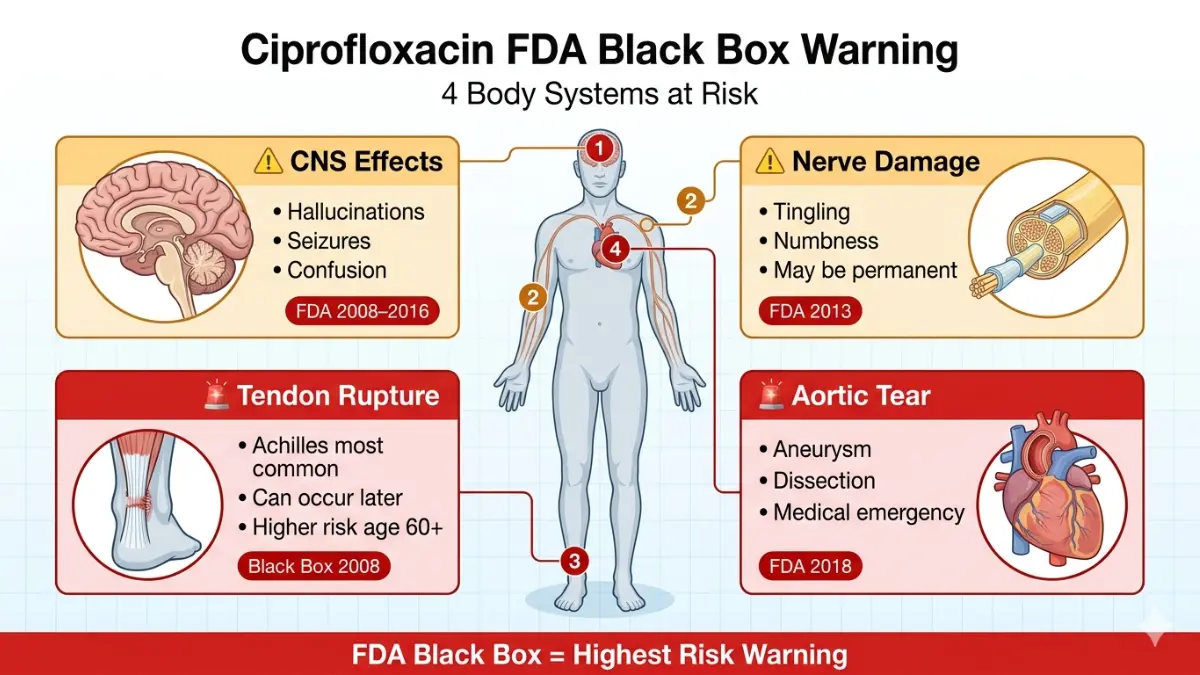
A Black Box Warning is the FDA’s highest-level safety alert — reserved for drugs that can cause death or permanent, disabling injury. Ciprofloxacin has accumulated multiple Black Box expansions since 2008:
| Year | FDA Warning Added |
|---|---|
| 2008 | Tendinitis and tendon rupture risk |
| 2011 | Worsening of myasthenia gravis (can cause respiratory failure/death) |
| 2013 | Peripheral neuropathy — potentially permanent nerve damage |
| 2016 | Expanded: serious risks outweigh benefits for simple UTIs, bronchitis, sinusitis |
| 2018 | Aortic aneurysm and aortic dissection (tear) — potentially fatal |
| 2022 | BMJ cohort study linked fluoroquinolones to increased suicidality risk |
🔑 What This Means For You: If you were prescribed ciprofloxacin for a simple sinus infection or uncomplicated UTI — the FDA explicitly states that safer alternatives should be used first. Ask your doctor if a first-line antibiotic like nitrofurantoin or trimethoprim is appropriate for your case.
Side Effect Severity Quick-Reference Table
| Side Effect | Frequency | Severity | Action Required |
|---|---|---|---|
| Nausea / diarrhea | Common (2–3%) | Mild | Continue, take with food |
| Headache / dizziness | Common | Mild | Monitor |
| Tendon pain or rupture | Uncommon | SEVERE ⚠️ | STOP — call doctor today |
| Peripheral neuropathy | Rare | SEVERE ⚠️ | STOP immediately |
| Hallucinations / psychosis | Very rare | SEVERE ⚠️ | ER visit |
| Aortic tear | Very rare | LIFE-THREATENING 🚨 | Emergency services (911) |
| Anaphylaxis | Very rare | LIFE-THREATENING 🚨 | Call 911 |
For a broader understanding of how antibiotics compare in safety profiles, see our guide on drug interactions and our detailed article on amoxicillin — a first-line antibiotic for many infections where Cipro is often over-prescribed.
Ciprofloxacin Drug Interactions — Foods, Medications & Supplements
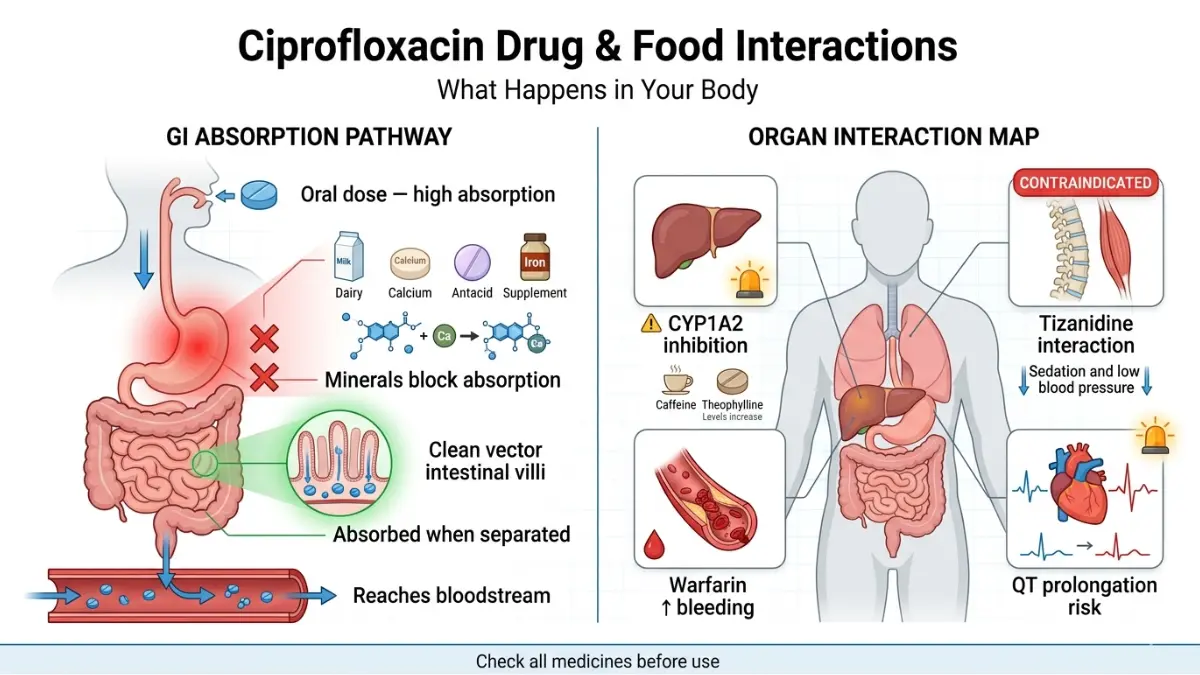
Ciprofloxacin interacts with 736 known drugs, 10 disease conditions, and 3 major food/lifestyle categories. These interactions range from reducing the drug’s effectiveness to causing life-threatening toxicity.
Food & Drink Interactions
| Substance | Interaction | Effect | What To Do |
|---|---|---|---|
| Dairy products (milk, yogurt, cheese) | Calcium chelation | Reduces absorption | Separate by 2 hours |
| Calcium-fortified juice / cereal | Calcium chelation | Reduces absorption | Separate by 2 hours |
| Antacids (magnesium/aluminum) | Chelation complex | Reduces absorption 50%+ | Separate by 2–4 hours |
| Caffeine (coffee, energy drinks) | CYP1A2 inhibition | Elevated caffeine levels → tremor, rapid heart rate | Limit caffeine |
| Alcohol | CNS interaction | Worsens dizziness, nausea | Avoid or minimize |
Research basis: PubMed — Ciprofloxacin Food-Drug Interactions
Critical Drug Interactions With Ciprofloxacin
These interactions can cause serious harm:
- Tizanidine (Zanaflex) — ❌ ABSOLUTELY CONTRAINDICATED. Combining these causes dangerously low blood pressure and extreme sedation. The FDA has explicitly prohibited this combination.
- Warfarin (Coumadin) — Ciprofloxacin increases warfarin’s blood-thinning effect, raising bleeding risk. INR must be monitored closely.
- Theophylline — Ciprofloxacin blocks theophylline breakdown, causing toxic blood levels → seizures, heart arrhythmia. Requires dose adjustment.
- NSAIDs (ibuprofen, naproxen) — Combined use increases seizure risk, particularly in elderly patients.
- QT-prolonging drugs — Combining ciprofloxacin with antiarrhythmics, certain antidepressants, or antipsychotics raises risk of fatal heart rhythms.
- Antacids, iron, zinc, multivitamins — Dramatically reduce ciprofloxacin absorption. Always separate by at least 2 hours.
🔑 What This Means For You: Before taking ciprofloxacin, give your pharmacist or doctor a complete list of every supplement, vitamin, and medication you take — including over-the-counter products. With 736 potential drug interactions, no assumption is safe.
If you’re monitoring blood glucose during antibiotic treatment (ciprofloxacin can cause both hypoglycemia and hyperglycemia), use our Blood Sugar Converter to track your readings accurately. Patients on diabetes medications require especially close monitoring.
Who Should NOT Take Ciprofloxacin — And What to Use Instead
High-Risk Groups — Use With Extreme Caution or Avoid
| Patient Group | Risk | Recommendation |
|---|---|---|
| Adults over 60 | Significantly elevated tendon rupture risk | Use only if no alternatives exist |
| Patients on corticosteroids | Doubles tendon rupture risk | Avoid if possible |
| Myasthenia gravis patients | Can cause respiratory failure / death | CONTRAINDICATED |
| Pregnant women | Bone/cartilage risk to fetus (animal data) | Use only if no alternative — discuss with OB |
| Children under 18 | Joint toxicity; arthropathy in animal studies | Not first-choice; used for anthrax/complicated UTI only |
| Kidney disease (severe) | Drug accumulation, toxicity | Dose adjustment mandatory |
| Prior fluoroquinolone allergy | Anaphylaxis risk | Do not use |
Pregnant patients who want to track weight and nutrition safely during treatment can use our Pregnancy Weight Gain Calculator — nutrition and weight management remain important even when antibiotics are necessary.
Ciprofloxacin vs. Safer Alternatives — Head-to-Head
| Antibiotic | Best For | Advantage Over Cipro |
|---|---|---|
| Nitrofurantoin | Simple, uncomplicated UTI | First-line per IDSA guidelines; no Black Box Warning |
| Trimethoprim-sulfamethoxazole | Simple UTI (where resistance is low) | Safer for uncomplicated infections |
| Amoxicillin | Ear, throat, respiratory infections | Narrower spectrum; lower risk profile |
| Doxycycline | Respiratory, STIs, skin | Fewer serious CNS/tendon risks |
| Levofloxacin | Serious respiratory infections | Same class but stronger respiratory coverage |
🔑 What This Means For You: The FDA’s 2016 Drug Safety Communication states clearly — “fluoroquinolones should be reserved for patients with these conditions who have no alternative treatment options.” This applies to sinusitis, bronchitis, and uncomplicated UTIs. If you have one of these and were given Cipro as a first prescription, it’s worth asking your doctor why.
For a deeper comparison, read our full guide on doxycycline and azithromycin (Z-Pak) — two antibiotics commonly used as alternatives to ciprofloxacin depending on the infection type.
Expert Summary — Using Ciprofloxacin Safely in 2026
5 Critical Expert Takeaways
- ✅ Cipro is effective and life-saving for serious bacterial infections — anthrax, plague, complicated UTIs, bone infections, and hospital-acquired pneumonia.
- ⚠️ It is over-prescribed for simple UTIs, sinus infections, and bronchitis — infections where safer first-line antibiotics work equally well with far less risk.
- 🚨 The Black Box Warning is real — tendon rupture, permanent nerve damage, CNS effects, aortic tears, and blood sugar changes are documented, FDA-confirmed risks.
- 🔑 Drug and food interactions are numerous — 736 drug interactions exist. Always disclose all medications to your prescriber and pharmacist.
- 🌍 Antibiotic resistance is a growing global emergency — the World Health Organization classifies ciprofloxacin as “critically important” for human medicine. Misusing it accelerates resistance that affects all of us.
Antibiotic Resistance: The 2026 Global Reality
Ciprofloxacin resistance is rising at an alarming rate worldwide. In some regions, resistance rates for E. coli — the most common UTI-causing bacteria — now exceed 30%. The CDC’s 2024 antibiotic resistance report identifies fluoroquinolone-resistant infections as one of the top public health threats in the United States.
Every unnecessary prescription of ciprofloxacin — for a cold, a viral infection, or an uncomplicated UTI where safer drugs work — is one step closer to making this antibiotic useless for the patients who genuinely need it.
What This Means For You
Ask these three questions before taking ciprofloxacin:
- “Is this infection definitely bacterial?” — If not confirmed, push back.
- “Is there a safer first-line antibiotic available?” — Per FDA guidance, for simple UTIs and respiratory infections, the answer is usually yes.
- “Do I have any of the high-risk factors?” — Over 60, on steroids, myasthenia gravis, or kidney disease? Make sure your doctor knows.
If you’re concerned about unexplained symptoms during antibiotic treatment, explore our drug interactions guide and always use our Symptom Checker to help identify warning signs early.
⚠️ Medical Disclaimer: This article is provided for educational and informational purposes only. It does not constitute professional medical advice, diagnosis, or treatment. Always seek guidance from a licensed physician or pharmacist before starting, adjusting, or discontinuing any medication.
Frequently Asked Questions — Ciprofloxacin
Q1. What is ciprofloxacin used to treat?
Ciprofloxacin treats serious bacterial infections including UTIs, pneumonia, prostatitis, bone infections, anthrax, plague, typhoid, and skin infections. It only works on bacterial — not viral — infections.
Q2. How long does ciprofloxacin take to work?
Most patients notice symptom improvement within 1–3 days of starting ciprofloxacin. However, the full course must be completed even if you feel better sooner.
Q3. Can I drink alcohol while taking ciprofloxacin?
Alcohol is not absolutely contraindicated, but it is strongly discouraged. Alcohol worsens dizziness, nausea, and impairs your immune response while your body is fighting infection.
Q4. Why can’t I take ciprofloxacin with milk or dairy?
Calcium in dairy products forms a chelate complex with ciprofloxacin in your gut, blocking absorption by up to 36–47%. You can consume dairy as part of a larger meal, but never take Cipro with dairy alone.
Q5. What are the most serious side effects of ciprofloxacin?
The most serious side effects include tendon rupture, permanent peripheral neuropathy, psychosis, aortic aneurysm, and severe allergic reactions (anaphylaxis). These are covered under ciprofloxacin’s FDA Black Box Warning.
Q6. Is ciprofloxacin the same as Cipro?
Yes. Cipro is simply the brand name for ciprofloxacin. Cipro XR is an extended-release formulation. Generic ciprofloxacin is identical in active ingredient and FDA-approved effectiveness.
Q7. Can I take ciprofloxacin during pregnancy?
Ciprofloxacin is generally avoided during pregnancy due to theoretical joint/cartilage risks based on animal data. It should only be used when no safer alternative exists and the benefit clearly outweighs the risk. Always discuss with your OB-GYN.
Q8. What is the FDA Black Box Warning on ciprofloxacin?
The FDA Black Box Warning — the agency’s most serious safety label — warns about tendon rupture, peripheral neuropathy, CNS effects (hallucinations, depression), worsening myasthenia gravis, and aortic tears. It states these risks “generally outweigh the benefits” for simple infections where alternatives exist.
Q9. How long does ciprofloxacin stay in your system?
Ciprofloxacin has a half-life of approximately 4 hours. It is mostly cleared from the body within 24 hours of the last dose. However, tendon-related side effects can appear weeks or even months after stopping the drug.
Q10. What happens if I miss a dose of ciprofloxacin?
Take the missed dose as soon as you remember — unless your next scheduled dose is within 6 hours (standard tablet) or 8 hours (extended-release). Never double-dose. Skipping doses raises the risk of antibiotic resistance.
Q11. Is ciprofloxacin a strong antibiotic?
Yes. Ciprofloxacin is classified as a broad-spectrum, critically important antibiotic by the World Health Organization. It is significantly more powerful than first-line antibiotics like amoxicillin, which is precisely why it carries greater risk and should be reserved for infections where simpler antibiotics cannot work.
Related Reading From mymedicineadvisor.com:
- Amoxicillin: What Doctors Want You to Know
- Doxycycline: What Doctors Won’t Tell You
- Azithromycin (Z-Pak): Dosage & Side Effects
- Metronidazole: What Doctors Don’t Tell
- Drug Interactions: Complete Guide
About this content
How this article was put together: researched from recognised health sources, drafted with the help of AI tools, and edited by hand, with sources linked throughout.

Sameer Patel is the founder and editor of My Medicine Advisor. He is not a doctor or medical professional — before starting this site he worked in banking,…
Medical disclaimer
The content on MyMedicineAdvisor is provided for general informational and educational purposes only and is not a substitute for professional medical advice, diagnosis, or treatment. Health information on this website should not be used to diagnose, treat, cure, or prevent any condition without guidance from a qualified healthcare professional. Always seek the advice of your doctor, physician, or another licensed healthcare provider with any questions you may have regarding a medical condition, symptoms, medications, or treatment decisions.