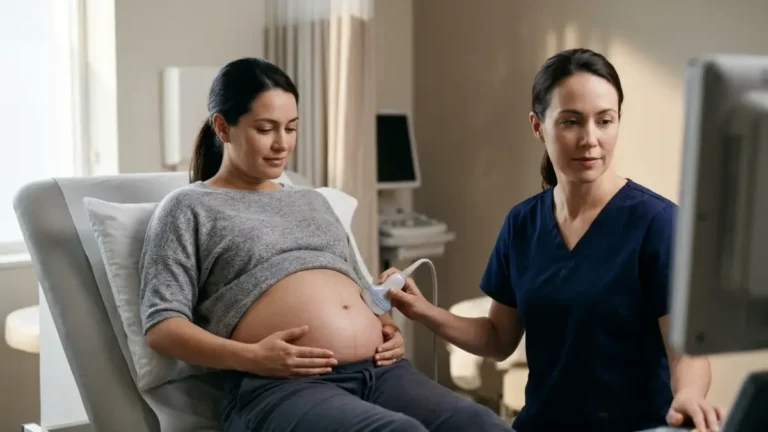
Pregnancy weight gain calculator
Enter your height, your weight before pregnancy, your weight today and how many weeks pregnant you are. You will see your BMI group, the gain range for this week, and the total range most US doctors use.
Your results
Range for this week
—
—BMI before pregnancy
—
—
Gained so far
—
Weight today minus weight before pregnancy
Total gain range by delivery
—
—
Weekly rate after week 13
—
—
On track for, at that rate
—
—
Still to gain to reach the total range
—
Low and high end of the total range
Weight at delivery if you finish inside the range
—
| Week | Trimester | Gain range | Weight range |
|---|
How this works: total ranges and weekly rates come from the Institute of Medicine 2009 guidelines (the IOM is now the National Academy of Medicine), which ACOG and the CDC use. The week-by-week range is an estimate: it assumes 1.1 to 4.4 lb (0.5 to 2 kg) in the first 13 weeks, as the IOM rates do, then a straight line to your total range. This tool does not diagnose anything, and your prenatal care team may set a different goal for you.
On This Page – Quick Medical Summary
Total gain ranges by BMI before pregnancy
For one baby, the recommended total gain runs from 11 to 40 lb. Your BMI before pregnancy decides which part of that span applies to you. The ranges come from the Institute of Medicine’s 2009 guidelines; the IOM is now called the National Academy of Medicine. ACOG and the CDC still use these ranges for prenatal care in the US.
| BMI before pregnancy | Total gain, one baby | Weekly gain after week 13 | Total gain, twins |
|---|---|---|---|
| Underweight (below 18.5) | 28–40 lb (12.5–18 kg) | 1.0–1.3 lb (0.44–0.58 kg) | 50–62 lb* |
| Normal weight (18.5–24.9) | 25–35 lb (11.5–16 kg) | 0.8–1.0 lb (0.35–0.50 kg) | 37–54 lb |
| Overweight (25.0–29.9) | 15–25 lb (7–11.5 kg) | 0.5–0.7 lb (0.23–0.33 kg) | 31–50 lb |
| Obesity (30.0 or higher) | 11–20 lb (5–9 kg) | 0.4–0.6 lb (0.17–0.27 kg) | 25–42 lb |
Sources: one-baby totals and weekly rates from the IOM 2009 table of total and weekly gain. Twin totals from the CDC’s pregnancy weight gain recommendations. *The underweight twin figure is the CDC’s, from a separate study; it is not an IOM range.
Fewer people land inside these ranges than you might expect. According to the CDC, about 1 in 3 gain within their range, about 1 in 5 gain less, and about half gain more.
The weekly rates in the third column apply from week 14 onward. They are built on a small first-trimester gain, and that assumption explains why early numbers look so low.

Week by week: why the first 13 weeks look flat
Plot the range on a chart and the line barely lifts for three months, then climbs at a steady angle until delivery. The IOM weekly rates assume only 1.1 to 4.4 lb (0.5 to 2 kg) of gain across the entire first trimester, as the same IOM table notes.
The calculator above builds your range for each week from two anchor points. The first is that first-trimester figure at week 13. The second is your total range at week 40. A straight line joins the two.
The checkpoints below use that method for one baby, in pounds gained since before pregnancy. They are an estimate drawn from the IOM totals, not an official IOM table.
| Week | Underweight | Normal weight | Overweight | Obesity |
|---|---|---|---|---|
| 13 | 1.1–4.4 | 1.1–4.4 | 1.1–4.4 | 1.1–4.4 |
| 20 | 8.1–13.6 | 7.3–12.3 | 4.7–9.7 | 3.7–8.4 |
| 28 | 16.0–24.2 | 14.4–21.4 | 8.8–15.8 | 6.6–13.1 |
| 34 | 22.0–32.1 | 19.7–28.2 | 11.9–20.4 | 8.8–16.5 |
| 40 | 28–40 | 25–35 | 15–25 | 11–20 |
Source: calculated from the IOM 2009 totals and the first-trimester assumption above.
Week 20 is where many people first compare notes, and the spread there is wide. Someone in the normal-weight group can sit anywhere from 7.3 to 12.3 lb and still be on the planned path. If you are unsure of your week, the Pregnancy Due Date Calculator works out how many weeks pregnant you are.

Is a reading above or below the range a problem?
Take a sample entry: 5 ft 5 in tall, 140 lb before pregnancy and 158 lb at week 24. That gives a BMI of 23.3, in the normal-weight group, and a week-24 range of 10.8 to 16.9 lb. The 18 lb gained so far sits 1.1 lb above the top of that range.
Now add the weekly rate. There are 16 weeks left, and at 0.8 to 1.0 lb a week the total would land between 30.8 and 34.0 lb. That is inside the 25 to 35 lb range for the whole pregnancy. A reading slightly over the line for one week can still finish inside the target, so a trend across several prenatal visits tells you more than a single weigh-in.
Readings below the range early on deserve the same patience. The IOM rates allow for as little as 1.1 lb in the first 13 weeks, so a flat number in early pregnancy usually sits close to the expected path. Persistent vomiting with weight loss is a different pattern, because it can point to hyperemesis gravidarum, a severe form of pregnancy nausea that can cause dehydration.
Ask your doctor whether your gain so far changes the weekly rate you should aim for between now and delivery.
Gaining outside the range shifts a few specific risks
Across 23 cohort studies covering about 1.3 million pregnancies, a 2017 meta-analysis in JAMA compared outcomes with gain inside the IOM ranges (study record on PubMed).
Gaining less than recommended raised the chance of two outcomes by about 5 percentage points each:
- a baby small for gestational age, meaning smaller than most babies born at the same week
- preterm birth
Gaining more than recommended raised the chance of:
- a baby large for gestational age, by 4 percentage points
- macrosomia, a much larger than average birth weight, by 6 percentage points
- cesarean birth, by 4 percentage points
These are absolute differences measured across very large groups of people. They are not a forecast for one pregnancy.
The review could not assess gestational diabetes from the available data. Your prenatal team screens for gestational diabetes separately, often with the 1-hour glucose test in pregnancy.
5 warning signs that go with sudden weight gain
Gaining more than 3 to 5 lb in a single week from fluid retention is one of the recognized signs of preeclampsia. Preeclampsia is a pregnancy condition marked by high blood pressure and protein in the urine. It usually appears in the last few months of pregnancy (NIH Genetic and Rare Diseases Information Center).
A steady gain of around a pound a week in the second half of pregnancy is the expected pattern. The concern is a sudden jump that comes with other symptoms.
Get emergency care now if: you gain weight suddenly and have any of the following. Call 911.
- Swelling of your face or hands
- Headaches
- Vision changes such as flashing lights, spots or blurring
- Pain in the upper belly
- Shortness of breath
Because preeclampsia is defined by blood pressure and urine protein, the next step is a blood pressure reading and a urine test, not another weigh-in.
What these ranges don’t cover
The ranges date from 2009 and have not been replaced. In September 2025, the National Academies held a workshop to review newer evidence. The organizers noted that the 2009 report had too little evidence for people who start pregnancy underweight or in the higher classes of obesity (National Academies workshop page). That is why one range of 11 to 20 lb covers every BMI from 30 upward.
There is even less data for twins. The IOM set no twin range for people who start underweight. The 50 to 62 lb figure the CDC lists for that group comes from a 2003 study.
For triplets or more, the CDC advises setting a weight goal with your provider instead of using these tables.
Take your week-by-week table to your next prenatal visit
Bring three numbers to the appointment: your weight before pregnancy, today’s weight, and the range the calculator shows for this week. The table under the results lists every week from 1 to 40. Your OB-GYN or midwife can use it to see where today’s reading falls and how it compares with your earlier visits.
Questions to ask:
- Is the IOM range for my BMI a good goal for me, or should mine be different?
- Based on my gain so far, what weekly rate should I aim for from here?
- Do you plan a growth ultrasound, and at what week?
- When is my glucose screening?
If a growth scan is done, the Fetal Growth Percentile Calculator shows how the estimated fetal weight compares with other babies at the same week.
More questions about pregnancy weight
How many extra calories do you need while pregnant?
In general, you need none extra in the first trimester. The CDC suggests about 340 extra calories a day in the second trimester and about 450 a day in the third (CDC).
How often should you weigh yourself while pregnant?
Start tracking at the beginning of pregnancy and keep going regularly, comparing each reading with your range, as the CDC advises. Using the same scale, at the same time of day, in similar clothing makes week-to-week numbers easier to compare.
Found this helpful? See more of our guides on Google.
Want to see our guides first on Google?
Found this helpful? See more of our guides on Google.
About this content
How this article was put together: researched from recognised health sources, drafted with the help of AI tools, and edited by hand, with sources linked throughout.

Dr. Pooja Sahu, MBBS, is a medical reviewer for MyMedicineAdvisor. She is a clinical physician whose experience includes serving as a Junior Resident in Nephrology at Dr. Ram…
Medical disclaimer
The content on My Medicine Advisor is provided for general informational and educational purposes only and is not a substitute for professional medical advice, diagnosis, or treatment. Health information on this website should not be used to diagnose, treat, cure, or prevent any condition without guidance from a qualified healthcare professional. Always seek the advice of your doctor, physician, or another licensed healthcare provider with any questions you may have regarding a medical condition, symptoms, medications, or treatment decisions.