BMI Calculator
Calculate body mass index, review adult BMI category, estimate a healthy weight range for your height, compare category threshold weights, and add waist-related risk context in one detailed, mobile-friendly tool.
Inputs
What this calculator uses
Standard adult BMI equation, CDC adult category thresholds, healthy BMI weight boundaries, and optional waist-size context.
Important
BMI is a screening tool, not a diagnosis. It does not directly measure body fat, muscle mass, or body-fat distribution.
Results
Body mass index
—
Calculated from weight relative to height squared.
BMI category
—
—
Healthy weight range
—
Estimated from BMI 18.5 to 24.9 for the entered height.
Weight change to healthy range
—
Shows the direction needed to reach the healthy BMI range.
Body weight entered
—
Used as the main mass input in the BMI calculation.
BMI Prime
—
BMI divided by 25, giving a quick ratio versus the upper healthy threshold.
Ponderal index
—
Another body-size index using weight relative to height cubed.
Waist-to-height ratio
—
—
Current position vs healthy range
—
Shows whether current weight sits below, within, or above the healthy BMI range.
Detailed interpretation
BMI: — • Category: — • Healthy weight range: —
—
Interpretation table
| Metric | Value | How to read it |
|---|---|---|
| BMI | — | A screening number comparing body weight with height. |
| BMI category | — | Adult category classification based on the BMI result. |
| Healthy weight range | — | The body-weight range corresponding to BMI 18.5 to 24.9 at the entered height. |
| Weight change to healthy range | — | The approximate gain or loss needed to enter the healthy BMI range, if outside it. |
| BMI Prime | — | A quick ratio comparing the BMI result with 25, the upper healthy-BMI cutoff. |
| Ponderal index | — | An alternate body-size index based on height cubed rather than height squared. |
| Waist-related context | — — | Adds central-adiposity context when a waist measurement is entered. |
Target weight table
| Reference point | BMI | Weight at this BMI | Your difference |
|---|
Results appear after you click “Calculate.”
Why People Worldwide Trust This BMI Calculator
Every month, millions search “BMI calculator online” to understand whether their weight is in a healthy range.
Our advanced Body Mass Index (BMI) Calculator instantly analyzes your height and weight using metric (kg/cm) or imperial (lb/ft in) units.
It goes far beyond a simple number:
- Calculates BMI + BMI Prime
- Shows your healthy weight range for your height
- Includes Asian/South-Asian cut-offs for greater accuracy
- Provides medical context and trustworthy guidance
Unlike basic calculators, My Medicine Advisor’s BMI tool combines clinical references, expert review, and educational context so that anyone — patients, fitness enthusiasts, or clinicians — can interpret results confidently.
How to Use the BMI Calculator
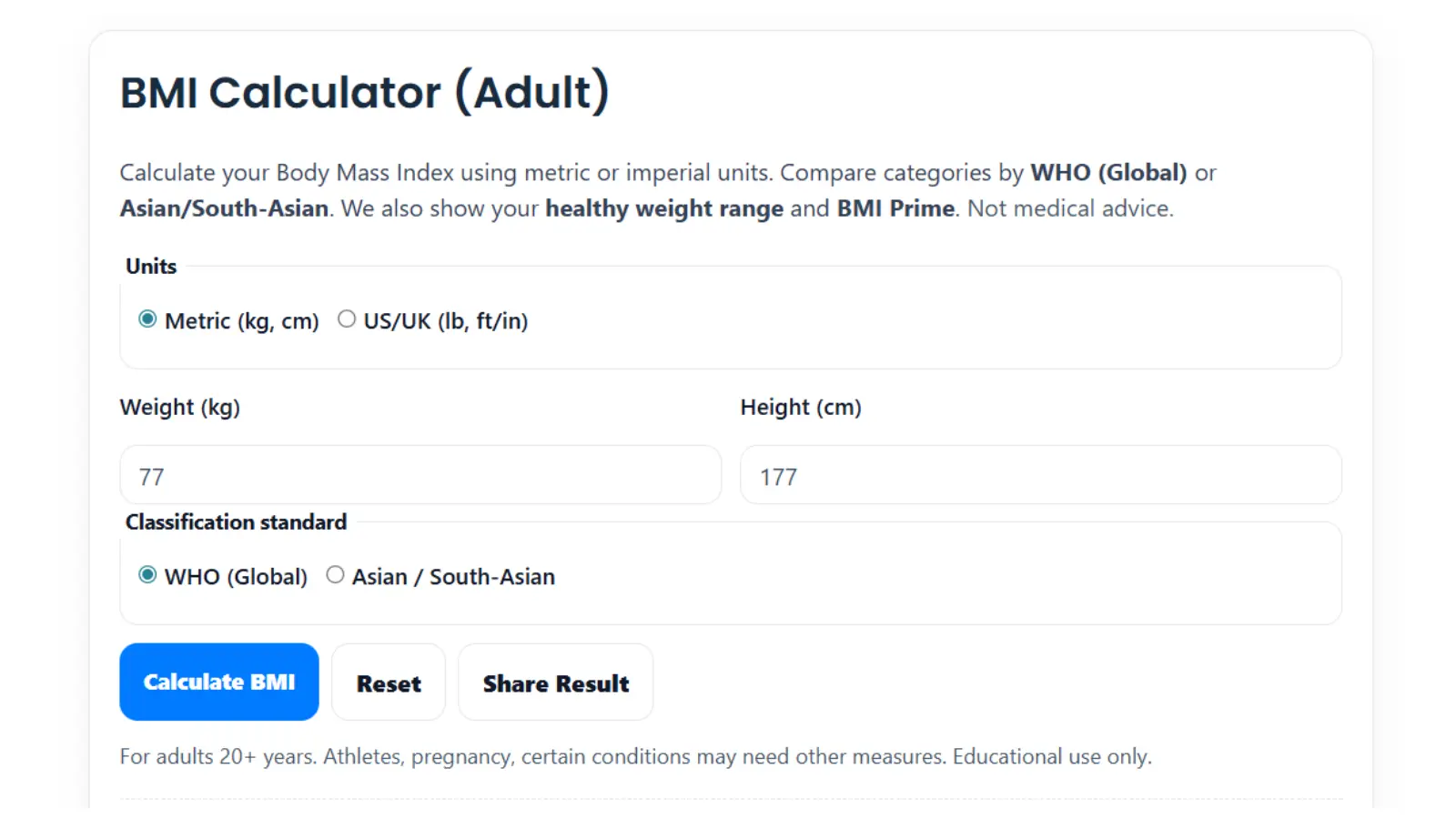
- 1. Select your measurement system – Metric (kg/cm) or Imperial (lb/ft/in).
- 2. Enter your weight and height.
- 3. (Optional) Choose WHO (Global) or Asian/South-Asian classification.
- 4. Click Calculate BMI to instantly see your results.
- 5. View:
- BMI value (1 decimal place)
- BMI category (Underweight / Healthy / Overweight / Obese)
- BMI Prime score
- Healthy weight range for your height
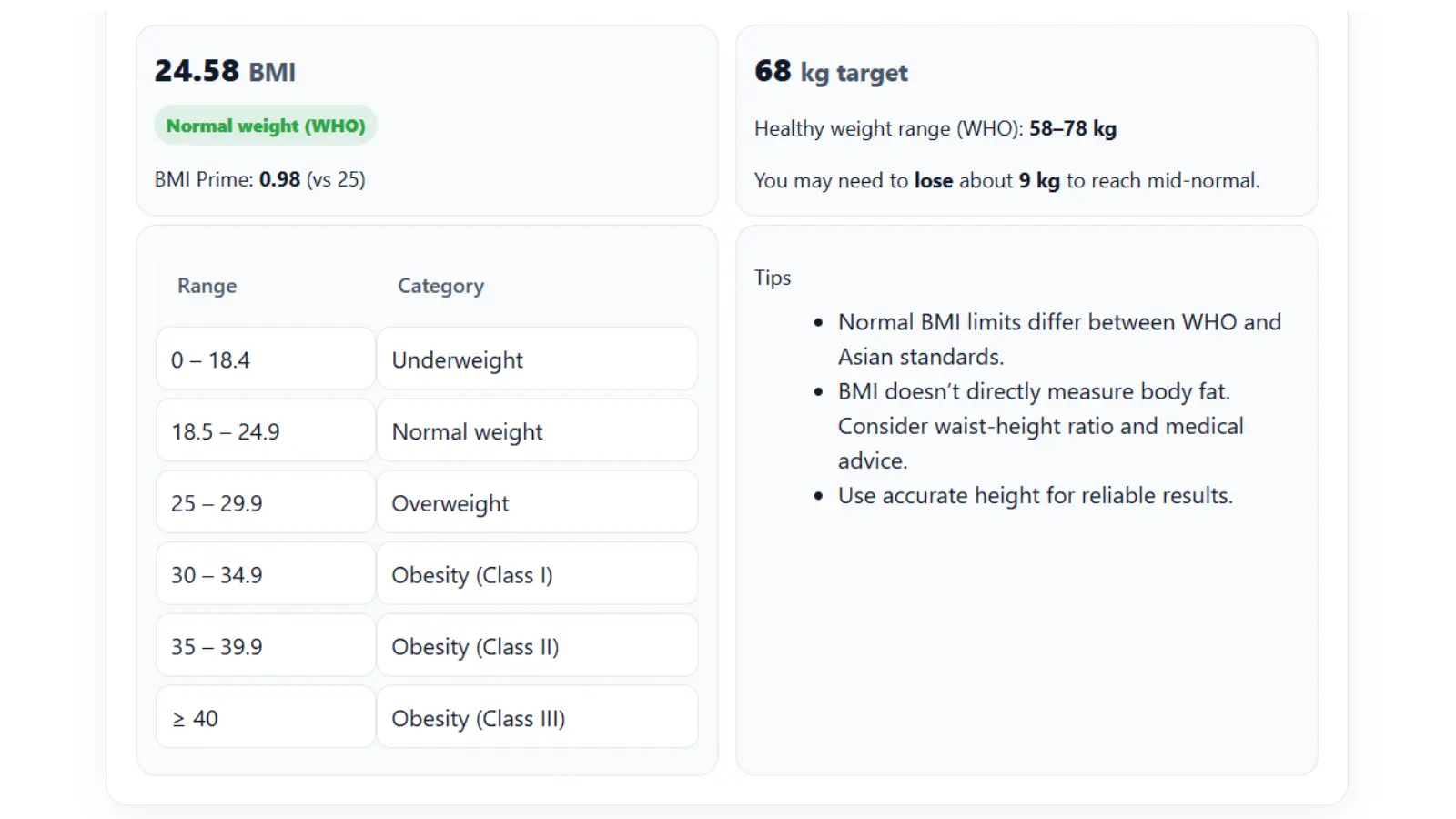
Your Results at a Glance (Example)
| Height | Weight | BMI (kg/m²) | Category | Healthy Range for Height |
|---|---|---|---|---|
| 170 cm (5′7″) | 65 kg (143 lb) | 22.5 | Healthy | 54 – 72 kg (119 – 159 lb) |
Your BMI is simply a starting point — a signal, not a diagnosis. Use it along with waist measurements and other health checks for the most accurate picture.
How BMI Is Calculated (Formula + Worked Example)

Example (Metric):
Weight = 68 kg Height = 1.70 m → BMI = 68 ÷ (1.70 × 1.70) = 23.5 kg/m²
Example (Imperial):
Weight = 150 lb Height = 66 in → BMI = (150 × 703) ÷ (66 × 66) = 24.2 lb/in²
🧠 BMI Prime = Your BMI ÷ 25.0 → Values < 1 = Healthy, > 1 = Above ideal.
💡 Tip: To lower BMI Prime by 0.05, you need to lose ≈ 5 % of your body weight.
BMI Categories & What They Mean (WHO Global Standards)
| Category | BMI (kg/m²) | Health Implications (General Adult Population) |
|---|---|---|
| Severe Thinness | < 16.0 | Possible malnutrition, immune weakness |
| Moderate Thinness | 16.0 – 16.9 | Low muscle mass, vitamin deficiency |
| Mild Thinness | 17.0 – 18.4 | Slight risk for fatigue, infertility |
| Normal (Healthy) | 18.5 – 24.9 | Balanced weight → lowest disease risk |
| Overweight | 25.0 – 29.9 | Raised risk for BP, cholesterol, T2D |
| Obesity Class I | 30.0 – 34.9 | Moderate cardiometabolic risk |
| Obesity Class II | 35.0 – 39.9 | High risk → clinical review advised |
| Obesity Class III | ≥ 40 | Very high risk → specialist assessment |
Key Takeaway: Risk rises gradually — not suddenly — so tracking BMI over time matters more than a single reading.
Asian & South-Asian Cut-offs (Why They Matter Globally)
Research from the World Health Organization (WHO Expert Consultation 2004) and subsequent studies found that people of Asian descent develop metabolic complications at lower BMI values than Europeans.
| Category | BMI (kg/m²) | Clinical Note |
|---|---|---|
| Underweight | < 18.5 | Same as WHO |
| Healthy Weight | 18.5 – 22.9 | Lowest risk range |
| At Risk / Overweight | 23.0 – 24.9 | Higher visceral fat even at lower BMI |
| Obese | ≥ 25.0 | Strong link to T2 diabetes & heart disease |
📈 Did you know? In South Asia, type 2 diabetes prevalence doubles once BMI crosses 23 kg/m² — a threshold considered “normal” in Western standards.
This is why our tool lets you toggle between Global and Asian cut-offs, so results reflect your ethnic background more accurately.
Healthy Weight Range by Height (Look-Up Chart)
Find your ideal weight zone using the global WHO ranges.
Each height band shows the corresponding healthy weight range (BMI 18.5 – 24.9).
| Height | Healthy Weight Range (kg) | Healthy Weight Range (lb) |
|---|---|---|
| 150 cm (4′11″) | 42 – 56 kg | 93 – 123 lb |
| 155 cm (5′1″) | 44 – 59 kg | 97 – 130 lb |
| 160 cm (5′3″) | 47 – 64 kg | 104 – 141 lb |
| 165 cm (5′5″) | 50 – 68 kg | 110 – 150 lb |
| 170 cm (5′7″) | 54 – 72 kg | 119 – 159 lb |
| 175 cm (5′9″) | 57 – 76 kg | 126 – 168 lb |
| 180 cm (5′11″) | 60 – 81 kg | 133 – 179 lb |
| 185 cm (6′1″) | 63 – 85 kg | 139 – 188 lb |
| 190 cm (6′3″) | 67 – 90 kg | 147 – 198 lb |
| 195 cm (6′5″) | 70 – 95 kg | 154 – 209 lb |
🩺 Tip: If your BMI is just above the upper limit, focus on small, sustainable changes—dropping 5 % of body weight can cut diabetes risk by up to 58 %.
BMI vs Other Measures (When BMI Isn’t Enough)
| Metric | What It Measures | Ideal Range | Strengths | Limitations |
|---|---|---|---|---|
| BMI (kg/m²) | Weight relative to height | 18.5 – 24.9 | Fast screening, globally standard | Doesn’t separate fat vs muscle |
| Waist-to-Height Ratio (WHtR) | Central fat distribution | < 0.5 | Predicts heart risk better than BMI | Needs accurate waist measure |
| Waist Circumference | Abdominal fat risk | < 90 cm (men) < 80 cm (women) | Simple indicator of metabolic risk | Doesn’t adjust for height |
| Body Fat Percentage | Proportion of fat mass | M: 10–20 % W: 18–28 % | Direct measure of fatness | Needs device or calipers |
| BMR / Calorie Needs | Energy burn at rest | Varies by age & sex | Links BMI to metabolism | Requires extra inputs |
🧩 Key Takeaway: Combine BMI + Waist + Body Fat % for a clearer picture of your true health risk.
🧮 Use our BMR Calculator to see how your numbers connect.
Special Situations — Because One Size Never Fits All
1. Athletes & Bodybuilders
- Why it matters: Muscle is denser than fat, so BMI often labels fit people as “overweight.”
- Better metrics: Use Body Fat %, Waist-to-Height Ratio, and performance tests.
- Quick check: If you’re lean, active & waist < 0.5 × height → you’re healthy regardless of BMI.
2. Pregnancy & Post-Partum
- During pregnancy, BMI is not used to monitor weight. Doctors compare your current gain to your pre-pregnancy BMI.
- Guidelines (Institute of Medicine):
| Pre-Pregnancy BMI | Recommended Gain (kg) | Recommended Gain (lb) |
|---|---|---|
| Underweight (<18.5) | 12.5–18 kg | 28–40 lb |
| Normal (18.5–24.9) | 11.5–16 kg | 25–35 lb |
| Overweight (25–29.9) | 7–11.5 kg | 15–25 lb |
| Obese (≥30) | 5–9 kg | 11–20 lb |
🤰 Tip: Steady gain supports baby growth and lowers risk of gestational diabetes.
🔗 Use our Pregnancy Due Date Calculator to track your journey.
3. Children & Teenagers
- Pediatric BMI is age- and sex-specific and expressed as a percentile.
- Underweight: < 5th percentile Healthy: 5th–84th Overweight: 85th–94th Obese: ≥ 95th.
- ⚠️ Adult BMI cut-offs don’t apply. Consult a pediatrician for growth-chart interpretation.
4. Older Adults (60 +)
- BMI may underestimate fatness due to muscle loss (sarcopenia).
- Combine BMI with waist measurement and strength testing.
- Slightly higher BMI (23–28) can be protective against frailty and bone loss.
Health Risks by BMI Category (Quick Reference)
| BMI Category | Key Health Concerns | Suggested Next Steps |
|---|---|---|
| Underweight (<18.5) | Weak immunity, low fertility, anemia | Add 300–500 cal/day, protein build-up foods |
| Healthy (18.5–24.9) | Lowest risk | Maintain weight, exercise ≥150 min/week |
| Overweight (25–29.9) | BP, cholesterol, fatty liver | Trim processed carbs, increase fiber, daily steps ≥ 8000 |
| Obesity Class I (30–34.9) | Type 2 Diabetes, joint pain | Medical review + gradual weight loss (~0.5 kg/week) |
| Obesity Class II (35–39.9) | Heart disease, sleep apnea | Structured plan + clinician supervision |
| Obesity Class III (≥40) | Severe metabolic risk | Multidisciplinary team care, possible bariatric consult |
Action Plans — What to Do After You Know Your BMI
If You’re Underweight
- Add nutrient-dense calories (oats, nuts, legumes).
- Strength train 3× weekly to add muscle mass.
- Check for thyroid or malabsorption issues if weight gain is hard.
If You’re Healthy
- Maintain with balanced meals, hydration, sleep ≥ 7 h.
- Recheck BMI every 3 months or after major lifestyle change.
If You’re Overweight or Obese
- Start with a 5–10 % weight loss goal.
- Combine caloric deficit + physical activity + sleep correction.
- Track progress weekly with BMI + Waist measurements.
- Link to our BMR Calculator to personalize calorie targets.
BMI Change Timeline — What’s Realistic?
| Goal | Safe Rate | Time Estimate |
|---|---|---|
| Lose 5 % Body Weight | 0.4–0.5 kg/week | ≈ 8–10 weeks |
| Lose 10 % Body Weight | 0.4 kg/week | ≈ 16–20 weeks |
| Gain Lean Muscle 3–4 kg | 0.25 kg/week | ≈ 12–16 weeks |
🧘♀️ Consistency beats speed — rapid changes often reverse within a year.
Why BMI Still Matters — But Needs Context
BMI has survived for nearly 200 years because it correlates well with population-level health risks. However, on an individual level it must be interpreted with other metrics.
🔍 Use BMI for screening, not self-diagnosis. Pair it with professional advice and follow-up testing when outside normal range.
A Brief History of BMI — Who Invented It and Why
BMI began almost two centuries ago with Adolphe Quetelet, a Belgian mathematician and statistician (1830s).
He created the “Quetelet Index” to describe the average body build of a healthy population—not to diagnose individuals.
In the 1970s, Dr. Ancel Keys revived and renamed it the Body Mass Index (BMI), proving it correlates strongly with mortality and chronic-disease rates across nations.
Purpose Then vs Now
- Then: population-level health indicator.
- Now: fast screening tool guiding further checks (waist, labs, body fat).
Even after decades of criticism, BMI remains the world’s most-researched anthropometric index—used by the WHO, CDC, NHS, and nearly every clinical guideline as a first step in risk assessment.
Modern Criticisms & Alternatives
Despite its usefulness, BMI has important limitations:
- Ignores body composition – treats muscle and fat as equal weight.
- No fat distribution insight – abdominal vs subcutaneous fat matters more.
- Ethnic bias – underestimates risk in Asians, overestimates in athletes.
- Age & sex differences – same BMI can mean different fat % in men vs women or young vs elderly.
Modern Alternatives
| Metric | What It Adds | Typical Use |
|---|---|---|
| Waist-to-Height Ratio | Central fat risk | Cardiometabolic screening |
| Body Fat % | Composition precision | Fitness & athlete tracking |
| Visceral Fat Index (VFI) | Deep-fat estimation | Advanced scans / DEXA |
| Body Surface Area (BSA) | Drug dosing metric | Clinical settings |
🩺 Best practice: Use BMI + Waist + Body Fat % + BMR for the most reliable overview.
BMI Calculator FAQs
1. Is BMI accurate for athletes or muscular people?
No. Muscle is denser than fat, so fit people may show “overweight.” Use body-fat % or waist ratio too.
2. What’s a healthy BMI range for Asians and South-Asians?
18.5 – 22.9 kg/m² = healthy; 23 – 24.9 = at-risk; ≥ 25 = obese.
3. Does BMI work during pregnancy?
No. Track gain relative to pre-pregnancy BMI and follow doctor guidelines.
4. Is BMI different for men and women?
Cut-offs are the same, but women naturally carry more fat at the same BMI.
5. What’s BMI Prime?
Your BMI ÷ 25. If < 1 → healthy; > 1 → above ideal.
6. How often should I re-check my BMI?
Every 3 months or after major lifestyle changes.
7. Can I be healthy if my BMI is over 25?
Yes — if your waist is < 0.5 × height and labs are normal.
8. Why do different countries use different cut-offs?
Genetic and metabolic differences shift risk thresholds for fat storage.
9. Does BMI apply to kids?
No. Use age- and sex-specific percentile charts.
10. Can BMI predict diabetes risk?
High BMI + large waist strongly raises Type 2 risk — screen if BMI > 23 (Asian) or > 25 (Global).
11. Can I reduce BMI fast?
Aim for 0.4 – 0.5 kg loss per week for safe results.
12. What’s Class I/II/III Obesity?
30–34.9 = Class I, 35–39.9 = Class II, ≥ 40 = Class III (severe).
13. Is BMI useful for older adults?
Yes for trend tracking, but combine with waist and strength tests.
14. What’s the waist-to-height ratio target?
Keep waist < ½ your height for lower heart risk.
15. Why is my BMI high even when I look fit?
Likely higher muscle mass; check body-fat % and waist.
16. What’s a safe BMI for pregnancy planning?
18.5–24.9 is ideal before conception.
17. What are the limitations of BMI?
Does not distinguish muscle/fat; ignores age, sex, ethnicity.
18. Can BMI be too low?
Yes — below 18.5 raises osteoporosis and fertility risk.
19. Does sleep affect BMI?
Yes; sleep < 6 h disturbs appetite hormones and weight control.
20. Which is better — BMI or Body Fat %?
For population use: BMI. For individual precision: Body Fat %.
References & Trusted Sources
- World Health Organization (WHO). BMI classification and Asian cut-offs. WHO Technical Report Series 894, Geneva, 2004.
- Centers for Disease Control and Prevention (CDC). About Adult BMI Calculator.
- Harvard T.H. Chan School of Public Health. Limitations of BMI and Alternative Measures.
- National Institutes of Health (NIH). Clinical Guidelines on Overweight and Obesity, 2022 Update.
- Heart Foundation Australia. BMI and Waist Measures for Health Risk Assessment, 2023.
Final Takeaway — BMI Is Your Starting Point, Not Your Destination
BMI is the simplest mirror of your body’s balance between height and weight.
Used wisely—with waist, body fat %, and BMR—it becomes a powerful early-warning system for metabolic risk.
✅ Use this calculator as your first checkpoint.
✅ Track your progress every 90 days.
✅ Pair results with our other tools to build a complete wellness profile.
Explore More Free Tools:
- BMR Calculator
- Vitamin Deficiency Calculator
- Diabetes Risk Test
- Symptom Checker
- Water Intake Calculator
About this content
How this article was put together: researched from recognised health sources, drafted with the help of AI tools, and edited by hand, with sources linked throughout.

Sameer Patel is the founder and editor of My Medicine Advisor. He is not a doctor or medical professional — before starting this site he worked in banking,…
Medical disclaimer
The content on MyMedicineAdvisor is provided for general informational and educational purposes only and is not a substitute for professional medical advice, diagnosis, or treatment. Health information on this website should not be used to diagnose, treat, cure, or prevent any condition without guidance from a qualified healthcare professional. Always seek the advice of your doctor, physician, or another licensed healthcare provider with any questions you may have regarding a medical condition, symptoms, medications, or treatment decisions.