Body fat percentage calculator (Navy tape method)
Enter a few tape measurements to estimate your body fat, fat mass and lean mass. The tool also checks your waist-to-height ratio and shows whether a "healthy" BMI may be hiding higher body fat.
Your measurements
How to measure (1 minute, flexible tape)
- Neck: just below the Adam's apple (larynx), tape sloping slightly down toward the front.
- Waist: men at the navel; women at the narrowest part of the waist. Stand relaxed and read the tape at the end of a normal breath out. Do not pull your stomach in.
- Hips (women): around the widest part of the buttocks, feet together.
- Keep the tape level and snug without pressing into the skin. Measure twice; if the two readings differ, measure a third time and use the average.
- For tracking, measure at the same time of day (morning, before eating, works well).
Your result
Your estimate will appear here after you press "Calculate body fat".
Bands from the American Council on Exercise. They describe fitness levels, not a diagnosis.
Fat mass
—
Weight × body fat %
Lean mass
—
Muscle, bone, organs and water
Waist-to-height ratio
—
—
BMI
—
—
| Cross-check | Body fat | What it uses |
|---|---|---|
| Navy tape equation (main result) | — | Height, neck, waist (and hips for women) |
| BMI-based estimate | — | BMI, age and sex only (Deurenberg equation) |
The two estimates differ by — points. A large gap usually means your build differs from the average: more muscle pulls the BMI estimate up, while fat carried around the middle pulls the tape estimate up. Each method has a typical error of roughly 3.5 to 4 percentage points against lab methods.
On This Page – Quick Medical Summary
A body fat percentage splits your weight into fat and everything else, which BMI cannot do. Because BMI only divides weight by height squared, a 165-pound man who lifts weights and a 165-pound man who carries extra fat around his middle can get the same number.
The calculator on this page uses the circumference equations developed at the Naval Health Research Center, later adopted as the U.S. Department of Defense body fat equations. Men enter height, neck and waist; women add hips. A flexible tape and a few minutes give you an estimate of fat mass and lean mass that a bathroom scale cannot.
That extra detail matters most when BMI looks fine. The 2025 NICE guideline on overweight and obesity asks adults with a BMI under 35 to measure their waist-to-height ratio alongside BMI to help predict risks such as type 2 diabetes, high blood pressure and heart disease. If you already have a number from the BMI calculator, read the two side by side.
What a body fat percentage tells you that BMI cannot
Muscle, bone, organs and water make up lean mass; the rest is fat mass. The tool multiplies your weight by your estimated body fat to get fat mass, then subtracts it from your weight to get lean mass. Two people with the same BMI can differ by 10 percentage points or more of body fat, as the sample results further down show.
Measuring neck, waist and hips for the tape test
Small tape errors move the result, because the men’s equation rests on the gap between waist and neck, and the women’s on waist plus hips minus neck. Use a flexible tape, stand relaxed, and follow these sites:
- Neck: just below the larynx (Adam’s apple), with the tape sloping slightly down toward the front.
- Waist, men: at the navel, read at the end of a normal breath out, without pulling the stomach in.
- Waist, women: at the narrowest part of the waist; hips at the widest part of the buttocks.
- Keep the tape level and snug without pressing into the skin, and measure twice. If the two readings differ, take a third and use the average.
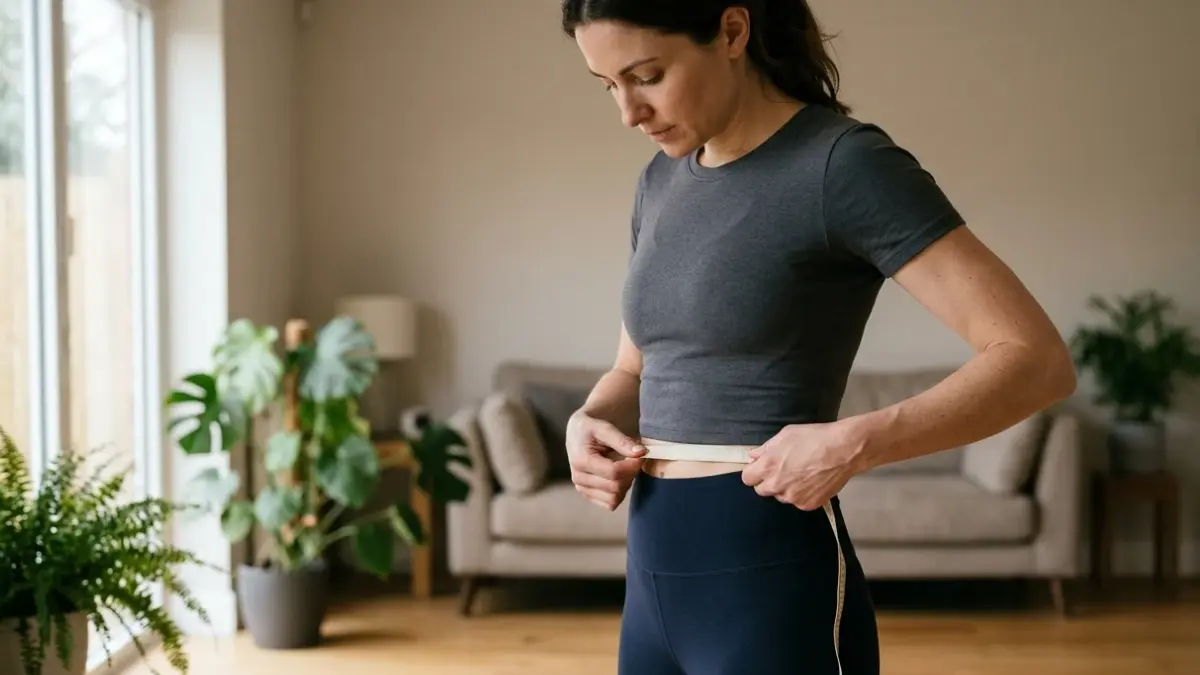
For tracking over months, measure at the same time of day and in the same spot each time.
One detail trips people up. The waist site in the NICE guideline sits midway between the bottom of the ribs and the top of the hips, usually just above the belly button. The calculator uses your one waist reading for both the body fat estimate and the waist-to-height ratio, so a ratio taken at the NICE site can come out slightly different.
What counts as a healthy body fat percentage?
Organizations draw the lines in different places, and none of these cutoffs is a diagnosis. The American Council on Exercise (ACE) describes 18% to 24% for men and 25% to 31% for women as typical for the average nonathlete. The table compares that range with research and military reference points.
| Reference point | Men | Women | What it is used for |
|---|---|---|---|
| ACE typical range, average nonathlete | 18–24% | 25–31% | Fitness norm |
| ACE “may be dangerously low” | Below 6% | Below 14% | Low body fat warning |
| Normal-weight obesity cutoff, Mayo Clinic analysis of US adults | Above 23.1% | Above 33.3% | Research definition, BMI 18.5–24.9 |
| DoD working group tiers, 1998: satisfactory / cautionary / unsatisfactory | Up to 20% / 20–26% / above 26% | Up to 30% / 30–36% / above 36% | Military standard proposal |
Sources: ACE; Romero-Corral et al., European Heart Journal, 2010; Hodgdon and Friedl, Naval Health Research Center, 1999.
The colored bar under your result uses ACE’s fitness bands. If you get a reading in the low zone, recheck the tape at every site. When repeat measurements agree, raise the result at your next visit.
A healthy BMI with high body fat
Normal-weight obesity is the research term for a BMI of 18.5 to 24.9 combined with a high share of body fat. A Mayo Clinic team analyzed 6,171 US adults with a normal BMI from the NHANES III national survey. They set the cutoff at the top third of each sex: above 23.1% body fat for men and above 33.3% for women (Romero-Corral et al., 2010). That group had more metabolic syndrome and more cardiovascular risk factors, and in women it was independently linked to a higher risk of cardiovascular death.
These are findings from one observational cohort, measured across groups. A high tape-based reading flags which numbers to check next: blood pressure, blood sugar and cholesterol. On its own, it cannot show whether heart disease is present.
The calculator flags this pattern when your BMI falls between 18.5 and 24.9 and either your body fat sits above the ACE nonathlete range or your waist measures half your height or more.
Same BMI, different body fat: two sample results
Two pairs of invented measurements, run through the calculator above, show how far apart people with an identical BMI can be.
| Sample | Measurements | BMI | Body fat (tape) | Waist-to-height |
|---|---|---|---|---|
| A, woman, 45 | 5 ft 5 in, 135 lb; waist 32 in, hips 41 in, neck 13 in | 22.5 | 34.7% | 0.49 |
| B, woman, 45 | 5 ft 5 in, 135 lb; waist 27.5 in, hips 38 in, neck 13.5 in | 22.5 | 24.6% | 0.42 |
| C, man, 40 | 5 ft 10 in, 165 lb; waist 37 in, neck 14.5 in | 23.7 | 23.8% | 0.53 |
| D, man, 40 | 5 ft 10 in, 165 lb; waist 31.5 in, neck 16 in | 23.7 | 9.9% | 0.45 |
Sample results: invented measurements, calculated with the body fat percentage calculator on this page.
Sample A is above the 33.3% cutoff from the Mayo analysis and above the ACE range for women, even though her waist is still just under half her height. Sample C sits inside the ACE range for men, yet he is past the 23.1% study cutoff and his waist is more than half his height. Samples B and D share those BMIs with far less fat.
The tool’s BMI-based cross-check returns 31.9% for both women and 21.4% for both men. It only knows height, weight, age and sex, so it cannot tell these pairs apart.
0.5 is the waist-to-height ratio to stay under
Keep your waist to less than half your height. NICE’s 2025 bands work like this:
- 0.4 to 0.49: healthy central adiposity, with no increased health risk.
- 0.5 to 0.59: increased risk.
- 0.6 or more: further increased risk.
The bands apply to adults of both sexes and all ethnicities with a BMI under 35 (NICE NG246).
Sample C, at 0.53, lands in the increased band despite a BMI of 23.7.
If a recent liver panel showed a raised ALT, high ALT and fatty liver (MASLD) explains how doctors connect the two.

Why the U.S. Navy dropped this formula in 2026
The Navy’s current body composition guide no longer takes neck or hip measurements. Sailors are measured for height, waist and weight. The first step is a waist-to-height ratio that passes at 0.5499 or below, with a body composition calculation as the second step (Navy Physical Readiness Program Guide-4).
Note: This calculator is not the Navy’s official assessment, and its result cannot stand in for a Physical Readiness Test measurement.
The neck-waist-hip equations have a long validation record. A DoD working group recommended them in 1998 as the standard body fat equations for all services, after validation against laboratory measurements (1999 DoD equation report). In that review, they predicted laboratory body fat about as well as the other circumference formulas the group compared.
How close is a tape estimate to a lab measurement?
Within about 3.5 percentage points for most adults. In the data used to set the DoD equations, the typical error was 3.52 points in men and 3.61 in women (Hodgdon and Friedl, 1999). The equations were also checked against a four-compartment laboratory model, which measures body water and bone mineral separately. Against that model, the error was 3.15 points in men and 3.12 in women.
A reading of 28%, then, is best treated as a range of a few points either side.
The women’s equation carried a bias in that check: it overestimated body fat by 2 points on average compared with the laboratory result. For a woman whose reading sits right at a cutoff, the true value may be slightly lower.
Bring these numbers to your next checkup
Write down your body fat result, waist in inches, waist-to-height ratio and BMI, along with the date and the sites you measured. Then ask:
- Is my waist size high enough that you want to check my blood pressure, fasting glucose or A1C, and cholesterol?
- Should any of those tests be repeated if they were borderline last time?
- Would a DXA body composition scan add anything in my case?
If your fasting glucose comes back in the borderline zone, what a fasting glucose of 100 to 125 mg/dL means covers the follow-up testing. How to read normal lipid panel results explains each cholesterol number on the report.
Found this helpful? See more of our guides on Google.
Want to see our guides first on Google?
Found this helpful? See more of our guides on Google.
About this content
How this article was put together: researched from recognised health sources, drafted with the help of AI tools, and edited by hand, with sources linked throughout.

Dr. Pooja Sahu, MBBS, is a medical reviewer for MyMedicineAdvisor. She is a clinical physician whose experience includes serving as a Junior Resident in Nephrology at Dr. Ram…
Medical disclaimer
The content on My Medicine Advisor is provided for general informational and educational purposes only and is not a substitute for professional medical advice, diagnosis, or treatment. Health information on this website should not be used to diagnose, treat, cure, or prevent any condition without guidance from a qualified healthcare professional. Always seek the advice of your doctor, physician, or another licensed healthcare provider with any questions you may have regarding a medical condition, symptoms, medications, or treatment decisions.