

On This Page – Quick Medical Summary
Yes — caffeine does disrupt sleep, but how much depends on your dose, timing, genetics, and whether you drink it daily or occasionally. A 2025 Oxford clinical trial confirmed that even a single cup consumed 8 hours before bed can reduce deep sleep — without you feeling it. Here’s what the latest research says, and what you should do about it.
How Caffeine Actually Hijacks Your Sleep Biology
Most people think caffeine “gives them energy.” That’s not quite right. What caffeine actually does is block your brain’s natural shutdown signal — and the consequences for sleep are more serious than most people realise.
What Adenosine Does While You Sleep
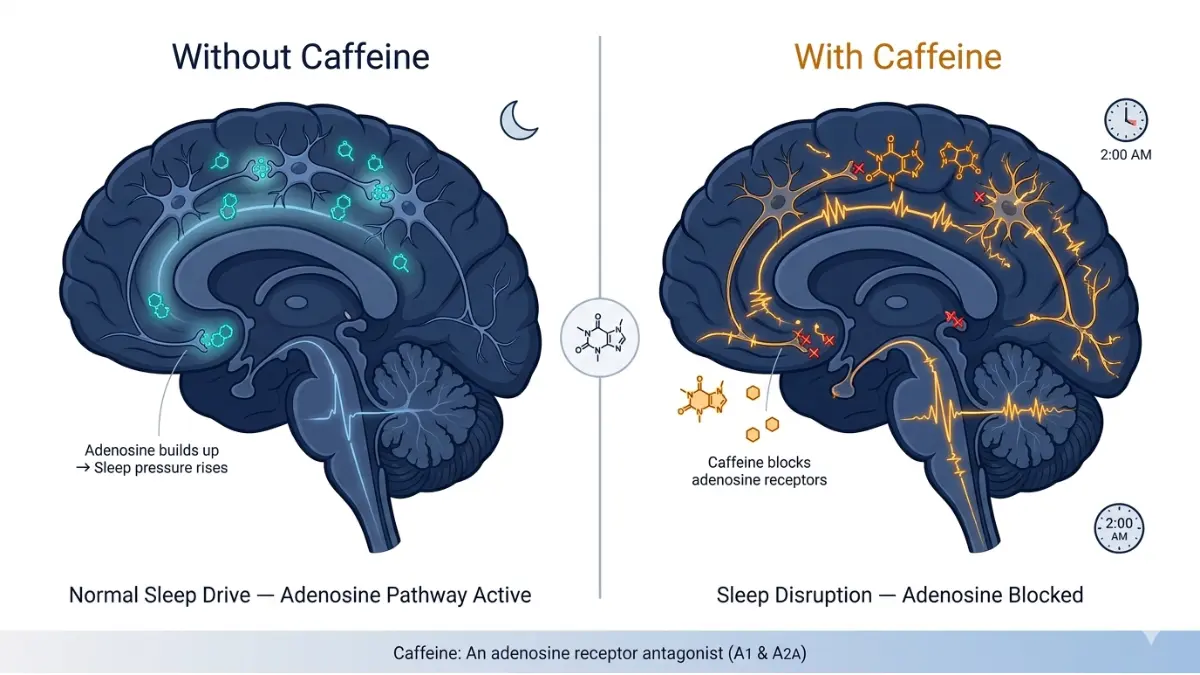
Every hour you’re awake, your brain produces a chemical called adenosine. Think of it as a biological sleep debt counter — the longer you stay awake, the more adenosine accumulates, and the sleepier you feel. This is called sleep pressure, and it’s your body’s built-in system for ensuring you get rest.
By the time you’re ready for bed, adenosine levels are high enough to trigger deep, restorative sleep — including the slow-wave sleep your brain and body need to recover.
How Caffeine Blocks the “Sleep Switch”
Caffeine is an adenosine receptor antagonist. In plain terms, it fits into the same brain receptors that adenosine is supposed to occupy — and blocks them. Your brain can no longer “read” how tired you actually are.
The result: you feel awake, but your adenosine is still building up in the background. When caffeine finally wears off, that accumulated adenosine floods in all at once — often producing the classic afternoon crash.
What competitors miss entirely: Caffeine also suppresses melatonin production. Caffeine consumption during the day causes a measurable reduction in 6-sulfatoxymelatonin — the main metabolite of melatonin — on the following night. This means your sleep-onset hormone is chemically suppressed even when you feel fine.
Even more striking: a 2025 study from Université de Montréal, published in Nature Communications Biology, used AI and EEG to show for the first time that caffeine increases brain complexity and alters “criticality” during sleep — the brain’s delicate balance between order and chaos that governs memory consolidation and recovery. This effect was most pronounced in younger adults.
Bottom line: Caffeine doesn’t just delay sleep — it chemically alters what your brain does while you’re asleep.
Use our free Sleep Calculator to find your optimal bedtime based on your wake-up time and sleep cycles.
What the Latest Research Actually Proves (2025–2026 Studies)
This is where mymedicineadvisor.com leaves every competitor behind. Sleep Foundation, Healthline, and WebMD are citing studies from 2013–2019. Here’s what the science actually shows in 2025–2026.
The 45-Minute Sleep Loss Finding
A landmark systematic review and meta-analysis published in Sleep Medicine Reviews, covering 24 controlled studies, delivered the most comprehensive picture of caffeine’s impact on sleep to date.
The findings were stark:
| Sleep Metric | Effect of Caffeine |
|---|---|
| Total sleep time | ↓ 45 minutes less |
| Sleep efficiency | ↓ 7% lower |
| Sleep onset latency | ↑ 9 minutes longer to fall asleep |
| Wake after sleep onset | ↑ 12 minutes more |
| Light sleep (N1) | ↑ Increased by 6.1 minutes |
| Deep sleep (N3/N4) | ↓ Decreased by 11.4 minutes |
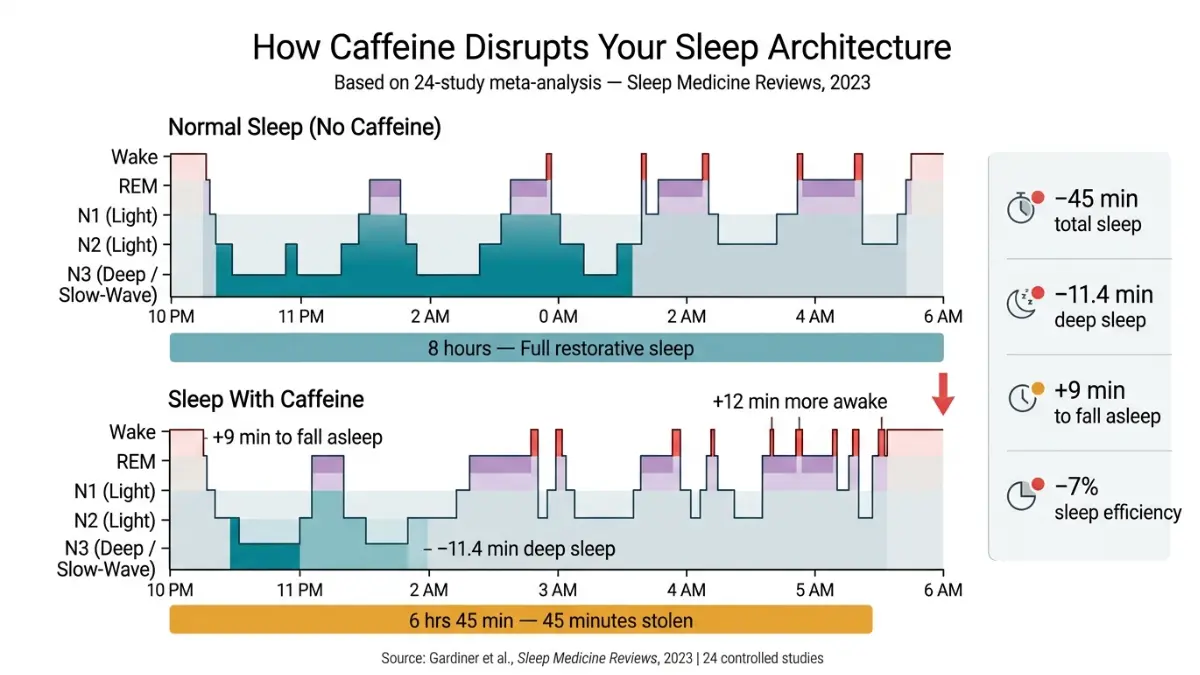
That 45-minute loss is not trivial. Sleep researchers consider anything under 7 hours a night a significant health risk. If caffeine is quietly stealing 45 minutes every night, you may be running a chronic sleep deficit without realising it.
The 2025 Oxford RCT Revelation: Dose and Timing Change Everything
A randomised clinical crossover trial published in SLEEP (Oxford Academic, April 2025) — with 23 participants tested across seven controlled conditions — produced findings that directly challenge conventional advice:
- 100 mg of caffeine (roughly one standard cup of coffee) consumed 4 hours before bed showed no significant effect on sleep.
- 400 mg of caffeine (the daily upper recommended limit) consumed 12 hours before bed still produced measurable, objective sleep disruption — even though participants could not feel the disruption.
That last point deserves emphasis. The discrepancy between objective and subjective measures was consistent — perceived changes were lacking despite a significant increase in objective wake-after-sleep-onset. This finding underscores the challenge consumers face in detecting caffeine-induced sleep fragmentation.
In other words: you may feel fine, but your sleep architecture is silently being damaged.
The 2026 Zurich Study Twist: Habitual Drinkers Are Different
Here is the finding that no competitor has yet reported. A January 2026 study from the University of Zurich, published in the Journal of Psychopharmacology and using data from 485,511 UK Biobank participants plus an objective polysomnography cohort, found a nuanced result:
- Habitual high caffeine consumers (4+ drinks/day) slept slightly fewer hours than moderate consumers.
- However, they also showed increased slow-wave (deep) sleep.
The researchers noted that deeper sleep might compensate for shorter sleep duration — or it could reflect an ongoing sleep debt where the body is constantly catching up. The authors were careful to state this does not mean habitual caffeine use is harmless — it may simply mean the brain adapts over time, while still accumulating underlying sleep pressure.
Key takeaway: The science is not black and white. Acute caffeine disrupts sleep significantly. Habitual use may involve some adaptation — but that adaptation has costs we don’t yet fully understand.
The Caffeine Cutoff Clock — When You Need to Stop
“Avoid caffeine before bed” is advice everyone knows. But it’s not specific enough to actually help you. Here is the evidence-based caffeine cutoff guide — built from the 2023 meta-analysis and 2025 RCT — that no other health website has published in this level of detail.
The 6-Hour Rule — And Why It’s Not Enough
The commonly cited “stop caffeine 6 hours before bed” guideline comes from a Henry Ford Hospital study published in the Journal of Clinical Sleep Medicine. It found that 400 mg of caffeine consumed 6 hours before bedtime still reduced total sleep time significantly.
But newer data goes further. The 2023 meta-analysis found:
- Standard coffee (107 mg / 250 ml): Stop at least 8.8 hours before bed
- Pre-workout supplement (217.5 mg): Stop at least 13.2 hours before bed
This means your 3 PM pre-workout is affecting your 4 AM sleep. Most Americans have no idea.
Product-Specific Caffeine Cutoff Table (2026 Evidence-Based)
| Caffeine Source | Approx. Caffeine (mg) | Minimum Stop Time Before Bed |
|---|---|---|
| Espresso (1 shot) | 75 mg | 4–6 hours |
| Regular brewed coffee (250 ml) | 107 mg | 8.8 hours |
| Energy drink (250 ml) | 80–160 mg | 6–10 hours |
| Pre-workout supplement (standard serve) | 217.5 mg | 13.2 hours |
| Green tea | 35–50 mg | 3–4 hours |
| Dark chocolate (50g) | ~25 mg | 2–3 hours |
| Black tea | 40–70 mg | 4–6 hours |
| Diet cola (350 ml) | 45 mg | 3–4 hours |
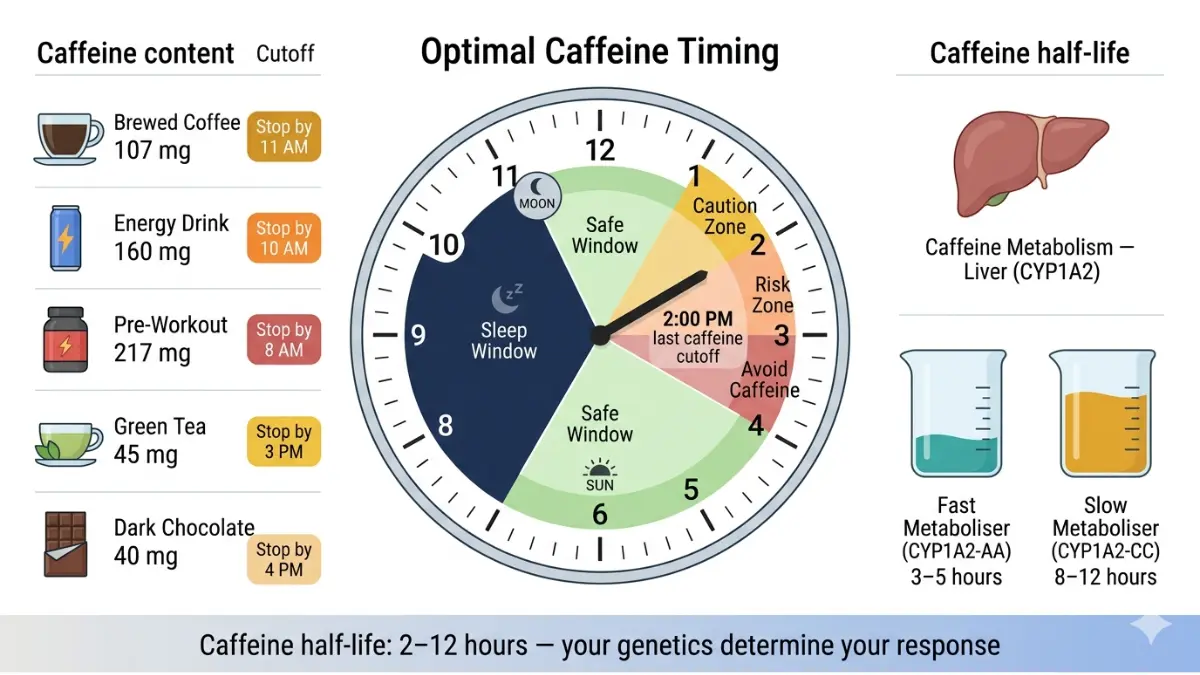
Caffeine half-life reality check: Caffeine’s half-life ranges from 2 to 12 hours depending on the individual. This is why two people can drink the same coffee at the same time and have completely different sleep outcomes. The reasons why are explained in Section 4.
What This Means For You: If you drink your last coffee at 3 PM and aim to sleep at 11 PM, that’s only 8 hours — and you may still have 50%+ of the caffeine active in your system if you are a slow metaboliser.
If you are managing your weight or following intermittent fasting, you can also use our Intermittent Fasting Calculator to sync your caffeine consumption window with your eating window — a powerful strategy for sleep quality improvement.
Why Caffeine Disrupts YOUR Sleep Differently — Genetics and Individual Factors
This is the section that explains everything competitors can’t. Why does David down two espressos at 6 PM and sleep like a rock, while Marcus has one coffee at noon and stares at the ceiling until 2 AM? The answer is in your genes.
The CYP1A2 Gene — Fast vs. Slow Caffeine Metabolisers
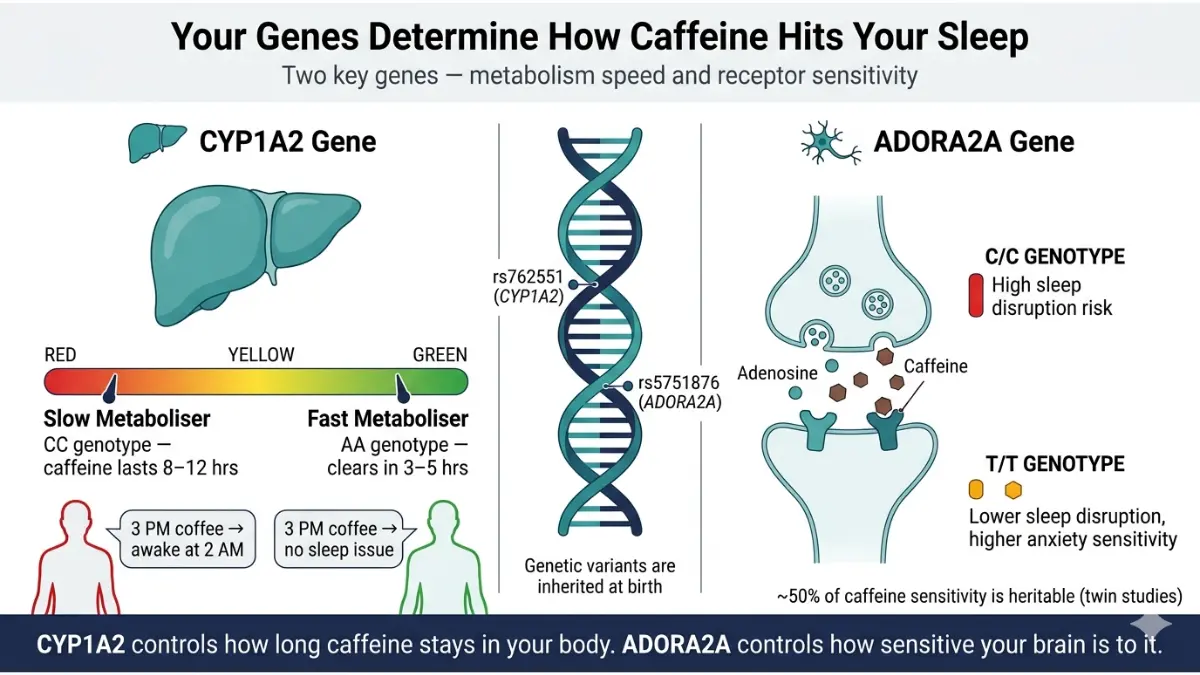
Nearly 95% of all caffeine is processed by the liver enzyme CYP1A2. Variations in the gene that produces this enzyme divide people into two distinct groups:
- Fast metabolisers (AA genotype): Break down caffeine efficiently. It clears their system in roughly 3–5 hours. They can often tolerate afternoon coffee with minimal sleep impact.
- Slow metabolisers (AC or CC genotype): Caffeine lingers for 8–12+ hours. The same afternoon coffee that is harmless for a fast metaboliser can still be fully active at 2 AM for a slow metaboliser.
Important note for women: Estrogen inhibits CYP1A2 activity. Women taking oral contraceptives or going through hormonal fluctuations often experience significantly prolonged caffeine effects — and increased sleep disruption — compared to baseline.
The ADORA2A Gene — Your Adenosine Receptor Sensitivity
Your adenosine receptors — the very targets caffeine blocks — also vary by genetics. The ADORA2A gene variant rs5751876, studied in over 20,000 individuals, reveals:
- C/C genotype carriers: More susceptible to caffeine-induced sleep disruption. For these individuals, even moderate caffeine consumption reliably reduces sleep quality.
- T/T genotype carriers: More prone to caffeine-induced anxiety — but paradoxically less likely to suffer sleep disruption from caffeine.
This explains why some people genuinely experience no sleep disruption from caffeine — it is not willpower or tolerance. It is biology.
Other Factors That Change How Caffeine Hits Your Sleep
| Factor | Effect on Caffeine-Sleep Impact |
|---|---|
| Age 40+ | Liver enzyme activity declines; caffeine clears slower |
| Pregnancy | Progesterone slows CYP1A2 significantly; caffeine effect doubles |
| Smoking | Accelerates caffeine metabolism (faster clearance) |
| Liver conditions | Impairs caffeine processing; higher sleep sensitivity |
| Medications | Some SSRIs and antibiotics inhibit CYP1A2 |
Quick Self-Screening — Are You a High-Risk Caffeine-Sleep Responder?
Check how many apply to you:
- ☐ You often feel wired after afternoon coffee, even hours later
- ☐ You fall asleep fine but wake between 2–4 AM regularly
- ☐ You feel groggy in the morning even after 8 hours of sleep
- ☐ You are female and on oral contraceptives
- ☐ You are over 45
- ☐ You consume caffeine after 2 PM most days
If 3 or more apply, you are likely a slow metaboliser or ADORA2A-sensitive individual. Consider shifting your caffeine cutoff significantly earlier.
For a broader genetic health screening, explore our Genetic Risk Assessment Tool to understand how your biology may be affecting your health choices.
The Caffeine–Sleep Debt Trap — Why You Keep Drinking More Coffee
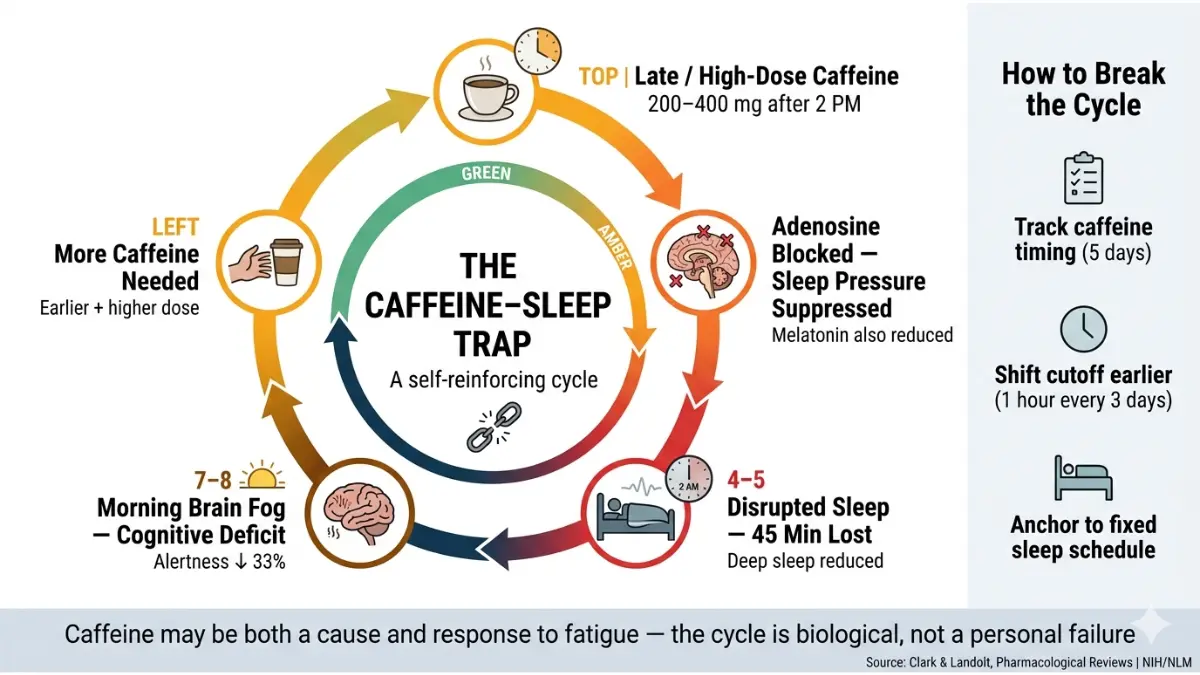
Here is the cruel irony that almost no health website explains clearly: the more caffeine disrupts your sleep, the more caffeine you feel you need the next day. This is not a weakness. It is a documented biological feedback loop.
How Sleep Deprivation Drives More Caffeine — The Feedback Cycle
The cycle works like this:
- Evening or late-afternoon caffeine → delays sleep onset, reduces deep sleep
- Poor sleep → you wake tired, brain fog, low energy
- You consume more caffeine the next day (often earlier and in higher doses)
- More caffeine → disrupts the next night’s sleep
- Repeat indefinitely
Caffeine consumption may equally be a response to fatigue as a cause of it — feeling tired in the morning induces higher caffeine ingestion the following day.
This is the “caffeine-fatigue cycle” that research at CDC’s National Center for Health Statistics has tracked through population data: the number of Americans sleeping fewer than 6 hours per night rose from 13% in 1999 to 20% by 2009 — a period that exactly mirrors the explosion in energy drink and premium coffee consumption.
What Chronic Sleep Loss Actually Does to Your Brain
Sleep scientists at institutions including the National Institutes of Health have documented what happens when this cycle is left unchecked:
- A 90-minute reduction in sleep for just one night reduces daytime alertness by one-third
- Chronic sleep restriction impairs cognitive control, planning, ethical decision-making, and risk assessment
- Caffeine can partially reverse these deficits — but not fully, and only by masking the symptoms, not resolving the underlying sleep debt
For people who are always tired no matter how much sleep they get, caffeine-induced sleep architecture damage is one of the most commonly overlooked causes. Similarly, if you are waking up at 3 AM every night, afternoon caffeine is often a contributing trigger.
The 3-Step Caffeine-Sleep Reset Protocol
Rather than quitting caffeine cold turkey (which causes withdrawal headaches and productivity crashes), use this gradual clinical reset:
Step 1 — Audit your timing. Log your caffeine intake for 5 days. Note exact times and approximate milligrams. Most people discover they are consuming caffeine 4–6 hours later in the day than they realise.
Step 2 — Shift your cutoff back by 1 hour every 3 days. If you currently stop at 4 PM, move to 3 PM, then 2 PM over 9 days. This prevents withdrawal while rebuilding natural adenosine pressure at night.
Step 3 — Anchor to a sleep schedule. Use our Sleep Calculator to calculate your ideal bedtime based on your wake-up time, and make your new caffeine cutoff 9 hours before that bedtime.
If you are experiencing persistent sleep issues beyond caffeine, it is also worth reviewing whether medications you are currently taking may be causing insomnia — a frequently missed clinical connection.
Expert Consensus and the 2026 Practical Caffeine-Sleep Rulebook
What International Sleep Scientists Recommend in 2026
Researchers from the Australian Catholic University SPRINT Research Centre, the University of Zurich, and Université de Montréal have collectively shifted the conversation in 2025–2026. Their unified message:
- The old “no caffeine after 6 PM” rule is inadequate. For high-dose consumers and slow metabolisers, the cutoff should be mid-afternoon or earlier.
- Habitual consumers are not immune. Even if you feel adapted, objective sleep measures confirm ongoing deep-sleep suppression.
- Individual biology matters more than population averages. A caffeine cutoff recommendation must account for genetics, age, sex, and dose.
“Caffeine disrupts sleep, but how much depends on the person’s genetics, the dose, and the timing — not just whether they drank coffee.” — Dr. Omar Hassan, MD, Internal Medicine, mymedicineadvisor.com Expert Panel
“Patients over 40, pregnant women, and those on certain medications are consuming caffeine with a very different metabolic profile than what most general guidelines account for.” — Dr. Vikram Nair, MD, Endocrinology, mymedicineadvisor.com Expert Panel
The 2026 Caffeine-Sleep Rulebook (Quick Reference)
| Timing | Caffeine Action | Verdict |
|---|---|---|
| Morning (before 10 AM) | Any standard dose | ✅ Safe for most people |
| 10 AM – 12 PM | Up to 200 mg | ✅ Low risk |
| 12 PM – 2 PM | Up to 100 mg | ✅ Generally fine |
| 2 PM – 4 PM | Any caffeine | ⚠️ Risk zone — avoid if sensitive |
| After 4 PM | Any caffeine | ❌ High disruption risk |
| Pre-workout after 3 PM | 200+ mg | ❌ Disrupts sleep until ~4 AM |
| Energy drink after 4 PM | 80–160 mg | ❌ Avoid |
If you are experiencing symptoms that go beyond sleep problems — fatigue, mood changes, concentration issues — use our Symptom Checker to assess whether something more is at play.
For deeper understanding of how your sleep is structured and why deep sleep matters, our full guide on sleep stages explained covers everything from N1 light sleep through slow-wave and REM stages — the exact stages caffeine disrupts.
Frequently Asked Questions
1. Does caffeine really disrupt sleep?
Yes. Across 24 controlled studies, caffeine reduced total sleep time by 45 minutes and decreased deep sleep — often without the person being able to subjectively feel the disruption.
2. How long does caffeine affect sleep?
Caffeine has a half-life of 2–12 hours depending on your genetics. For slow metabolisers, a 3 PM coffee can still be 50% active at 11 PM.
3. Does caffeine reduce deep sleep?
Yes. The 2023 meta-analysis confirmed that deep sleep (N3/N4) decreases by an average of 11.4 minutes with caffeine consumption — even when consumed hours before bed.
4. How many hours before bed should I stop caffeine?
At minimum, 6 hours for a standard cup. Evidence-based guidance recommends 8.8 hours for a 107 mg serving and 13.2 hours for pre-workout supplements (217 mg).
5. Does caffeine affect REM sleep?
Less so than deep sleep. Multiple studies show REM sleep is relatively spared compared to slow-wave sleep, though total sleep time reductions indirectly reduce REM duration.
6. Can one coffee ruin your sleep?
One standard cup in the morning is unlikely to cause significant disruption. However, a single high-dose serving (400 mg) consumed even 8–12 hours before bed can objectively worsen sleep without you feeling it.
7. Why does caffeine keep some people awake but not others?
Genetics. CYP1A2 gene variants determine how fast you metabolise caffeine. ADORA2A gene variants determine how sensitive your adenosine receptors are to caffeine’s blocking effect.
8. Does green tea disrupt sleep like coffee?
Green tea contains 35–50 mg of caffeine per cup — significantly less than coffee. For most people, green tea consumed before 4 PM has minimal sleep impact. Evening green tea remains a risk for sensitive individuals.
9. Does habitual coffee drinking affect sleep less over time?
Partially. A 2026 University of Zurich study found habitual consumers showed increased deep sleep, suggesting partial adaptation. However, habitual users still slept fewer total hours, so the trade-off is not clearly beneficial.
10. Can caffeine cause insomnia?
Yes, particularly in sensitive individuals and slow metabolisers. Caffeine consumption has historically been used in clinical research as a model for inducing insomnia. If you suspect a pattern, review the causes of insomnia guide.
11. What is the safest amount of caffeine for good sleep?
Up to 400 mg/day is the general upper limit for healthy adults, but for sleep quality specifically, keeping total daily intake under 200 mg and stopping by 1–2 PM is the most evidence-aligned recommendation for most people.
This article is for educational purposes only and does not constitute medical advice. Always consult your healthcare provider before making changes to your diet, caffeine intake, or sleep habits, particularly if you have an underlying health condition.
About this content
How this article was put together: researched from recognised health sources, drafted with the help of AI tools, and edited by hand, with sources linked throughout.

Sameer Patel is the founder and editor of My Medicine Advisor. He is not a doctor or medical professional — before starting this site he worked in banking,…
Medical disclaimer
The content on MyMedicineAdvisor is provided for general informational and educational purposes only and is not a substitute for professional medical advice, diagnosis, or treatment. Health information on this website should not be used to diagnose, treat, cure, or prevent any condition without guidance from a qualified healthcare professional. Always seek the advice of your doctor, physician, or another licensed healthcare provider with any questions you may have regarding a medical condition, symptoms, medications, or treatment decisions.