
On This Page – Quick Medical Summary
Christopher, a 38-year-old software engineer from Austin, was getting 8 hours of sleep every night — yet woke exhausted every single morning. His doctor ran a sleep study and found he was barely reaching Stage 3 deep sleep. The problem wasn’t how long he slept. It was which sleep stages he was actually completing.
Understanding your sleep stages isn’t just biology trivia. It’s the difference between waking restored and waking broken.
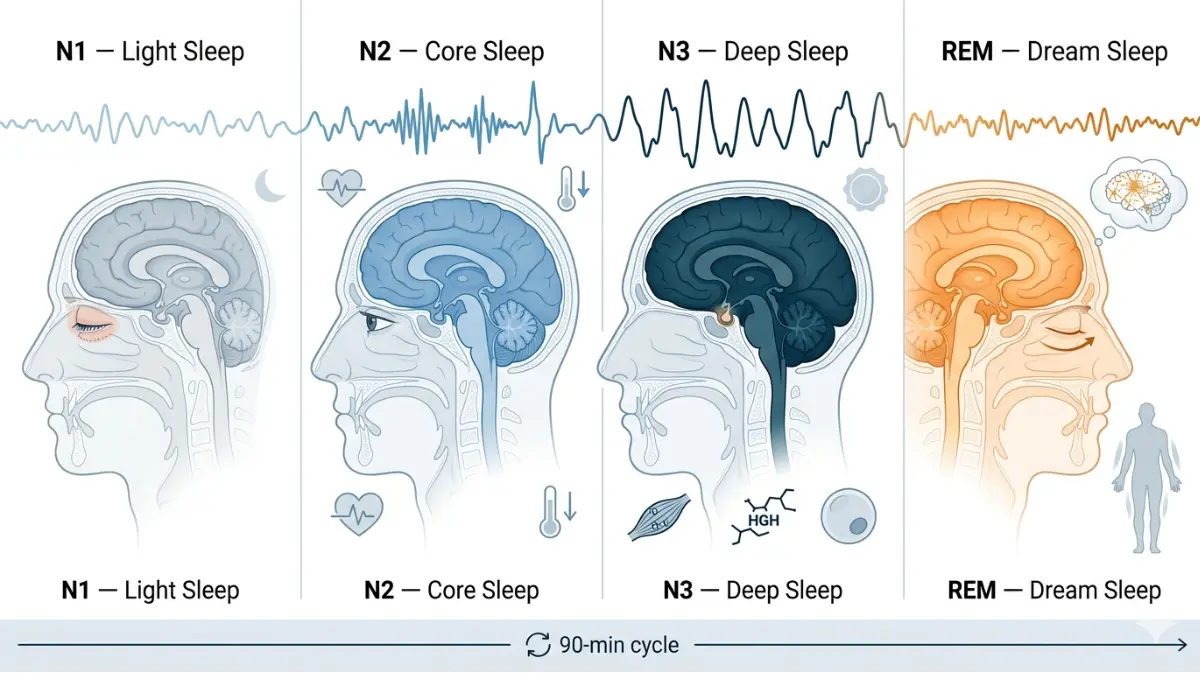
Your body cycles through 4 distinct sleep stages — N1, N2, N3 (deep sleep), and REM — in 90-minute cycles, repeating 4–6 times each night. Each stage performs a specific biological function that cannot be replaced by the others. Miss one chronically, and measurable damage follows.
This article is for educational purposes only and does not constitute medical advice. If you experience persistent sleep difficulties, consult a licensed healthcare provider or sleep specialist.
The 4 Sleep Stages — Your Nightly Body Blueprint
What Are the 4 Stages of Sleep?
Every night, your brain and body execute a precise, repeating program. The sleep cycle has two main phases: Non-REM (NREM) sleep — divided into three stages (N1, N2, N3) — and REM sleep. According to the National Heart, Lung, and Blood Institute (NHLBI), the cycle restarts every 80–100 minutes, and most adults complete 4–6 cycles per night.
Here’s your complete sleep architecture at a glance:
| Sleep Stage | Duration (1st Cycle) | % of Total Sleep | Primary Function | Brain Waves |
|---|---|---|---|---|
| N1 (Light Sleep) | 1–7 min | ~5% | Transition to sleep | Alpha, Theta |
| N2 (Core Sleep) | 10–25 min | ~45% | Memory sorting, temperature drop | Theta + Sleep Spindles |
| N3 (Deep Sleep) | 20–40 min | 15–25% | Physical repair, immune boost, HGH release | Delta (slowest) |
| REM Sleep | 10 min (first cycle) | 20–25% | Dreaming, emotional regulation, brain detox | Beta-like (near-waking) |
Key insight most sites miss: Your cycle composition shifts across the night. Deep sleep (N3) dominates the first half. REM dominates the second half. This is why a 6-hour night disproportionately destroys physical recovery — you lose your longest REM windows. And why a late bedtime destroys your body repair window — you lose your peak N3 time.
Use our Sleep Calculator to find your exact bedtime based on 90-minute cycle timing — waking mid-cycle is the single biggest cause of morning grogginess.
Your Body Hour-by-Hour During Sleep
What Is Your Body Doing at 11 PM, 1 AM, 3 AM, and 5 AM?
No competitor maps this. Every major site tells you what the stages are. None tell you when they happen to your body on a real nightly timeline.
Here’s what occurs during a typical 10:30 PM–6:30 AM night’s sleep:
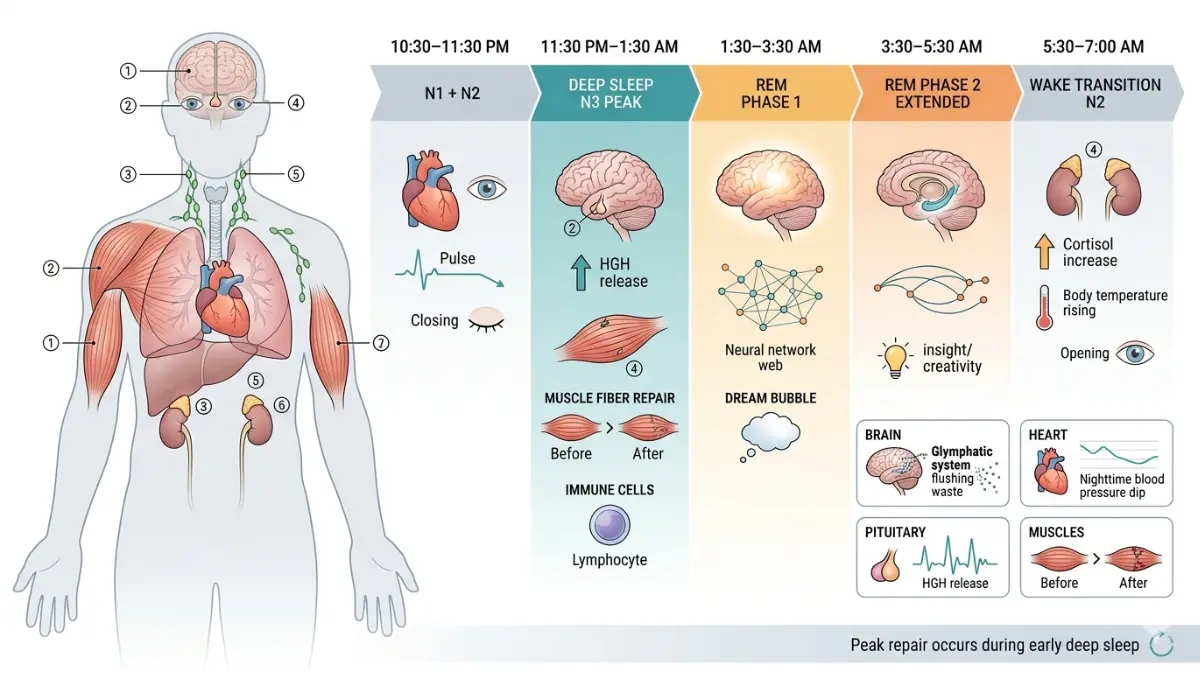
🕙 10:30–11:30 PM → N1 and N2: The Descent
- Heart rate slows. Core body temperature begins dropping — this thermal drop is what triggers deeper sleep.
- Brain produces sleep spindles during N2 — short bursts of electrical activity that sort and file the day’s experiences into long-term memory.
- Eye movements stop. Breathing becomes rhythmic.
- If your phone screen fires at this point, melatonin suppression can delay your entire night’s architecture by 1–3 hours.
🕛 11:30 PM–1:30 AM → N3 Peak: The Repair Window
This is the most physically critical window of your entire night.
- 95% of your daily human growth hormone (HGH) is released during this window — driving muscle repair, bone density maintenance, and cellular recovery.
- The glymphatic system activates, flushing neurotoxic waste (including beta-amyloid — a protein linked to Alzheimer’s disease) from brain tissue.
- Immune cytokines are produced, strengthening pathogen defense.
- Blood pressure drops 10–20% — a process called “nocturnal dipping” that protects cardiovascular health.
Bold Takeaway: Miss your first deep sleep block and your body cannot compensate later. N3 time shrinks with every subsequent cycle — there is no “make-up” window.
Your resting heart rate during this stage reveals a great deal about cardiovascular recovery. Use our Heart Rate Zone Calculator to understand what your overnight metrics mean.
🕑 1:30–3:30 AM → First REM Window: The Mind Repair Phase
- Brain activity surges back toward near-waking levels.
- Emotional memories are processed and emotionally “de-charged” — this is why a night of good sleep literally makes problems feel smaller.
- New motor skills and factual knowledge learned that day are consolidated.
- The body enters atonia — temporary muscle paralysis preventing you from physically acting out dreams.
- First REM period: approximately 10 minutes.
🕓 3:30–5:30 AM → REM Elongates: The Creative Engine
- REM windows now extend to 30–60 minutes per cycle.
- This is when your most vivid, narrative-rich dreams occur.
- Creative insight consolidation peaks — researchers at Johns Hopkins Medicine describe this phase as critical for “brain plasticity,” the ability to form new neural connections.
- Cortisol begins its slow rise in preparation for waking.
🕔 5:30–7:00 AM → The Exit: N2 and Light REM
- Body temperature begins rising.
- Cortisol peaks, preparing alertness systems.
- Sleep becomes lighter — this is the window in which most natural awakenings occur.
- Waking naturally within this phase = the secret to feeling alert immediately.
For adults managing weight and metabolic health, sleep architecture and metabolism are tightly linked. Chronic deep sleep loss triggers hormonal shifts that slow metabolism — calculate your baseline with our BMR Calculator.
Deep Sleep vs. REM Sleep — The Debate Settled
Is Deep Sleep or REM Sleep More Important?
Neither is optional. They perform entirely different biological jobs. Framing one as “better” is like asking whether your heart or lungs matter more.
Here is the precise difference:
| Category | Deep Sleep (N3) | REM Sleep |
|---|---|---|
| Primary job | Physical repair | Emotional + cognitive repair |
| Brain activity | Slowest (delta waves) | Near-waking (beta-like) |
| Hormones | HGH, IGF-1 surge | Suppressed (norepinephrine off) |
| Disrupted by | Alcohol, late exercise, heat | Stress, sleep apnea, antidepressants |
| Deficiency signs | Physical fatigue, low immunity, slow wound healing | Anxiety, poor memory, mood instability |
| Wearable accuracy | Moderate | Low — most devices overestimate by 20–30% |
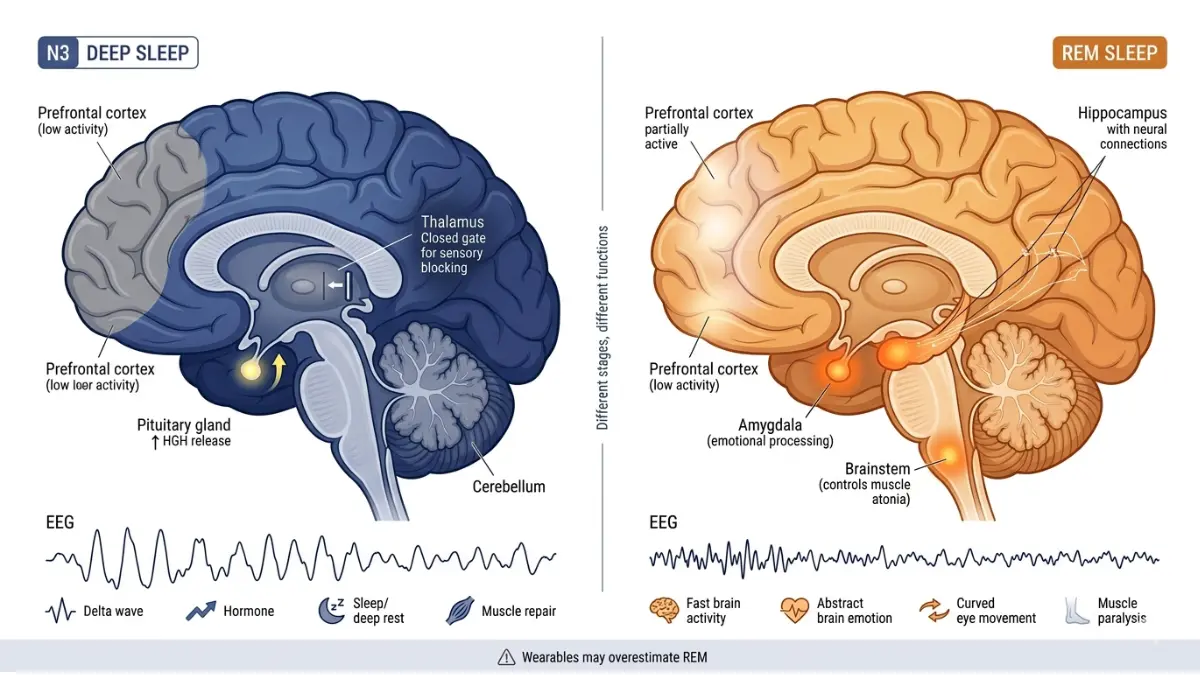
That last row matters enormously in 2026. A 2024 Stanford University analysis found consumer wearables like Fitbit and Apple Watch consistently overestimate REM sleep duration, because they rely on heart rate and movement rather than EEG brain signals. Your wearable’s REM reading may be inflated by nearly a third. Don’t optimize your sleep based on that number alone.
Diagnostic Self-Check:
- Waking physically exhausted, heavy limbs, low immunity → you are losing N3 deep sleep
- Waking emotionally flat, anxious, mentally foggy → you are losing REM sleep
These are distinct problems requiring distinct solutions — not the same “get more sleep” advice every competitor gives.
If your fatigue pattern seems linked to a broader health issue, our Symptom Checker can help you identify whether a sleep disorder may be the underlying cause.
For a deeper understanding of what happens specifically during REM, read our detailed guide on what REM sleep is and why it matters.
7 Habits That Are Silently Destroying Your Sleep Stages
What Disrupts Sleep Stages? The Stage-Specific Damage Map
Every competitor lists generic sleep hygiene tips. Here, we map each disruptor to the specific stage it destroys — because the fix depends entirely on what’s being broken.
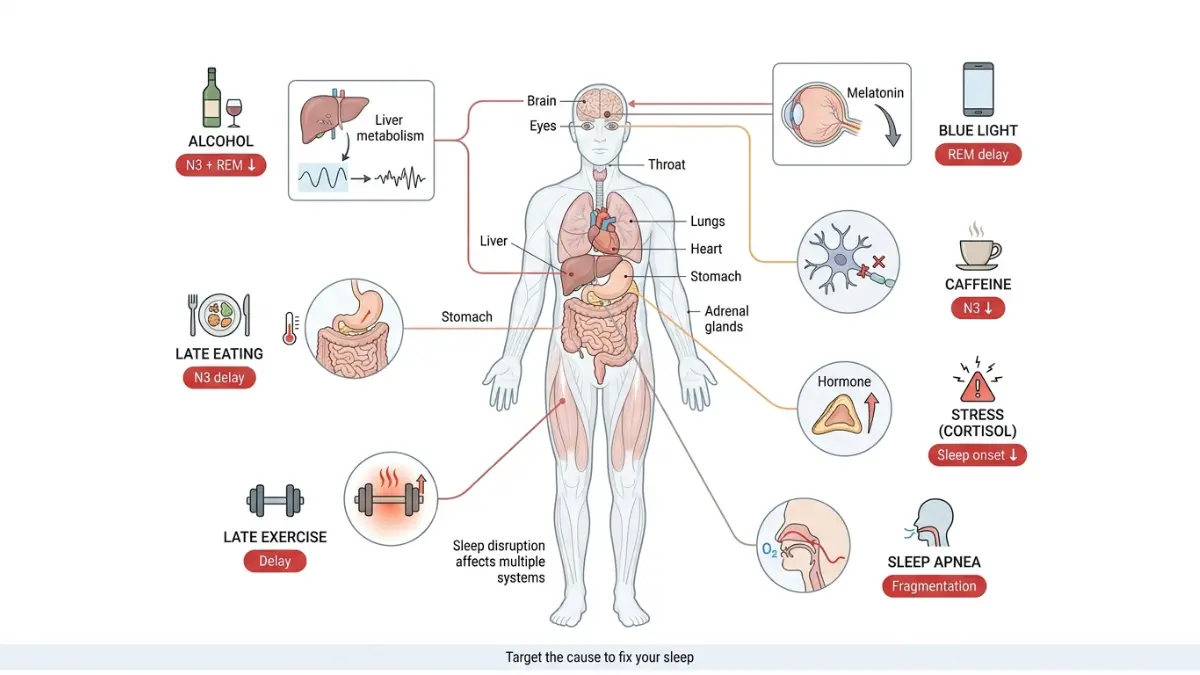
1. Alcohol
- Suppresses N3 deep sleep in the first half of the night.
- Triggers REM rebound in the second half — fragmented, low-quality REM that leaves you drained.
- Even one drink within 3 hours of bed measurably reduces deep sleep duration.
2. Blue Light / Screen Use After 9 PM
- Suppresses melatonin production by up to 50%, delaying sleep onset by 1–3 hours.
- You fall asleep later → your entire architecture shifts → you wake before completing your final long REM cycles.
- Stage most damaged: REM (final cycles, lost entirely with early wake alarm)
3. Caffeine After 2 PM
- Caffeine has a half-life of 5–7 hours. A 3 PM coffee still has active levels at 10 PM.
- Blocks adenosine receptors that drive deep sleep pressure — reducing N3 duration by up to 20% according to CDC sleep research data.
- Stage most damaged: N3
4. Irregular Sleep Schedule
- Your circadian rhythm anchors your entire sleep architecture. Shifting bedtime by even 60–90 minutes on weekends (“social jet lag”) desynchronizes when each stage occurs.
- All stages damaged — architecture mistimes across the night.
5. High Evening Stress / Elevated Cortisol
- Cortisol directly competes with delta wave generation required for N3.
- Anxiety keeps the brain in high-arousal states incompatible with deep sleep onset.
- Stage most damaged: N3 (fails to initiate). For readers managing anxiety’s impact on health, see our guide on how to reduce anxiety naturally.
6. Undiagnosed Sleep Apnea
- Micro-arousals caused by airway collapse fragment both N3 and REM repeatedly throughout the night — without the sleeper being consciously aware.
- This is the most common cause of chronic stage deprivation in American adults. Learn more in our complete guide to sleep disorders, symptoms, and causes.
7. Late-Night Eating
- Digestion elevates core body temperature, competing with the thermal cooling required for N3 onset.
- Eating within 2–3 hours of bed reduces deep sleep efficiency.
- If you practice time-restricted eating, use our Intermittent Fasting Calculator to time your eating window in a way that protects your deep sleep entry point.
Sleep Stages by Age — How Your Architecture Changes Across Life
How Do Sleep Stages Change With Age?
Sleep architecture is not static. It evolves dramatically from birth through old age — and understanding your life stage tells you which sleep challenge you’re most vulnerable to.
| Age Group | % Deep Sleep (N3) | % REM | Cycles/Night | Key Clinical Note |
|---|---|---|---|---|
| Newborn (0–3 mo) | ~20% | ~50% | Irregular | REM supports central nervous system development |
| Child (3–12 yr) | ~35–40% | ~25–30% | 5–6 | Peak deep sleep period of entire life |
| Teen (13–18 yr) | ~20–25% | ~25% | 4–5 | Biological circadian phase delay — not laziness |
| Adult (18–60 yr) | 15–25% | 20–25% | 4–5 | Lifestyle is the primary modifier |
| Older Adult (60+) | 5–10% | 15–20% | 3–4 | Deep sleep significantly and progressively reduced |
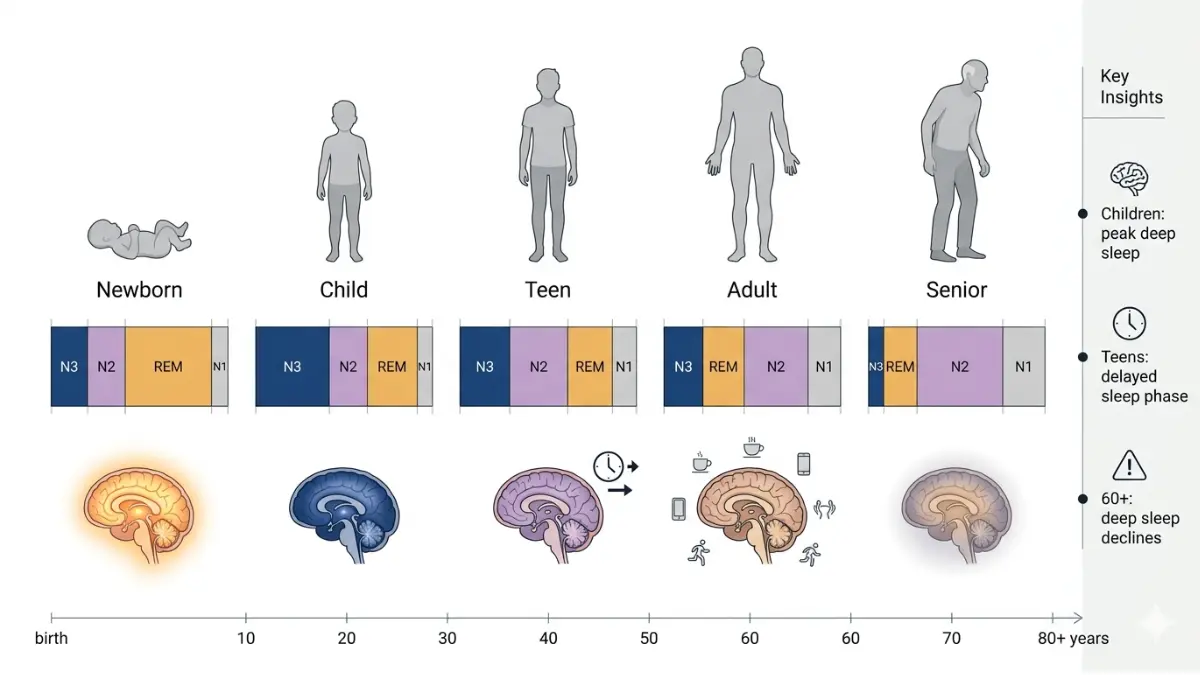
Three critical facts no competitor covers:
- Teenagers are biologically wired to fall asleep later and wake later. The American Academy of Pediatrics recognizes delayed circadian phase as a physiological reality — not a behavior problem. Early school start times create chronic REM deprivation in adolescents.
- After age 60, deep sleep (N3) diminishes dramatically. Older adults may lose N3 almost entirely, shifting to predominantly N2 sleep. This explains increased infection rates, slower physical recovery, and cognitive decline risk — not as separate aging effects, but as downstream consequences of lost deep sleep.
- Babies spend 50% of sleep in REM because REM is essential for central nervous system development. Disturbing infant sleep disrupts neurological architecture formation.
For age-specific sleep duration recommendations, see our research-backed guide on how many hours of sleep you need by age.
Hydration also directly supports cellular repair processes active during deep sleep — find your daily target with our Water Intake Calculator.
How to Optimize Every Sleep Stage — A Clinically Grounded Protocol
How Do You Improve Sleep Stage Quality?
Generic “sleep hygiene” lists are not a protocol. Here is a stage-specific, evidence-based approach — each action mapped to the stage it targets.
Optimize N3 Deep Sleep
- Temperature: Set your bedroom to 65–68°F (18–20°C). Core body temperature must drop 1–2°F to trigger N3 onset. This is the single most powerful environmental lever for deep sleep.
- Exercise timing: Finish vigorous workouts at least 3 hours before bed. Exercise elevates core temperature and stimulates cortisol — both N3 antagonists when timed too late.
- Magnesium glycinate (200–400mg before bed): Multiple randomized controlled trials show this form of magnesium increases slow-wave sleep duration. It works by activating GABA receptors that drive N3 onset. Always consult your physician before supplementing.
- Avoid alcohol entirely on nights before physically demanding days — its N3-suppression effect is dose-dependent but begins at even low intake levels.
Optimize REM Sleep
- Consistent wake time is the most powerful REM anchor. REM cycles lengthen toward morning — every 30 minutes you sleep past your usual wake time adds meaningfully to your REM total. Maintain your wake time even on weekends.
- Address anxiety proactively. The American Academy of Sleep Medicine identifies Cognitive Behavioral Therapy for Insomnia (CBT-I) as the gold-standard first-line treatment — superior to sleep medication for long-term REM quality restoration.
- Eliminate alcohol on nights before cognitively demanding tasks — REM is where skill consolidation and emotional processing occur. Alcohol-disrupted REM means you wake less equipped to perform.
Optimize N2 (Sleep Spindles + Memory Consolidation)
- Strategic napping: A 20-minute nap captures N2 sleep without entering N3 — avoiding the sleep inertia (grogginess) that follows deep sleep awakenings. Naps longer than 30 minutes risk N3 entry and can reduce the following night’s deep sleep pressure.
- Review new material before sleep. Sleep spindles during N2 are the brain’s filing mechanism. Studying or reviewing information immediately before sleep measurably improves retention — a well-documented principle in sleep science research.
Your 3 Non-Negotiable Starting Points
- Fix your wake time first — it anchors every stage that follows.
- Cool your room to 65–68°F — thermal environment is the fastest modifiable N3 lever.
- Stop alcohol within 3 hours of bed — it simultaneously destroys N3 and fragments REM.
Frequently Asked Questions About Sleep Stages
1. What are the 4 stages of sleep?
The four sleep stages are N1 (light transition), N2 (core sleep), N3 (deep slow-wave sleep), and REM (rapid eye movement). They cycle in sequence over 90-minute blocks, repeating 4–6 times per night, each serving a distinct physical or cognitive function.
2. How long should deep sleep be per night?
Adults need 1.5–2 hours of deep sleep (N3) per night, representing roughly 15–25% of total sleep time. Less than 1 hour of deep sleep consistently indicates disrupted sleep architecture and is associated with impaired immune function and physical recovery.
3. Is REM sleep the deepest stage of sleep?
No — this is one of the most common misconceptions. REM sleep is characterized by near-waking brain activity. N3 (slow-wave deep sleep) is the deepest stage, defined by the slowest, highest-amplitude delta brain waves and the highest arousal threshold.
4. What happens to your brain during REM sleep?
During REM sleep, brain activity closely resembles wakefulness. The brain processes emotional memories, consolidates newly learned information, and performs creative problem-solving. The body’s muscles are temporarily paralyzed (atonia) to prevent acting out dreams.
5. Why do I wake up tired even after 8 hours of sleep?
Eight hours in bed does not guarantee adequate time in each stage. Alcohol, undiagnosed sleep apnea, high stress, or an inconsistent schedule can fragment deep sleep and REM — leaving you technically “asleep” but physiologically underrecovered. Our sleep disorders guide covers the most common culprits.
6. How many sleep cycles per night is normal?
Four to six complete sleep cycles per night is normal for adults. Each cycle averages 90–120 minutes. Getting fewer than four full cycles — even with adequate total hours — often indicates disrupted sleep architecture.
7. What destroys deep sleep the most?
Alcohol is the single most potent suppressor of N3 deep sleep in clinical research. Even moderate intake before bed measurably reduces slow-wave sleep duration in the first half of the night.
8. Does alcohol affect sleep stages?
Yes, significantly. Alcohol sedates you faster but suppresses N3 in the first half of the night and causes REM rebound fragmentation in the second half. The net result is less physical repair and lower-quality emotional processing despite a full night in bed.
9. How do sleep stages change as you age?
Deep sleep (N3) declines progressively from early adulthood. Adults over 60 may retain as little as 5–10% N3, compared to 35–40% in children. REM also decreases modestly with age. This decline is associated with reduced immune resilience and slower physical recovery.
10. Can a wearable accurately track sleep stages?
Consumer wearables provide estimates, not clinical measurements. They rely on heart rate and movement — not EEG brain signals. A 2024 Stanford study found wearables overestimate REM sleep by 20–30% on average. Use wearable data for trends, not precise stage percentages.
11. What is sleep architecture?
Sleep architecture refers to the structural pattern of sleep stages across a full night — how long each stage lasts, how cycles are sequenced, and how that pattern shifts from the first cycle to the last. Disrupted sleep architecture is the underlying cause in most cases of non-restorative sleep.
This article is for educational purposes only. It does not replace professional medical advice, diagnosis, or treatment. Always consult a qualified healthcare provider regarding any sleep concerns.
Medical disclaimer
The content on MyMedicineAdvisor is provided for general informational and educational purposes only and is not a substitute for professional medical advice, diagnosis, or treatment. Health information on this website should not be used to diagnose, treat, cure, or prevent any condition without guidance from a qualified healthcare professional. Always seek the advice of your doctor, physician, or another licensed healthcare provider with any questions you may have regarding a medical condition, symptoms, medications, or treatment decisions.