On This Page – Quick Medical Summary
REM sleep (Rapid Eye Movement sleep) is the fourth and most neurologically active stage of your sleep cycle. It’s when your brain consolidates memories, regulates emotions, and processes the day’s experiences. Adults need roughly 1.5–2 hours of REM sleep per night — and most Americans are quietly falling short.
“You slept a full 8 hours. You woke up exhausted, foggy, and irritable — like you hadn’t slept at all. Your problem probably isn’t how long you slept. It’s how little REM sleep you actually got.”
What Is REM Sleep? The Science Made Simple
REM sleep is the stage of sleep characterized by rapid side-to-side eye movements, vivid dreaming, and intense brain activity that closely mirrors wakefulness. Despite your body being nearly paralyzed, your brain is firing at full capacity.
To understand REM sleep, you need to understand where it fits in your sleep architecture.
The 4 Stages of the Sleep Cycle
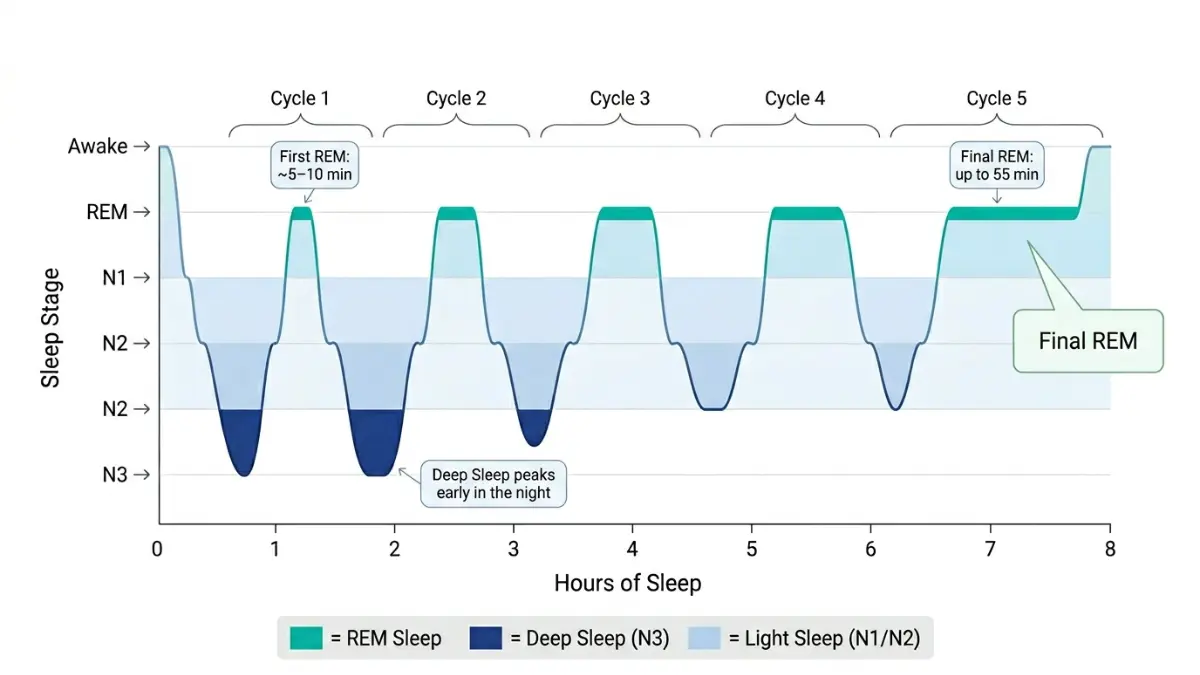
Each night, your brain cycles through four sleep stages, roughly every 90 minutes:
| Stage | Type | What Happens |
|---|---|---|
| Stage 1 (N1) | Light NREM | Transition to sleep; easily woken |
| Stage 2 (N2) | Light NREM | Heart rate slows; body temperature drops |
| Stage 3 (N3) | Deep NREM | Physical repair; tissue and immune restoration |
| Stage 4 (REM) | REM Sleep | Brain consolidates memory; emotions processed; dreaming |
A typical night includes 4–6 complete sleep cycles. Your first REM episode lasts just 5–10 minutes. By your final cycle — in the early morning hours — REM can stretch to 45–60 minutes. This is why cutting your sleep short by even 60–90 minutes disproportionately eliminates your most valuable REM time.
Use our free Sleep Calculator to find your ideal sleep window and protect your morning REM cycles.
What Actually Happens in Your Brain During REM Sleep
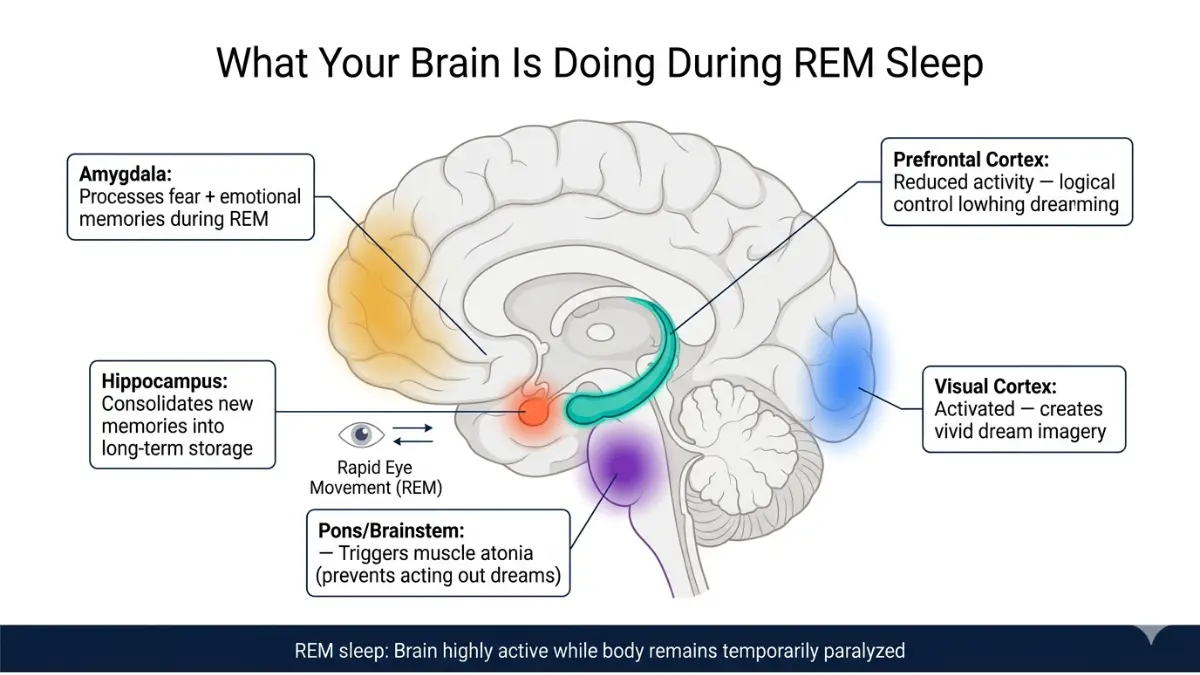
During REM sleep, the brain’s electrical activity resembles an awake state on an EEG. Key processes include:
- Synaptic pruning: The brain actively trims unnecessary neural connections, sharpening learning and memory
- Neurotransmitter replenishment: Serotonin, norepinephrine, and dopamine stores are restored
- Muscle atonia: Voluntary muscles become temporarily paralyzed — a protective mechanism preventing you from physically acting out dreams
- Amygdala activation: The brain’s emotional processing center is highly active, working through emotionally charged memories
REM Sleep vs. Deep Sleep: The Key Difference
This is one of the most searched sleep questions — and most competitors blur the answer. Here’s the clear distinction:
| Feature | REM Sleep | Deep Sleep (N3) |
|---|---|---|
| Primary function | Memory, emotion, creativity | Physical repair, immune support |
| Brain activity | High (similar to waking) | Low |
| Dreaming | Vivid, narrative dreams | Rare, fragmented |
| When it peaks | Final 2–3 hours of sleep | First half of the night |
| Muscle state | Paralyzed (atonia) | Relaxed but not paralyzed |
| What you lose when short on sleep | Morning hours | Early night hours |
Key takeaway: You cannot substitute deep sleep for REM sleep. They serve completely different functions. You need both.
How Much REM Sleep Do You Actually Need?
The CDC recommends adults get 7–9 hours of total sleep per night. Of that, approximately 20–25% should be REM sleep — equating to roughly 1.5 to 2 hours per night for most adults.
But REM sleep needs aren’t fixed across your lifetime. They shift dramatically by age.
REM Sleep Requirements by Age Group
| Age Group | % of Sleep in REM | Notes |
|---|---|---|
| Newborns (0–3 months) | ~50% | Critical for rapid brain development |
| Infants (4–12 months) | ~30–40% | REM declines as brain matures |
| Children (1–12 years) | ~25–30% | Sleep architecture approaches adult patterns by age 5 |
| Teenagers (13–18 years) | ~20–25% | Circadian shift pushes sleep later |
| Adults (19–64 years) | ~20–25% | ~1.5–2 hours per night recommended |
| Older Adults (65+) | ~17–20% | Natural decline; risk of cognitive impact increases |
How Many REM Cycles Per Night Is Normal?
In a typical 7–8 hour night, you pass through 4–5 full sleep cycles. REM sleep appears in each cycle, but grows longer with each repetition:
- Cycle 1: ~5–10 minutes of REM
- Cycle 2: ~15–20 minutes of REM
- Cycle 3: ~25–30 minutes of REM
- Cycle 4–5: ~40–60 minutes of REM per cycle
This is why the final 2 hours of sleep are so critical. If you go to bed at midnight and set an alarm for 5 AM, you’ve cut off the two longest, most restorative REM cycles of your night. Seven hours starting at 10 PM delivers vastly more REM than seven hours starting at 1 AM.
7 Science-Backed Reasons REM Sleep Matters for Your Health
1. Memory Consolidation and Learning
During REM sleep, your brain reviews everything you learned during the day, deciding what to keep and what to discard — essentially filing and organizing new information into long-term memory. According to research published through the National Library of Medicine, this process involves active synaptic pruning and the strengthening of neural pathways essential for recall and problem-solving.
Key takeaway: Studying before a full night of sleep — not an all-nighter — produces significantly better retention.
2. Emotional Regulation and Mood Stability
REM sleep is when your amygdala — the brain’s emotional processing hub — works through fear memories and negative experiences. Healthy REM sleep literally “takes the edge off” difficult emotions overnight.
Research shows that restless or fragmented REM sleep impairs this process, leaving the amygdala hyperreactive to stress the following day. Chronically poor REM sleep is strongly linked to anxiety, emotional volatility, and poor stress resilience. If you’re managing anxiety, our guide on how to reduce anxiety naturally may offer additional support strategies.
Key takeaway: Waking up irritable or emotionally reactive after a full night is a hallmark sign of disrupted REM sleep.
3. Brain Development in Infants and Children
Newborns spend nearly 50% of their total sleep time in REM sleep — far more than adults. This isn’t accidental. REM sleep is considered essential for the rapid development of the central nervous system, including the formation of synaptic connections that underpin language, motor skills, and cognition.
By age 5, a child’s sleep architecture begins to mirror adult patterns. Sleep disorders in early childhood — even those that seem minor — can affect this developmental window.
Key takeaway: REM sleep deprivation in infants and young children carries developmental consequences that may not be immediately visible.
4. Dementia and Alzheimer’s Disease Risk (2026 Research Alert)
This is the finding no major competitor is covering — and it may be the most important reason to protect your REM sleep right now.
A landmark study from the University of California, San Francisco (January 2025) found that people who take significantly longer to enter REM sleep show measurably higher levels of Alzheimer’s-linked proteins: 16% more amyloid and 29% more tau in the brain compared to those who reached REM sleep early in the night.
An earlier study published in Neurology found that for every 1% reduction in REM sleep, there is a 9% increase in dementia risk. These aren’t correlations to dismiss.
REM sleep appears to facilitate the clearance of toxic proteins from the brain — a process that, when disrupted consistently over years, may contribute to neurodegenerative disease progression.
Key takeaway: Protecting your REM sleep tonight is an investment in your cognitive health decades from now.
5. Cardiovascular Protection
During REM sleep, the cardiovascular system undergoes rhythmic fluctuations in heart rate and blood pressure. These fluctuations — far from being harmful — are believed to serve as a form of cardiac “exercise,” training and conditioning the heart’s adaptive response.
Insufficient REM sleep is associated with elevated blood pressure the following day and reduced heart rate variability — both early markers of cardiovascular risk. Our article on preventing heart disease expands on how sleep is one of the most underrated cardiovascular interventions available.
Key takeaway: Poor REM sleep doesn’t just make you tired — it stresses your cardiovascular system overnight.
6. Immune System Function
Adequate REM sleep enhances the immune response against infections by supporting cytokine production — the signaling proteins your immune system uses to coordinate its defense. Sleep-deprived individuals not only get sick more easily; they also recover more slowly.
Key takeaway: Consistently losing REM sleep weakens immune defenses in ways no supplement can fully compensate for.
7. Pain Sensitivity
One of the least-known consequences of REM deprivation: it makes you hurt more. Research reviewed via ScienceDirect’s sleep deprivation database found that REM sleep deprivation reduced pain threshold by 27% compared to subjects who received full sleep. Patients with chronic pain conditions who sleep poorly often enter a vicious cycle — pain disrupts REM, and disrupted REM amplifies pain sensitivity.
Key takeaway: If you manage a chronic pain condition, optimizing REM sleep is a legitimate part of your pain management strategy.
Warning Signs You’re Not Getting Enough REM Sleep
Marcus, a 38-year-old software engineer from Chicago, was clocking 7.5 hours every night. He still dragged himself through every workday, snapped at his kids by 6 PM, and couldn’t remember details from meetings held hours earlier. His doctor ran blood panels — all clear. A sleep study revealed the actual culprit: severely fragmented REM sleep caused by undiagnosed mild sleep apnea.
His story is not unusual. Tens of millions of Americans sleep “enough” hours but still experience REM deprivation without knowing it.
9 Warning Signs of REM Sleep Deprivation
- Brain fog despite a full night’s sleep — you wake feeling unrested and mentally slow
- Mood swings, irritability, or emotional overreaction — small frustrations feel disproportionately large
- Difficulty retaining new information — memory feels unreliable; you re-read things repeatedly
- Increased anxiety or depressive symptoms — emotional regulation breaks down without adequate REM
- Vivid nightmares or REM rebound episodes — the brain is desperately catching up on missed REM
- Heightened pain sensitivity — aches that previously felt mild now feel sharp
- Poor creative thinking or problem-solving — REM sleep supports abstract and lateral thinking
- Persistent daytime fatigue regardless of total hours slept — the clearest red flag
- Worsening memory over weeks or months — especially word retrieval and short-term recall
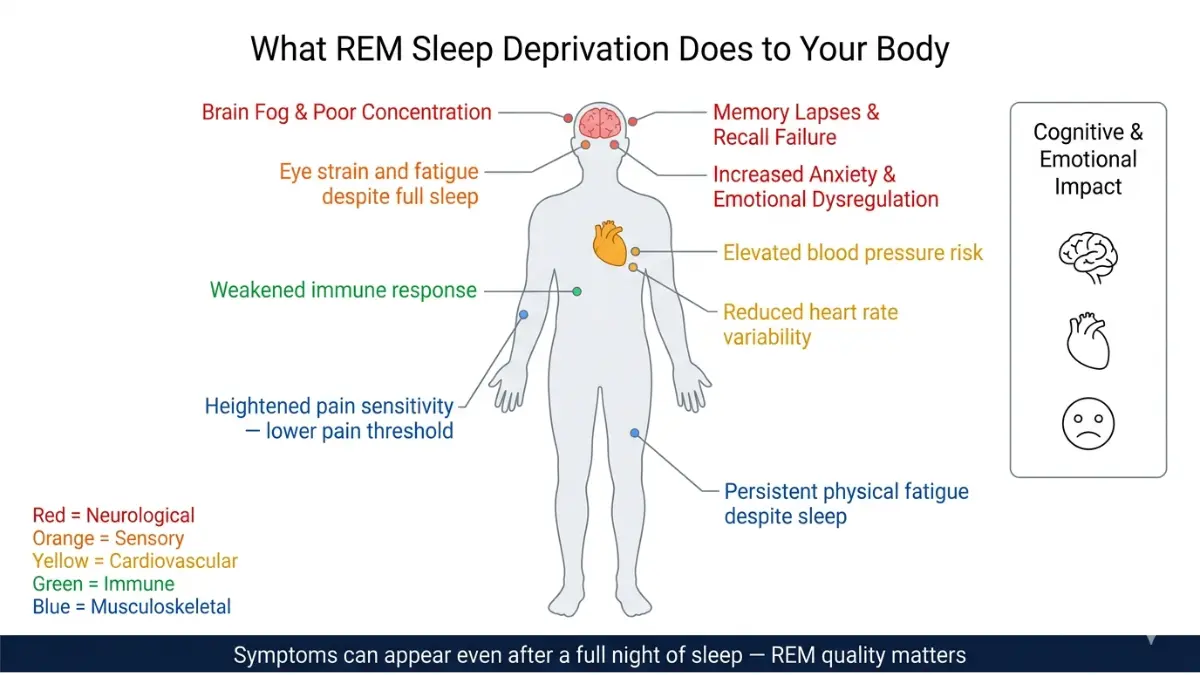
Bold callout: Waking up groggy after 8 hours? That is often a REM problem, not a sleep-length problem. The hours matter less than the quality and continuity of your REM cycles.
If you’re experiencing several of these symptoms, use our Symptom Checker to help identify whether an underlying condition may be contributing. For a deeper look at sleep-related conditions, our guide on sleep disorders: symptoms and causes provides a comprehensive clinical overview.
What Destroys REM Sleep — And What You Can Do Tonight
6 Common REM Sleep Killers
| REM Disruptor | How It Harms REM Sleep | What to Do Instead |
|---|---|---|
| Alcohol within 3–4 hours of bedtime | Suppresses REM in first half of night; causes fragmented REM rebound in second half | Stop alcohol intake at least 4 hours before sleep |
| SSRIs and many antidepressants | Clinically documented REM suppressants; reduce total REM duration | Discuss timing or alternatives with your prescribing physician |
| Blue light and screens before bed | Delays melatonin release, pushing back REM sleep onset | Screens off 60 minutes before bed; use blue-light blocking settings |
| Untreated sleep apnea | Repeatedly fragments REM cycles throughout the night | Get a sleep study; CPAP therapy dramatically restores REM |
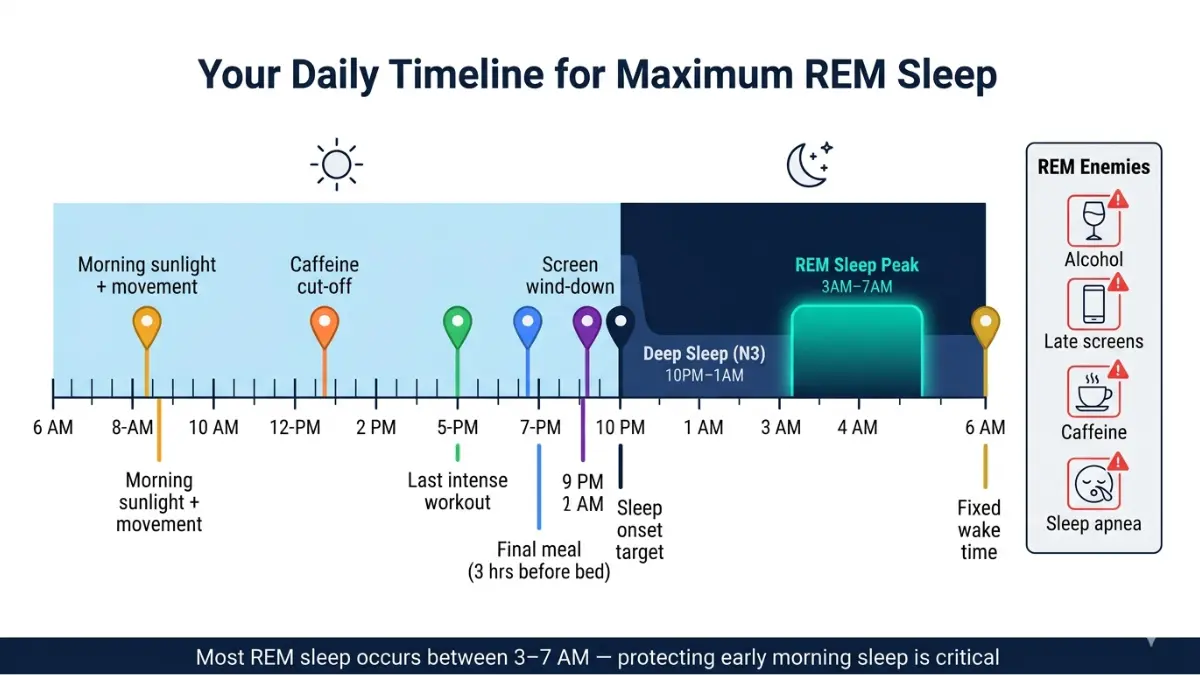
| Irregular sleep and wake times | Disrupts the circadian rhythm that schedules REM in the late sleep cycle | Fix your wake time first — it anchors your entire sleep architecture |
| Caffeine after 2 PM | Blocks adenosine receptors for 8–10 hours, reducing overall sleep pressure and REM quality | Cut off caffeine by early afternoon |
Note on medications: Many commonly prescribed antidepressants, benzodiazepines, and sedative sleep aids suppress REM sleep. According to National Institutes of Health sleep research, this is one of the most underappreciated causes of persistent poor sleep quality. Never discontinue prescription medications without consulting your physician, but do raise the conversation.
5 Evidence-Based Ways to Increase REM Sleep Starting Tonight
1. Protect the last 2 hours of your sleep window — at all costs. Most of your REM is concentrated in the final cycles. Extending sleep even 30–60 minutes beyond your usual wake time on weekends dramatically increases REM.
2. Set a fixed wake time and hold it daily. A consistent wake time anchors your circadian rhythm. Your brain learns when to schedule deep sleep and when to front-load REM cycles. This single habit has more evidence behind it than almost any other sleep intervention.
3. Treat sleep apnea if you have it. Obstructive sleep apnea is the single most common undiagnosed cause of REM deprivation in American adults. If you snore loudly, wake gasping, or feel excessively tired despite adequate sleep, ask your doctor for a sleep study referral.
4. Time your exercise correctly. Regular aerobic exercise increases deep sleep and supports overall sleep architecture, indirectly improving REM. However, intense exercise within 2 hours of bedtime can delay sleep onset. Our Heart Rate Zone Calculator can help you plan workouts at the right intensity and time of day. According to Mayo Clinic’s sleep hygiene guidance, morning aerobic exercise is optimal for supporting nighttime sleep quality.
5. Align meal timing with your sleep window. Late heavy meals fragment sleep by triggering digestive activity during the first REM cycles. If you practice intermittent fasting, our Intermittent Fasting Calculator can help you schedule your eating window to close 3–4 hours before bed — a practical way to protect early-night sleep quality.
Expert Insight + What This Means For You
Dr. Priya Nambiar, MD, Sleep Medicine and Neurology, mymedicineadvisor.com Expert Panel:
“In clinical practice, the most common mistake I see is patients counting hours of sleep and calling it adequate. What matters far more is whether those hours include sufficient, uninterrupted REM cycles. A person sleeping 6.5 high-quality hours with intact REM architecture will often function better than someone sleeping 9 fragmented hours with repeatedly disrupted REM.”
What This Means For You — 3 Actionable Takeaways
- If you sleep 7–8 hours but wake exhausted: The problem is almost certainly REM quality, not quantity. Investigate alcohol timing, screen habits, and sleep apnea risk.
- If you’re over 50: Declining REM is a natural part of aging — but protecting what you have through consistent sleep timing and treating sleep disorders becomes critically important for long-term brain health.
- If you’re managing mental health conditions: Depression, anxiety, and PTSD all have documented bidirectional relationships with REM sleep. Improving REM quality is a legitimate, evidence-supported component of mental health management.
For further reading on cognitive health and sleep’s role in brain function, explore our article on neuroplasticity and how to rewire your brain, or visit mymedicineadvisor.com for our full library of expert-reviewed health guides.
⚠️ Medical Disclaimer: This article is for educational purposes only and does not constitute medical advice. REM sleep disorders, sleep apnea, and related conditions require evaluation by a qualified healthcare provider. Always consult your physician before making changes to medications or if you are experiencing significant sleep disturbances.
Frequently Asked Questions: REM Sleep
1. What is REM sleep in simple terms?
REM sleep is the dreaming stage of sleep where your brain is highly active, consolidating memories and processing emotions while your body remains temporarily paralyzed.
2. How much REM sleep do adults need per night?
Most adults need approximately 1.5–2 hours of REM sleep per night, representing about 20–25% of total sleep time.
3. What happens to your body during REM sleep?
Your eyes move rapidly beneath closed lids, brain activity spikes, voluntary muscles become paralyzed, and vivid dreaming occurs. Emotional processing and memory consolidation are at their peak.
4. Is REM sleep the same as deep sleep?
No. Deep sleep (Stage 3, NREM) focuses on physical repair and immune restoration. REM sleep focuses on memory, emotions, and brain function. Both are essential — they serve different purposes.
5. What are the signs of not enough REM sleep?
Brain fog after a full night, mood swings, memory lapses, increased anxiety, persistent daytime fatigue, and heightened pain sensitivity are the most common warning signs.
6. What destroys REM sleep the most?
Alcohol close to bedtime, untreated sleep apnea, SSRIs, irregular sleep schedules, and late-night screen use are the leading disruptors of REM sleep quality.
7. Can alcohol affect REM sleep?
Yes, significantly. Alcohol suppresses REM sleep in the first half of the night and causes fragmented, lower-quality REM rebound in the second half — leaving you unrested even after a full night.
8. Does REM sleep improve memory?
Strongly. REM sleep is the stage during which the brain consolidates new information into long-term memory, prunes irrelevant connections, and strengthens learned skills.
9. Can lack of REM sleep cause depression or anxiety?
Yes. Disrupted REM sleep is both a symptom and a contributing factor in depression and anxiety disorders. The amygdala becomes hyperreactive without adequate REM, amplifying emotional distress.
10. How can I naturally increase my REM sleep?
Maintain a consistent wake time daily, avoid alcohol within 4 hours of bed, cut off screens 60 minutes before sleep, treat sleep apnea if present, and protect your final 2 sleep hours.
11. Is REM sleep linked to Alzheimer’s disease?
Yes. A 2025 UCSF study found delayed REM sleep onset is associated with 29% higher tau protein levels — a key Alzheimer’s biomarker. Every 1% reduction in REM sleep correlates with a 9% increase in dementia risk, per Neurology journal research.
About this content
How this article was put together: researched from recognised health sources, drafted with the help of AI tools, and edited by hand, with sources linked throughout.

Sameer Patel is the founder and editor of My Medicine Advisor. He is not a doctor or medical professional — before starting this site he worked in banking,…
Medical disclaimer
The content on MyMedicineAdvisor is provided for general informational and educational purposes only and is not a substitute for professional medical advice, diagnosis, or treatment. Health information on this website should not be used to diagnose, treat, cure, or prevent any condition without guidance from a qualified healthcare professional. Always seek the advice of your doctor, physician, or another licensed healthcare provider with any questions you may have regarding a medical condition, symptoms, medications, or treatment decisions.