
On This Page – Quick Medical Summary
Which kind of free A1C are you being offered?
A free A1C screening is not one thing. The phrase covers at least four different arrangements, and they differ in who is allowed one, in how the blood is collected, and — the part almost nobody explains — in what the result can actually be used for afterwards.
Find yourself here:
- You have a health plan and want to know if a screening test is free. Start with the insurance route below. The conditions that decide your answer are mostly not about your health.
- You have no insurance. Skip ahead to the section on income-based care. A federally funded route exists, it is set by two things only, and it is the section written for you.
- Someone has offered you a free test at a health fair, a pharmacy counter or a blood drive. The section on what each result settles is the one you need before you accept.
- You are arranging this for a parent or another adult. The questions in the second-to-last section work whether you are asking for yourself or for someone else.
- You already have a diabetes diagnosis. This page is not about your situation. A monitoring A1C — the one your clinician orders to see how treatment is going — is a different test order from a screening test, and it is not the one covered as free preventive care.
If you have insurance
The word that unlocks the answer is not “free” — it is “preventive.” What decides whether you pay is a short stack of conditions, and most of them are about your plan, your provider and the visit rather than about your health.
If you don’t
A federally funded route exists in every state and it runs on a different principle entirely. It asks two questions about your household, neither of them medical, and it cannot turn you away for being unable to pay.
ℹ️ Medical Disclaimer: This article explains how free and low-cost diabetes screening is arranged in the United States. It does not diagnose any condition, tell you whether you need testing, or interpret any result, and coverage rules, eligibility criteria and program availability all vary by plan, by state and over time. Consult a licensed primary care clinician about whether screening is appropriate for you, and your plan administrator or a certified enrollment assister about what your specific coverage pays for.
The four free routes, side by side
Each route below is a genuine way people obtain an A1C at no charge or reduced charge in the United States. What separates them is not quality of intent — it is the collection method and the paperwork behind it, and those two things decide what a clinician can do with the number afterwards.
What each route asks of you
The insurance route asks whether you meet published screening criteria and whether several conditions about your plan and provider are satisfied. The income route asks two questions about your household and nothing about your health at all. The community and donation routes usually ask almost nothing.
What each route gives you back
| Route | What it asks of you | How blood is collected | What the result can be used for |
|---|---|---|---|
| Preventive screening through a health plan | That you meet the published screening criteria, and that several plan conditions are met | Venous draw sent to a laboratory | A full diagnostic-grade result your clinician can act on, including confirmation steps |
| A federally funded health center | Your income and your family size. Nothing about your health | Venous draw sent to a laboratory | The same laboratory-grade result, at a discounted or fully discounted charge |
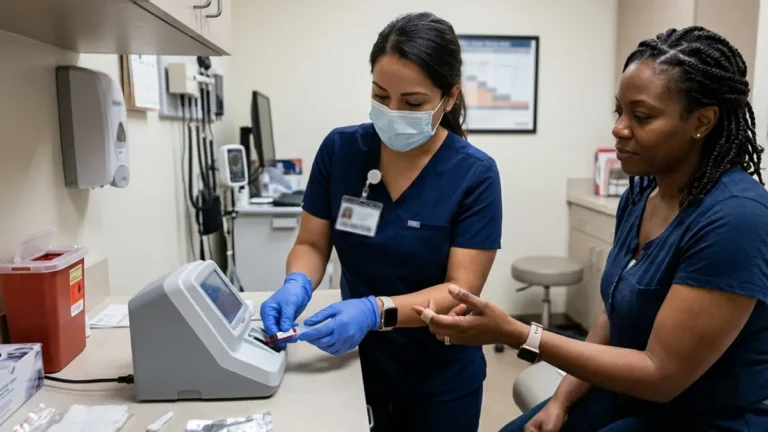
| A community or pharmacy screening event | Usually nothing | Fingerstick, read on the spot | An early signal only. Point-of-care results are not used to diagnose diabetes |
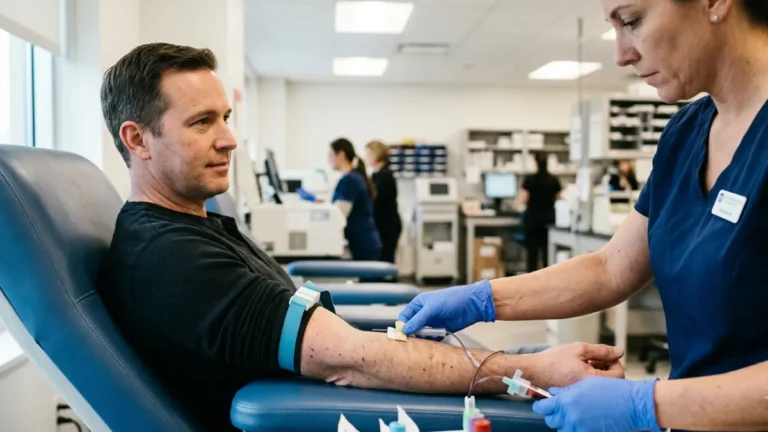
| An A1C attached to a blood donation | That you donate blood and the donation is successful | Taken from the donation sample | An early signal only, and one worth discussing with a clinician rather than acting on alone |
Route descriptions reflect how each arrangement is structured; the limits in the final column are sourced in the sections below.
Why the easiest free test settles the least
There is a pattern running through that table, and it runs the opposite way to what most people expect. The fewer conditions a free A1C attaches to, the less its result can be used for. The route with the most paperwork produces the only number a clinician can build a diagnosis on.
A fingerstick result and a lab result are not the same object
A drop of blood read by a handheld analyzer and a tube of blood analyzed by a certified laboratory are both real A1C measurements. They do not carry the same standing. NIDDK states plainly that point-of-care A1C results should not be used to diagnose diabetes, and that a diagnosis rests on a venous sample analyzed by a method certified for that purpose — guidance that has held on its A1C test page since its April 2018 review.
That is not a criticism of screening events. Catching a high number early is exactly what they exist to do. It simply means the free fingerstick is the beginning of the process, and our guide to why a fingerstick A1C is treated as a monitoring test explains what happens to that number next.
🩺 Physician Note: A screening result and a diagnosis are different objects in clinical practice, whoever performed the test. Current guidance is that a diabetes diagnosis is confirmed with a second measurement unless clear symptoms are present — which is why even a laboratory A1C in the diagnostic range usually leads to a second test rather than a prescription.
Free at a blood drive: what that result is and is not
Blood donation organizations have made A1C testing one of the most widely available free options in the country, and for someone without regular primary care it may be the first blood sugar information they have ever had. It is worth having. It also sits in an unusual relationship with the thing that earned it.
🔬 How It Works: An A1C reflects how much sugar has attached to your red blood cells, so it depends on two inputs — your blood sugar, and how long those cells have been in circulation. Conditions that shorten red cell survival or lower the average age of your red cells push an A1C reading downward regardless of which laboratory method is used, which is why recent blood loss and transfusion both appear on NIDDK’s list of things that change A1C levels.
Read that carefully, because it is easy to over-read. It does not mean a donation A1C is wrong, it does not tell you how much any individual result might shift, and it is emphatically not a reason to stop donating blood. Blood donation saves lives and nothing on this page should be taken as an argument against it. What it means is narrower and more useful: treat a donation A1C as a prompt to arrange a proper test, not as a substitute for one, and know that several ordinary conditions can move an A1C in either direction.
What a free result can do for you
Everything above is about what a free result cannot settle by itself. What it can do is considerable: it can tell you that a conversation is overdue, it can give a clinician a reason to order the confirmatory test, and it can turn an abstract worry into a specific next step. A number you would not otherwise have is worth more than a number you were too unsure to go and get, and our pillar guide to what an A1C result can and cannot settle covers how any A1C — free or billed — is read.
⚠️ Clinical Warning: A free screening result in the normal range is not a clearance. It reflects the sample taken on that day, by that method, and early type 2 diabetes frequently causes no symptoms at all. If you have symptoms — unusual thirst, unexplained weight loss, frequent urination, blurred vision — those are a reason to see a clinician now rather than to wait for the next free screening event.
The insurance route: what has to line up
If you have a health plan, the phrase you are looking for is not “free” — it is preventive. Most plans must cover a defined set of preventive services without a copayment or coinsurance, and diabetes screening for eligible adults is on that list, even if you have not met your deductible.
The conditions that are not about you
Here is the part that surprises people: whether you personally meet the screening criteria is only one of the conditions, and several of the others have nothing to do with your health. The federal Marketplace states that these services are generally covered at no cost when provided by an in-network provider, and adds plainly that $0 cost is not guaranteed in all cases. Separately, a plan can charge for the office visit itself where the preventive service was not the visit’s main purpose, and some older plan categories are not required to provide these benefits at all.
So a person can meet every clinical criterion and still receive a bill, for reasons that were decided before they walked in. Which criteria apply, and the fact that different authorities publish different ones, is covered in our guide to which screening criteria your plan follows. Younger adults are often told they are too young to need testing, and our guide to when that answer is the wrong one explains the routes that have no age term in them at all.
When a screening test stops being free
The single most common way a “free” test produces a bill is that it was not ordered as a screening test. Screening means looking for a condition in someone without symptoms; once a test is ordered to investigate a symptom or to monitor a known condition, it is a different kind of order and it is billed differently. That mechanism, and what it means for the price, is set out in why the order decides the bill.
This is not unique to the A1C. The same conditional-$0 structure, and the same confusion it causes, shows up across preventive care — our explainer on whether a colonoscopy is actually free walks through the identical mechanism for a different test, and what to do about an unexpected preventive bill covers your options if one arrives.
🩺 Physician Note: Medicare handles diabetes screening under its own preventive benefit with its own eligibility rules and its own frequency limit, rather than under the Marketplace rules described here. If you are covered by Medicare, that is a separate question with a separate answer.
No insurance: income and family size decide
If you have no coverage, almost everything written above is answered for somebody else. There is a route built for you, it is federally funded, and it works on a completely different principle: it does not ask about your health at all.
What a sliding fee discount is
Health centers funded under the federal Health Center Program are required to serve patients regardless of ability to pay, and to maintain a schedule of discounts adjusted according to what a patient can afford. That discount schedule is not charity offered case by case. It is a documented requirement of the program, with a full discount applying at or below the federal poverty guidelines, and it applies to laboratory work ordered as part of your care.
One caution so the word “free” does not mislead: a nominal charge may still be collected even at the fullest discount level. It is small by design, but it is not always nothing, and it is better to hear that here than at the desk.
What they can and cannot ask you for
Eligibility for the discount is determined by income and family size — those two factors. Your diabetes risk, your weight, your age and your medical history decide nothing about whether you qualify for the discount, though they may well decide whether a clinician there recommends the test.
This is the point where the two systems separate completely. Someone who fails every condition of the insurance route may sail through this one, and the criteria they would have checked for the first tell them nothing whatsoever about the second.
How to find a health center
Health centers operate nationwide, including in rural areas, and you do not need a referral to become a patient. Federal directories of funded health centers are searchable by location, and the same sliding scale applies whether you are uninsured or underinsured with a high deductible.
✅ Patient Action: When you call to book, say this: “I am uninsured and I would like to apply for the sliding fee discount.” Ask what proof of income and household size to bring to the first visit. The discount is applied, not automatic — it has to be requested and documented, and doing it before the appointment is far easier than afterwards.
The same route exists for other screening tests, and the practical steps are the same ones described in our guide to getting a colonoscopy without insurance.
What to ask before you accept a free test
Any free A1C offer, anywhere, in any month, can be assessed with a small number of questions. This is the part of this article worth keeping, because it does not expire and it does not depend on where you live.
The one question that does the most work
“Is this a fingerstick, or a blood draw sent to a laboratory?” That single answer tells you which row of the table above you are standing in, and therefore what the number you are about to receive will be able to settle. Ask it first; everything else is secondary.
Three more worth asking
- “Who receives the result, and how do I get a copy?” A result that reaches no clinician and no record is a number you will struggle to act on later.
- “If it comes back high, what happens next — and who orders that test?” Screening events vary enormously in whether they arrange follow-up or simply hand you a slip.
- “Is there any charge if I am not eligible?” Rare at community events, but worth thirty seconds.
CDC’s guidance on diabetes testing is consistent on the point that a screening result is something to discuss with your own clinician, whoever performed the test. How often screening is repeated afterwards is a separate question, answered in our guide to how often an A1C is checked.
If you are arranging this for someone else
Ask the same first question on their behalf, and ask whether they can receive a copy of the result directly — a free test whose result only reaches the person who cannot remember it a week later has not achieved much.
✅ Patient Action: Before you accept any free A1C, ask whether the sample is going to a laboratory. If the answer is no, plan on the result being a prompt rather than an answer, and ask your clinician for a laboratory test if the number is high.
What a free A1C cannot do for you
What we cannot tell you from here
We cannot tell you what is available in your town this month. Community screening programs are local, seasonal and constantly changing, and any list of events published on a national page is out of date the week after it goes up. That is why this article explains how to evaluate an offer rather than listing offers — the reasoning keeps working when the calendar moves.
We also do not recommend buying an at-home A1C kit as a way around the cost of screening, and the reason comes from the sources above rather than from preference. A result read on the spot by a handheld device is a point-of-care result with point-of-care limits, and CMS maintains a separate billing code for an A1C performed on a device cleared for home use — the billing system itself treats the two as different things. A mail-in kit analyzed by a certified laboratory is a different product from a fingerstick device, and the two should not be judged together, but neither replaces a test ordered by someone who will act on the result.
When not to wait for a free test
⚠️ Clinical Warning: If you have symptoms that suggest high blood sugar, or a clinician has already told you to get an A1C, waiting for a free screening event is the wrong call. Those are situations where the test is being ordered for a reason, which changes both its urgency and how it is billed. Arrange it through a clinician and, if cost is the obstacle, ask the health center route in this article about the sliding fee discount rather than delaying.
Frequently asked questions about free A1C screening
1. What does free A1C screening actually mean?
The phrase covers four different arrangements: preventive screening through a health plan, discounted care at a federally funded health center, community or pharmacy screening events, and A1C testing offered alongside blood donation. They differ in who qualifies, how blood is collected, and what the result can be used for. “Free” describes who paid, not what the number settles.
2. Who decides whether I qualify for a free A1C?
Two separate systems decide, and they share no criteria. The insurance route turns on published screening criteria plus conditions about your plan, your provider and the visit. The health center route turns on income and family size only and asks nothing about your health at all, so failing the first tells you nothing whatsoever about the second.
3. Can I get a free A1C test without insurance?
Yes, by more than one route. Federally funded health centers must serve patients regardless of ability to pay and must offer a sliding fee discount based on income and family size, with a full discount at or below the federal poverty guidelines. Community screening events are another option, though they usually produce a fingerstick result rather than a laboratory one.
4. Do I need a doctor’s order for a free A1C screening?
It depends on the route, and the difference matters: community and pharmacy screening events and donation-linked testing generally require no order at all. A laboratory A1C billed as preventive care through a health plan, or performed at a health center, is ordered by a clinician. Speak with a primary care clinician about which route suits your situation.
5. Is a free fingerstick A1C the same as a lab A1C?
No — both are real measurements, but they do not carry the same standing at all. NIDDK guidance is that point-of-care A1C results should not be used to diagnose diabetes, and that diagnosis rests on a venous sample analyzed by a certified laboratory method. A fingerstick result is an early signal worth acting on by arranging a laboratory test.
6. Can a free A1C result diagnose diabetes?
Only if it came from a venous sample analyzed by a certified laboratory method, and even then a diagnosis is normally confirmed with a second measurement unless clear symptoms are present. A fingerstick result from a screening event is not used for diagnosis. Take any high result to a clinician who can order the confirmatory test.
7. Does Medicare cover a free A1C screening?
Medicare covers diabetes screening under its own preventive benefit, with its own eligibility rules and its own frequency limit, separate from the Marketplace rules that apply to most other plans. What you owe also depends on whether your provider accepts assignment. Ask your provider’s billing office how the test will be submitted before it is done.
8. What is a sliding fee discount and who gets one?
It is a required discount schedule at federally funded health centers, adjusted according to a patient’s ability to pay. Eligibility is determined by income and family size, with a full discount at or below the federal poverty guidelines and a nominal charge still possible. Ask for it by name when booking, and bring proof of income and household size.
9. Why did I get a bill after a screening I was told was free?
Usually because one of the conditions was not met. The provider may have been out of network, the visit’s main purpose may not have been the preventive service, the plan may fall into a category not required to provide the benefit, or the test may have been ordered to investigate a symptom rather than as screening. Each is a different fix.
10. Should I ask my doctor to code my test as screening?
No — how a test is coded follows the reason it was ordered, and asking for it to be recorded differently is asking someone to misstate a claim on your behalf. The useful question is whether a screening test is due for you, which is a clinical question with a real answer. Ask your primary care clinician whether screening is indicated in your case.
11. If I get a free A1C at a blood drive, is that enough?
Treat it as a prompt rather than a conclusion. It is genuine information and worth having, but it is a screening signal, and blood loss is among the conditions that can shift an A1C reading downward. Take the result to a clinician who can arrange a laboratory test if it is high — and please do not let this stop you donating.
Your next step
If you have no insurance, call a federally funded health center and ask about the sliding fee discount by name. If you do have a plan, call the number on your card and use two words — preventive and screening — then ask what conditions apply to an in-network lab. If you have already taken a free test, take the result to a clinician who can decide whether a laboratory A1C is the next step, and read how any A1C result is interpreted before that appointment.
The sentence worth remembering is the one this whole page turns on: free describes who paid for the test, not what the result can settle. Both of those things matter, and they are not the same question.
About this content
How this article was put together: researched from recognised health sources, drafted with the help of AI tools, and edited by hand, with sources linked throughout.

Sameer Patel is the founder and editor of My Medicine Advisor. He is not a doctor or medical professional — before starting this site he worked in banking,…
Medical disclaimer
The content on MyMedicineAdvisor is provided for general informational and educational purposes only and is not a substitute for professional medical advice, diagnosis, or treatment. Health information on this website should not be used to diagnose, treat, cure, or prevent any condition without guidance from a qualified healthcare professional. Always seek the advice of your doctor, physician, or another licensed healthcare provider with any questions you may have regarding a medical condition, symptoms, medications, or treatment decisions.