
On This Page – Quick Medical Summary
Why your doctor ordered a test you have never heard of
Most people meet the fructosamine test the same way: it appears on a lab order, or on a results portal, with no explanation attached. If you were expecting an A1C, being handed something else can feel like a verdict — as though your body is complicated enough to need a special test.
It usually means something narrower and less alarming. It means the standard test would probably have given a misleading answer in your particular case, and someone noticed before it did.
You have likely arrived here from one of five places. If your A1C was described as unreliable, unexpected, or at odds with your glucose readings, Section 3 explains why that happens and what replaces it — and how to read an A1C result covers the test this one is standing in for. If you have a hemoglobin variant such as sickle cell trait, or another inherited red blood cell condition, that section covers you too.
If you have kidney disease or you are on dialysis, Sections 3 and 6 both matter, and Section 6 in particular carries something most articles on this topic leave out. If you are pregnant, or your treatment changed recently and someone wants a faster read on it, Section 3 explains the timing advantage.
If you are a family member helping someone manage diabetes and trying to work out what this result means for them, Section 7 has the questions worth taking to the appointment. And if you found this test for sale online and are considering ordering it yourself, Section 7 is written for you specifically — with the reason, not just the advice.
One thing is worth saying before anything else, because it shapes everything below. This test is a monitoring tool. It is not used to diagnose diabetes, and no current guideline supports using it that way.
ℹ️ Medical Disclaimer: This article explains laboratory testing for educational purposes only. It does not diagnose diabetes or prediabetes, does not interpret your individual result, and does not recommend, start, stop, or adjust any medication, supplement, or treatment. Laboratory reference ranges differ between laboratories, and insurance coverage differs between plans and policies. Decisions about which glucose test is appropriate for you, what your result means, and what should change as a result belong with a board-certified endocrinologist or the clinician managing your diabetes.
What a fructosamine test actually measures
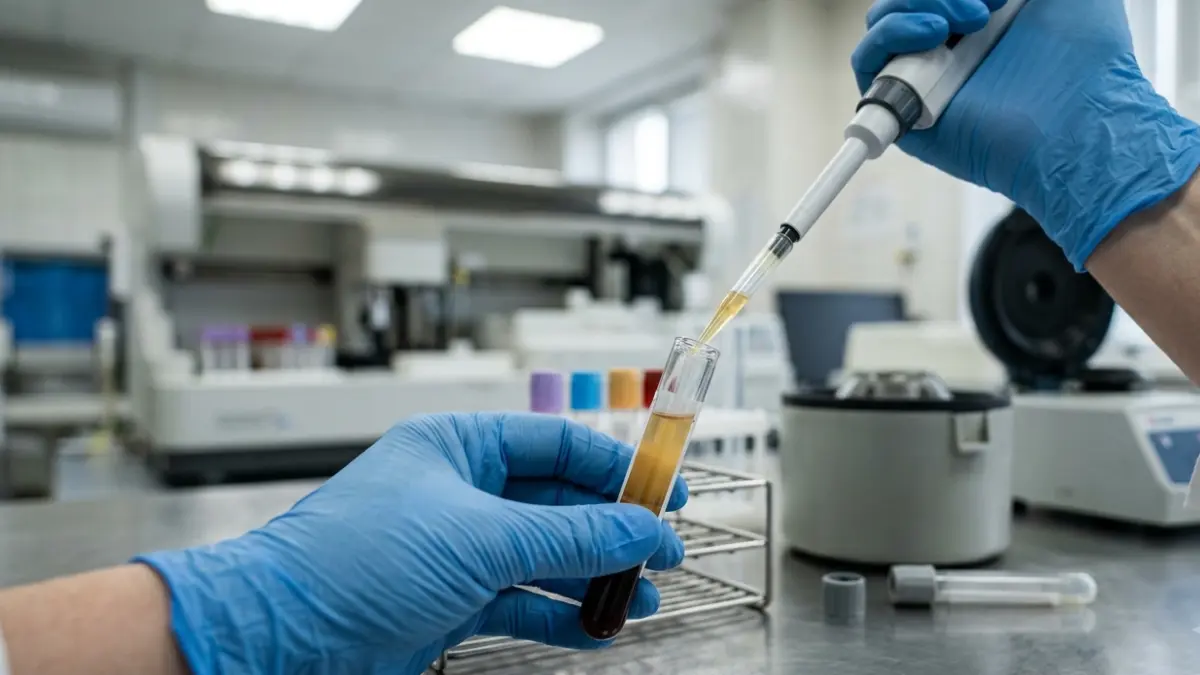
A fructosamine test measures sugar that has attached itself to the proteins floating in your blood. That is the whole idea, and it is the same chemistry as an A1C — only measured on a different carrier.
How sugar attaches to blood proteins
When glucose circulates, some of it binds to nearby proteins and stays there. The glycated serum protein that results is stable, and the more glucose there has been in the bloodstream, the more of it accumulates.
Because albumin is by far the most abundant protein in serum, a fructosamine measurement is predominantly a measurement of glycated albumin, according to the clinical reference chapter on fructosamine and glycated albumin maintained on the National Library of Medicine’s Bookshelf. Globulins and lipoproteins contribute a smaller share.
🔬 How It Works: An A1C measures glucose stuck to hemoglobin, which sits inside red blood cells. A fructosamine test measures glucose stuck to proteins dissolved in the fluid part of your blood instead. Same chemical process, different carrier — and the carrier is what decides how far back the test can see.
Why the window is weeks, not months
Red blood cells live around three or four months, which is why an A1C reflects your average blood glucose over roughly the past three months, as NIDDK explains.
Serum proteins are replaced far faster. Non-immunoglobulin serum proteins have a half-life of roughly 14 to 21 days, so a fructosamine result reflects only the recent past.
That shorter memory is the point, not a shortcoming. When a treatment changed three weeks ago, an A1C is still weighed down by the two months before the change, while a fructosamine result is not.
Why sources give different windows
Here is something no consumer article on this test will tell you: the length of that window is not agreed on.
| Source | Window it states |
|---|---|
| American Diabetes Association, Standards of Care in Diabetes 2026, section 6 | 2 to 4 weeks |
| NIH Bookshelf clinical reference chapter (updated September 2025) | 2 to 3 weeks |
| NIDDK, The A1C Test & Race/Ethnicity | about 3 weeks |
| Three major reference laboratory test directories | 1 to 3 weeks |
| A veterinary reference laboratory | 1 to 2 weeks |
Sources as named; each window verified on the source stated. The veterinary figure is included because those pages compete on this search term — it is accurate for the animals it describes, not for you.
These are not contradictions. Serum proteins do not all turn over at one speed, so different authorities round the same underlying biology differently — and an assay weighted slightly differently toward albumin will see slightly further back.
The practical version: think of a fructosamine test as covering the last few weeks, and do not treat any single number of weeks as exact.
When A1C stops working and this test steps in
An A1C is the standard test, and for most people it works. It stops being trustworthy in a specific and well-documented set of situations, and that is when a fructosamine test enters the picture.

The conditions that make an A1C unreliable
Because an A1C depends on red blood cells, anything that changes how long those cells live changes the result. NIDDK lists recent blood loss, sickle cell disease, erythropoietin treatment, hemodialysis, and transfusion among the conditions that can shift A1C levels, along with kidney failure, liver disease, and very low iron.
Inherited hemoglobin variants are the other major category. Most people who carry one have no symptoms and do not know, which is why the problem usually surfaces as a result that does not match everything else.
You can read more about how accurate the A1C test actually is and about what pushes an A1C falsely high. If a hemoglobin variant is the issue in your case, sickle cell trait and A1C results covers that specific situation.
⚠️ Worth being precise about, because it is commonly overstated: not every variant breaks every A1C test. NIDDK’s guidance for clinicians on hemoglobin variants states that reliable A1C tests are available for people with most hemoglobin variants, and that the question is which assay method a laboratory uses.
What replaces it, and who decides
When an A1C cannot be interpreted — or cannot be measured at all, as with some inherited variants — fructosamine or glycated albumin may serve as alternative measures of glycemic status, and these serum glycated protein assays reflect glycemia over the preceding two to four weeks rather than two to three months.
The 2026 Standards of Care put it as a recommendation: fructosamine or continuous glucose monitoring can be used for glycemic monitoring when an alternative to A1C is required. Note that the recommendation names two options, not one — this test is an alternative, not the alternative.
NIDDK also names it directly for readers with hemoglobin variants, describing the fructosamine test as an example of an alternative that shows average glucose levels over about three weeks and suggesting it as something for a doctor to consider.
Why this test cannot diagnose diabetes
No — a fructosamine test is not used to diagnose diabetes, and no current guideline supports using it or glycated albumin for diagnosing diabetes or prediabetes.
There is a mechanical reason, and it is more useful than the rule itself. Fructosamine values in people with well-controlled diabetes overlap the values seen in people without diabetes. A test whose ranges overlap between the two groups cannot separate them, which is exactly what a diagnostic test has to do.
So what does diagnose diabetes when an A1C is unreliable? In conditions with an altered relationship between A1C and blood glucose — hemoglobin variants, pregnancy, G6PD deficiency, HIV, hemodialysis, recent blood loss or transfusion, erythropoietin therapy — plasma glucose criteria rather than A1C should be used for diagnosis, and how A1C and fasting glucose compare covers that comparison in detail.
✅ Patient Action: Ask the clinician managing your diabetes — or a board-certified endocrinologist — one question at your next appointment: “Are we using fructosamine to monitor my control, and what are we using to diagnose or confirm?” Those are two different jobs, and this test only does the first one.
What your fructosamine number means, and what it does not
Most people arrive at this article holding a number and wanting to know whether it is good. That question has an honest answer, and the honest answer has two halves that must stay together.
The usual reported range
The reference range for fructosamine in people without diabetes is generally 200 to 285 µmol/L. Laboratories report in micromoles per liter, and your report will show that laboratory’s own range beside your value.
Higher values reflect more glucose exposure over the preceding weeks. A downward trend across repeated tests at the same laboratory is what a clinician is usually looking for.
Why the range does not separate people the way you would expect
Here is the half that gets left out, and it changes what the number is for.
📊 Clinical Data Point: The reference range for fructosamine in people without diabetes is generally 200 to 285 µmol/L — and the fructosamine values of people with well-controlled diabetes overlap the values of people without diabetes. Source: NIH Bookshelf clinical reference chapter on fructosamine and glycated albumin, updated September 2025, together with published clinical reference data on the overlap. This overlap is precisely why the test cannot be used to screen for or diagnose diabetes — and why a single value read against a published range tells you much less than it appears to.
Read that as a limit on the question, not a limit on the test. Fructosamine is good at showing whether your glucose exposure has gone up or down over recent weeks. It is not built to place you into a category.
Why your lab’s number is not your friend’s lab’s number
Unlike A1C, there is a serious lack of standardization across the different fructosamine assays. A1C results are standardized so that a value from one certified laboratory means the same thing as a value from another. Fructosamine results are not held to an equivalent common scale.
The consequence is concrete. Your fructosamine value should be compared against the range printed by the laboratory that produced it, and against your own previous results from that same laboratory — not against a number from a different laboratory, a different assay, or an article.
🩺 Physician Note: A common point of confusion is that “not standardized” sounds like “not accurate.” Those are different properties. The 2026 Standards of Care describe the performance of modern assays as typically excellent, meaning an individual assay can be precise and reliable. Standardization is about whether two different laboratories’ results sit on the same scale — and for fructosamine, they may not.
Why you cannot convert fructosamine into an A1C
Search for this and you will find conversion charts. They are the single most requested thing about this test, and they are the thing this section is going to take away — with a reason worth more than the chart.
What the conversion tables are actually doing
To convert one measurement into another honestly, two things have to exist. There has to be a common scale, so that the input means the same thing everywhere. And there has to be outcome data tying the converted number to real clinical risk, so the output means something.
For fructosamine to A1C, the first does not exist — that is the standardization problem from Section 4. Which means any published conversion is describing the relationship between one particular assay’s output and A1C, presented as though it applied to all of them.
There is a legitimate comparison to draw here. A1C does convert to an estimated average glucose, and how A1C relates to average blood sugar explains that conversion — including why even that one produces a range rather than a single number.
What the ADA publishes, and what it does not
The 2026 Standards of Care include a table of rough equivalents between A1C and mean glucose, drawn from an international study of average glucose. They do not publish a fructosamine-to-A1C conversion.
That absence is informative. The organization that recommends fructosamine as a monitoring alternative has not put a conversion behind it.
The same section of those Standards says something else that no consumer page on this test carries, and it is the most honest sentence available about fructosamine. Fructosamine and glycated albumin are highly correlated with each other in people with diabetes, and the performance of modern assays is typically excellent — however, there have been few clinical trials, and the evidence base supporting the use of these biomarkers to monitor glycemic status is much weaker than that for A1C.
Both halves matter. The assays work. The research base behind using them to steer treatment is thinner than A1C’s, which is why a fructosamine result is a conversation with your clinician rather than a number you act on alone.
Fructosamine, glycated albumin and continuous glucose monitoring compared
| Measure | What it reflects | Key clinical detail |
|---|---|---|
| Fructosamine | Total glycated serum protein over recent weeks | Widely available and inexpensive; affected by anything that alters serum albumin |
| Glycated albumin | Glycated albumin as a percentage of total albumin | Reported as a ratio, which reduces the albumin problem; reported as a better marker than A1C in chronic kidney disease and in people on dialysis |
| Continuous glucose monitoring | Interstitial glucose, continuously | Named alongside fructosamine in the 2026 monitoring recommendation; answers a different question — variability and time in range rather than an average |
Source: NIH Bookshelf clinical reference chapter (updated September 2025) and the 2026 Standards of Care, section 6.
Which of these is right for you is a clinical decision, not a preference. Continuous glucose monitoring and time in range covers the third row in depth.
If your report gives glucose values in units you do not recognize, the blood sugar unit converter converts between mg/dL and mmol/L. It does not convert A1C or fructosamine, and no tool honestly can.
What can make a fructosamine result wrong
The things that distort a fructosamine test are completely different from the things that distort an A1C, which is the point of switching. But they are real, and one of them may be in your kitchen cupboard.

When low albumin makes the result unreliable
Because the measurement rests largely on albumin, the amount of albumin you have changes it. Fructosamine is unreliable when serum albumin falls below 3.0 g/dL.
That happens in two families of conditions: those that reduce albumin production, such as liver cirrhosis, and those that cause albumin or protein loss, including nephrotic syndrome and protein-losing enteropathies.
🔬 How It Works: The test counts sugar attached to serum proteins. If you have less albumin circulating to begin with, there is less for sugar to attach to — so the total falls for a reason that has nothing to do with your blood sugar. The number drops without your control improving. Conditions that raise total protein, such as multiple myeloma and polyclonal gammopathies, can also influence the result. What causes low albumin covers that finding on its own.
The supplement that interferes with the assay
Fructosamine assays are influenced by temperature and by raised levels of reducing substances in serum — specifically vitamin C and bilirubin.
This is unusually actionable, and almost nothing written for patients mentions it. Major reference laboratories ask patients to hold ascorbic acid supplements for at least 24 hours before the sample is collected, because high levels interfere with the assay itself.
⚠️ Clinical Warning: If you take a vitamin C supplement, say so before this blood draw. Laboratories that run this assay commonly ask patients to hold ascorbic acid supplements beforehand, and whether that applies depends on which assay your laboratory uses — so ask your clinician or the laboratory rather than deciding the timing yourself. This is about supplement doses, not vitamin C in food.
When the backup test is the wrong backup
Now the part that matters most, and that no consumer article on this topic connects.
Kidney disease is one of the commonest reasons an A1C is called unreliable. Nephrotic syndrome is a kidney condition that lowers albumin — and low albumin is what makes fructosamine unreliable. So it is possible to be routed off one test for a reason that also compromises the other.
The answer is already in the literature, and it is why raising this is safe rather than alarming. Glycated albumin is reported as a percentage of total albumin rather than as an absolute concentration, which minimizes exactly this limitation — and it has been reported as a better marker than A1C for people with chronic kidney disease and those on hemodialysis and peritoneal dialysis.
If kidney function is part of your picture, what a high creatinine result can mean explains the marker most often involved.
✅ Patient Action: If you have kidney disease, liver disease, or any condition affecting protein levels, ask your endocrinologist or nephrologist directly: “Is my albumin high enough for a fructosamine result to be reliable, or should we be using glycated albumin instead?” That is a single question that decides whether the number is worth acting on.
Getting the test, paying for it, and why not to buy it yourself
The practical side of a fructosamine test is simple, with one wrinkle worth knowing before the bill arrives.
What the draw involves and whether you fast
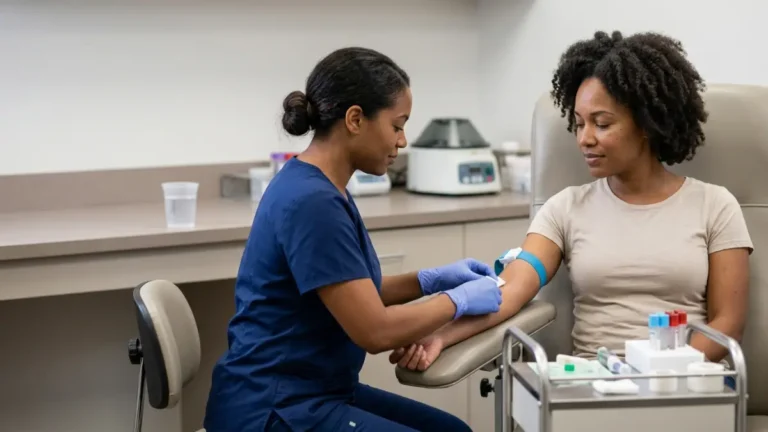
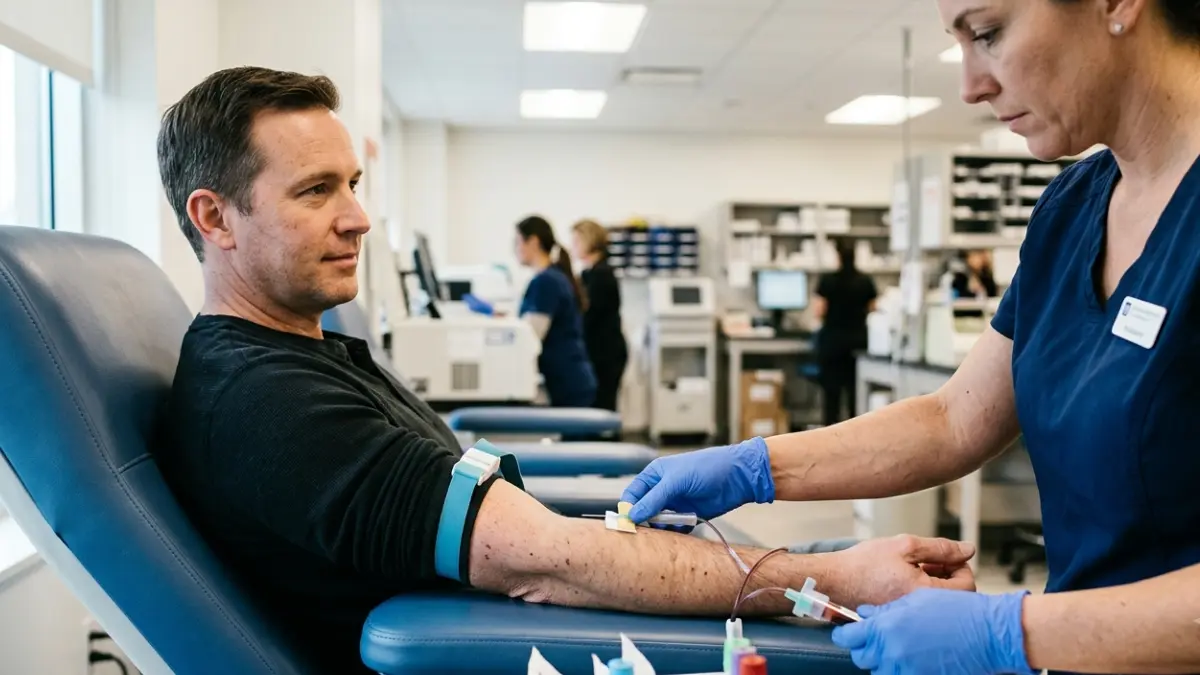
It is an ordinary blood draw from a vein, run on serum or plasma. Fasting specimens are not required, so you can eat normally beforehand — which is one genuine convenience over the glucose tests that do require it. If you are wondering about the other test, whether you fast for an A1C answers that separately.
Results typically come back within a day or two, depending on the laboratory.
Why coverage can differ from an A1C
Here is the wrinkle. A fructosamine test is billed under its own laboratory code, separate from the A1C code, and at least one major reference laboratory flags that code as subject to a Medicare limited-coverage policy that may require a signed advance beneficiary notice before the sample is collected.
That is not a warning that you will be charged. It means the coverage path for this test is not automatically the same as the one you are used to for an A1C, and the time to ask is before the draw rather than after the statement.
✅ Patient Action: Before the blood draw, ask the ordering office two things: whether a prior authorization or an advance beneficiary notice is needed for this specific test under your plan, and what diagnosis code is being submitted with it. Both questions take a minute at the desk and are far harder to resolve once a claim has been processed.
Why buying this test direct is the wrong move
Fructosamine is sold direct to consumers by online laboratory retailers, and at least one markets it as a way to detect insulin resistance early, citing a preprint — research that has not completed peer review. That same retailer’s own FAQ, further down the same page, correctly answers that the test cannot diagnose diabetes.
You do not need to resolve that contradiction, because the sources already have. No guideline supports fructosamine for diagnosing diabetes or prediabetes, and the ranges overlap between well-controlled diabetes and no diabetes — so a value bought without a clinician attached cannot tell a self-purchaser the thing they are hoping to learn.
There is also no at-home fructosamine device. What some services offer is in-home collection — a phlebotomist draws venous blood that still travels to a certified laboratory. That is a convenience in logistics, not a home test, and the two are worth keeping separate in your mind when comparing offers.
The test is genuinely useful. It is useful as part of a plan, ordered because something about your A1C could not be trusted, and read by someone who knows why it was ordered.
Common questions about the fructosamine test
1. What is a fructosamine test used for?
A fructosamine test is used to monitor blood glucose control over recent weeks in people with diabetes, particularly when an A1C would be unreliable or cannot be measured. It is a monitoring tool rather than a diagnostic one, and it is also useful when a treatment has recently changed and a faster read is wanted. Discuss with the clinician managing your diabetes why it was ordered for you.
2. What is a normal fructosamine level?
The reference range in people without diabetes is generally 200 to 285 µmol/L, though your laboratory prints its own range. That range is less informative than it looks, because fructosamine values in well-controlled diabetes overlap those in people without diabetes. Compare your value against your own previous results from the same laboratory, and ask your clinician what it means for you.
3. Can a fructosamine test diagnose diabetes?
No — no current guideline supports using fructosamine or glycated albumin to diagnose diabetes or prediabetes. The mechanical reason is that values in well-controlled diabetes overlap values in people without diabetes, so the test cannot separate the two groups, and when an A1C is unreliable it is plasma glucose criteria that diagnose diabetes. Any diagnosis of diabetes belongs with your clinician.
4. How do you convert fructosamine to A1C?
You cannot do this reliably — unlike A1C, fructosamine assays lack a common standard across laboratories, so a conversion built on one assay does not transfer to another. The 2026 Standards of Care publish A1C-to-mean-glucose equivalents but no fructosamine conversion at all. Treat published conversion charts with caution and ask your clinician to interpret the actual value instead.
5. How far back does a fructosamine test measure?
A few weeks, but the exact window is not agreed across sources. The 2026 Standards of Care state two to four weeks; a current NIH clinical reference states two to three weeks; NIDDK says about three weeks; laboratory directories often say one to three weeks. The underlying reason is that serum proteins have a half-life of roughly 14 to 21 days and do not all turn over at one speed.
6. Do you need to fast for a fructosamine test?
No — fasting specimens are not required for a fructosamine test, so you can eat and drink normally beforehand. It is an ordinary venous blood draw run on serum or plasma, taking the same few minutes as any other. This is one practical advantage over glucose tests that do require fasting, though it does not change what the test can and cannot tell you about your diabetes.
7. Why would a doctor order fructosamine instead of A1C?
Because something makes an A1C unreliable in your case. Conditions that alter red blood cell lifespan — recent blood loss, sickle cell disease, dialysis, transfusion, erythropoietin treatment — and inherited hemoglobin variants all affect A1C, while a fructosamine test does not depend on red blood cells at all. It is also used when a recent treatment change needs a faster read than an A1C can provide.
8. What makes a fructosamine result unreliable?
Anything that changes your serum proteins will change it. Fructosamine is unreliable when serum albumin falls below 3.0 g/dL, which occurs in liver cirrhosis, nephrotic syndrome and protein-losing enteropathies, and conditions raising total protein such as multiple myeloma also affect it. Vitamin C supplements and raised bilirubin interfere too, so ask your clinician whether your albumin makes this test appropriate for you.
9. Is fructosamine the same as glycated albumin?
Not quite — fructosamine measures all glycated serum proteins, and because albumin is the most abundant, it is predominantly a measure of glycated albumin. Glycated albumin is measured specifically and reported as a percentage of total albumin, which reduces the problem of varying albumin levels considerably. Which one is appropriate for you is a clinical decision worth raising with your clinician.
10. Does vitamin C affect a fructosamine test?
Yes — fructosamine assays are influenced by raised levels of reducing substances in serum, including vitamin C and bilirubin. Major reference laboratories ask patients to hold ascorbic acid supplements for at least 24 hours before the sample is collected. Whether this applies depends on the assay your laboratory uses, so tell the ordering clinician what supplements you take rather than adjusting timing yourself.
11. Is a fructosamine test covered by insurance?
Coverage differs from an A1C. The test is billed under its own laboratory code, and at least one major reference laboratory flags that code as subject to a Medicare limited-coverage policy that may require a signed advance beneficiary notice. Ask the ordering office about prior authorization and the diagnosis code being submitted before the blood is drawn.

What to do with your fructosamine result
A fructosamine test does a narrower job than an A1C, and the narrowness is the point. It looks back weeks instead of months, it does not depend on your red blood cells, and it answers a question about direction rather than category.
Three questions turn this into a useful appointment: are we using this to monitor, or to diagnose? Is my albumin normal enough for this result to be reliable? And should we be comparing my results only against this laboratory’s own range?
If you want the wider context for the test this one replaced, what an A1C result can and cannot tell you is the place to start. Bring your actual report to the conversation — the number matters far less than the trend it sits in.
About this content
How this article was put together: researched from recognised health sources, drafted with the help of AI tools, and edited by hand, with sources linked throughout.

Sameer Patel is the founder and editor of My Medicine Advisor. He is not a doctor or medical professional — before starting this site he worked in banking,…
Medical disclaimer
The content on MyMedicineAdvisor is provided for general informational and educational purposes only and is not a substitute for professional medical advice, diagnosis, or treatment. Health information on this website should not be used to diagnose, treat, cure, or prevent any condition without guidance from a qualified healthcare professional. Always seek the advice of your doctor, physician, or another licensed healthcare provider with any questions you may have regarding a medical condition, symptoms, medications, or treatment decisions.