
On This Page – Quick Medical Summary
Why your team wants an A1C before surgery
If you have a surgery date and someone has mentioned your A1C, you are here for one number. There is now a named goal, it comes from a guideline you can look up, and it is looser than most of what you will find online — but one thing matters more than the number.
⚠️ Clinical Warning: Do not start, stop, or change any diabetes medicine because of something you read on this page or anywhere else online. Several of these medicines are deliberately adjusted around an operation, and the timing depends on the drug, the procedure and you. Tell the team that booked your surgery everything you take, including anything bought without a prescription, and let them make the changes.
That is not a formality. National guidance on what to tell your provider before surgery if you have diabetes routes every medicine question back to the people running your operation, and so does this page.
You have a date and a number you’re worried about
Read the next two sections. The goal is real, it is attributed, and it carries a qualifier written into the recommendation itself.
You’re arranging surgery for someone else
The same sections apply, and the questions in the final section are written so you can ask them on someone’s behalf.
Your pre-op A1C came back raised and you have no diabetes diagnosis
That is a different situation from the one this page is built for. A raised result without a diagnosis is a conversation with your regular clinician, and what an A1C result can and cannot tell you is the better starting point.
ℹ️ Medical Disclaimer: This article is general education about a preoperative laboratory goal — it does not diagnose diabetes, set a target for you, decide whether your operation should proceed, or tell you how to take or stop any medicine, including insulin and oral diabetes medicines. Decisions about surgical timing, glycemic targets, medication adjustment and anesthesia belong to your surgeon, your anesthesia provider and the clinician who manages your diabetes. Consult them before acting on anything here.
The A1C goal a 2026 guideline added
For adults with diabetes having elective surgery, the Standards of Care in Diabetes—2026 recommend a preoperative A1C goal below 8%, measured within three months of the operation, and applied with an individualized weighing of risks and benefits for each person.
📊 Clinical Data Point: Preoperative A1C goal below 8% within three months of elective surgery, with a perioperative blood glucose range of 100–180 mg/dL before, during and after the procedure — Source: American Diabetes Association, Standards of Care in Diabetes—2026, Section 16, Recommendations 16.14 and 16.15.
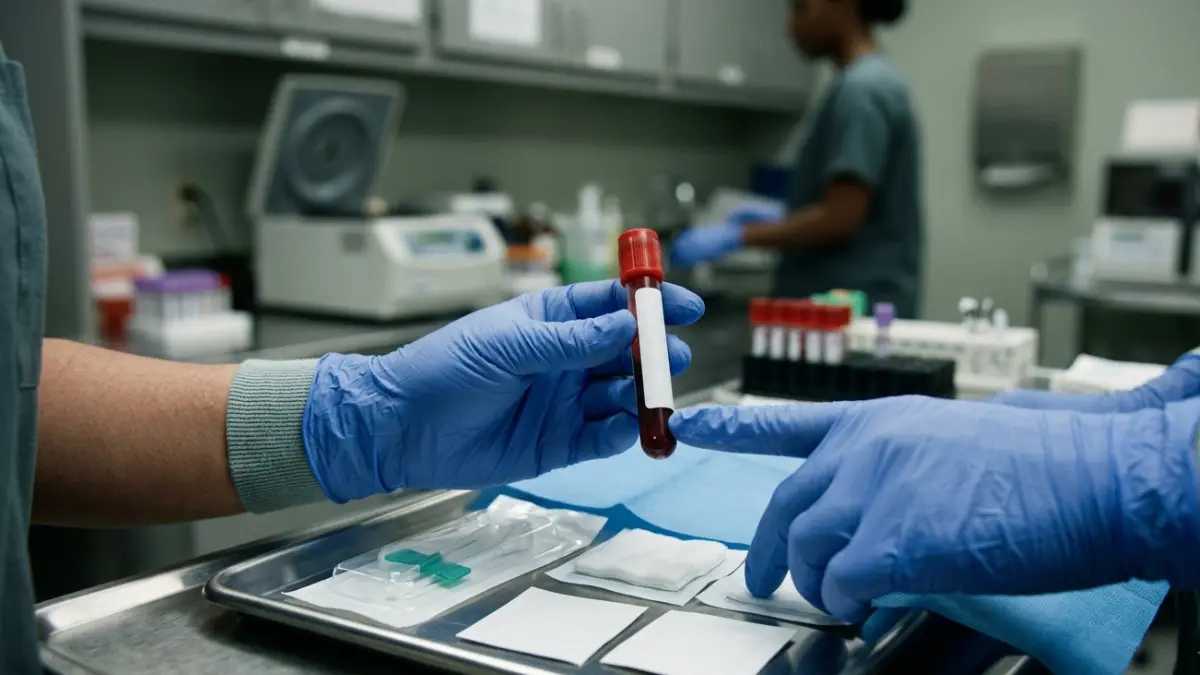
What Recommendation 16.14 actually says
Two things, and the second is usually dropped when the first gets quoted. The goal is below 8%; the recommendation then states that it is to be applied with an individualized assessment of risk against benefit. That is the guideline declining to treat its own number as a pass mark.
A second route is offered for people using continuous glucose monitoring: a 14-day glucose management indicator below 8%, or time in range above 50%, may be used instead.
Why “within three months” is part of the goal
The window is not administrative. It exists because of what the test physically measures.
🔬 How It Works: Glucose in your blood attaches to hemoglobin inside red blood cells, and stays attached for the life of that cell. Because red cells circulate for around three months, an A1C reflects roughly that period of average glucose — which is why a result older than three months no longer describes the person arriving for the operation. If your last one predates that window, your team may repeat it; how often an A1C is normally repeated covers the usual intervals.
Why this is new to the Standards but not new to practice
The 2026 edition added two perioperative recommendations where the Standards previously had none, and the ADA’s own summary of what changed for 2026 lists both as additions. The target itself is older: the Endocrine Society suggested the same preoperative figure in 2022 and the ADA co-sponsored that guideline, so what changed in 2026 is where the number lives, not that it exists. The full text sits in the 2026 Standards of Care section on diabetes care in the hospital, and why A1C targets are individualized explains the principle it invokes.
Why you keep finding a different number
Search this question and you will meet at least four figures presented as the pre-op A1C. They disagree because they answer slightly different questions, and almost none of the pages carrying them has been updated since the 2026 recommendation appeared.
A general A1C goal is not a surgical one
The glycemic target most often quoted for adults with diabetes describes day-to-day management over years. It was not written about operations. When that figure is repeated on a pre-op page it arrives stricter than the surgical guidance and with none of the surgical reasoning attached.
Hospitals and surgeons set their own requirements
Individual hospitals and surgical services do work to their own preoperative thresholds, and a service that performs a particular kind of operation tuning its own protocol is ordinary practice rather than a mistake. It does mean a national figure cannot tell you what your service uses. That is a question for the people holding your file.
Which A1C your number came from
A result from a fingerstick device at a clinic and one from a venous sample sent to a laboratory are not automatically interchangeable, and the difference matters when a number is being read against a threshold. A fingerstick A1C taken at the clinic explains what that kind of result is built for.
Why aiming lower is not automatically better
If your number is near the goal, the instinct is to push it further down before the date. The guidance that sets the goal says the opposite, unusually directly.
What the guideline says about stricter goals
The 2026 Standards state plainly that stricter perioperative glycemic goals are not advised, because they may not improve outcomes and carry risks of their own. Aiming below the goal is not a safer version of meeting it. The narrative alongside the recommendation puts the supporting evidence in a band between 7% and 8% — and that band is a preoperative window drawn from surgical outcome data, not the general management target discussed in the previous section.
How strong the evidence behind the goal actually is
Both bodies that name this figure publish their own rating of the evidence behind it, and neither rating is strong.
| Guideline | Preoperative A1C goal | How that body grades its own evidence | Key clinical detail |
|---|---|---|---|
| ADA, Standards of Care in Diabetes—2026 (Rec 16.14) | Below 8%, from a result within three months of elective surgery | Grade C — supportive evidence from poorly controlled or uncontrolled studies. The CGM alternative carries Grade E: expert consensus or clinical experience, with no clinical-trial evidence | The recommendation carries its own qualifier — it is to be applied with an individualized assessment of risk against benefit |
| Endocrine Society clinical practice guideline, 2022 (Rec 5.1) | Below 8%, alongside preoperative blood glucose of 100–180 mg/dL | A weak (conditional) recommendation on very low certainty evidence, in the guideline’s own published notation | Its Recommendation 5.2 adds a fallback for when the A1C goal is not feasible |
Source note: American Diabetes Association, Standards of Care in Diabetes—2026, Section 16 (Recommendations 16.14, 16.15) and the ADA’s published evidence-grading definitions; Endocrine Society clinical practice guideline on managing hyperglycemia in hospitalized adults, 2022 (Recommendations 5.1, 5.2). The grades shown are each body’s own rating of the evidence behind its own recommendation.
🩺 Editor’s Note: A weak grade is not a reason to ignore a recommendation — it is the reason the recommendation is written with an individualization clause rather than as a cut-off. Current guidance emphasizes that the Standards of Care are not intended to displace clinical judgment and are meant to be applied with adjustment for the person in front of the clinician. That is why two surgical teams can reasonably reach different decisions about the same number.
Why chasing a decimal point does not work
An A1C describes about three months, so it does not move quickly in response to a fortnight of effort — how quickly an A1C can actually move sets out what is realistic. There is also measurement to account for: a single result carries a margin, which how precise a single A1C result is explains. Chasing a tenth of a percentage point is chasing something smaller than the test’s own precision.
If the goal is out of reach before your date
If your A1C is above 8% and your operation is in three weeks, the honest answer is that a documented path already exists for exactly this situation — and it is the part of the guidance that almost never reaches patients.
There is a documented alternative
Where targeting an A1C below 8% is not feasible before an elective procedure, the Endocrine Society’s guidance suggests working instead to a preoperative blood glucose range of 100–180 mg/dL. The 2026 Standards name the same range for the perioperative period, monitored before, during and after the operation.
That shifts the lever from a measure that moves over months to one that responds within days, and it is a clinical decision made by your team rather than something to elect on your own. If your result is well above the goal, a result well above the goal covers what usually happens next.
Elective is not the same as optional
“Elective” in this guidance means scheduled rather than emergency — it does not mean the operation does not matter. The Endocrine Society’s recommendations are explicitly scoped to procedures where it is reasonable to allow time to work toward a target. Urgent surgery is not held up while an A1C is optimized.
Who actually makes the call
Your surgeon and anesthesia provider decide whether an operation proceeds, in discussion with whoever manages your diabetes. Some teams will delay when blood sugar is high on the day of surgery, which is a check on that morning’s reading rather than on your A1C. The two get merged constantly and they are not the same measurement.
✅ Patient Action: Call the pre-operative or anesthesia clinic and ask: “My A1C is above the goal and my date is in [N] weeks — do you want me working toward the A1C, or toward the day-of blood glucose range?” Ask the same question of the clinician who manages your diabetes, so both are working to the same plan.
What else your pre-op blood work checks
An A1C rarely arrives alone. Understanding what sits around it makes it easier to see why this one test attracts a goal when most of the others do not.
The tests that usually come with it
A pre-operative checkup is usually done within the month before surgery, and the checkups and tests that usually happen before an operation lists the common blood work: a complete blood count together with kidney, liver and blood sugar tests. That same guidance notes that someone with diabetes, or someone whose pre-op blood sugar was raised, may be referred to a diabetes specialist before the operation.
Why routine panels are ordered selectively
This is where our own pages need reading together: blood panels are ordered selectively rather than automatically before low-risk surgery in an otherwise healthy person, and the reasoning is in the metabolic panel before surgery and the blood count before surgery. An A1C in someone who already has diabetes is a different act: it is condition-specific, it has a named guideline recommendation behind it, and the pre-op guidance above routes that person to a specialist rather than away from testing. Screening a healthy person and assessing a known condition are not the same decision.
If you have no diabetes diagnosis and your A1C came back raised
A raised result in someone with no diagnosis is not settled by a surgical goal, and diagnosing diabetes is a separate process with its own confirmation requirements. A raised A1C without a diagnosis sets out what usually follows. Raise it with your regular clinician as well as the surgical team.
What to ask the team that booked your operation
Everything above turns into one phone call. These four questions are ours — no institution publishes them as a list — and each one is answerable by the people holding your file.
Four questions worth asking
- Which preoperative A1C figure does this service work to, and is it the guideline’s or your own?
- Does my current result change my date, and who makes that decision?
- Would you rather I worked toward the A1C or toward day-of blood glucose in the time we have?
- Which of my medicines change before the operation, and when do those changes start?
Why we don’t recommend a home A1C kit or a quick-fix product
We do not link or recommend a home A1C test kit, a supplement, or any “lower your A1C fast” product on this page, and the reason is the guidance this article is built on. That guidance tells a pre-operative reader to route every medicine and every change through their surgical team. Selling something beside that instruction would contradict it, so the recommendation is absent by choice rather than by oversight.
What to bring to the pre-op appointment
Bring a written list of everything you take, including anything bought without a prescription, and your most recent A1C with its date on it. If you use continuous glucose monitoring, bring the report rather than a summary from memory. If cost is the reason a repeat test has not happened, what an A1C is billed as covers how the charge is usually generated.
A1C before surgery: your questions answered
1. What A1C do you need before surgery?
The 2026 Standards of Care recommend a preoperative goal below 8% from a result within three months of elective surgery, applied with an individualized assessment of risk against benefit. That figure is a planning target for your team, not a pass mark, and your hospital may work to a different one. Ask your surgical team which number applies to your A1C before surgery.
2. Will my surgery be canceled if my A1C is too high?
Not automatically — a high A1C before surgery is one input among several, and the guideline naming the goal says it should be applied with an individualized assessment. Some teams do delay an operation when blood sugar is high on the day itself, which is a separate check from the A1C. Ask the team that booked your operation what their process is.
3. How far before surgery is the A1C measured?
The recommendation specifies a result from within three months of elective surgery. That window exists because the test reflects roughly the preceding three months, so an older value no longer describes your current glucose control. If your last A1C before surgery is older than that, your team may simply repeat it.
4. Is a lower A1C always better before an operation?
No. The same 2026 guidance states that stricter perioperative glycemic goals are not advised, because they may not improve outcomes and carry risks of their own. Aiming below the goal is not a safer version of meeting it, and a very low A1C before surgery raises separate questions your clinician would want to look at.
5. What if I cannot lower my A1C before my date?
A documented path exists. Where the A1C goal is not feasible, published guidance suggests working to the preoperative blood glucose range of 100–180 mg/dL instead. That moves the lever from your A1C before surgery, which shifts over months, to day-to-day glucose, which responds faster — discuss it with the clinician who manages your diabetes.
6. Does an A1C before surgery replace a blood sugar check?
No, because the two answer different questions and are not interchangeable. Your A1C before surgery describes roughly three months of average glucose, while the readings taken on the morning of your operation describe that moment only. Current guidance names both separately: a preoperative A1C goal, and a perioperative glucose range monitored before, during and after the procedure.
7. Do I need an A1C before surgery if I don’t have diabetes?
Usually not as a routine screen. Blood work before an operation is ordered selectively rather than automatically, and an A1C before surgery is most relevant when diabetes is already known or a pre-op blood sugar reading came back raised. A raised result without a diagnosis is a separate conversation with your regular clinician.
8. Can I use my CGM instead of an A1C before surgery?
The 2026 recommendation allows an alternative: a 14-day glucose management indicator below 8%, or time in range above 50%. That option carries the guideline’s lowest evidence grade, meaning expert consensus rather than trial evidence. Whether it substitutes for an A1C before surgery in your case is a decision for your surgical and diabetes teams.
9. Does an emergency operation use the same A1C goal?
No — the recommendation is written for elective surgery, where there is time to work toward a target. Emergency care is not held up while an A1C before surgery is optimized; glucose is managed around the procedure instead. If your operation is urgent, this goal is not the frame your team will be working within.
10. Should I change my diabetes medicine before surgery?
Not on your own. Several diabetes medicines are adjusted around an operation, and the timing differs by drug, by procedure and by person, which is why the decision belongs to your surgical team. Tell them everything you take, including anything bought without a prescription, when you discuss your A1C before surgery.
11. Who decides whether my A1C before surgery is acceptable?
Your surgical team decides, together with the clinician who manages your diabetes. The guideline supplies a goal and then explicitly leaves its application to individualized assessment of risk against benefit, which means no national figure can settle an individual case. Ask directly whether your A1C before surgery changes your date, and who is making that call.
What to do with your number this week
You are looking for one figure and there is now a real one: below 8%, within three months, for elective surgery — attached to a qualifier that says it is to be weighed rather than applied. If you are above it, that is a conversation about which lever to pull in the time you have, not a verdict on your operation. Your surgical team and your diabetes clinician make that call together.
Call the office that booked your surgery this week and ask which figure they work to and whether yours changes anything. Take your medicine list with you, and leave every change to them. Our A1C test guide covers what a single result can and cannot tell you if you want the background first.
About this content
How this article was put together: researched from recognised health sources, drafted with the help of AI tools, and edited by hand, with sources linked throughout.

Sameer Patel is the founder and editor of My Medicine Advisor. He is not a doctor or medical professional — before starting this site he worked in banking,…
Medical disclaimer
The content on MyMedicineAdvisor is provided for general informational and educational purposes only and is not a substitute for professional medical advice, diagnosis, or treatment. Health information on this website should not be used to diagnose, treat, cure, or prevent any condition without guidance from a qualified healthcare professional. Always seek the advice of your doctor, physician, or another licensed healthcare provider with any questions you may have regarding a medical condition, symptoms, medications, or treatment decisions.