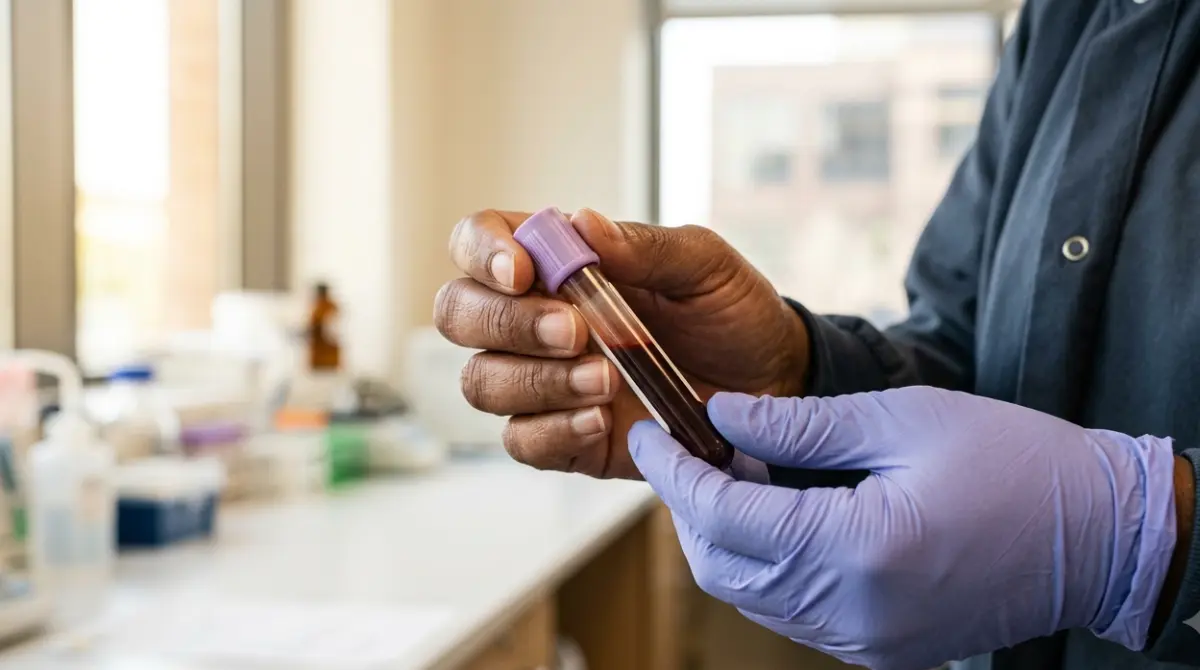

On This Page – Quick Medical Summary
Your AST is high and you drink: the short answer first
Alcohol is a common reason an AST blood test comes back high, and the number can come down. The AST already in your blood clears within about a day, but if heavy drinking has injured the liver, it can stay raised for 10 days or more.
Find your situation in 20 seconds
- One heavy night before the test: see what changes how fast AST falls.
- Cutting back after long-term heavy drinking: start with the recovery timeline.
- Yellow eyes, confusion or vomiting blood: see urgent care signs now.
The one-line answer
Expect days to weeks, not hours, and let your clinician set the retest date. Still unsure what a high AST result means? Start there.
ℹ️ Medical Disclaimer: This article explains AST results, alcohol-related liver injury, retesting, withdrawal and urgent warning signs for general education only; it does not diagnose, treat, prescribe or replace a clinician. Recovery timelines are study averages, not promises, and lab ranges vary. If you drink heavily, do not stop suddenly without medical advice, and seek same-day care for yellow skin or eyes, confusion, vomiting blood or black stools. Check any decision with a board-certified primary care physician, gastroenterologist or hepatologist.
Why alcohol pushes AST up more than ALT
Alcohol tends to raise AST more than ALT because heavy drinking lowers vitamin B6, which helps keep ALT up, while injured liver cells leak AST. MedlinePlus’s guide to the AST blood test lists a typical range of 8 to 33 U/L; your lab’s own range applies.
Where AST comes from besides the liver
AST also sits in heart and muscle, so hard exercise can raise it, while ALT stays mostly in the liver.
The vitamin B6 reason AST outruns ALT

🔬 How It Works: Both enzymes rely on pyridoxal-5′-phosphate, a form of vitamin B6. Low levels pull ALT down more than AST, though a De Ritis ratio review notes B6 is not the whole story.
AST above ALT fits alcohol but does not prove it; see how the AST/ALT ratio works.
How long until AST normalizes after you stop drinking
AST itself clears quickly: half leaves the blood in about 17 to 18 hours, versus 36 to 47 hours for ALT. After heavy drinking, though, injured liver cells keep releasing it, so AST usually falls over days to weeks.
AST clears fast, but injury keeps refilling it
A short half-life helps only once the injury stops.
What a 10-day detox study actually showed
In a study tracking liver tests during alcohol detox, average AST fell from 109.7 to 73.6 U/L over 10 days, still well above 31.4 U/L in healthy volunteers. Treat this small study as a direction, not a deadline; how ALT changes after you quit alcohol covers ALT.
Alcohol marker recovery table
| Marker | How fast it clears | Back to normal after heavy drinking | Key Clinical Detail |
|---|---|---|---|
| AST | Half-life about 17–18 hours | Still raised at day 10 | Responds fastest |
| ALT | Half-life about 36–47 hours | Can lag behind AST | More liver-specific |
| GGT | Half-life 14–26 days | 2–6 weeks without alcohol | Most-used alcohol marker |
| MCV | Slow | About 3 months | Reflects long-term drinking |
Sources: StatPearls; Botros & Sikaris 2013; Kethawath et al. 2020; NIAAA; Current Psychiatry 2017.
What changes how fast your AST comes back down
Speed depends mostly on how long you drank heavily and how much injury resulted. A biomarker review lists AST as rising after about 3 to 7 days of heavy drinking, so one night is less likely to move it much.
One heavy night vs long-term heavy drinking
- After a one-off: AST’s short half-life lets a brief rise fade quickly.
- After months or years: The American College of Gastroenterology (ACG) describes alcohol-associated liver disease as running from silent early injury to advanced disease and calls stopping alcohol crucial.
When AST stays high after weeks without alcohol
Another cause, such as fatty liver, a medicine or viral hepatitis, may be adding to it.
✅ Patient Action: Ask your primary care clinician or gastroenterologist: “If my AST hasn’t dropped after weeks without alcohol, what should we test next?”
When to retest AST and how to cut back safely
Good timing and an honest history make a retest useful.
Before your retest
- Bring your last report for comparison.
- Give an honest drink count.
- Mention recent hard exercise, which can raise AST.
- Ask about preparation; MedlinePlus lists none for AST.
- Ask for a specific retest date.
If you drink heavily, don’t stop cold turkey alone
⚠️ Clinical Warning: Alcohol withdrawal usually starts within 8 hours of the last drink but can begin days later. It ranges from mild to life-threatening, and delirium tremens is an emergency; see MedlinePlus on alcohol withdrawal.
✅ Patient Action: Ask your primary care or addiction medicine clinician: “Is it safe for me to stop at home, or do I need supervised withdrawal?”
When high AST and drinking need urgent care
Some patterns cannot wait for a retest.
⚠️ Clinical Warning: Get same-day care for yellow skin or eyes, new confusion, vomiting blood or black stools.
Signs of alcohol-associated hepatitis
Alcohol-associated hepatitis is sudden liver inflammation in long-term heavy drinkers. National Institute on Alcohol Abuse and Alcoholism (NIAAA) consensus criteria include jaundice within the past 8 weeks, bilirubin above 3 mg/dL, AST above 50 U/L, an AST/ALT ratio above 1.5, and both under 400 U/L.
So a modest AST does not rule it out. The American College of Gastroenterology’s 2024 guideline puts the 1-month death risk in severe cases at 20% to 50%, so jaundice in a heavy drinker is urgent.
Could it be muscle breakdown (rhabdomyolysis) instead?
Binge drinking can damage muscle, which holds far more AST than ALT; a creatine kinase test tells them apart. See how rhabdomyolysis raises AST.
What to watch for at home
- Yellowing of the eyes or skin
- New confusion, shaking or seizures after they cut back
- Vomiting blood or black stools
Any of these needs same-day medical care. Jaundice with high liver enzymes explains the yellowing in detail.
Alcohol and AST: quick answers
1. How long will alcohol affect liver enzymes?
After heavy drinking, AST stayed high at day 10 in one detox study, and GGT usually takes 2 to 6 weeks.
2. Does alcohol raise liver enzymes?
Yes. Alcohol and AST are closely linked: heavy drinking often raises AST more than ALT, and raises GGT too.
3. What liver enzymes are affected by alcohol?
Mainly AST, ALT and GGT. AST often rises more than ALT, and GGT is the most-used heavy-drinking marker.
4. Can you drink alcohol with elevated liver enzymes?
If alcohol drives a high AST, guidelines call stopping crucial. Ask your clinician whether any drinking is safe for you.
5. How much alcohol raises liver enzymes?
No single cut-off links alcohol and AST, but AST usually rises after about 3 to 7 days of heavy drinking.
6. Can drinking alcohol before a blood test raise liver enzymes?
MedlinePlus lists no special preparation for an AST test, but tell the lab about any recent drinking.
7. How long without alcohol to lower liver enzymes?
AST can start falling within days, but in heavy drinkers it may stay high beyond 10 days; GGT needs 2–6 weeks.
8. Will reducing alcohol lower liver enzymes?
Usually, since it removes a main cause of high AST, though existing liver injury slows the fall. Ask your clinician when to retest.
9. What causes high liver enzymes besides alcohol?
Hard exercise, muscle injury, fatty liver, medicines and viral hepatitis can raise AST, so alcohol and AST aren’t always linked.
10. Can rhabdomyolysis raise liver enzymes?
Yes. Muscle holds far more AST than ALT, so muscle breakdown can raise it. Ask your clinician about a creatine kinase test.
11. How long do liver enzymes stay elevated after drinking alcohol?
AST clears in about a day, but ongoing injury after heavy drinking can keep alcohol and AST linked beyond 10 days.
Your next step with a high AST and alcohol
Recovery is usually gradual, and a falling number is real progress. Book the check your clinician suggests and give an honest account of your drinking; that is what makes the next result useful. If you want help cutting back, NIAAA’s Alcohol Treatment Navigator explains how to find quality care, including five signs of a good provider.
About this content
How this article was put together: researched from recognised health sources, drafted with the help of AI tools, and edited by hand, with sources linked throughout.

Sameer Patel is the founder and editor of My Medicine Advisor. He is not a doctor or medical professional — before starting this site he worked in banking,…
Medical disclaimer
The content on MyMedicineAdvisor is provided for general informational and educational purposes only and is not a substitute for professional medical advice, diagnosis, or treatment. Health information on this website should not be used to diagnose, treat, cure, or prevent any condition without guidance from a qualified healthcare professional. Always seek the advice of your doctor, physician, or another licensed healthcare provider with any questions you may have regarding a medical condition, symptoms, medications, or treatment decisions.