
On This Page – Quick Medical Summary
What a high ALT after drinking usually means
Alcohol ALT levels rise when liver cells release more of this enzyme into your blood than usual. ALT sits mainly in the liver, and damaged liver cells leak it into the bloodstream. If ALT itself is new to you, start with what your ALT number really tells you.
After a single night of heavy drinking
We found no authoritative source that gives a reliable ALT recovery window after a single binge drinking episode. A repeat test after time without alcohol is what answers it.
After months or years of regular drinking
Regular heavy drinking can build fat and inflammation in the liver, which keeps ALT raised longer. If you’ve already stopped and your number hasn’t moved, skip to the section on why ALT might not be coming down.
ℹ️ Medical Disclaimer: This article explains liver blood tests for general education. It does not diagnose liver disease, recommend treatment or medication, or replace a supervised plan for stopping alcohol. Before acting on any liver test result, or before stopping heavy daily drinking, speak with your primary care clinician, a board-certified gastroenterologist or hepatologist, or an addiction medicine specialist.
How alcohol pushes ALT (and AST) up
Heavy drinking stresses liver cells, and damaged cells release enzymes into your blood.
🔬 How It Works: ALT is concentrated inside liver cells, as the StatPearls review of the ALT test explains. When alcohol injures those cells, ALT and AST leak into your bloodstream, and your result rises.
Why AST is often higher than ALT with alcohol
In viral hepatitis and non-alcohol fatty liver, ALT usually runs higher than AST. Alcohol often flips that: the AST/ALT ratio is usually above 2 in alcohol-related liver disease. One matched study found a mean ratio of 2.6 with alcohol versus 0.9 in NASH. For more detail, see how the AST:ALT ratio is interpreted.
Fatty liver versus alcohol-associated hepatitis
StatPearls estimates that 20% to 40% of people who drink excessively develop fatty liver and, eventually, inflammation. In alcohol-associated hepatitis, the ratio typically exceeds 1.5:1, and AST or ALT rarely tops 400 U/L.
How long it takes ALT to fall after you stop drinking
ALT already in your blood clears fairly fast. Its circulating half-life is about 47 hours, so enzyme already released halves roughly every two days. Your result only settles once the injury behind it heals, though, so fatty liver or inflammation keeps ALT raised longer.
📊 Clinical Data Point: ALT’s circulating half-life is approximately 47 hours. — Source: StatPearls, NIH National Library of Medicine (updated February 2024).
ALT, AST and GGT recover at different speeds
The three liver markers on your panel clear at very different speeds.
| Marker | Circulating half-life | Recovery pattern | Key Clinical Detail |
|---|---|---|---|
| ALT | About 47 hours | Falls as liver injury heals | More liver-specific than AST |
| AST | About 17 hours | Clears fastest once injury stops | Also found in muscle, kidney and other tissues |
| GGT | 14–26 days | Usually normal after 4–5 weeks of abstinence | Stays high longer if the starting level was very high |
Sources: StatPearls (ALT); ScienceDirect Topics clinical summary (AST); an NIH-hosted review of alcohol biomarkers and PubMed study 2859812 (GGT).
Why fatty liver changes the timeline
Half-lives describe only enzyme that has already been released. If there’s no scarring, fatty liver and inflammation can reverse once drinking stops, and the Merck Manual notes that fatty liver may resolve completely within about 6 weeks.

How to read your repeat liver panel
Your repeat result only makes sense measured against the right range.
Your lab’s range versus the guideline’s healthy range
MedlinePlus lists a typical ALT range of 4 to 36 U/L and notes that ranges vary between labs. The American College of Gastroenterology’s liver test guideline is stricter: a healthy ALT is 29–33 IU/L for men and 19–25 IU/L for women.
Can a normal ALT still hide liver damage?
Yes. The ACG guideline cautions that a normal ALT may not exclude significant liver disease, and the AST/ALT ratio becomes less reliable once cirrhosis develops. Learn why a normal ALT can still miss liver damage.
✅ Patient Action: Ask your primary care clinician: “Which upper limit are you using for my ALT, and should my fibrosis risk be checked?”
Why your ALT might not be coming down
A slow fall doesn’t mean you’ve failed. It can mean something besides alcohol is involved.
Other common causes of a high ALT
The MedlinePlus list of conditions that raise ALT includes:
- Fatty liver, including fatty liver not caused by alcohol
- Hepatitis and cirrhosis
- Too much iron in the body (hemochromatosis)
- Drugs that are toxic to the liver; see medications that can raise ALT
- Mononucleosis and pancreatitis
When the pattern points away from alcohol
ALT running higher than AST fits non-alcohol fatty liver better than alcohol. For elevations of 5–15 times the upper limit, the ACG guideline recommends testing for viral hepatitis, iron overload, Wilson disease, alpha-1 antitrypsin deficiency and autoimmune liver disease.
✅ Patient Action: Ask a gastroenterologist or hepatologist: “My ALT hasn’t normalized since I stopped drinking. Should we test for viral hepatitis, iron overload or fatty liver?”
How to stop drinking safely before your retest
Stopping alcohol helps your liver, but for heavy drinkers, stopping suddenly carries its own risk.
Why quitting cold can be dangerous for heavy drinkers
⚠️ Clinical Warning: After a period of heavy drinking, stopping suddenly can trigger alcohol withdrawal. Seizures are most common 12–48 hours after the last drink. Delirium tremens, a medical emergency, usually starts 48–96 hours after the last drink but can appear 7–10 days later; see the MedlinePlus guide to severe alcohol withdrawal.
Planning your recheck with your clinician
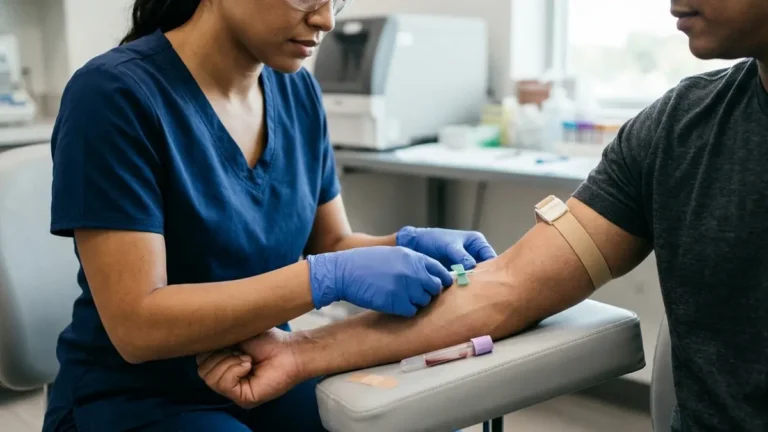
No single verified retest date fits everyone. The ACG guideline advises repeating an abnormal panel to confirm it before a full workup, and your clinician will time that retest from your starting results.
✅ Patient Action: Ask your primary care clinician or an addiction medicine specialist: “Do I need medical support to stop drinking safely, and when should we recheck my ALT, AST and GGT?”
When a high ALT needs care now, not a retest
Some symptoms shouldn’t wait for a scheduled blood test.
Signs of alcohol-associated hepatitis
StatPearls describes alcohol-associated hepatitis in people who drank heavily until 3–4 weeks before symptoms began. Warning signs include yellow skin or eyes (jaundice), fever, a fast heartbeat, fast breathing and an enlarged liver. If these appear, seek urgent medical care.
What stopping can and can’t reverse
Without scarring, fatty liver and inflammation can reverse. Fibrosis and cirrhosis often can’t, but people who stop drinking tend to live longer than those who continue.
Alcohol and ALT: common questions
1. How long does ALT take to go down after stopping alcohol?
ALT already in your blood clears with a half-life of about 47 hours, but it normalizes only as liver injury heals.
2. Can one night of drinking affect my ALT test?
Authoritative sources give no reliable ALT recovery window after a single binge; a repeat test after time without alcohol answers it.
3. What is a normal ALT level?
The ACG guideline puts healthy ALT at 29–33 IU/L for men and 19–25 IU/L for women. Ask which limit your clinician uses.
4. Why is my AST higher than my ALT after drinking?
An AST/ALT ratio above 2 is typical of alcohol-related liver disease. Your clinician interprets it alongside your history and other tests.
5. How long does GGT take to normalize after quitting alcohol?
GGT has a 14–26 day half-life and is usually normal after about four to five weeks without alcohol.
6. Is alcohol-related fatty liver reversible?
Without scarring, fatty liver can reverse after stopping alcohol and may resolve within about six weeks, helping ALT settle.
7. Why is my ALT still high after I quit drinking?
Non-alcohol fatty liver, hepatitis, iron overload or liver-toxic medications can keep ALT raised. Ask a hepatologist which tests you need.
8. When should I retest ALT after stopping alcohol?
No single retest date fits everyone; your clinician times it from your starting ALT, AST and GGT results.
9. Is it safe to stop drinking suddenly to lower ALT?
After heavy drinking, sudden stopping can cause withdrawal seizures within 12–48 hours. Ask your clinician whether you need medical support first.
10. Can a normal ALT still mean liver damage?
Yes, a normal ALT may not exclude significant liver disease. Ask your clinician whether your fibrosis risk should be checked.
11. Does alcohol-related cirrhosis reverse if I stop drinking?
Cirrhosis often can’t be reversed, but people who stop drinking alcohol tend to live longer than those who continue.
Your next step
ALT already in your blood clears within days, but your result settles only as the liver heals, and GGT trails behind by weeks. If you’ve been drinking heavily, stop with medical support. Bring your full panel to your retest, and ask what else could be raising ALT if it stays high.
About this content
How this article was put together: researched from recognised health sources, drafted with the help of AI tools, and edited by hand, with sources linked throughout.

Sameer Patel is the founder and editor of My Medicine Advisor. He is not a doctor or medical professional — before starting this site he worked in banking,…
Medical disclaimer
The content on MyMedicineAdvisor is provided for general informational and educational purposes only and is not a substitute for professional medical advice, diagnosis, or treatment. Health information on this website should not be used to diagnose, treat, cure, or prevent any condition without guidance from a qualified healthcare professional. Always seek the advice of your doctor, physician, or another licensed healthcare provider with any questions you may have regarding a medical condition, symptoms, medications, or treatment decisions.