
On This Page – Quick Medical Summary
Your ALT is higher than your AST: what that usually means
If your liver panel shows ALT above AST and an ultrasound mentioned fat in your liver, you’re looking at the most common pattern in metabolic dysfunction-associated steatotic liver disease (MASLD). It is a clue, not a verdict.
Why fatty liver is now called MASLD
In 2023, a multisociety Delphi consensus replaced the term “NAFLD” with MASLD. MASLD means fat in the liver plus at least one of five cardiometabolic risk factors. The name changed; your diagnosis didn’t.
Which part of this page fits your result
- ALT higher than AST: keep reading from the next section.
- AST higher than ALT: skip to the section on scarring or alcohol.
- Yellowing skin or eyes, or very high numbers: start with our guide to the right next step for jaundice and high liver enzymes.
ℹ️ Medical Disclaimer: This article explains liver lab patterns for general education only. It does not diagnose liver disease, recommend any treatment, medication or procedure, interpret your personal fibrosis results, or advise on insurance coverage. Review your results with your primary care physician or a board-certified gastroenterologist or hepatologist before acting on them.
Where AST and ALT come from in your body
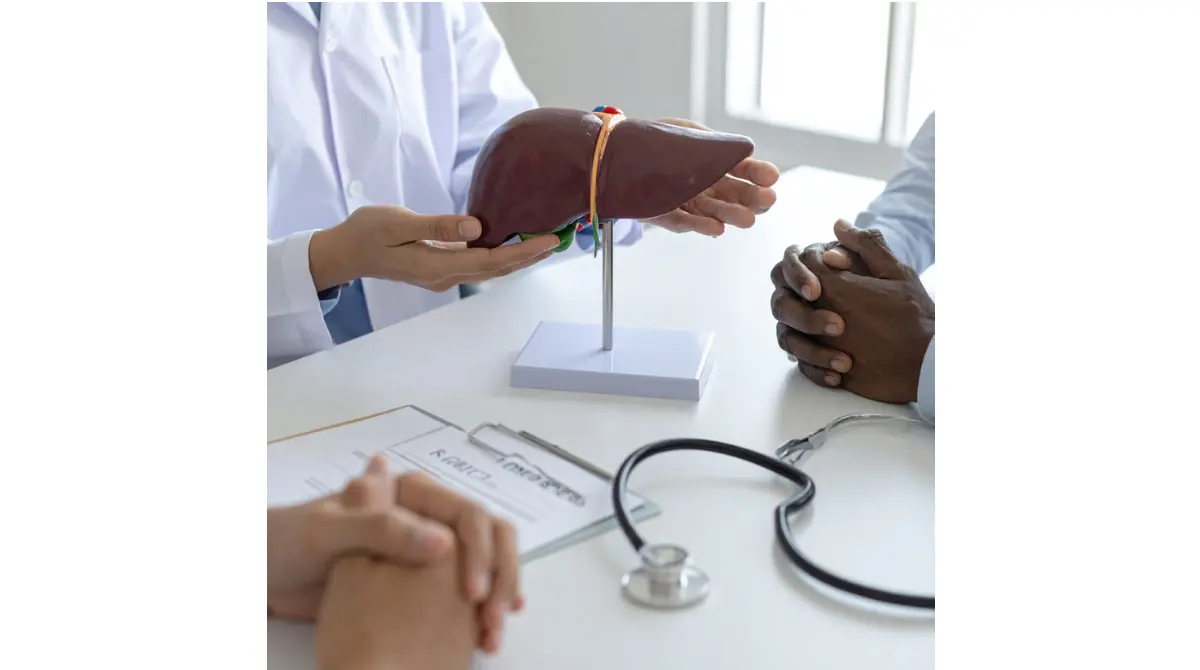
In MASLD, ALT is usually higher than AST because ALT is concentrated in the liver and floats free in the cell’s fluid. Much of the liver’s AST, by contrast, is held inside mitochondria. Early fat-related injury tends to leak the free enzyme first.
ALT: the more liver-specific enzyme
Alanine aminotransferase (ALT) is found at high levels in the liver. A rise usually points there first.
AST: liver, heart, and muscle — and inside mitochondria
Aspartate aminotransferase (AST) is found at high levels in the liver, heart and muscles, as explained in MedlinePlus’s guide to how the AST blood test works. Inside liver tissue, about 80% of AST activity comes from the mitochondrial form.
🔬 How It Works: Think of a liver cell as a room with a locked cabinet. ALT sits loose in the room, while much of the AST is in the cabinet (the mitochondria). Mild fat-related stress damages the cell’s outer membrane and lets loose enzymes out first. That is why ALT tends to lead.
What the AST/ALT ratio usually looks like in MASLD

Your AST/ALT ratio compares the two numbers, and in MASLD it is usually below 1.
| AST/ALT ratio | What it usually suggests | Key Clinical Detail |
|---|---|---|
| Below 1 (ALT higher) | Typical MASLD pattern | Expected before advanced scarring |
| Above 1 in MASLD | Possible advanced fibrosis | A reason to ask about fibrosis testing |
| Above 2 | Alcohol-associated pattern | Usually prompts an alcohol review |
Sources: BMJ Best Practice, MASLD investigations (reviewed 2025); Indian Journal of Clinical Biochemistry study of ALD vs NASH (PMC3903934).
How to work out your ratio
Divide AST by ALT. For example, AST 40 ÷ ALT 60 = 0.67. If your ALT is high but AST is still in range, read our guide to when ALT is high but AST is normal.
How high the numbers usually go
In MASLD, enzymes rise to 1–4 times the upper limit of normal in 50–90% of patients, and rarely past 300 IU/L. Normal results are also possible.
📊 Clinical Data Point: In a Hiroshima check-up study, 1,399 non-drinkers with fatty liver had a median AST/ALT ratio of 0.73. Among 3,781 non-drinkers without fatty liver, the median was 1.1. — Source: BMC Gastroenterology, 2022 (PMC9101936).
Can you have MASLD with a normal ALT?
Yes. A “normal” result can hide real liver disease.
| Group | Healthy ALT ceiling (ACG, 2017) | Key Clinical Detail |
|---|---|---|
| Men | 29–33 IU/L | Many lab reports use higher cutoffs |
| Women | 19–25 IU/L | Many lab reports use higher cutoffs |
Source: ACG Clinical Guideline: Evaluation of Abnormal Liver Chemistries (Kwo et al., 2017).
Why the “normal” range on your report may be too high
The American College of Gastroenterology based these ranges on research linking ALT levels to liver-related deaths. The AASLD’s 2023 guidance on fatty liver disease also treats ALT above 30 U/L as abnormal.
Why ALT doesn’t track how much scarring you have
Studies summarized in Annals of Hepatology found that up to 22–33% of MASLD patients with advanced fibrosis had ALT under 40 U/L. ALT also correlates poorly with disease severity on biopsy.
✅ Patient Action: Ask your primary care physician: “Is my ALT normal by this lab’s range, or by the ACG ranges for men and women?”
When AST climbs above ALT: scarring or alcohol?
An AST/ALT ratio above 1 in MASLD may signal more advanced liver scarring, while a ratio above 2 is the classic alcohol-related pattern. Muscle injury can also raise AST, so a flipped ratio is a prompt for testing, not a diagnosis.
Ratio above 1 in MASLD: a possible fibrosis signal
In a Newcastle study of biopsy-proven fatty liver disease, the AST/ALT ratio flagged advanced fibrosis nearly as accurately as the FIB-4 score. That is why doctors pay attention when the ratio flips.
Ratio above 2: the alcohol pattern, and MetALD
🔬 How It Works: Alcohol injures mitochondria, releasing their AST. It is also linked to a shortage of pyridoxine (vitamin B6), which is thought to hold ALT back. Researchers studying the AST/ALT ratio in alcohol-related versus fatty liver disease proposed both mechanisms.
The 2023 consensus created MetALD for people with MASLD who drink 140–350 g of alcohol a week (women) or 210–420 g (men). ACG guidance flags women above 140 g and men above 210 g weekly who have AST above ALT as at risk for alcohol-related liver disease.
✅ Patient Action: Ask a hepatologist or gastroenterologist: “Could my AST-over-ALT pattern reflect fibrosis, and do I need elastography?”
How your doctor uses AST and ALT in a FIB-4 score
The FIB-4 index turns your age, AST, ALT and platelet count into one fibrosis-risk number.
The FIB-4 formula
FIB-4 = (age × AST) ÷ (platelet count × √ALT). Our guide to how the FIB-4 score is read walks through the math.
What your FIB-4 result means and when it’s unreliable
| FIB-4 result | What AASLD guidance suggests | Key Clinical Detail |
|---|---|---|
| Below 1.3 | Advanced fibrosis unlikely | Over 65, 2.0 replaces 1.3 |
| 1.3 to 2.67 | A second test is needed | Usually elastography |
| Above 2.67 | Advanced fibrosis likely | Usually prompts referral |
Source: AASLD Practice Guidance, 2023.
FIB-4 is less reliable under age 35 or over 65. Alcohol use can also falsely raise blood-based scores. AASLD’s guideline on imaging-based fibrosis testing recommends imaging as the first-line way to detect moderate-to-advanced fibrosis.
✅ Patient Action: Ask your primary care physician: “Can you calculate my FIB-4, and does my age change the cutoff?”
When this pattern needs a liver specialist
MASLD is usually silent, so lab patterns and scores, not symptoms, drive most referrals.
Signs to get checked promptly
According to NIDDK, most people have few or no symptoms, even with cirrhosis. Some feel tired or have discomfort in the upper right abdomen. AASLD’s pathway refers patients to a liver specialist when FIB-4 is above 2.67 or when AST and ALT stay raised.
Treatments now approved for MASH
The FDA has approved resmetirom (Rezdiffra, March 2024) and semaglutide (Wegovy, August 2025). Both are approved for noncirrhotic MASH with moderate-to-advanced fibrosis, alongside diet and exercise, as the FDA’s MASH approval announcement explains. Weight loss may also shift MASH back toward simple fatty liver; our weight loss calculator can help you discuss a realistic goal.
⚠️ Clinical Warning: These drugs are approved only for MASH with moderate-to-advanced fibrosis, not cirrhosis. Fibrosis staging comes first, and they are not for every MASLD diagnosis.
✅ Patient Action: Ask a hepatologist: “Based on my fibrosis stage, am I a candidate for MASH-specific treatment?”
Frequently asked questions about MASLD, AST and ALT
1. Is ALT higher than AST in fatty liver?
Usually, yes. In MASLD the AST/ALT ratio typically stays below 1, because ALT is the more liver-specific enzyme.
2. What AST/ALT ratio is normal in MASLD?
Below 1 is the typical MASLD pattern. A Hiroshima study found a median ratio of 0.73 in non-drinkers with fatty liver.
3. Can you have MASLD with normal ALT?
Yes. Up to 22–33% of MASLD patients with advanced fibrosis had ALT under 40 U/L in published studies.
4. What is a normal ALT for women?
ACG defines a healthy ALT as 19–25 IU/L for women and 29–33 IU/L for men. Ask your clinician which range applied.
5. What does AST higher than ALT mean?
In MASLD, a ratio above 1 may signal advanced scarring, and above 2 suggests alcohol. Ask your doctor about fibrosis testing.
6. Does AST higher than ALT always mean alcohol?
No. AST also rises with muscle or heart injury, and in MASLD a flipped ratio can reflect fibrosis.
7. What is MetALD?
MetALD describes MASLD plus 140–350 g of alcohol weekly for women, or 210–420 g for men.
8. How is FIB-4 calculated?
FIB-4 equals age times AST, divided by platelet count times the square root of ALT.
9. What FIB-4 score needs a specialist?
A FIB-4 above 2.67 suggests likely advanced fibrosis and usually prompts referral; 1.3–2.67 needs a second test. Confirm next steps with your clinician.
10. Why did NAFLD change to MASLD?
A 2023 multisociety Delphi consensus adopted MASLD to define fatty liver by cardiometabolic risk factors and drop potentially stigmatizing language.
11. Are there FDA-approved drugs for MASH?
Yes. Resmetirom (2024) and semaglutide (2025) are approved for noncirrhotic MASH with moderate-to-advanced fibrosis. Ask a hepatologist whether you qualify.
The bottom line on your AST and ALT
ALT higher than AST is the expected MASLD pattern. What matters more is whether AST is overtaking ALT and what your FIB-4 shows. Overweight and obesity make MASLD more likely, so our BMI calculator is a quick check before your appointment.
About this content
How this article was put together: researched from recognised health sources, drafted with the help of AI tools, and edited by hand, with sources linked throughout.

Sameer Patel is the founder and editor of My Medicine Advisor. He is not a doctor or medical professional — before starting this site he worked in banking,…
Medical disclaimer
The content on MyMedicineAdvisor is provided for general informational and educational purposes only and is not a substitute for professional medical advice, diagnosis, or treatment. Health information on this website should not be used to diagnose, treat, cure, or prevent any condition without guidance from a qualified healthcare professional. Always seek the advice of your doctor, physician, or another licensed healthcare provider with any questions you may have regarding a medical condition, symptoms, medications, or treatment decisions.