Weight Loss Calculator
Estimate how much weight you want to lose, a realistic timeline, daily calorie target, BMI change, milestone dates, and monthly progress in one detailed mobile-friendly tool.
Inputs
Enter your planned weekly loss pace.
Results
Weight to lose
—
Percent of current weight
—
Weekly pace
—
Monthly pace
—
Estimated goal time
—
Goal date: —
Estimated calorie target
—
Estimated daily deficit
—
Estimated maintenance
—
Estimated BMR
—
Current BMI
—
Goal BMI
—
Activity factor used
—
Pace check
Alternative pace scenarios
| Weekly loss pace | Daily deficit | Target calories/day | Estimated goal time |
|---|
Goal milestones
| Milestone | Target weight | Total lost | Estimated time | Estimated date |
|---|
Monthly projection
| Month | Estimated end weight | Total estimated loss | BMI | Status |
|---|
Results appear after you click “Calculate.”
Guide
How to use this tool
- Enter your current weight, goal weight, height, age, sex, and activity level.
- Pick a weekly pace if you want the tool to estimate your finish date from speed.
- Pick a target number of weeks if you want the tool to calculate the pace and calorie gap needed.
- Check the milestone and monthly tables to see whether the plan looks realistic for daily life.
- Recalculate after meaningful weight changes because maintenance needs usually change as body weight changes.
When extra care is needed
- You are pregnant, breastfeeding, under 18, or have a history of an eating disorder.
- You take medicines that affect appetite, blood sugar, fluid balance, or body weight.
- You have diabetes, kidney disease, liver disease, thyroid disease, or another significant medical condition.
- You feel dizzy, weak, unwell, or unable to recover on the calorie level suggested by the tool.
- You want a personalized plan for obesity treatment, athletic performance, or body-composition goals.
On This Page – Quick Medical Summary
A weight loss calculator tells you exactly how many calories to eat daily, how long it will take to reach your goal weight, and what pace of loss is safe for your body. It does this using your height, weight, age, sex, and activity level — all in under 60 seconds.
Use the calculator above, then read below to understand every number it produces — and exactly what to do with them.
What this calculator gives you:
- Your Basal Metabolic Rate (BMR) and daily maintenance calories (TDEE)
- Daily calorie target and calorie deficit
- Weekly, monthly, and milestone-based weight loss timeline
- BMI at your current and goal weight
- Four pace scenarios so you can choose what fits your life
- A downloadable CSV plan you can share with your doctor
How This Weight Loss Calculator Works
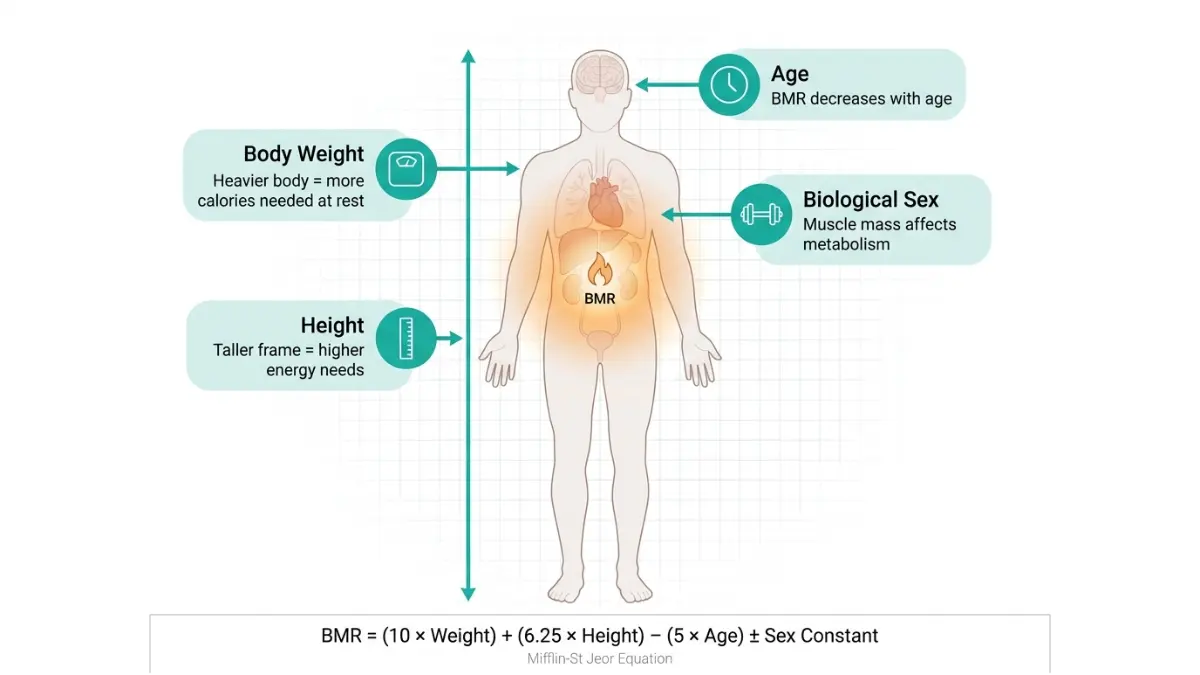
The Mifflin-St Jeor Equation: Why It’s More Accurate Than Other Formulas
Every weight loss calculator is only as accurate as the formula it runs on. This tool uses the Mifflin-St Jeor equation — the gold standard in clinical nutrition since 1990.
The Mifflin-St Jeor equation has been found to predict resting metabolic rate within 10% of directly measured values, making it more accurate than the older Harris-Benedict equation for the general population.
Here’s what the formula actually calculates — in plain English:
| Variable | What It Means |
|---|---|
| Weight (kg) | How much energy your body needs to sustain itself |
| Height (cm) | A structural proxy for lean mass and organ size |
| Age (years) | BMR declines approximately 2–3% per decade after age 30 |
| Sex | Men average 5–10% higher BMR due to greater lean muscle mass |
The result is your BMR — the calories your body burns at complete rest, just keeping you alive. Think of it as your body’s minimum fuel requirement with the engine idling.
From BMR to TDEE: How Activity Level Changes Everything
BMR alone is not enough to plan a weight loss diet. You need your Total Daily Energy Expenditure (TDEE) — the true number of calories you burn every day, including movement.
TDEE is calculated by multiplying your BMR by an activity factor:
| Activity Level | Daily Life Example | Multiplier |
|---|---|---|
| Sedentary | Desk job, no gym | 1.2x |
| Lightly Active | 1–3 light workouts/week | 1.375x |
| Moderately Active | 3–5 moderate workouts/week | 1.55x |
| Active | 6–7 intense workouts/week | 1.725x |
| Very Active | Physical job + daily training | 1.9x |
Most people underestimate their activity level. If you work a desk job but walk 20 minutes at lunch and do yoga twice a week, you are lightly active — not sedentary. Getting this right can shift your TDEE by 200–400 calories.
Use our BMR Calculator to isolate your resting rate before applying the activity multiplier.
What Your Weight Loss Calculator Results Actually Mean
Daily Calorie Deficit: The Engine of All Weight Loss
Your calorie deficit is the daily gap between the calories you eat and the calories you burn. This number drives every pound of fat you lose.

The widely accepted science: 1 lb of fat ≈ 3,500 calories | 1 kg of fat ≈ 7,700 calories.
| Weekly Goal | Daily Deficit Needed | Estimated Timeline for 10 lbs |
|---|---|---|
| 0.5 lb/week | ~250 cal/day | ~20 weeks |
| 1 lb/week | ~500 cal/day | ~10 weeks |
| 1.5 lb/week | ~750 cal/day | ~7 weeks |
| 2 lb/week | ~1,000 cal/day | ~5 weeks |
Important: Going below 1,200 calories/day (women) or 1,500 calories/day (men) risks muscle loss, nutritional deficiency, and metabolic slowdown — even if the deficit looks mathematically right on paper.
Use our Calorie Deficit Calculator to verify your daily target against your TDEE before committing to a plan.
Weekly Pace vs. Monthly Projection — Which Should You Focus On?
Most people fixate on weekly results and feel demoralized when the scale doesn’t move. Monthly projections are far more psychologically reliable.
Real example: Marcus, a 42-year-old male at 210 lbs targeting 185 lbs, running a 500-calorie daily deficit. Weekly pace: 1 lb. His monthly projection at Month 3 shows 12 lbs lost — a clearer, more motivating number than obsessing over each weekly weigh-in.
People who lose weight at a gradual, steady pace — about 1 to 2 pounds per week — are more likely to keep the weight off than people who lose weight more quickly, according to the CDC.
Our calculator shows you both timelines — weekly pace AND a full 12-month projection table — so you can see the complete picture at once.
How Your BMI Changes as You Lose Weight
Your Body Mass Index (BMI) gives you a clinical reference point as your weight changes. The calculator shows your BMI at your starting weight and at your goal weight — so you can see exactly where you’ll land on the clinical spectrum.
| BMI Range | Classification | Health Risk |
|---|---|---|
| Below 18.5 | Underweight | Increased risk |
| 18.5 – 24.9 | Healthy weight | Low risk |
| 25.0 – 29.9 | Overweight | Elevated risk |
| 30.0 and above | Obesity | High risk |
For a full BMI breakdown with waist circumference context, use our BMI Calculator. To find your science-backed target weight range, the Ideal Weight Calculator factors in your height, frame size, and sex.
How Long Will It Take? Real Weight Loss Timelines
The Timeline Table No Competitor Shows You
This is what everyone searching for a weight loss calculator actually wants to know — and what Healthline, WebMD, and Mayo Clinic all fail to show clearly.
| Weight Loss Goal | 0.25 kg/week (Conservative) | 0.5 kg/week (Moderate) | 0.75 kg/week (Faster) |
|---|---|---|---|
| 5 kg / 11 lbs | ~20 weeks | ~10 weeks | ~7 weeks |
| 10 kg / 22 lbs | ~40 weeks | ~20 weeks | ~14 weeks |
| 15 kg / 33 lbs | ~60 weeks | ~30 weeks | ~20 weeks |
| 20 kg / 44 lbs | ~80 weeks | ~40 weeks | ~27 weeks |
These are estimates. Your actual results will shift based on metabolic adaptation, medication, sleep quality, and adherence. The calculator above gives you a personalized timeline — not a population average.
Key insight most people miss: As your body gets lighter, your TDEE drops. A 200-lb person burns more calories doing the same exercise than they will at 175 lbs. This is why you must recalculate your targets every 5–10 lbs of weight lost.
Why Faster Isn’t Always Better — The Medical Reality
Losing weight too quickly increases the risk of losing lean muscle mass, not just fat. When you lose muscle, your BMR drops — making future weight loss even harder.
The NIDDK recommends beginning with a weight loss of 5 to 10 percent of your starting body weight over a period of 6 months as a safe and clinically effective starting point.
Dr. Vikram Nair, MD (Endocrinology) notes: “Patients who attempt to lose more than 1 kg per week without medical supervision often experience metabolic adaptation — the body responds by lowering TDEE, creating a frustrating plateau. A moderate, steady deficit consistently outperforms aggressive restriction in 6-month outcomes.”
For context on safe, sustained weight management, the NIH’s weight management resource is the most comprehensive U.S. government reference.
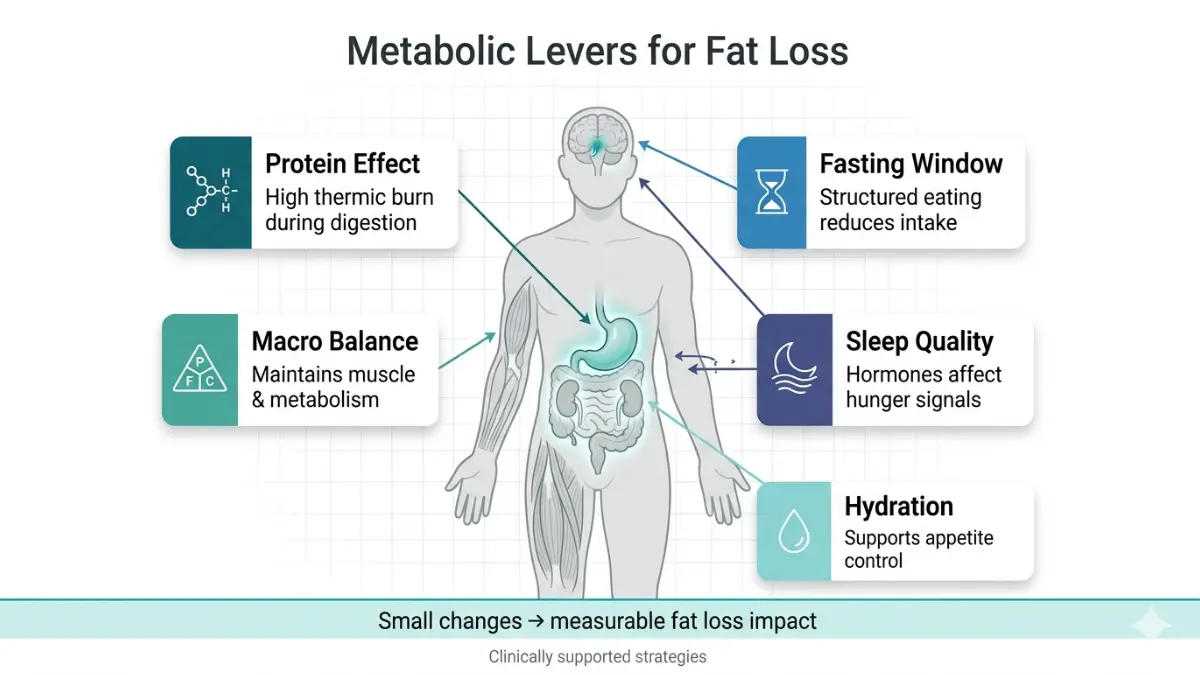
5 Doctor-Reviewed Ways to Lose Weight Faster Than the Calculator Predicts
These five strategies work with your calorie target — not instead of it. Each one is supported by clinical evidence and can meaningfully improve your results beyond what the numbers alone suggest.
1. Increase Protein to 25–30% of Your Daily Calories
Protein has a thermic effect — your body burns 20–30% of protein calories just to digest it. No other macronutrient comes close (carbs burn 5–10%, fat burns 0–3%).
Higher protein also preserves lean muscle during a calorie deficit, keeping your BMR from dropping as fast.
Goal: Aim for 0.7–1g of protein per pound of bodyweight daily. Use our Protein Intake Calculator to find your exact daily protein target based on your body weight and goals.
2. Use Intermittent Fasting to Create a Natural Deficit
Intermittent fasting (IF) compresses your eating window — making it easier to stay in a calorie deficit without meticulously counting every meal.
Common protocols like 16:8 (fast 16 hours, eat in an 8-hour window) work because most people eat fewer total calories when the eating window is shorter. There’s no metabolic magic — it’s structured calorie reduction made simpler.
Use the Intermittent Fasting Calculator to find your optimal fasting and eating window based on your schedule and goals.
3. Track Macros — Not Just Total Calories
Calories matter. But the source of those calories matters for body composition. A person eating 1,600 calories from 40% protein, 30% fat, and 30% carbs will preserve more muscle during fat loss than someone eating the same 1,600 calories from high-carb, low-protein sources.
The practical difference: More muscle retained = higher BMR = less weight regain after you hit your goal.
Our Macro Calculator breaks down your exact daily protein, fat, and carbohydrate targets for weight loss — not just a generic 40/30/30 split.
4. Prioritize Sleep — The Overlooked Metabolic Variable
Sleep deprivation raises ghrelin (the hunger hormone) and lowers leptin (the satiety hormone). Even one night of poor sleep can increase next-day calorie intake by 300–500 calories in some studies — silently erasing your carefully planned deficit.
According to the CDC, regular physical activity combined with adequate sleep supports weight management and reduces the risk of chronic disease — including cardiovascular disease and type 2 diabetes.
Use the Sleep Calculator to find your optimal sleep and wake schedule based on your REM cycles.
5. Drink Water Before Every Meal
Pre-meal water intake is one of the simplest, most evidence-backed tools for reducing total calorie intake. A 2016 clinical trial found that drinking 500ml of water 30 minutes before meals led to significantly greater weight loss over 12 weeks compared to a control group.
Water has zero calories, zero cost, and zero side effects. Use the Water Intake Calculator to find your personalized daily hydration target based on your body weight and activity level.
Why Weight Loss Slows Down (And How to Break Through)
The Science of Weight Loss Plateaus
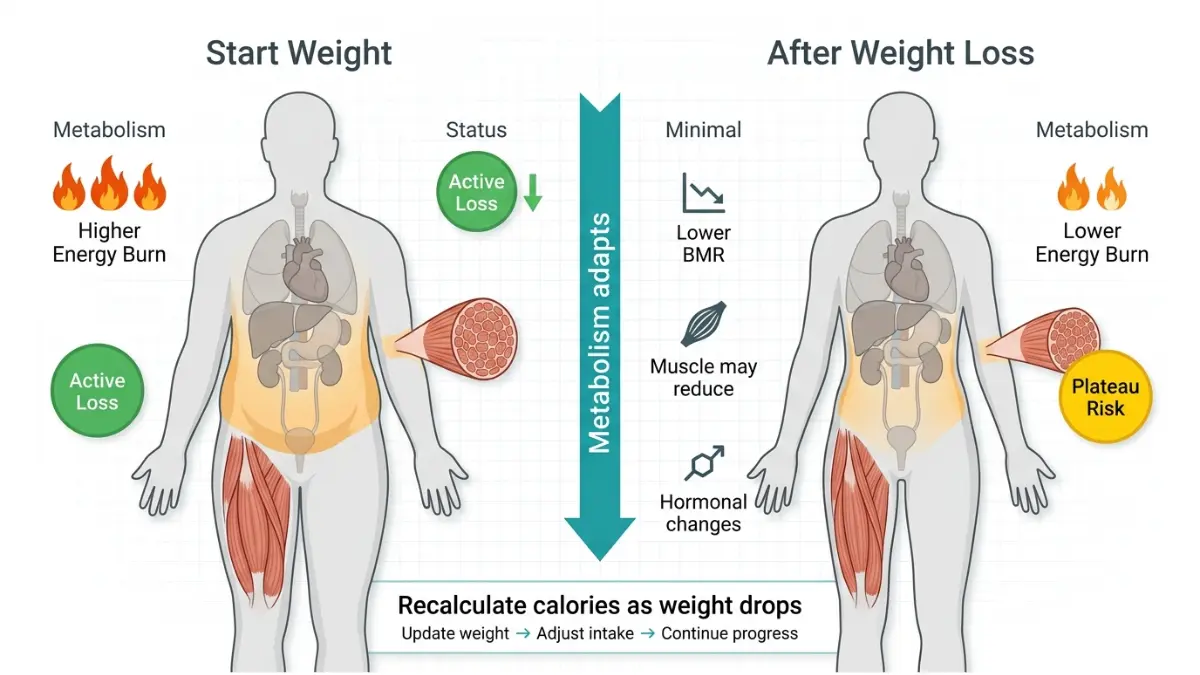
Nearly everyone hits a weight loss plateau at some point. It is not a failure of willpower — it is biology doing exactly what it’s designed to do.
Here’s what happens:
- As your body gets lighter, your TDEE decreases
- Your current calorie target, which created a 500-calorie deficit at 200 lbs, may now only create a 200-calorie deficit at 185 lbs
- The result: your weight loss slows or stops — even though your habits haven’t changed
This is why your weight loss calculator results need to be updated regularly, not set once and forgotten.
Signs your TDEE has dropped and you need to recalculate:
- Weight has been stable for 3+ weeks with no diet changes
- You are losing significantly more slowly than your original projection showed
- You feel less hungry at your current calorie level than you did when you started
Dr. Omar Hassan, MD (Internal Medicine) explains: “Metabolic adaptation is the most common reason patients plateau at 8–12 weeks. The fix is simple: recalculate your TDEE at your new weight, then reassign your deficit from that updated baseline.”
The 3-Step Recalibration Plan
Step 1: Re-enter your current (new lower) weight into the weight loss calculator above. Your TDEE will be lower than when you started.
Step 2: Check your current body composition with the Body Fat Calculator. If you’ve lost muscle as well as fat, your BMR may be lower than your original estimate suggested.
Step 3: Adjust your daily calorie target to restore a 300–500 calorie deficit from your new TDEE baseline — not your starting one.
The NIDDK’s guidance on eating and physical activity for weight management recommends continuing to track intake and adjusting weekly weigh-ins as your weight and metabolism evolve over time.
Is This Weight Loss Calculator Right for You?
Who Should Use This Tool — and Who Should See a Doctor First
This calculator is designed for healthy adults aged 18 and over as a planning and estimation tool. It is not a substitute for clinical advice.
| ✅ Well-Suited For This Calculator | ⚠️ Consult a Doctor Before Using Results |
|---|---|
| Healthy adults 18+ planning weight loss | Pregnant or breastfeeding women |
| People tracking slow, gradual weight goals | Anyone with a history of an eating disorder |
| Adults managing diet and exercise together | People with diabetes, kidney, or liver disease |
| Those planning around general activity levels | Anyone on GLP-1 medications (Ozempic, Wegovy) |
| People checking how BMI changes over time | Anyone with thyroid disease or hormonal conditions |
A critical note for GLP-1 users in 2026: Medications like semaglutide (Ozempic, Wegovy) significantly alter appetite, gastric emptying rate, and total calorie consumption. Standard TDEE calculations may substantially overestimate your calorie needs if you are on these medications. Always work with your prescribing physician to set calorie targets.
If you’re unsure whether your current symptoms are weight-related or indicate another condition, use our Symptom Checker to help assess what to discuss with your doctor. You can also review our guide on Ozempic weight loss results for detailed context on how GLP-1 medications affect body weight outcomes in 2026.
For official clinical guidance on overweight and obesity treatment options in the U.S., the CDC’s steps for losing weight is the most authoritative patient resource available.
⚕️ Medical Disclaimer: This weight loss calculator and the content on this page are for educational purposes only. They do not constitute medical advice, diagnosis, or treatment. Always consult a qualified healthcare provider before making significant changes to your diet, exercise program, or medication regimen. Results will vary based on individual health conditions, medications, genetics, and lifestyle factors.
Frequently Asked Questions about Weight Loss Calculator
1. How accurate is a weight loss calculator?
Weight loss calculators using the Mifflin-St Jeor equation predict BMR within 10% for approximately 82% of healthy adults. They are planning estimates — not guaranteed outcomes. Factors like medications, sleep, stress, and hydration all affect real-world results. Treat the numbers as a starting point and adjust based on 3–4 weeks of actual data.
2. How many calories do I need to cut to lose 1 kg per week?
Losing 1 kg of fat per week requires a daily calorie deficit of approximately 1,100 calories (7,700 ÷ 7). Most medical guidelines consider this toward the upper limit of safe unsupervised weight loss. Most adults find 0.5 kg/week (a 550-calorie daily deficit) more sustainable and easier to maintain.
3. What is a safe daily calorie deficit for weight loss?
A deficit of 300–750 calories per day is considered safe for most healthy adults. Going below 1,200 calories/day (women) or 1,500 calories/day (men) is generally not recommended without medical supervision, as it risks muscle loss and nutrient deficiencies.
4. How long does it take to lose 10 kg?
At a moderate 0.5 kg/week pace, losing 10 kg takes approximately 20 weeks (5 months). At a faster 0.75 kg/week pace, the same goal takes about 13–14 weeks. The calculator above gives you a personalized date based on your specific inputs — not a population average.
5. What is BMR and why does it matter for weight loss?
BMR (Basal Metabolic Rate) is the number of calories your body burns at complete rest — just to keep your organs functioning. It accounts for 60–75% of your total daily energy expenditure. If you eat below your BMR for extended periods, your body begins breaking down muscle for fuel, which lowers your BMR further over time.
6. Is losing 0.5 kg per week healthy?
Yes. Losing 0.5 kg per week is widely considered the optimal pace for sustainable fat loss. It creates a moderate daily deficit (~550 calories), preserves lean muscle mass, and minimizes metabolic adaptation. Most endocrinologists and dietitians recommend this range as the primary target for long-term weight management.
7. What’s the difference between BMR and TDEE?
BMR is how many calories you burn at rest. TDEE is how many calories you burn across an entire day — including work, exercise, and all other movement. TDEE = BMR × activity multiplier. Your daily calorie target for weight loss should always be calculated from TDEE, not BMR.
8. Why have I stopped losing weight even though I’m in a calorie deficit?
The most common reason is metabolic adaptation — as your body weight drops, your TDEE also decreases, shrinking your deficit without any change in your diet. You need to recalculate your TDEE at your new, lower body weight and adjust your calorie target accordingly.
9. Can I use this calculator if I’m on Ozempic or another GLP-1 medication?
You can use it for reference, but GLP-1 medications significantly reduce appetite and calorie intake in ways the Mifflin-St Jeor equation cannot account for. Your actual calorie needs and deficit may be much smaller than the calculator suggests. Always set calorie targets with your prescribing physician when on GLP-1 therapy.
10. What’s the difference between fat loss and weight loss?
Weight loss includes fat, muscle, water, and glycogen. Fat loss specifically targets stored body fat while preserving muscle. High-protein diets, moderate calorie deficits, and strength training all help shift the balance toward fat loss rather than muscle loss. Our Body Fat Calculator helps you track body composition changes beyond the scale number.
11. How often should I recalculate my calorie target?
Recalculate every time you lose 5–10 lbs (2–4 kg) of body weight. Your TDEE drops as you get lighter, so your original calorie target becomes less effective over time. Re-entering your updated weight into the calculator above takes under 60 seconds and keeps your plan accurate.
Related Tools You May Find Useful:
- Free Calorie Deficit Calculator — cross-check your daily target
- Keto Calculator — if you’re following a low-carb approach
- Heart Rate Zone Calculator — optimize your cardio for fat burning
- Metabolic Syndrome Signs — understand when weight affects disease risk
- 7 Gut Bacteria Facts That Affect Weight — the microbiome’s role in weight loss
About this content
How this article was put together: researched from recognised health sources, drafted with the help of AI tools, and edited by hand, with sources linked throughout.

Sameer Patel is the founder and editor of My Medicine Advisor. He is not a doctor or medical professional — before starting this site he worked in banking,…
Medical disclaimer
The content on MyMedicineAdvisor is provided for general informational and educational purposes only and is not a substitute for professional medical advice, diagnosis, or treatment. Health information on this website should not be used to diagnose, treat, cure, or prevent any condition without guidance from a qualified healthcare professional. Always seek the advice of your doctor, physician, or another licensed healthcare provider with any questions you may have regarding a medical condition, symptoms, medications, or treatment decisions.