Heart Rate Zone Calculator
Calculate estimated maximum heart rate, heart rate reserve, moderate and vigorous target zones, a full 5-zone training table, and live workout-zone classification in a detailed mobile-friendly format.
Inputs
What this tool gives
Maximum HR estimate, heart rate reserve, moderate and vigorous zones, full 5-zone training ranges, and optional live-zone interpretation.
Helpful use
Good for walking, running, cycling, cardio machines, interval training, and general workout pacing.
Results
Estimated maximum heart rate
—
Formula used: —
Zone method
—
Heart rate reserve: —
Moderate target zone
—
Often used for steady cardio.
Vigorous target zone
—
Often used for harder conditioning work.
Current exercise heart rate
—
% of max HR: —
Current-zone reading
—
Workout intensity: —
Heart rate reserve view
—
% of reserve from current HR: —
Weekly activity goal
150 min moderate
or 75 min vigorous
Quick reading
Estimated max HR: — • Resting HR: — • HR reserve: —
Moderate range: — • Vigorous range: —
Interpretation table
| Metric | Value | How to read it |
|---|---|---|
| Estimated maximum HR | — | Your workout zones are built from this number unless you enter a custom maximum heart rate. |
| Zone method | — | Either a simple percentage of max HR or a heart rate reserve method that also uses resting HR. |
| Moderate target zone | — | A practical target range for steady moderate-intensity aerobic exercise. |
| Vigorous target zone | — | A harder range often used for more demanding cardio sessions. |
| Current workout HR | — | Useful when you want to compare your live effort against your personalized zone table. |
| Current intensity | — | Quick interpretation of how hard the current reading appears relative to your estimated maximum. |
Detailed heart rate zone table
| Zone | Percent range | Lower bpm | Upper bpm | Typical use |
|---|
Results appear after you click “Calculate.”
On This Page – Quick Medical Summary
A heart rate zone calculator divides your maximum heart rate into 5 training zones (50%–100%). Each zone targets a specific physiological response — from fat burning in Zone 2 to maximum cardiovascular effort in Zone 5. Your zones are unique to your age, resting heart rate, and health status.
What Are Heart Rate Training Zones? A Medical Definition
James, 52, started a cardio program after his annual physical. His doctor told him to “keep his heart rate moderate.” But what does that mean exactly? Without understanding heart rate zones, he was guessing — sometimes overexerting, sometimes barely moving the needle.
That’s exactly the problem a heart rate zone calculator solves.
What Is a Heart Rate Zone?
A heart rate zone is a specific range of beats per minute (bpm) that corresponds to a defined level of cardiovascular effort. There are five standard training heart rate zones, each producing distinct physiological effects in the body.
This system was scientifically validated by Finnish exercise physiologist Martti Karvonen in 1957, whose landmark research established the heart rate reserve method — still used in clinical exercise prescription today.
Why zones matter medically — not just athletically:
- They help prevent overexertion, which can be dangerous for people with cardiac conditions
- They align exercise intensity with specific health outcomes (fat loss, cardiovascular fitness, blood pressure management)
- They are used by cardiologists in post-cardiac rehabilitation programs
- They account for individual differences — two people the same age can have very different safe exercise intensities
The 5 Heart Rate Zones at a Glance
| Zone | Name | % Max HR | What Happens in Your Body | Best For |
|---|---|---|---|---|
| Zone 1 | Recovery | 50–60% | Light effort; body uses fat as primary fuel | Warm-up, cool-down, active recovery |
| Zone 2 | Aerobic Base | 60–70% | Steady fat oxidation; builds mitochondrial density | Endurance, weight loss, longevity |
| Zone 3 | Tempo | 70–80% | Carbohydrate burning increases; builds cardiovascular efficiency | General fitness, moderate cardio |
| Zone 4 | Threshold | 80–90% | Lactic acid begins accumulating; high performance training | Speed, race preparation |
| Zone 5 | Maximum | 90–100% | Near-maximal effort; VO2 max training | Elite performance only — short bursts |

Most Americans, according to the American Heart Association, should target Zones 2–3 for the majority of their weekly cardio activity. This corresponds to 50–85% of maximum heart rate during moderate to vigorous exercise.
Key takeaway: Your heart rate training zones are not one-size-fits-all. They shift as you age, as your fitness improves, and if you take certain medications. That’s why using a personalized heart rate zone calculator — not a generic chart — is the medically sound approach.
How to Use This Heart Rate Zone Calculator (Step-by-Step)
Our free Heart Rate Zone Calculator above is built with two scientifically validated calculation methods. Here’s exactly how to use it for the most accurate results.
Step-by-Step: Getting Your Personalized Zones
Step 1 — Enter your age. This is used to estimate your maximum heart rate using either the standard AHA formula (220 − age) or the more precise Tanaka formula (208 − 0.7 × age).
Step 2 — Choose your zone calculation method.
- % of Maximum HR — Simpler, beginner-friendly. Recommended by the AHA for most adults.
- Heart Rate Reserve (Karvonen Method) — More accurate. Factors in your resting heart rate for a personalized result.
Step 3 — Enter your resting heart rate (for HRR method). Measure this first thing in the morning before getting out of bed. Count your pulse for 60 seconds. A normal resting heart rate for adults is 60–100 bpm, though fit individuals often measure 40–60 bpm.
Step 4 — Add your current exercise heart rate (optional). If you’re wearing a monitor during a workout, enter your live reading to see which zone you’re currently in — in real time.
Step 5 — Enter a custom max HR (optional but more accurate). If your doctor has performed a stress test, use that measured maximum. The formula estimates can be off by 10–20 bpm for many individuals.
Which Method Should You Choose?
| Your Situation | Recommended Method |
|---|---|
| Just starting out, no fitness tracker | % of Max HR (simple formula) |
| Intermediate user with a fitness watch | Heart Rate Reserve (Karvonen) |
| Had a cardiac stress test | Custom Max HR + Karvonen |
| On blood pressure medication | See Section 5 before calculating |
How to Measure Your Resting Heart Rate Correctly
- Measure in the morning — before coffee, before moving, before checking your phone
- Use your wrist or neck pulse — two fingers, light pressure
- Count for 60 full seconds — don’t use a 15-second estimate and multiply
- Average 3 consecutive mornings for the most reliable baseline
Once you have your zones from our calculator, pair them with our Running Pace Calculator to align your target heart rate zones with your training pace — a combination no competitor currently offers their users.
💡 What This Means For You: If you’re over 50, take any heart or blood pressure medication, or haven’t exercised regularly in over a year, always enter your custom max HR from a physician-supervised stress test rather than relying on the age formula.
Heart Rate Zones by Age — The Complete 2026 Medical Reference Chart
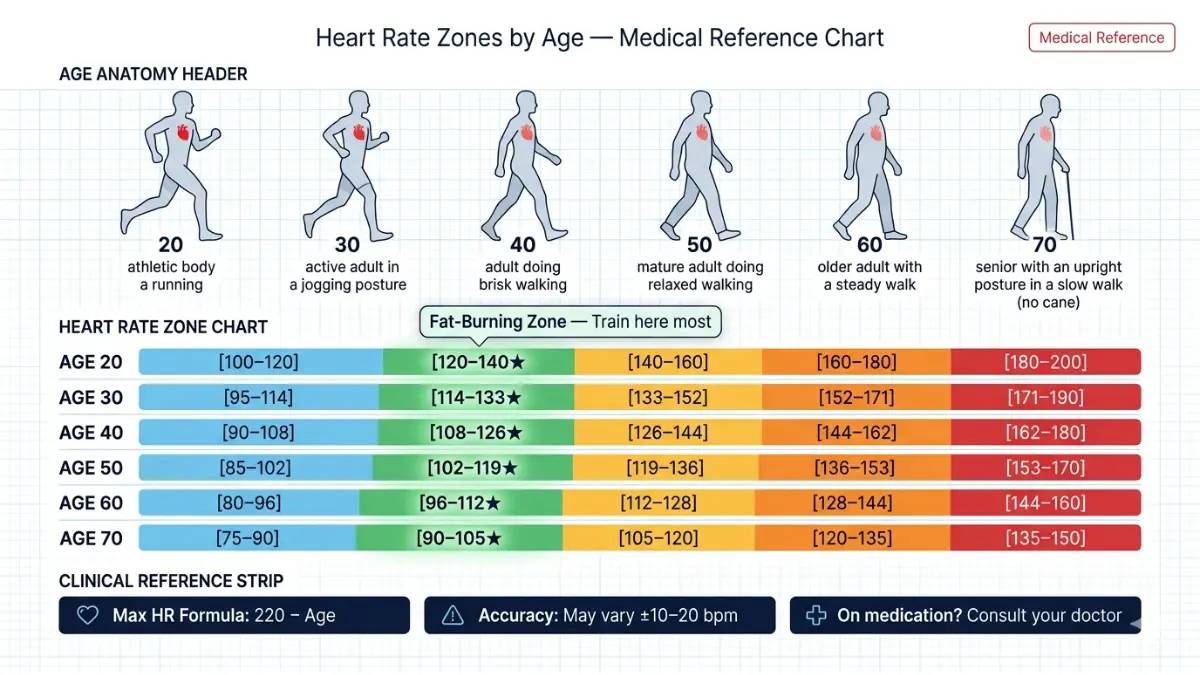
This is the section no competitor offers — a clinically framed, age-stratified heart rate zone reference table that covers adults from age 20 through 70.
Why the 220−Age Formula Is Often Inaccurate
The classic 220−age formula has been used since the 1970s. Research published in the Journal of Medicine and Science in Sports, including the landmark HUNT Fitness Study (Nes et al., 2013), found this formula can overestimate or underestimate true maximum heart rate by up to 20 bpm in adults over 40. The Tanaka formula (208 − 0.7 × age) — which our calculator includes — has shown greater accuracy across diverse age groups. Per Mayo Clinic’s exercise intensity guidance, individuals should ideally confirm max HR through supervised testing if precision matters.
Heart Rate Zones by Age: 2026 Reference Chart (% of Max HR Method)
| Age | Est. Max HR | Zone 1 (50–60%) | Zone 2 (60–70%) | Zone 3 (70–80%) | Zone 4 (80–90%) | Zone 5 (90–100%) |
|---|---|---|---|---|---|---|
| 20 | 200 bpm | 100–120 | 120–140 | 140–160 | 160–180 | 180–200 |
| 25 | 195 bpm | 98–117 | 117–137 | 137–156 | 156–176 | 176–195 |
| 30 | 190 bpm | 95–114 | 114–133 | 133–152 | 152–171 | 171–190 |
| 35 | 185 bpm | 93–111 | 111–130 | 130–148 | 148–167 | 167–185 |
| 40 | 180 bpm | 90–108 | 108–126 | 126–144 | 144–162 | 162–180 |
| 45 | 175 bpm | 88–105 | 105–123 | 123–140 | 140–158 | 158–175 |
| 50 | 170 bpm | 85–102 | 102–119 | 119–136 | 136–153 | 153–170 |
| 55 | 165 bpm | 83–99 | 99–116 | 116–132 | 132–149 | 149–165 |
| 60 | 160 bpm | 80–96 | 96–112 | 112–128 | 128–144 | 144–160 |
| 65 | 155 bpm | 78–93 | 93–109 | 109–124 | 124–140 | 140–155 |
| 70 | 150 bpm | 75–90 | 90–105 | 105–120 | 120–135 | 135–150 |
These are estimates based on the 220−age formula. Individual variation can be ±10–20 bpm. Use our calculator above for a personalized result.
Do Men and Women Have Different Heart Rate Zones?
Yes — with clinical significance. Research indicates women typically have a 2–7 bpm higher maximum heart rate than men of the same age, particularly before menopause. This means:
- A 40-year-old woman’s true max HR may be closer to 184–187 bpm, not 180
- Her Zone 2 fat-burning target may be correspondingly higher
- Postmenopausal women often see max HR shift closer to male averages
This gender variation is one reason why using your custom measured max HR — rather than relying on the formula — produces more precise heart rate training zones. Combine your zone data with our Body Fat Calculator to track how zone-based training is improving your body composition over time.
What Each Heart Rate Zone Does to Your Body — A Medical Breakdown
Zone 1 (50–60% Max HR) — Active Recovery
What your body does: Uses primarily fat as fuel. Heart rate is slightly elevated. Muscles receive increased blood flow without significant stress.
Who it’s ideal for:
- People returning from injury or illness
- Post-cardiac rehab patients
- Anyone doing active recovery between harder sessions
- Beginners establishing an exercise habit
Clinically important: Zone 1 is the only zone appropriate for people who have been cleared for “light activity only” after a cardiac event or surgery.
Zone 2 (60–70% Max HR) — The Longevity Zone
Zone 2 is the most talked-about training zone in 2026 — and for good reason. It is the gold standard for metabolic health, fat oxidation, and cardiovascular longevity.
What your body does:
- Burns a higher proportion of fat relative to carbohydrates
- Builds mitochondrial density in muscle cells — increasing energy efficiency
- Improves insulin sensitivity
- Lowers resting heart rate over time
The 80/20 rule: Elite endurance athletes spend approximately 80% of their training time in Zones 1–2, and only 20% in harder zones. Research supports this approach for both performance and long-term health.
Zone 2 target heart rates by age (quick reference):
| Age 30 | Age 40 | Age 50 | Age 60 |
|---|---|---|---|
| 114–133 bpm | 108–126 bpm | 102–119 bpm | 96–112 bpm |
If your primary goal is weight loss, most of your cardio time should be in this zone. Use our Calorie Deficit Calculator to combine zone-based training with your daily calorie targets for a complete fat-loss strategy.
Zone 3 (70–80% Max HR) — Cardiovascular Fitness
What your body does: Energy demand shifts toward carbohydrates. Breathing becomes noticeably harder. This is where most recreational cardio occurs.
Clinical relevance: The CDC’s physical activity guidelines recommend at least 150 minutes per week of moderate-intensity cardio — which largely corresponds to Zone 3.
Caution: Spending too much time in Zone 3 without adequate Zone 2 base work is a common training error. It’s metabolically demanding without delivering the fat oxidation benefits of Zone 2 or the VO2 max gains of Zone 4.
Zone 4 (80–90% Max HR) — Lactate Threshold Training
What your body does: Lactic acid accumulates faster than it can be cleared. This is an intense, uncomfortable zone sustainable for only 20–40 minutes in trained individuals.
Who benefits:
- Runners preparing for a 10K or half marathon
- Cyclists working on time trial performance
- Anyone wanting to raise their lactate threshold
Medical caution: Zone 4 training is not appropriate for beginners, sedentary adults, or those with cardiovascular risk factors without physician clearance. Track your strength gains alongside this training with our One Rep Max Calculator.
Zone 5 (90–100% Max HR) — Maximum Effort
What your body does: Near-total reliance on anaerobic energy systems. Lactic acid accumulates rapidly. This zone can only be sustained for 30 seconds to 2 minutes at a time.
Medical warning: Zone 5 should be used only by trained, medically cleared individuals. It is not appropriate for:
- Anyone over 60 without physician clearance
- Individuals with hypertension, arrhythmia, or any cardiac condition
- Beginners or deconditioned adults
💡 What This Means For You: Research consistently shows that most people get their best long-term health results from spending 80% of cardio time in Zones 1–2 and only 20% in Zones 3–5. More is not always better — recovery in low zones is where adaptation happens.
Critical Medical Warning — When Standard Heart Rate Zones Don’t Apply
This section contains information that no major competitor currently addresses. It is potentially the most important part of this guide for millions of Americans.

If You Take Beta Blockers — Read This Carefully
Approximately 1 in 10 adults in the United States takes a beta blocker medication (metoprolol, atenolol, carvedilol, propranolol, and others). These drugs are prescribed for high blood pressure, arrhythmia, heart failure, and post-heart attack care.
The critical problem: Beta blockers artificially suppress your maximum heart rate by 10–30 bpm or more. This means:
- The standard heart rate zone formulas significantly overestimate your safe target zones
- Training at your “formula-based” Zone 4 may actually push you beyond your true physiological maximum
- The American Heart Association explicitly warns that people on these medications may have a lower maximum heart rate and must adjust their target zones accordingly
What to do if you take beta blockers:
- Do NOT use standard heart rate zone calculators without physician input
- Ask your cardiologist for a stress-test-based maximum heart rate measurement
- Use the RPE (Rating of Perceived Exertion) scale alongside heart rate — aim for a 5–7 out of 10 effort for moderate exercise
- The “talk test” is also reliable: you should be able to speak in short sentences but not sing
If You Have a Diagnosed Heart Condition
Patients who have experienced a heart attack, been diagnosed with atrial fibrillation, heart failure, or another cardiac condition require physician-prescribed exercise zones — not calculator-generated estimates.
Stop exercising immediately and seek medical attention if you experience:
- Chest pain, pressure, or tightness
- Shortness of breath disproportionate to effort level
- Dizziness, lightheadedness, or fainting
- Irregular heartbeat or palpitations during exercise
- Sudden extreme fatigue
Use our Symptom Checker to assess any concerning symptoms, and always report them to your healthcare provider promptly.
If You Are Pregnant
Exercise during pregnancy is generally safe and beneficial, but heart rate zone targets shift. The American College of Obstetricians and Gynecologists recommends that healthy pregnant women maintain moderate-intensity exercise — roughly equivalent to Zones 2–3 — for 150 minutes per week. Zone 4 and Zone 5 training is not recommended during pregnancy.
Monitor your weight gain throughout your pregnancy with our Pregnancy Weight Gain Calculator to ensure you’re staying within clinically healthy ranges alongside your exercise routine.
If You Have Diabetes or Hypertension
Both conditions affect heart rate response during exercise. People with Type 2 diabetes may have autonomic neuropathy that blunts normal heart rate increases, making zone-based training less reliable. Those with hypertension should be careful about Zone 4 and Zone 5 training, which can cause significant acute blood pressure spikes.
Monitor your blood glucose trends alongside exercise data using our Blood Sugar Converter to understand how different exercise intensities affect your readings.
🔴 Bold Medical Callout: If you take ANY prescription medication — for heart, blood pressure, thyroid, diabetes, or psychiatric conditions — consult your physician before using any heart rate zone calculator to set exercise targets. Medications can significantly alter the accuracy of standard zone formulas.
How to Train in Your Heart Rate Zones — Doctor-Approved 7-Day Starter Plan
Understanding your target heart rate zones is step one. Actually training within them consistently is where the health benefits occur. Here’s a practical, medically appropriate framework.
The 3 Things You Must Track
- Your heart rate during exercise — via chest strap (most accurate) or wrist-based wearable
- Your resting heart rate trend — measured every morning; as fitness improves, this number drops
- Your zone distribution — aim for ~80% of cardio time in Zones 1–2
Doctor-Approved 7-Day Heart Rate Zone Training Plan
| Day | Workout Type | Target Zone | Duration | Effort Feel |
|---|---|---|---|---|
| Monday | Brisk walk or light jog | Zone 1–2 | 30–40 min | Easy — can hold a conversation |
| Tuesday | Moderate cardio (bike, swim, elliptical) | Zone 2–3 | 30 min | Somewhat hard — can speak short sentences |
| Wednesday | Active recovery (yoga, walking) | Zone 1 | 20–25 min | Very easy |
| Thursday | Tempo run or interval cardio | Zone 3–4 | 25 min | Hard — breathing deeply |
| Friday | Rest or light stretching | — | — | — |
| Saturday | Long steady effort (Zone 2 priority) | Zone 2 | 45–60 min | Steady — the fat-burning zone |
| Sunday | Full rest | — | — | — |
This plan is suitable for healthy adults cleared for moderate exercise. Adjust zones if you take cardiac medications (see Section 5).

How Often Should You Recalculate Your Heart Rate Zones?
Your zones aren’t static. Recalculate them:
- Every 8–12 weeks as your fitness improves (lower resting HR = higher HRR = new zones)
- After significant weight change — body composition affects cardiovascular efficiency
- After any new cardiac diagnosis or medication change
- After a supervised stress test — use that measured max HR for greater precision
Best Devices to Monitor Heart Rate Zones in 2026
Chest strap monitors (gold standard):
- Most accurate for real-time HR tracking
- Optical interference is eliminated
- Recommended for Zone 4–5 training where precision matters most
Wrist-based wearables (convenient, slightly less accurate):
- Sufficient for Zones 1–3 monitoring
- May underread in cold weather or for people with dense tattoos on the wrist
- Major brands (Garmin, Apple Watch, Whoop) have improved accuracy significantly in 2025–2026
To build a complete health picture alongside your zone training, combine your results with our BMR Calculator to understand your baseline calorie burn, and our Macro Calculator to fuel your training correctly based on your zone intensity distribution.
Frequently Asked Questions — Heart Rate Zone Calculator
1. What is a normal heart rate zone during exercise for most adults?
For most healthy adults, Zone 2 (60–70% of max HR) to Zone 3 (70–80% of max HR) represents the recommended moderate-intensity cardio range. The AHA recommends targeting 50–85% of maximum heart rate during exercise sessions, depending on fitness level and health goals.
2. What is Zone 2 heart rate training and why is everyone talking about it in 2026?
Zone 2 training involves sustained exercise at 60–70% of your maximum heart rate. It has become the defining longevity and metabolic health trend of the mid-2020s because research consistently shows it maximizes fat oxidation, improves mitochondrial function, and enhances insulin sensitivity — all without the recovery demands of high-intensity training.
3. How do I calculate my maximum heart rate accurately?
The most widely used estimate is 220 minus your age. A more accurate alternative validated in research is the Tanaka formula: 208 − (0.7 × age). Both are available in our heart rate zone calculator above. For the highest precision, a supervised treadmill or bicycle stress test performed by a physician provides a clinically measured maximum.
4. Is the 220 minus age formula accurate for everyone?
No. Research shows this formula can overestimate or underestimate true maximum heart rate by 10–20 bpm, particularly for adults over 40, highly trained athletes, and people with certain health conditions. It’s a useful starting estimate, but your actual max HR can vary significantly from the formula prediction.
5. Which heart rate zone burns the most fat?
Zone 2 (60–70% of max HR) produces the highest proportion of fat-derived energy per minute of exercise. However, higher zones burn more total calories per minute. For weight loss, a combination of consistent Zone 2 training (for fat oxidation efficiency) and periodic Zone 3–4 sessions (for higher calorie expenditure) is most effective.
6. How does the Karvonen method differ from basic percentage of max HR?
The Karvonen (Heart Rate Reserve) method factors in your resting heart rate, not just your maximum. The formula is: Target HR = [(Max HR − Resting HR) × % intensity] + Resting HR. Because it accounts for your individual cardiovascular fitness baseline, it produces more personalized — and typically more accurate — heart rate training zones than the simple percentage method.
7. Can I use a heart rate zone calculator if I take blood pressure medication?
With caution. Beta blockers specifically can lower your maximum heart rate by 10–30 bpm, making standard formula-based zones inaccurate and potentially unsafe. Calcium channel blockers can also affect heart rate response. Always consult your prescribing physician before using calculated zones as exercise targets if you take any cardiovascular medication.
8. What heart rate zone is best for weight loss?
Zone 2 for consistency, Zone 3 for calorie burn. Zone 2 training is sustainable for longer durations and burns a higher fat percentage. Zone 3 burns more total calories. The most effective weight loss approach combines both — with Zone 2 forming the foundation of your weekly cardio volume. Pair your zone training with our Weight Loss Calculator to project your outcomes based on weekly training volume.
9. How often should I recalculate my heart rate training zones?
Recalculate every 8–12 weeks, after any significant change in fitness level, after starting or stopping a medication that affects heart rate, or after a supervised cardiac stress test. As your resting heart rate decreases with improved fitness, your heart rate reserve increases — shifting all five zones slightly.
10. Are heart rate zones different for men and women?
Yes, with clinical significance. Women typically have a 2–7 bpm higher maximum heart rate than men of the same age, particularly before menopause. This means women’s corresponding zones (especially Zone 2 and Zone 3 targets) are proportionally higher. The gender difference typically narrows after menopause.
11. What happens if I always train in Zone 3 and skip Zone 2?
This is one of the most common training errors — often called “junk miles” syndrome. Training exclusively in Zone 3 creates chronic metabolic and muscular stress without adequate Zone 2 base building. The result over time is: plateaued fitness, elevated resting heart rate, impaired fat oxidation, higher injury risk, and reduced training adaptability. Elite coaches consistently recommend spending at least 70–80% of cardio time in Zones 1–2 to enable proper recovery and long-term progression.
Medically reviewed by the mymedicineadvisor.com Expert Panel | Last updated: March 2026
For more health tools, explore our full suite at mymedicineadvisor.com — including our Intermittent Fasting Calculator, Sleep Calculator, and Water Intake Calculator — to build a complete, data-driven approach to your health.
Medical disclaimer
The content on MyMedicineAdvisor is provided for general informational and educational purposes only and is not a substitute for professional medical advice, diagnosis, or treatment. Health information on this website should not be used to diagnose, treat, cure, or prevent any condition without guidance from a qualified healthcare professional. Always seek the advice of your doctor, physician, or another licensed healthcare provider with any questions you may have regarding a medical condition, symptoms, medications, or treatment decisions.