Pregnancy Weight Gain Calculator
Calculate prepregnancy BMI, current pregnancy weight gain, recommended total gain range, current-week planning range, remaining target gain, projected end-of-pregnancy trend, and a detailed week-by-week planning table.
Inputs
What this calculator uses
Pre-pregnancy BMI plus pregnancy type to estimate recommended total gain and a detailed week-by-week planning path.
Important
This is an educational planning tool. It does not diagnose complications and does not replace prenatal care.
Results
Pre-pregnancy BMI
—
Category: —
Current gain so far
—
Average pace: —
Recommended total gain
—
— • —
Current-week planning status
—
Target by this week: —
Current-week midpoint target
—
Helps compare against the middle of the planning range.
Remaining gain to lower / middle / upper total targets
Lower: —
Middle: —
Upper: —
Projected total gain at week 40
—
Projected end weight: —
Recommended final weight range
—
Based on prepregnancy weight plus recommended total gain.
Detailed comparison
Pre-pregnancy weight: — • Current weight: —
Difference vs current-week lower target: —
Difference vs current-week midpoint target: —
Difference vs current-week upper target: —
—
Interpretation table
| Metric | Value | How to read it |
|---|---|---|
| Pre-pregnancy BMI | — | Used to place the pregnancy into the appropriate recommended gain category. |
| BMI category | — | This category drives the total recommended gain range shown above. |
| Current gain so far | — | The difference between current weight and prepregnancy weight. |
| Current-week planning range | — | An estimated range for this week based on the full recommended gain range. |
| Remaining gain to total targets | Lower: — Middle: — Upper: — | How much more gain would be needed to reach each delivery-range point. |
| Projected week-40 trend | — — | A simple continuation of the average pace so far, useful for rough planning only. |
| Recommended final weight range | — | Estimated delivery-weight range based on prepregnancy weight plus recommended gain. |
Week-by-week planning table
| Week | Trimester | Target gain low | Target gain midpoint | Target gain high | Target weight low | Target weight midpoint | Target weight high |
|---|
Results appear after you click “Calculate.”
On This Page – Quick Medical Summary
At week 22, Jennifer stepped on the scale and froze. She’d gained 19 lbs already. Her sister had gained only 12 lbs at the same point. Was she eating too much? Was something wrong?
The answer depends entirely on one number: your pre-pregnancy BMI. A pregnancy weight gain calculator takes that number and your current week and tells you exactly where you should be — not where your sister was, not where your friend was. Where you should be.
Use our free Pregnancy Weight Gain Calculator above to get your personalised week-by-week gestational weight gain plan, based on the Institute of Medicine (IOM) and ACOG 2026 guidelines. If you don’t know your exact due date yet, start with our Pregnancy Due Date Calculator first.
⚕️ Medical Disclaimer: This article and calculator are for educational purposes only and do not constitute medical advice. Always consult your OB-GYN, midwife, or qualified healthcare provider for personalised guidance on gestational weight gain.
How Much Weight Should You Gain During Pregnancy? (IOM 2026 Guidelines)
The short answer: Between 11 and 40 lbs total — but the exact range is driven by your pre-pregnancy BMI, not a one-size-fits-all number.
According to the CDC’s gestational weight gain recommendations, only about 1 in 3 women gain the recommended amount during pregnancy. About half gain too much, and roughly 1 in 5 gain too little. Both extremes carry real health risks for mother and baby.
Before entering your data into a pregnancy weight gain calculator, you need your pre-pregnancy BMI. Not sure of yours? Use our free BMI Calculator to find your category in under 30 seconds.
Recommended Healthy Weight Gain During Pregnancy by Pre-Pregnancy BMI
| Pre-Pregnancy BMI | Category | Singleton Total Gain | Weekly Rate (2nd & 3rd Trim) | Twins Total Gain |
|---|---|---|---|---|
| Below 18.5 | Underweight | 28–40 lbs (12.5–18 kg) | ~1.0–1.3 lbs/week | Not established |
| 18.5–24.9 | Normal weight | 25–35 lbs (11.5–16 kg) | ~1 lb/week | 37–54 lbs |
| 25.0–29.9 | Overweight | 15–25 lbs (7–11.5 kg) | ~0.6 lb/week | 31–50 lbs |
| 30.0+ | Obese | 11–20 lbs (5–9 kg) | ~0.5 lb/week | 25–42 lbs |
Source: Institute of Medicine 2009 Guidelines, adopted by ACOG and CDC

What About Twin Pregnancies?
Twin pregnancies require significantly more gestational weight gain. Normal-weight women carrying twins should aim for 37–54 lbs total. Our calculator handles singleton and twin pregnancies separately — make sure you select the correct pregnancy type before running your results.
💡 What This Means For You: Your healthy pregnancy weight gain range is personal. A woman with a BMI of 22 and a woman with a BMI of 32 have completely different targets — even if they’re the same height, week, and age. Always use your pre-pregnancy BMI as your starting point.
Pregnancy Weight Gain by Trimester — Week-by-Week Breakdown
Weight gain during pregnancy doesn’t happen in a straight line. It follows a predictable curve that accelerates through the second trimester and levels off near the end of the third.
First Trimester Weight Gain (Weeks 1–13)
Expected total gain: 1–4 lbs for most women.
The baby is still tiny — roughly the size of a lime by week 13. Most weight changes in the first trimester come from hormonal shifts, increased blood volume, and early fat storage. Many women gain very little, and some lose a few pounds due to morning sickness and food aversions. This is completely normal.
When weight loss becomes a concern: If vomiting is severe and persistent, it may indicate hyperemesis gravidarum — a condition requiring medical attention. If you’re concerned about symptoms, use our Symptom Checker and flag anything unusual to your provider.
Second Trimester Weight Gain (Weeks 14–27)
Expected rate: ~1 lb per week (normal BMI).
This is when pregnancy weight gain accelerates meaningfully. Your baby grows from about 1.5 oz to nearly 2 lbs during this period. Your blood volume increases by up to 50%, amniotic fluid builds up, and your body starts laying down fat stores for breastfeeding.
This is also when the Pregnancy Weight Gain Calculator becomes most useful — it shows your current-week planning range against what you’ve actually gained so far, flagging if you’re ahead of or behind your personal target. Pair it with our Fetal Growth Percentile Calculator for a complete picture of your baby’s development.
Third Trimester Weight Gain (Weeks 28–40)
Expected rate: ~1 lb per week, slowing near weeks 37–38.
Your baby gains the majority of their birth weight in the final trimester. Most of the weekly gain at this stage reflects baby growth, amniotic fluid, and continued blood volume increases. It’s common to plateau or even dip slightly in the final 1–2 weeks before labor.
Important: Sudden rapid gain in the third trimester — particularly swelling in the hands and face — is not normal weight gain. It can signal fluid retention associated with preeclampsia. See the warning signs in Section 4.

Trimester Summary Table
| Trimester | Weeks | Expected Gain (Normal BMI) | Primary Driver |
|---|---|---|---|
| First | 1–13 | 1–4 lbs total | Hormones, early blood volume |
| Second | 14–27 | ~1 lb/week | Rapid baby growth, fat stores |
| Third | 28–40 | ~1 lb/week (may slow) | Baby weight, amniotic fluid |
💡 What This Means For You: Missing your first trimester target is rarely a concern if nausea is the cause. The second and third trimesters are where steady, consistent gestational weight gain matters most.
Where Does Pregnancy Weight Go? The Full Breakdown
Here’s a question most competitors never answer clearly: If a newborn weighs 7–8 lbs, where do the other 17–27 lbs go?
According to March of Dimes weight gain guidelines, the weight distributes across every system your body builds and adapts during pregnancy. It’s not fat. It’s infrastructure.
Where Pregnancy Weight Actually Goes
| Component | Average Contribution |
|---|---|
| Baby | 7–8 lbs (3.2–3.6 kg) |
| Placenta | 1.5 lbs (0.7 kg) |
| Amniotic fluid | 2 lbs (0.9 kg) |
| Uterus enlargement | 2 lbs (0.9 kg) |
| Increased blood volume | 3–4 lbs (1.4–1.8 kg) |
| Increased body fluids | 2–3 lbs (0.9–1.4 kg) |
| Breast tissue | 1–3 lbs (0.5–1.4 kg) |
| Fat and nutrient stores | 6–8 lbs (2.7–3.6 kg) |
| Total (normal BMI) | ~25–35 lbs |
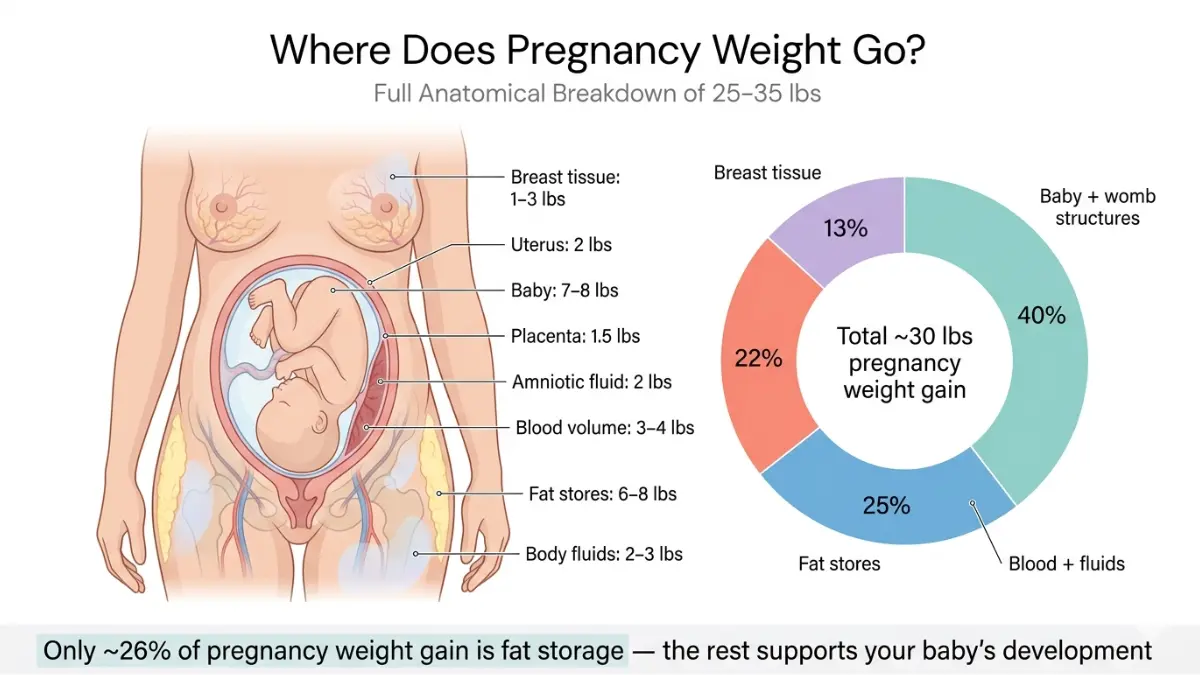
The fat stores deserve special mention. They are not excess weight — they are your body’s pre-built energy reserve for breastfeeding. Breastfeeding burns approximately 300–500 calories per day. Those stored calories are what fuels that process in the weeks after delivery.
💡 What This Means For You: Every pound of healthy gestational weight gain is doing something purposeful. The goal was never to gain as little as possible — it was to gain the right amount.
After delivery, you’ll immediately lose 10–13 lbs from the baby, placenta, and amniotic fluid. Most women return to their pre-pregnancy weight within 6–12 months. Our Weight Loss Calculator can help you plan a safe, gradual postpartum strategy once your provider clears you.
Warning Signs — When Pregnancy Weight Gain Becomes a Medical Concern
This is the section no other pregnancy weight gain calculator page includes — and it may be the most important one.
⚠️ Signs You May Be Gaining Too Much Weight
Gaining above your IOM range raises the risk of:
- Gestational diabetes — Excess weight gain, particularly in the second trimester, increases insulin resistance. According to the March of Dimes on gestational diabetes, about 6 in every 100 U.S. pregnancies are affected.
- Fetal macrosomia — A baby born over 8 lbs 13 oz carries higher risk of birth injuries and C-section delivery.
- Preeclampsia — Sudden weight gain of 3+ lbs in one week, especially with face/hand swelling, can be an early warning sign. This is a medical emergency.
- Postpartum weight retention — Women who gain significantly above IOM guidelines are statistically more likely to retain pregnancy weight long-term.
🔴 Call your provider immediately if you notice:
- Gain of 3 or more lbs in a single week
- Sudden swelling in hands, feet, or face
- Headaches combined with vision changes
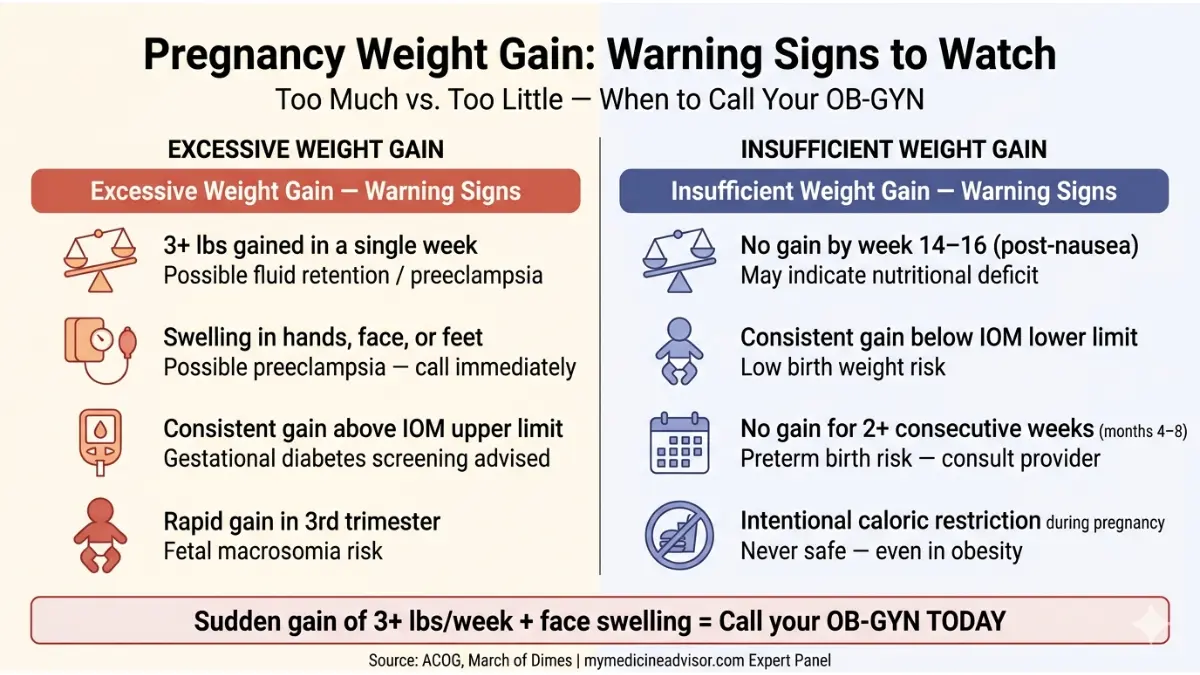
⚠️ Signs You May Be Gaining Too Little Weight
Insufficient gestational weight gain carries its own serious risks:
- Low birth weight — Babies born under 5 lbs 8 oz are at higher risk of breathing problems, developmental delays, and NICU admission.
- Preterm birth — Research shows insufficient weight gain in the second and third trimesters is independently associated with increased preterm delivery risk.
- Nutrient deprivation — The baby will pull what it needs from maternal stores, leaving the mother deficient in iron, calcium, and B12.
🟡 Speak to your provider if:
- You haven’t gained any weight by week 14–16 (outside of first-trimester nausea)
- You’re consistently below the lower planning range on your week-by-week calculator
- You’re restricting food intake to avoid weight gain — this is never safe during pregnancy
Use our Blood Sugar Converter if your provider orders glucose testing as part of gestational diabetes screening.
💡 What This Means For You: Your pregnancy weight gain calculator is a monitoring tool, not a diagnosis. Consistent deviations from your planning range — in either direction — are the signal to call your OB, not to self-adjust your diet.
How to Stay Within Your Healthy Pregnancy Weight Gain Range
Healthy gestational weight gain is almost never about eating less. It’s about eating better and moving smarter.
Nutrition: What Actually Needs to Change
The “eating for two” myth is one of the most damaging in obstetric care.
You do not need double the calories. According to the CDC pregnancy weight gain page:
- First trimester: No extra calories needed
- Second trimester: Add ~340 calories per day
- Third trimester: Add ~450 calories per day
That’s roughly one extra healthy snack. Not a second meal.
Focus nutrients, not just calories:
- Iron — Needed to support your 50% increase in blood volume. Found in lean red meat, beans, fortified cereals, and spinach.
- Calcium — 1,000 mg/day to support fetal bone formation without depleting yours.
- Folate/Folic Acid — Critical for neural tube development, especially in the first trimester.
- Omega-3 (DHA) — Supports fetal brain development; found in fatty fish and prenatal supplements.
- Protein — Essential for tissue building throughout all three trimesters.
Our Protein Intake Calculator and Water Intake Calculator can help you dial in your daily targets based on your current pregnancy week and weight. For a full macro breakdown, use our Macro Calculator.
Exercise: Safe Movement During Pregnancy
ACOG recommends at least 150 minutes of moderate-intensity exercise per week during uncomplicated pregnancies. Safe activities include:
- Walking — The most universally recommended prenatal exercise
- Swimming — Low-impact, ideal in the third trimester
- Prenatal yoga — Improves flexibility and reduces lower back pain
- Stationary cycling — Safe and effective throughout pregnancy
Keep your heart rate at a conversational level. Use our Heart Rate Zone Calculator to identify your safe exercise heart rate zone during pregnancy — always confirm the appropriate zone with your OB-GYN.
Avoid: Contact sports, activities with fall risk, hot yoga, and any exercise that causes dizziness or shortness of breath.
Postpartum: What to Expect After Delivery
At delivery, you’ll lose 10–13 lbs immediately — baby, placenta, and amniotic fluid. Over the following weeks, blood volume and fluid decrease further.
Realistic timeline:
- Weeks 1–6: 10–15 lbs lost naturally
- Months 2–6: Gradual loss with healthy eating; breastfeeding accelerates this
- Months 6–12: Most women reach pre-pregnancy weight with consistent effort
💡 What This Means For You: Your body grew a human being. Give it the same patience you gave your pregnancy. A gradual, sustainable approach beats restriction every time.
How to Use This Pregnancy Weight Gain Calculator (Step-by-Step)
Our Pregnancy Weight Gain Calculator is built on IOM and ACOG 2026 clinical guidelines and gives you significantly more data than the basic tools on Calculator.net or OmniCalculator.
Here’s exactly how to use it:
- Select your unit system — Metric (kg/cm) or Imperial (lb/ft/in)
- Choose pregnancy type — Singleton or Twins
- Enter your current pregnancy week — Weeks 1–42 accepted
- Enter your height — Used to calculate pre-pregnancy BMI
- Enter your pre-pregnancy weight — The weight you were before becoming pregnant
- Enter your current weight — Your weight today
- Click “Calculate” — Results appear instantly below
What you get:
- Your pre-pregnancy BMI and category
- Your IOM recommended total weight gain range
- Your current-week planning range (low / mid / high)
- Your current gain status (within range, above, or below)
- Remaining gain needed to reach your targets
- Projected total gain at week 40 based on your current pace
- A complete week-by-week planning table (weeks 1–40)
- A downloadable CSV to share with your OB-GYN or midwife
Don’t know your current pregnancy week? Calculate it first with our Pregnancy Due Date Calculator. Want to track your baby’s size alongside your weight? Use our Fetal Growth Percentile Calculator for a complete prenatal health picture.
What Our Medical Expert Says
“One of the most common concerns I hear from patients is that they’re gaining ‘too much’ or ‘too little’ — but the question only makes sense relative to their pre-pregnancy BMI and how far along they are. A week-by-week pregnancy weight gain calculator removes the guesswork. What matters is the trend over several weeks, not one number on a scale.”
— Dr. Priya Nair, MD, OB-GYN, mymedicineadvisor.com Expert Panel
Frequently Asked Questions About Pregnancy Weight Gain
1. How much weight should I gain during pregnancy?
It depends on your pre-pregnancy BMI. Normal-weight women (BMI 18.5–24.9) should gain 25–35 lbs. Underweight women should gain 28–40 lbs. Overweight women should gain 15–25 lbs. Women with obesity (BMI 30+) should aim for 11–20 lbs. Use the calculator above for a personalised week-by-week breakdown.
2. Is it normal to lose weight in the first trimester?
Yes, it’s common. Morning sickness, food aversions, and nausea can cause mild first-trimester weight loss. This is generally not a concern as long as you can stay hydrated and eat when possible. Severe or persistent vomiting may indicate hyperemesis gravidarum — consult your provider immediately.
3. How much weight do you gain in the first trimester?
Most women gain just 1–4 lbs during the entire first trimester (weeks 1–13). Some gain nothing. A small number experience slight weight loss. The baby is still very small at this stage, and most early changes are hormonal, not physical.
4. What happens if I gain too much weight during pregnancy?
Excessive gestational weight gain raises the risk of gestational diabetes, fetal macrosomia (large baby), preeclampsia, prolonged labour, C-section delivery, and postpartum weight retention. Gaining 3+ lbs in a single week — especially with swelling — warrants an immediate call to your OB.
5. How much weight do you lose immediately after giving birth?
Most women lose 10–13 lbs at delivery — from the baby (~7–8 lbs), placenta (~1.5 lbs), and amniotic fluid (~2 lbs). Additional fluid loss continues over the following days and weeks as blood volume normalises.
6. How accurate is a pregnancy weight gain calculator?
A good calculator based on IOM guidelines — like ours — gives you a clinically validated planning range, not a medical diagnosis. It’s accurate as a tracking and planning tool. For medical decisions, always defer to your OB-GYN who can factor in individual health history.
7. Does pregnancy weight gain differ for twins?
Significantly, yes. Women carrying twins should gain considerably more — typically 37–54 lbs for normal-weight women. Our calculator includes a separate Twin Pregnancy mode to reflect these higher targets.
8. How many extra calories do I need during pregnancy?
Zero extra calories in the first trimester. Approximately 340 additional calories per day in the second trimester, and 450 per day in the third. That’s equivalent to one nutritious snack — not a full extra meal.
9. Can being overweight affect my pregnancy weight gain goal?
Yes. Women with a pre-pregnancy BMI of 25–29.9 should target 15–25 lbs total. Women with a BMI of 30+ should target 11–20 lbs. Lower targets for overweight and obese women don’t mean restricting nutrition — they mean supporting the baby without excess fat accumulation that raises complication risk.
10. What is the IOM guideline for gestational weight gain?
The Institute of Medicine (IOM) published its current evidence-based gestational weight gain guidelines in 2009. These remain the gold standard, endorsed by ACOG and the CDC. They categorise recommended gain by pre-pregnancy BMI for both singleton and twin pregnancies.
11. How do I use my pre-pregnancy BMI in a weight gain calculator?
Enter your height and your weight before you became pregnant. The calculator automatically computes your BMI and assigns you to the correct IOM category. If you’re unsure of your pre-pregnancy weight, use your most recent measurement from before conception or your first prenatal appointment.
⚕️ Medical Disclaimer: This content is for educational purposes only. It does not replace advice from a licensed medical professional. If you have concerns about your pregnancy weight gain, contact your OB-GYN, midwife, or healthcare provider.
About this content
How this article was put together: researched from recognised health sources, drafted with the help of AI tools, and edited by hand, with sources linked throughout.

Sameer Patel is the founder and editor of My Medicine Advisor. He is not a doctor or medical professional — before starting this site he worked in banking,…
Medical disclaimer
The content on MyMedicineAdvisor is provided for general informational and educational purposes only and is not a substitute for professional medical advice, diagnosis, or treatment. Health information on this website should not be used to diagnose, treat, cure, or prevent any condition without guidance from a qualified healthcare professional. Always seek the advice of your doctor, physician, or another licensed healthcare provider with any questions you may have regarding a medical condition, symptoms, medications, or treatment decisions.