Intermittent Fasting Calculator
Plan a fasting routine with detailed eating-window times, weekly fasting totals, wake-and-sleep overlap analysis, meal timing suggestions, protocol comparisons, and a 7-day schedule view.
Inputs
Results
Selected protocol
—
Goal focus
—
Eating window
—
Fasting window
—
Weekly fasting time
—
Monthly fasting time
—
First meal
—
Last calorie intake
—
Fast after waking
—
Gap before bedtime
—
Sleep spent fasting
—
Awake time fasting
—
Schedule fit note
Protocol comparison
| Plan | Fast | Eat | Window start | Window end | Weekly fasting | Notes |
|---|
Suggested meal timing inside your eating window
| Meal | Suggested time | Spacing | Note |
|---|
Daily rhythm analysis
| Metric | Meaning | Value |
|---|
7-day schedule preview
| Date | Eating window | Window end day | Fast duration | Fast completes | Fast after wake |
|---|
Results appear after you click “Calculate.”
Guide
How to use this tool
- Pick a fasting protocol such as 14:10, 16:8, 18:6, 20:4, OMAD, or a custom fast length.
- Set the eating window by either its start time or its end time.
- Add wake-up time and bedtime so the calculator can show whether fasting happens mostly during sleep or mostly while awake.
- Use the meal-timing table to spread meals or snacks inside your chosen window.
- Compare other protocols in the results table before locking in a routine.
When extra care is needed
- You use insulin, sulfonylureas, or other glucose-lowering medicines.
- You are pregnant, breastfeeding, under 18, or are an older frail adult.
- You have a history of an eating disorder.
- You become dizzy, weak, excessively hungry, dehydrated, or unwell during fasting periods.
- You have a major medical condition and want a medically tailored fasting plan.
On This Page – Quick Medical Summary
An intermittent fasting calculator tells you exactly when to eat and when to stop — personalized to your wake time, bedtime, and chosen protocol. Use the MD-verified tool above to generate your fasting window instantly. Below, our expert panel explains how to read your results, choose the right protocol, fast safely, and maximize every hour of your fasting window.
How to Use This Intermittent Fasting Calculator
Most intermittent fasting calculators give you a single start and stop time. This one goes further. It analyzes your sleep-fasting overlap, shows your daily rhythm breakdown, compares all major protocols side by side, and generates a full 7-day schedule — features no top competitor currently offers.
Here is exactly how to use it.
Step 1 — Enter Your Age and Goal
- Your age determines how the tool flags safety thresholds.
- Your goal — fat-loss planning, routine consistency, maintenance, or meal-timing discipline — tailors the output framing to your intent.
Step 2 — Choose Your Fasting Protocol
Select from 12:12, 14:10, 16:8, 18:6, 20:4, OMAD, or a custom fasting duration. If you are unsure which protocol suits you, leave the default at 16:8 — it is the most studied time-restricted eating schedule and the safest starting point for most healthy adults.
Step 3 — Anchor Your Eating Window
You can anchor the calculator by either:
- Eating window start time — the time you plan to have your first meal or calorie-containing drink
- Eating window end time — the time you plan to stop eating for the day
For most people working 9-to-5 schedules in the US, setting a 12:00 PM start on a 16:8 protocol means eating between noon and 8:00 PM — which fits naturally around work without skipping family dinners.
Step 4 — Enter Wake and Bedtime
This is the feature that separates this tool from every competitor. By entering your wake-up time and bedtime, the calculator shows:
- How much fasting occurs while you sleep (passive fasting — zero willpower needed)
- How much fasting occurs while you are awake (active fasting — the part that requires discipline)
- Whether your eating window overlaps your sleep period (a red flag most people miss)
Step 5 — Read Your Full Output
After clicking Calculate, your results show:
| Output | What It Means |
|---|---|
| Eating window | Your precise start and stop times |
| Fasting window | When your fast begins and ends |
| Weekly fasting hours | Total fasting load per week |
| Fast after waking | How long you continue fasting after waking up |
| Gap before bedtime | Time between last calorie and sleep |
| Sleep spent fasting | Passive fasting hours — the easiest part |
| Awake time fasting | Active fasting hours — the discipline zone |
What This Means For You: If your awake-time fasting is under 4 hours (on a standard 16:8 from noon to 8 PM), you are in the easiest-adherence zone. If it exceeds 6 hours, consider adjusting your anchor time before assuming 16:8 won’t work for your lifestyle.
Before adjusting calorie intake around your fasting schedule, use the free calorie deficit calculator to set your daily energy target first — fasting without a calorie strategy rarely produces consistent fat loss.
Which Intermittent Fasting Protocol Is Right for You?
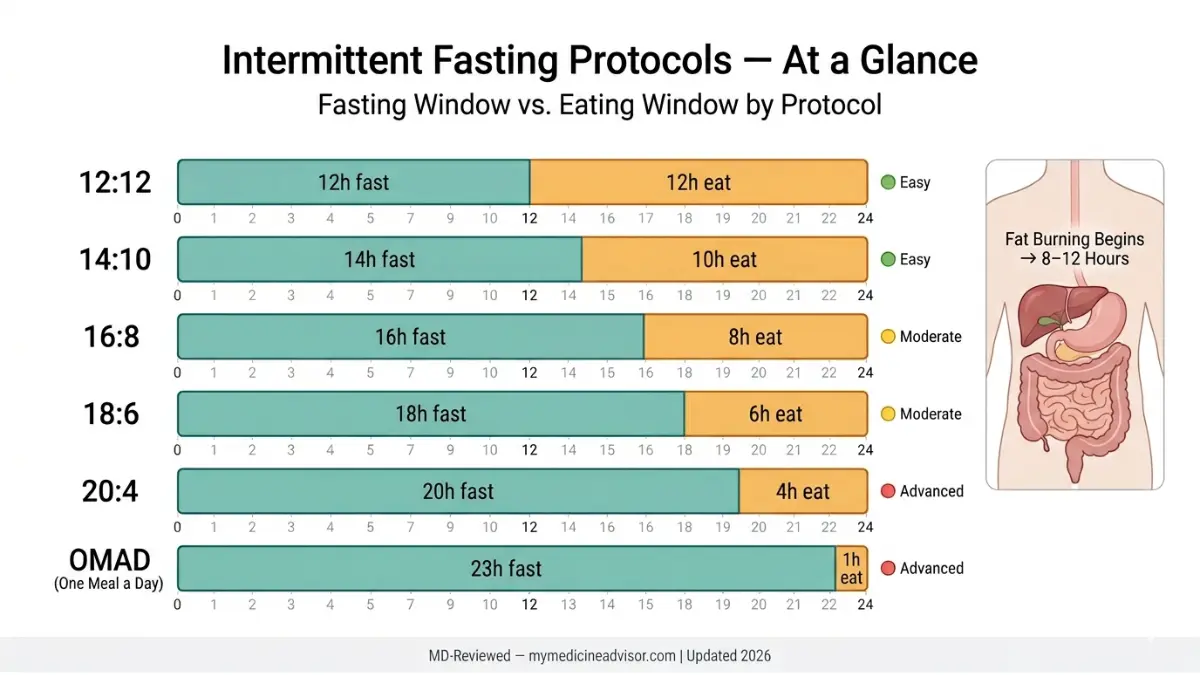
Not all fasting schedules are equal. The right intermittent fasting schedule depends on your body composition goal, work schedule, gender, and medical history. Here is the full comparison that most calculator pages never provide.
Protocol Comparison Table
| Protocol | Fasting Hours | Eating Window | Best For | Difficulty | MD Verdict |
|---|---|---|---|---|---|
| 12:12 | 12h | 12h | Beginners, elderly | ⭐ Easy | Safe entry point |
| 14:10 | 14h | 10h | Women, active adults | ⭐⭐ Moderate | Strong starting protocol |
| 16:8 | 16h | 8h | Most adults, weight loss | ⭐⭐ Moderate | Most evidence-backed |
| 18:6 | 18h | 6h | Experienced fasters | ⭐⭐⭐ Hard | Effective, monitor energy |
| 20:4 | 20h | 4h | Advanced practitioners | ⭐⭐⭐⭐ Demanding | Clinical caution required |
| OMAD | 23h | 1h | Expert level only | ⭐⭐⭐⭐⭐ Extreme | Not recommended without MD guidance |
Best Protocol by Goal
- Fat loss: 16:8 or 18:6. Both methods have shown reductions in body weight, fat mass, waist circumference, LDL cholesterol, and fasting insulin in peer-reviewed meta-analyses published on PubMed.
- Muscle maintenance while cutting: 16:8 with protein-timed meals inside the eating window. Pair with our protein intake calculator to hit your daily protein floor even with fewer meals.
- Blood sugar and insulin management: 14:10 or 16:8. Time-restricted eating improves fasting insulin and HbA1c in overweight and obese adults.
- Longevity and cellular health: 18:6 or longer, for experienced fasters who want to maximize autophagy activation.
Intermittent Fasting for Women — Why the Rules Are Different
This is the section every top competitor omits entirely.
Women’s hormonal systems — particularly the hypothalamic-pituitary-ovarian (HPO) axis — are sensitive to caloric restriction signals. Aggressive fasting (18:6 or OMAD) can disrupt menstrual cycles, suppress luteinizing hormone (LH), and trigger cortisol spikes in some women, especially those with low body fat or high training volume.
MD Recommendation for Women:
- Start at 14:10, not 16:8
- Avoid fasting on high-intensity training days
- Women with PCOS should consult a clinician before starting any fasting protocol — see our PCOS symptoms guide for context
- Do not fast if pregnant — use our pregnancy weight gain calculator instead
Intermittent Fasting for Men Over 40
Testosterone production is influenced by feeding frequency and calorie availability. Men over 40 using aggressive fasting protocols (20:4 or OMAD) may experience reduced testosterone output if they are already in a significant calorie deficit.
Practical fix: Keep total daily calories at maintenance or a modest deficit (10–15% below TDEE), not a severe restriction. Use our BMR calculator to find your baseline before combining fasting with calorie cutting.
What Happens Inside Your Body During a Fast — Hour by Hour
This is the metabolic timeline every fasting calculator should explain — but almost none do.
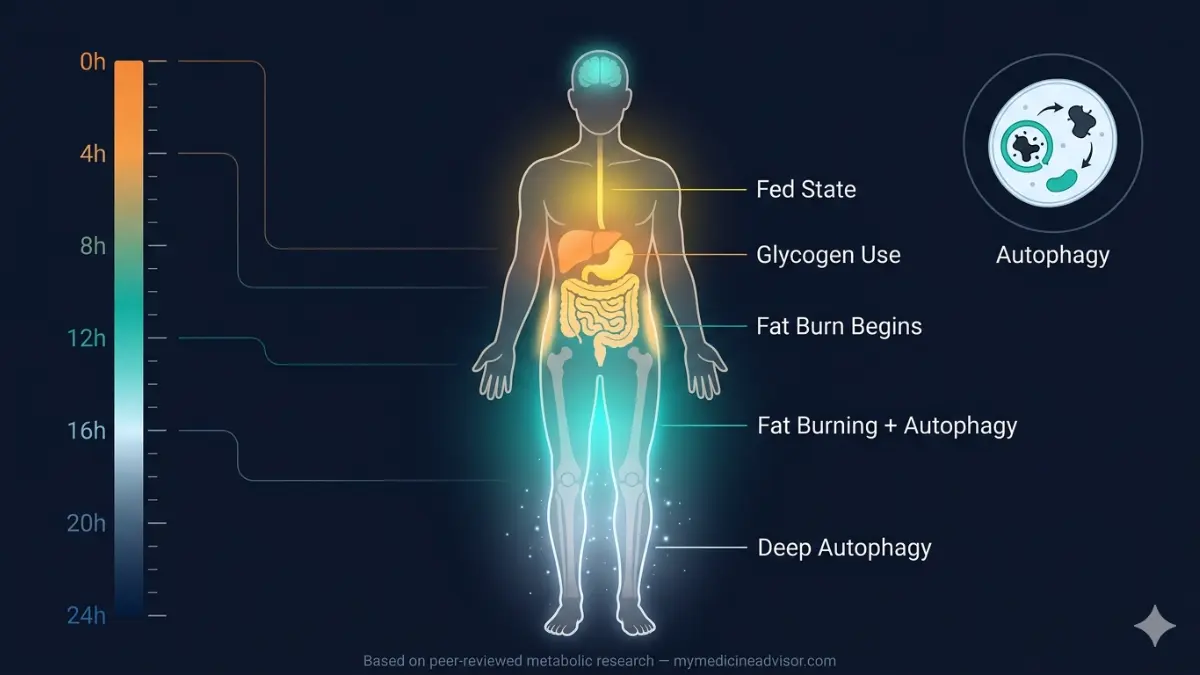
The Metabolic Timeline: 0 to 24 Hours
| Hours Fasted | Metabolic State | What Is Happening | Clinical Note |
|---|---|---|---|
| 0–4h | Fed state | Digestion active, insulin elevated | No fat burning yet |
| 4–8h | Post-absorptive | Insulin dropping, liver glycogen used | Transition begins |
| 8–12h | Early fat oxidation | Glycogen stores depleting, fat access rising | Fat burning begins |
| 12–16h | Active fat burning | Significant fat oxidation, early autophagy signals | The 16:8 sweet spot |
| 16–18h | Deep metabolic shift | Growth hormone rising, ketone production | Maximum benefit zone for most adults |
| 18–24h | Deep autophagy | Cellular cleanup active, ketones elevated | Advanced protocols only |
Source: PMC — Biological Effects of Intermittent Fasting, 2025
When Does Fat Burning Actually Start?
Fat burning meaningfully accelerates between hours 8 and 12 as liver glycogen depletes. This is why a 12:12 fast does produce some benefit — but 16:8 captures the full metabolic window, including the period of highest fat oxidation.
What This Means For You: On a standard 16:8 schedule from noon to 8 PM, the final 4 hours of your fast (8 AM to noon) are your highest fat-burning window. Protect this window — avoid breaking it with cream in coffee, gum with calories, or flavored supplements.
When Does Autophagy Begin? — 2026 Research Update
Autophagy (cellular self-cleaning, linked to the 2016 Nobel Prize in Medicine) begins at low levels around hour 12–14 and increases significantly from hour 16 onward in most adults. Deep autophagy associated with cellular repair requires 18–24+ hours of fasting in current human research.
Important caveat (updated March 2026): Autophagy timing varies significantly by individual metabolic health, prior meal composition, and activity level. High-carbohydrate last meals delay the onset. Low-carbohydrate last meals may accelerate it.
Proven Health Benefits of Intermittent Fasting — 2026 Evidence Summary
Here is what the peer-reviewed science — not fitness blogs — actually confirms about intermittent fasting in 2026.
Weight Loss and Fat Reduction
A 2025 systematic review and meta-analysis published in The BMJ — covering 93 randomized clinical trials — found that all intermittent fasting strategies reduced body weight compared to ad-libitum eating. Alternate-day fasting showed the greatest weight reduction advantage over time-restricted eating approaches.
Key findings across major IF trials:
- 3–8% body weight reduction in trials lasting 3–24 weeks (NEJM review data)
- Significant reductions in waist circumference and fat mass
- LDL cholesterol, triglycerides, and total cholesterol reductions observed across multiple protocols
For a clinical view of how fasting interacts with metabolic markers, the comprehensive PMC umbrella review (2024) is one of the most thorough available.
Insulin Sensitivity and Blood Sugar Control
Time-restricted eating consistently improves fasting insulin levels and insulin sensitivity in overweight and obese adults. This makes the intermittent fasting schedule particularly relevant for people managing pre-diabetes or metabolic syndrome.
Pair your IF schedule with our blood sugar converter to track your fasting glucose values in context — and review our guide on metabolic syndrome signs if you are managing multiple risk factors simultaneously.
Evidence Strength Summary
| Benefit | Evidence Level | Best Protocol |
|---|---|---|
| Weight loss | 🟢 Strong (93 RCTs) | 16:8, ADF |
| Fat mass reduction | 🟢 Strong | 16:8, 18:6 |
| Insulin sensitivity | 🟢 Strong | 16:8, TRE |
| LDL/cholesterol reduction | 🟢 Strong | ADF, 5:2 |
| Autophagy induction | 🟡 Moderate (human data limited) | 18:6+ |
| Brain health/cognition | 🟡 Moderate | Any IF protocol |
| Longevity extension | 🔴 Emerging (mostly animal models) | Extended fasting |
🟢 Strong = multiple high-quality RCTs | 🟡 Moderate = consistent but limited data | 🔴 Emerging = promising, needs more human trials
Who Should NOT Use an Intermittent Fasting Calculator — MD Safety Guide
This section does not appear in any meaningful form on top competitor pages. Every competitor’s “safety” section is a single-paragraph disclaimer. Here is the full clinical picture.
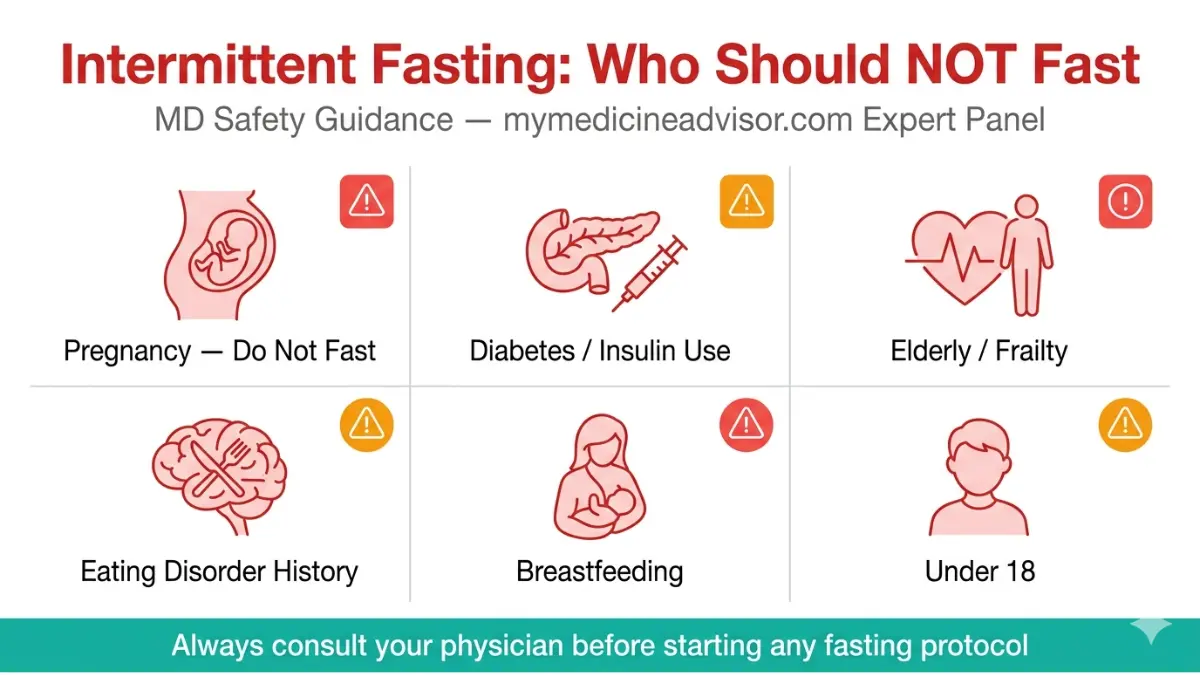
Medical Contraindications — When Fasting Is Clinically Unsafe
| Population | Risk | MD Recommendation |
|---|---|---|
| Pregnant women | Caloric restriction may harm fetal development | Do not fast. Use our pregnancy weight gain calculator |
| Breastfeeding mothers | Insufficient calorie intake reduces milk supply and quality | Avoid fasting windows beyond 12:12 |
| Type 1 diabetics | Fasting can trigger dangerous hypoglycemia | Only with direct clinician supervision |
| Insulin users | Medication timing conflicts with fasting windows | Medical adjustment required before starting |
| SGLT2 inhibitor users | Risk of diabetic ketoacidosis with extended fasting | Consult prescribing physician first |
| Eating disorder history | Fasting structures can reinforce disordered behaviors | Strongly contraindicated without mental health clearance |
| Under age 18 | Developing bodies require consistent fuel | Not recommended |
| Adults with frailty | Muscle loss risk is amplified | 12:12 maximum, with dietitian oversight |
Warning Signs — Stop Fasting Immediately If You Experience:
- Persistent dizziness or lightheadedness
- Heart palpitations or irregular heartbeat
- Severe headaches that do not resolve with water intake
- Extreme weakness or difficulty concentrating
- Nausea or vomiting during fasting periods
- Fainting or near-fainting episodes
If any of these occur, break your fast with a small carbohydrate-containing food and use our symptom checker to assess whether further evaluation is needed.
A Note on Women with PCOS or Thyroid Conditions
Women with PCOS may actually benefit from IF — but the protocol selection matters significantly. Women with hypothyroidism should be cautious, as caloric restriction can lower already-suppressed T3 levels. Always discuss your fasting plan with your physician if you have an active thyroid condition. For context, see our hypothyroidism symptoms guide.
⚕️ Medical Disclaimer: This article and the calculator above are for educational and informational purposes only. They do not constitute medical advice, diagnosis, or treatment. Always consult a qualified healthcare professional before starting any new dietary protocol, especially if you have a pre-existing medical condition or take prescription medication.
How to Maximize Your Intermittent Fasting Results — Expert Protocol Guide
Using the intermittent fasting calculator correctly is step one. Getting results from your fasting schedule requires the right behavior inside and outside your eating window.
What to Eat During Your Eating Window
Your body has a compressed window to absorb all daily nutrients. Nutrient quality becomes more important, not less, when you have fewer hours to eat.
Prioritize in every eating window:
- Protein first — aim for 0.7–1.0g per pound of body weight. Use our protein intake calculator to set your personal target.
- Whole food carbohydrates — sweet potatoes, oats, legumes, fruit. These refuel glycogen without spiking insulin aggressively.
- Healthy fats — avocado, olive oil, nuts. These slow digestion and extend satiety within the eating window.
- Fiber-rich vegetables — at minimum 2 servings per meal to support gut health and slow gastric emptying.
What Breaks Your Fast vs. What Doesn’t
| BREAKS Your Fast ❌ | Does NOT Break Fast ✅ |
|---|---|
| Milk, cream, oat milk in coffee | Black coffee (no additives) |
| Fruit juice, sports drinks | Plain water, sparkling water |
| Protein shakes or BCAA drinks | Plain herbal tea (no sugar) |
| Sweetened electrolytes | Unsweetened electrolytes (some argue fine) |
| Gum with calories | Salt in water |
| “Zero calorie” flavored drinks (debated) | Black tea, green tea |
How to Break Your Fast Correctly
Breaking a 16+ hour fast with a large, high-carbohydrate meal produces a significant insulin spike and often causes bloating, fatigue, and digestive discomfort — the most common reason people abandon IF.
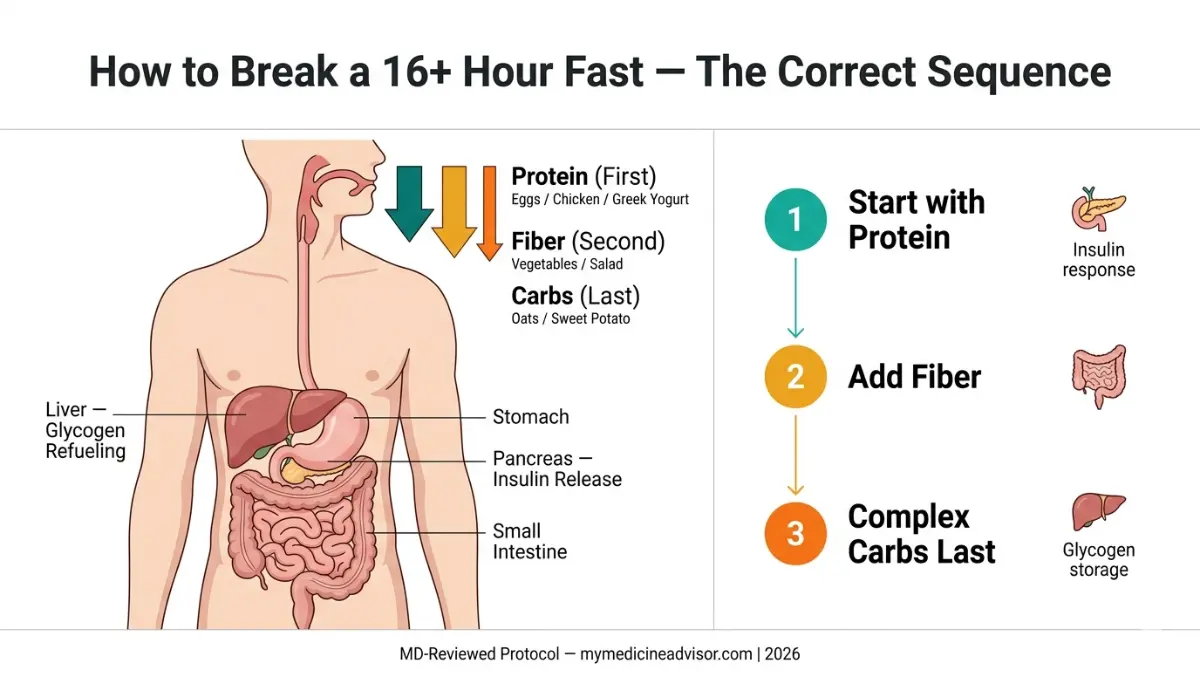
The 3-Step Sequence to Break Your Fast:
- Start with protein — eggs, Greek yogurt, or a small portion of meat. This blunts the insulin response.
- Add fiber — raw vegetables or a small salad alongside the protein.
- Add complex carbohydrates last — not first. This sequence dramatically reduces post-fast digestive distress.
Marcus, a 38-year-old software engineer from Austin, Texas, reported abandoning 16:8 twice before learning this sequence. After switching to a protein-first break-fast approach, he maintained the protocol consistently for 4 months and lost 18 lbs alongside a modest calorie deficit.
Exercise Timing Around Your Fasting Window
- Low-to-moderate intensity cardio (walking, cycling at easy pace): best performed during your fasting window for maximum fat oxidation benefit. Use our heart rate zone calculator to ensure you stay in fat-burning Zone 2.
- Strength training and HIIT: best timed within 1–2 hours of your first meal, or at the start of your eating window. Performance requires available carbohydrates.
- Running or pace-dependent training: schedule within the eating window whenever possible. Our running pace calculator can help time your sessions around your fueling window.
Setting Up Your Weekly Macros
Your macros do not disappear because you are fasting — they compress into a shorter window. Use our macro calculator to set your personalized fat, protein, and carbohydrate targets within your eating window. Fasting without tracking macros is the most common reason people see no progress after 6+ weeks.
Frequently Asked Questions — Intermittent Fasting Calculator
1. What is an intermittent fasting calculator?
An intermittent fasting calculator is a tool that takes your chosen fasting protocol (such as 16:8 or 18:6), your preferred eating window start or end time, and your sleep schedule to generate your precise eating window, fasting window, meal timing suggestions, and a weekly fasting schedule.
2. How do I calculate my fasting window?
Subtract your eating hours from 24. On a 16:8 schedule, your eating window is 8 hours — for example, noon to 8 PM — and your fasting window runs from 8 PM through to noon the next day (16 hours). The calculator above does this automatically and adjusts for your sleep schedule.
3. What is the best intermittent fasting method for beginners?
14:10 is the safest and most sustainable starting point for most beginners. It provides a 14-hour fast (most of which occurs during sleep) and a 10-hour eating window, making it easy to maintain without significant hunger or fatigue. Move to 16:8 after 2–4 weeks if comfortable.
4. Does sleep count toward fasting hours?
Yes — absolutely. Sleep is entirely part of your fasting window. If you finish eating at 8 PM and wake at 7 AM, you have already completed 11 hours of fasting before you even get out of bed. This is one of the reasons 16:8 is far easier than it sounds.
5. Can intermittent fasting help with weight loss?
Yes, with an important condition: you must maintain a calorie deficit within your eating window. Fasting alone does not guarantee weight loss — it creates a structure that makes calorie reduction easier for most people. Use our weight loss calculator to model your projected timeline.
6. How long does it take to see results from intermittent fasting?
Most people notice changes in energy levels and reduced hunger within days 3–7 as the body adapts. Measurable weight loss and waist circumference changes typically appear within 2–4 weeks when combined with appropriate calorie intake.
7. What can I drink during my fasting window?
Safe during fasting: plain water, black coffee (no sugar, cream, or milk), plain green or herbal tea, sparkling water, and unsweetened electrolytes. Anything containing calories — including most “zero calorie” flavored drinks — may trigger an insulin response and partially break the fast in some individuals.
8. Is 16:8 or 18:6 better for fat loss?
Both are effective. The 2025 BMJ meta-analysis found comparable weight loss between most daily fasting protocols when calories were controlled. 16:8 has better long-term adherence data — and adherence always beats protocol aggressiveness. Start at 16:8 and move to 18:6 only when 16:8 feels effortless.
9. Can women do intermittent fasting safely?
Yes — but with adjustments. Women should start at 14:10 rather than 16:8, avoid fasting on high-intensity training days, and monitor menstrual cycle regularity as a key adherence signal. Women who are pregnant or breastfeeding should not use a fasting calculator — see the safety section above.
10. What breaks a fast?
Any calorie-containing food or drink breaks a fast. This includes milk in coffee, flavored waters with sugar, protein powders, and fruit juice. Plain black coffee, water, and unsweetened plain tea are safe. A full breakdown is in the table in Section 6 above.
11. When does autophagy start during intermittent fasting?
Current research indicates that autophagy begins to measurably increase after 14–16 hours of fasting in most adults, with deeper cellular repair processes becoming active between 16 and 24 hours. The exact timing varies based on your prior meal composition, metabolic health, and activity level. High-carbohydrate last meals significantly delay autophagy onset.
About this content
How this article was put together: researched from recognised health sources, drafted with the help of AI tools, and edited by hand, with sources linked throughout.

Sameer Patel is the founder and editor of My Medicine Advisor. He is not a doctor or medical professional — before starting this site he worked in banking,…
Medical disclaimer
The content on MyMedicineAdvisor is provided for general informational and educational purposes only and is not a substitute for professional medical advice, diagnosis, or treatment. Health information on this website should not be used to diagnose, treat, cure, or prevent any condition without guidance from a qualified healthcare professional. Always seek the advice of your doctor, physician, or another licensed healthcare provider with any questions you may have regarding a medical condition, symptoms, medications, or treatment decisions.