
On This Page – Quick Medical Summary
A high TSH result usually points toward an underactive thyroid. It does not always, and rarely on the strength of one test.
TSH can read high for four distinct reasons: the thyroid is genuinely struggling, ordinary day-to-day variation pushed the number over the line, something temporary moved it, or the test itself was affected. Where you fit decides what happens next.
Route yourself. If your free T4 came back normal, start with variation and temporary causes. If you already take levothyroxine and your number climbed, go to absorption. If your TSH is high in isolation and nothing else fits, read the section on lab interference. Most people with a persistently raised TSH do have thyroid disease — a single raised reading is a different thing.
ℹ️ Medical Disclaimer: This article explains how TSH results are interpreted. It does not diagnose thyroid disease, recommend or adjust any medication, interpret your specific result, or advise on procedures or insurance coverage. Decisions about testing, treatment and dose belong to a board-certified endocrinologist or your primary care clinician, who can see your full results and history.
Why TSH rises when your thyroid hormone is still normal
The most confusing result in thyroid function testing is a high TSH sitting next to a normal free T4. It is not a contradiction. It is a system compensating.
TSH is a pituitary hormone, not a thyroid hormone
TSH is made by the pituitary gland, not the thyroid. It is the instruction, not the product — which is why a high TSH means the pituitary is pushing harder, not that you have too much thyroid hormone. You can read more about what the TSH test measures at MedlinePlus.
Why a small T4 drop causes a large TSH rise
🔬 How It Works: The pituitary watches circulating thyroid hormone and adjusts TSH to keep it steady. The relationship is logarithmic, so a small fall in T4 produces a much larger rise in TSH. That amplification is what makes TSH a sensitive early signal — and what makes borderline results so common.
What antibody testing adds
Each person has an individual pituitary setpoint, which is why your own TSH varies far less than the population range suggests. Thyroid peroxidase antibodies help separate genuine early thyroid failure from the other causes in this article.
Normal variation that can push TSH over the line
Before treating a borderline number as a diagnosis, it helps to know how much TSH moves on its own.
Time of day
📊 Clinical Data Point: In people with normal thyroid function, the circadian rhythm is the single largest source of TSH variation, with an overnight surge around 02:00–04:00 and a daytime low — Source: Within-Person Variation in Serum Thyrotropin Concentrations, PMC/NIH, 2021.
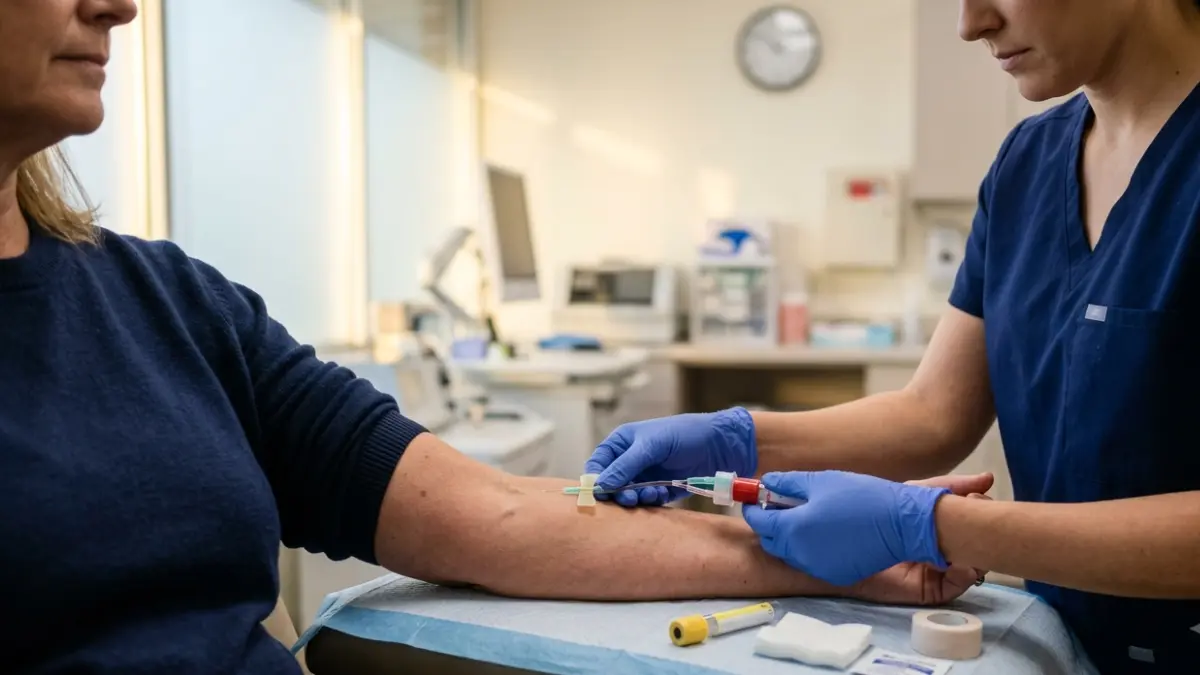
The same person can cross the upper limit before dawn and sit mid-range by afternoon, which is why when your blood was drawn matters.
Age
TSH rises across the lifespan. In NHANES III, 14% of people older than 85 had a TSH above 4.5 mIU/L — a level that would be flagged as abnormal at 30.
Weight, season and the range itself
TSH runs modestly higher in people with obesity and may fall after weight loss. Levels are generally higher in winter. And because reference ranges are built from the middle 95% of a healthy population, roughly 2.5% of perfectly well people sit above the upper limit by definition — a point covered in this clinical reference on transient TSH elevation.
Temporary causes: illness, recovery and thyroid inflammation
A result taken in a difficult week is not a baseline.

Recovering from an illness raises TSH
During serious illness TSH is often normal or low, then rises during the recovery phase — a pattern described in the NIH’s reference chapter on non-thyroidal illness. A blood test drawn in that window can look like new thyroid disease and resolve without treatment.
Thyroid inflammation has phases
Thyroiditis, including the postpartum form, moves through phases that can leave TSH temporarily high before it settles.
When a repeat test is done
📊 Clinical Data Point: In a six-month follow-up of screening-detected subclinical hypothyroidism, 73.8% of participants became euthyroid and 12.2% progressed to biochemical hypothyroidism — Source: peer-reviewed cohort, PubMed, 2021. Among hospitalised patients with mild elevation who were readmitted, thyroid function had improved in 79.4% — Source: retrospective cohort, PMC/NIH, 2021.
Clinical practice is to confirm stability over weeks before diagnosing, which is why mildly raised results are usually monitored first.
✅ Patient Action: Ask your primary care clinician or endocrinologist: “My result was taken during/just after illness — should we repeat the TSH with a free T4 and thyroid antibodies before deciding anything?”
Medications, supplements and absorption problems
If you take thyroid medication daily and your TSH still climbed, the dose is not the only variable.
Why TSH can rise even if you never miss a dose
Levothyroxine has to be absorbed to work. A documented list of drugs and foods that block thyroxine absorption includes calcium carbonate, ferrous sulphate, aluminium-containing antacids, sucralfate, bile acid sequestrants, phosphate binders, raloxifene and proton-pump inhibitors, plus food, dietary fibre and espresso coffee. Coeliac disease, inflammatory bowel disease, H. pylori infection and atrophic gastritis do the same from the gut side — the timing and interaction details are covered separately.
Drugs that affect the thyroid directly
Amiodarone carries a large iodine load and can push thyroid function either way. Lithium affects hormone release, and enzyme-inducing anticonvulsants such as carbamazepine, phenobarbital and phenytoin increase how much levothyroxine the body needs.
⚠️ Clinical Warning: Never change a levothyroxine dose, or the spacing between it and another medicine, on your own. Separation intervals differ by drug, and guessing can swing TSH in either direction. Bring the full list to your prescriber or pharmacist instead.
When the test itself is wrong
A falsely high TSH is uncommon, but it happens through specific, identifiable mechanisms — and it is worth knowing them if your result fits nothing else.
Macro-TSH
📊 Clinical Data Point: Macro-TSH — TSH bound into a large, biologically inactive complex that assays still measure — has a reported prevalence of 0.6% to 1.6% — Source: European Thyroid Journal; 1.09% in a 1,500-patient series, Indian Journal of Endocrinology and Metabolism.
Antibodies that confuse the assay
Heterophile and human anti-mouse antibodies interfere in an estimated 0.05% to 6.0% of samples depending on the platform, and falsely high results are the more common direction in sandwich assays such as TSH.
The biotin myth, corrected
Biotin is widely blamed for high TSH. The direction is backwards: the FDA’s warning on biotin and lab tests notes interference can run either way, and in thyroid panels high-dose biotin characteristically produces a falsely low TSH alongside raised T4 and T3 — a picture resembling an overactive thyroid. Stopping biotin before testing still matters; it just isn’t why your TSH is high.
Rare causes, and when to see a specialist
Two rare causes come up in searches and frighten people out of proportion to their frequency.
Pituitary and resistance causes
TSH-secreting pituitary adenomas make up roughly 0.5% to 2% of all pituitary adenomas, and they raise TSH together with high free T4 and T3. That combination is the distinguishing feature — it is not the high-TSH-with-normal-T4 pattern most readers are holding. Resistance to thyroid hormone produces a similar lab picture and is also uncommon.
✅ Patient Action: If both your TSH and free T4 are above range, ask an endocrinologist directly: “What explains a raised TSH alongside a raised free T4 in my case?”
Referral is also reasonable when TSH stays above range on a repeat test, or keeps rising on a stable levothyroxine dose.
Common questions about high TSH
1. Can TSH be high without having hypothyroidism?
Yes. Normal daily variation, recent illness, medication effects and rare lab interference can all raise TSH while thyroid hormone stays normal.
2. What counts as a mildly high TSH?
Most laboratories set the upper limit near 4.0–4.5 mIU/L, so results sitting just above that are described as mildly high.
3. Does a high TSH always mean I need medication?
No. It depends on how high the TSH is, your free T4, antibodies and symptoms. Discuss those thresholds with your clinician.
4. Should I retest my TSH, and when?
A single high TSH is usually repeated weeks later alongside free T4 before any diagnosis. Ask your clinician about the right interval.
5. Does being sick raise TSH?
TSH can rise during recovery from illness, which is why results taken around a hospital stay are commonly rechecked afterwards.
6. Does weight affect TSH levels?
TSH runs modestly higher in people with obesity and may fall after weight loss, though it often remains inside the reference range.
7. Does TSH go up with age?
Yes. In NHANES III, 14% of people older than 85 had a TSH above 4.5 mIU/L, a level flagged as abnormal in younger adults.
8. Why did my TSH rise if I take levothyroxine every day?
Calcium, iron, antacids, coffee and gut conditions can block absorption. Review the timing of every medicine with your prescriber.
9. Does biotin raise TSH?
No. High-dose biotin typically causes a falsely low TSH with raised T4 and T3, resembling an overactive thyroid instead.
10. Can a pituitary tumour cause high TSH?
Rarely. TSH-secreting adenomas raise TSH alongside high free T4 and T3, not the high-TSH-with-normal-T4 pattern most people see.
11. When should I see an endocrinologist for high TSH?
Consider referral if TSH and free T4 are both high, TSH stays above range on repeat, or rises on stable levothyroxine.
What to do with your result
Write down three things before your next appointment: what time of day your blood was drawn, whether you were ill or recovering in the preceding weeks, and every medicine and supplement you take with its timing.
That single page turns a number you can’t interpret into a conversation your clinician can act on.
About this content
How this article was put together: researched from recognised health sources, drafted with the help of AI tools, and edited by hand, with sources linked throughout.

Sameer Patel is the founder and editor of My Medicine Advisor. He is not a doctor or medical professional — before starting this site he worked in banking,…
Medical disclaimer
The content on MyMedicineAdvisor is provided for general informational and educational purposes only and is not a substitute for professional medical advice, diagnosis, or treatment. Health information on this website should not be used to diagnose, treat, cure, or prevent any condition without guidance from a qualified healthcare professional. Always seek the advice of your doctor, physician, or another licensed healthcare provider with any questions you may have regarding a medical condition, symptoms, medications, or treatment decisions.