

On This Page – Quick Medical Summary
Your report has one number flagged, or two you can’t connect
Most people arrive here holding a thyroid panel with a TSH value on it, and either a free T4 line they can’t interpret or no second number at all. What your results mean comes from how the values read together — a single figure rarely settles anything.
Start where your situation fits:
- You want the TSH figure itself in context first — see how TSH values shift across age groups
- You have both TSH and free T4 on the page — skip to the pattern table
- Your results look normal but you feel unwell — go to the section on misleading results
- You have an antibody line you don’t recognise — go to the antibody sections
ℹ️ Medical Disclaimer: This article explains what thyroid tests measure and how clinicians read them together. It does not diagnose thyroid disease, recommend or adjust any medication, interpret your individual results, or advise on testing you should request. Reference ranges differ by laboratory and assay, so your own report and a board-certified endocrinologist or primary care physician govern any decision about testing, monitoring or treatment.
What TSH and free T4 each actually measure
TSH is a signal sent by your pituitary gland asking the thyroid to work harder; free T4 is the unbound thyroid hormone already circulating and entering your tissues. One measures demand, the other measures supply.
TSH is a request, not a supply
TSH is made by the pituitary, not the thyroid. It rises when the gland underproduces, which is why a TSH test is the usual first step.
Free T4 is the hormone that reaches your tissues
Total T4 includes hormone bound to carrier proteins. Free T4 measures only the unbound fraction able to enter cells and act, which is why it tracks gland function more closely alongside TSH.
Why labs test TSH first
TSH shifts before hormone levels do, so laboratories commonly measure it first and add free T4 when TSH comes back abnormal.
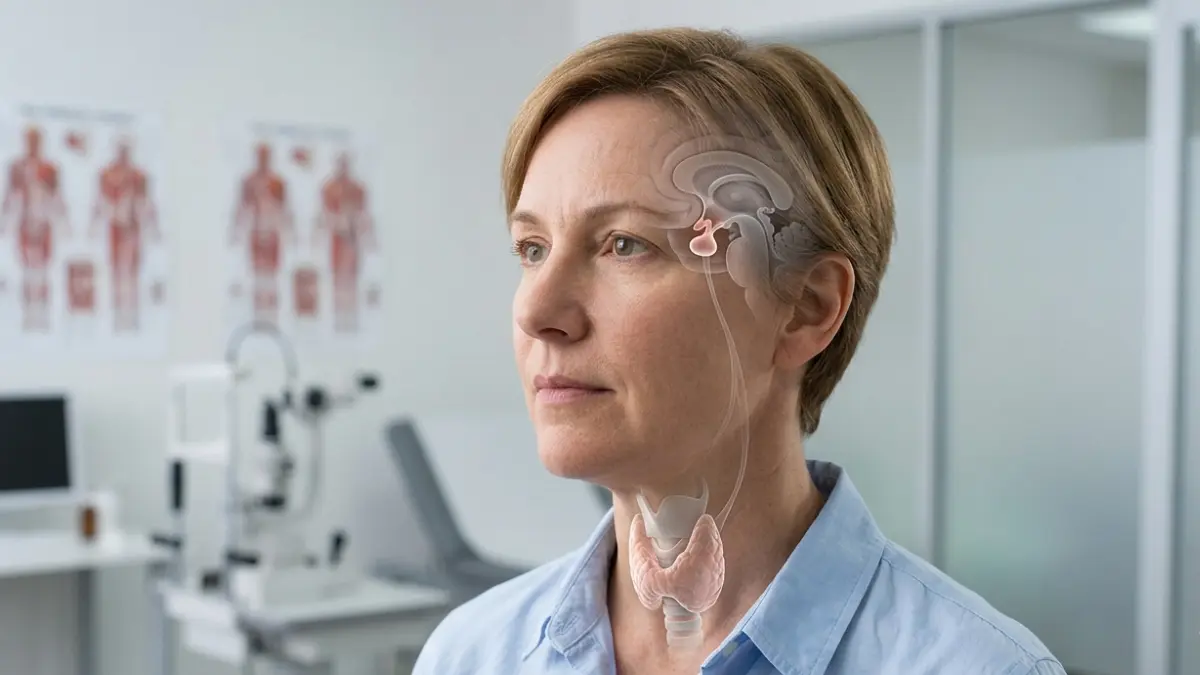
🔬 How It Works: Your pituitary constantly samples circulating thyroid hormone. When it senses too little, it raises TSH output to push the thyroid harder — so a high TSH often means the pituitary is compensating for a gland that is falling behind.
How your TSH and free T4 read together
Clinicians read the pair as a combination. These are the four patterns, plus the normal one.
| TSH | Free T4 | What this pattern is usually called | Key clinical detail |
|---|---|---|---|
| High | Low | Primary hypothyroidism | The problem is in the thyroid gland itself |
| High | Normal | Subclinical (mild) hypothyroidism | The pituitary is compensating; hormone output still holds |
| Low | High | Hyperthyroidism | Gland producing more hormone than the body signals for |
| Low or normal | Low | Central hypothyroidism | Points to the pituitary or hypothalamus; uncommon |
| Normal | Normal | No current evidence of thyroid dysfunction | Symptoms may have another cause |
Pattern definitions verified against the American Thyroid Association’s thyroid function tests guidance and NIDDK’s thyroid tests overview, September 2026.

This table names the pattern, not the action
Finding your row tells you what the combination is called. It does not establish a diagnosis or indicate whether treatment is warranted — the high-TSH-with-normal-free-T4 row alone covers a decision that clinicians weigh case by case.
Your lab’s range beats any chart
Reference intervals are assay-specific, so read each value against the range printed on your own report rather than a number published anywhere else.
When TSH alone gives the wrong picture
A TSH result can sit inside its range while something real is happening, and it can sit outside its range for reasons unrelated to thyroid disease.
When the pituitary is the problem
Central hypothyroidism shows low free T4 with a TSH that is low, normal, or only slightly raised. A TSH-only panel cannot detect it, which is the main reason free T4 exists as a separate test.
Biotin and supplement interference
Biotin, common in hair, skin and nail supplements, can interfere with immunoassays and produce results that are falsely high or falsely low depending on the test, sometimes without any flag. The FDA has published warnings on biotin interference with lab tests, and there is specific guidance on biotin timing before a thyroid draw.
Illness, age and recent dose changes
Serious non-thyroid illness can lower TSH temporarily, and TSH tends to run higher in older adults. Persistent symptoms alongside normal results are worth raising rather than dismissing.
⚠️ Clinical Warning: Do not stop a biotin supplement on your own before a blood draw to “fix” a result. Tell the ordering clinician and the laboratory that you take it, so the result can be interpreted or the sample retested appropriately.
What thyroid antibodies add that hormone tests can’t
TSH and free T4 describe how the gland is functioning. Thyroid antibody tests address a different question: why.
TPO antibodies and Hashimoto’s
High thyroid peroxidase antibodies are a sign that Hashimoto’s disease is behind hypothyroidism, which NIDDK identifies as the most common cause of an underactive thyroid in the United States. A positive result names a likely cause; it is not by itself a diagnosis.
Thyroglobulin and TSH receptor antibodies
Thyroglobulin antibodies are measured less often and carry weaker standalone meaning. TSH receptor antibodies are associated with Graves’ disease, the most common cause of an overactive thyroid.
When antibody testing is usually ordered
Antibody tests are generally added after hormone tests already show a problem, and they more often explain a result than change what is done next.
What a positive antibody result changes about your risk
Seeing “autoimmune” on a report is alarming. Population data make the finding easier to place.
How common thyroid antibodies actually are
📊 Clinical Data Point: In NHANES III, a national sample of 17,353 people, TPO antibodies were positive in 11.3% and thyroglobulin antibodies in 10.4%; hypothyroidism was found in 4.6% of the US population — 0.3% clinical and 4.3% subclinical — Source: Hollowell et al., J Clin Endocrinol Metab, 2002 (PMID 11836274).
What the cohort data show
📊 Clinical Data Point: In the Whickham survey’s 20-year follow-up, the odds of developing hypothyroidism were 8 in women and 44 in men with raised TSH alone, and 38 and 173 respectively when raised TSH and antithyroid antibodies were present together — Source: Vanderpump et al., Clinical Endocrinology, 1995 (PMID 7641412).
These are group comparisons across two decades, not a prediction about any one person, and they are why a positive antibody result usually changes monitoring interval rather than immediate treatment.
What to ask before more thyroid tests are ordered
Four questions cover most of what this article can’t decide for you.
Questions worth asking
- Does my result pattern need a repeat draw before any decision?
- Should free T4 be measured on the same sample as TSH?
- Would an antibody result change what we do, or only what we call it?
- Given my age and other conditions, what range applies to me?
✅ Patient Action: Bring a written symptom list to the appointment — the Symptom Checker can help you turn vague complaints into specifics. Ask your primary care physician whether an endocrinology referral is warranted if free T4 is low with a normal TSH.
Common questions about TSH, free T4 and thyroid antibodies
1. Is free T4 more accurate than TSH?
Neither is more accurate. TSH shifts earliest, while free T4 shows circulating hormone; they answer different questions.
2. Can you have a thyroid problem with a normal TSH?
Yes. Central hypothyroidism shows low free T4 with normal or low TSH, so TSH alone can miss it.
3. What does high TSH with normal free T4 mean?
That pattern is called subclinical hypothyroidism. Treatment decisions vary, so discuss monitoring with your clinician.
4. What does low free T4 with a normal TSH mean?
This combination points toward the pituitary rather than the thyroid. It needs clinician assessment, not self-interpretation.
5. Do I need a thyroid antibody test?
Antibody tests are usually added after hormone tests show a problem. Ask your clinician whether the result would change management.
6. What counts as a normal TSH level?
There is no single universal figure. Reference intervals are assay-specific, so use the range printed on your own report.
7. Does biotin affect thyroid test results?
Yes. Biotin can cause falsely high or low immunoassay results, so tell the lab and your clinician if you take it.
8. Are TPO antibodies serious?
TPO antibodies were positive in 11.3% of a national US sample. They raise long-term risk, not immediate danger.
9. Can TPO antibodies go away?
Antibody levels can change over time. Their meaning depends on your hormone results, which your clinician should interpret together.
10. Should TSH be retested before starting treatment?
A repeat draw is commonly considered before acting on an isolated abnormal result. Ask your clinician what applies here.
11. Which doctor handles abnormal thyroid results?
Start with primary care. An endocrinologist is typically involved for pituitary-pattern results or persistent unexplained findings.
Where this leaves you
Three tests, three questions: TSH asks how hard the pituitary is pushing, free T4 asks how much hormone is actually circulating, and antibodies ask why. Bring your four questions and your own lab’s reference ranges to the appointment — that pairing is what the numbers on the page can’t supply on their own.
About this content
How this article was put together: researched from recognised health sources, drafted with the help of AI tools, and edited by hand, with sources linked throughout.

Sameer Patel is the founder and editor of My Medicine Advisor. He is not a doctor or medical professional — before starting this site he worked in banking,…
Medical disclaimer
The content on MyMedicineAdvisor is provided for general informational and educational purposes only and is not a substitute for professional medical advice, diagnosis, or treatment. Health information on this website should not be used to diagnose, treat, cure, or prevent any condition without guidance from a qualified healthcare professional. Always seek the advice of your doctor, physician, or another licensed healthcare provider with any questions you may have regarding a medical condition, symptoms, medications, or treatment decisions.