
On This Page – Quick Medical Summary
You have the report — here’s the order to read it in
A thyroid panel is not read one flagged value at a time. Clinicians read it as a set, starting with TSH and then checking what the thyroid actually produced.
Where you are right now decides which part matters most:
- Waiting for an appointment, holding a flagged lab report — start with the next two sections.
- Symptoms, but a result marked normal — go to “When to call, and what to ask when you do.”
- Already taking thyroid medication and tracking numbers — the pattern grid and the range section.
- Reading a parent’s or partner’s report — the pattern grid answers most of it.
Four lines do the work: TSH, free T4, T3, and thyroid antibodies.
ℹ️ Medical Disclaimer: This article explains what the lines on a thyroid panel measure. It does not diagnose thyroid disease, interpret your individual result, recommend or adjust medication, advise on procedures, or address insurance coverage. Only a clinician who has your history and examination can do that. Bring your report to the clinician who ordered it, or to a board-certified endocrinologist if you have been referred to one.
Why TSH is the first line you read
Read the panel in this order:
- TSH — the pituitary’s signal, checked first
- Free T4 — what your thyroid is producing
- T3 — added when an overactive thyroid is suspected
- Thyroid antibodies — added to find the cause
🔬 How It Works: TSH is made in the pituitary gland, not the thyroid, and it tells the thyroid how much T4 and T3 to make. When thyroid output falls, the pituitary pushes harder and TSH climbs. That inversion is why TSH moves opposite to the gland it is measuring.
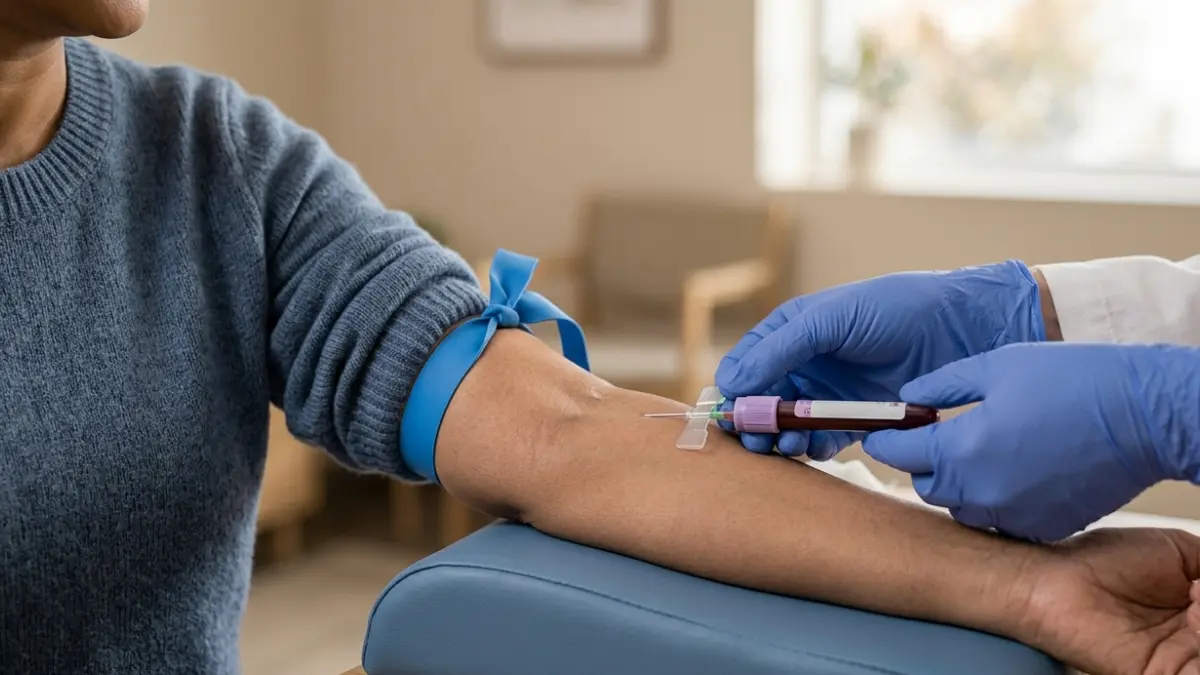
A high TSH most often means an underactive thyroid, and a low TSH usually means an overactive one, according to how doctors use thyroid blood tests at NIDDK. If the result is outside the range, at least one further test is needed to find the cause.
For age-banded context, see our TSH levels chart by age, and MedlinePlus covers the TSH test explained in detail.
Free T4: the line that says what your thyroid is making
Free T4 is the portion of thyroxine not bound to blood proteins, so it is available to enter your tissues. Bound T4 is held in reserve. Many clinicians prefer the free value for exactly that reason.
🔬 How It Works: Most T4 travels attached to carrier proteins. Pregnancy and oral contraceptives raise those proteins; severe illness and corticosteroids lower them. Total T4 rises and falls with the carriers, while free T4 stays steady — which is why two reports can disagree on T4 and both be correct.
That is the single most common reason a total T4 value looks alarming without meaning much. A low free T4 alongside a high TSH is a different and more definite picture than a high TSH alone.
✅ Patient Action: Ask the clinician who ordered the test: “Did my lab report free T4 or total T4, and is anything I’m taking shifting that number?”
What T3 and the antibody lines are doing on your report
Neither line is routine, so a blank space beside them does not mean your workup was cut short.
A T3 test is usually added when an overactive thyroid is suspected despite a normal T4, since T4 can read normal while T3 runs high. Free T3 is generally reserved for suspected hyperthyroidism when TSH is suppressed but free T4 is not elevated.
Thyroid antibodies are ordered when other blood tests already point toward thyroid disease. They identify autoimmune causes — Graves’ disease and Hashimoto’s disease. TPO antibodies are present in most people with Hashimoto’s disease and thyroid antibodies, per NIDDK.
🩺 Editor’s’ Note: A common point of confusion is reading a positive antibody result as a severity score. It identifies a likely cause; it does not grade how affected your thyroid is, and on its own it is not a treatment trigger.
Our guide to TPO antibodies and Hashimoto’s disease covers what follows a positive result.
Reading TSH and free T4 together: four common patterns
A high TSH with a normal free T4 is called subclinical hypothyroidism — one of four combinations clinicians look for.
| TSH | Free T4 | What this combination is called | Key clinical detail |
|---|---|---|---|
| High | Low | Overt hypothyroidism | Both the signal and the output agree |
| High | Normal | Subclinical hypothyroidism | Signal is raised; output still in range |
| Low | High | Hyperthyroidism | Output exceeds what the signal calls for |
| Low | Normal | Subclinical hyperthyroidism | Suppressed signal, output still in range |
Pattern definitions: NIDDK, Thyroid Tests; StatPearls, Subclinical Hypothyroidism (NCBI Bookshelf).
These names describe result combinations. They are not a diagnosis — only a clinician with your history can make one.
📊 Clinical Data Point: Nearly 5 out of 100 Americans aged 12 and older have hypothyroidism, and most cases are mild or produce few obvious symptoms — Source: NIDDK, Hypothyroidism, 2025.
Whether the second pattern leads anywhere is covered in whether subclinical hypothyroidism gets treated.
✅ Patient Action: Ask your primary care clinician: “My results fall in this pattern — does my history change what it means, and should we repeat the test before deciding anything?”
Why your lab’s normal range isn’t universal
There is no single normal TSH range that applies everywhere — the interval printed beside your own result is the one that applies to it.
| What to check | Where to find it | Key clinical detail |
|---|---|---|
| Your reference interval | Printed beside your result | Set by that lab’s method and population |
| Which T4 was run | The line label itself | Free and total are not interchangeable |
| Recent supplements | Your own list | Biotin can shift immunoassay results |
Published upper limits genuinely differ — one large US population analysis used 4.5 mIU/L as its hypothyroidism cutoff (NHANES analysis, Thyroid, 2007), while other clinical references list 4.0. We explain why reference ranges differ between labs separately.
⚠️ Clinical Warning: FDA warns that biotin can interfere with lab tests and produce falsely high or falsely low results, as set out in the FDA’s warning on biotin and lab tests. Tell the lab and the ordering clinician if you take a biotin supplement, including hair, skin and nail products.
When to call, and what to ask when you do
A result marked normal does not close the question. TSH alone is not reliable for pituitary-driven hypothyroidism, and symptoms cannot diagnose thyroid disease on their own because they overlap with so much else.
If symptoms persist, keep asking — our guide to a normal TSH with ongoing symptoms covers what usually comes next.
✅ Patient Action: Bring three questions to your primary care clinician: “Which T4 did we measure?” · “Does anything I take affect this result?” · “If my symptoms continue, what would you check next, and would you refer me to endocrinology?”
Thyroid panel questions people ask most
1. What does a thyroid panel measure?
A thyroid panel measures TSH, T4, sometimes T3, and thyroid antibodies, which together show how your thyroid is working.
2. Which thyroid result do doctors read first?
Clinicians usually check TSH first, then order at least one further test if that result falls outside the reference range.
3. What is a normal TSH range?
There is no universal normal TSH range. Published upper limits differ, so use the interval printed beside your own result.
4. What does high TSH with normal free T4 mean?
High TSH with normal free T4 is called subclinical hypothyroidism. Ask the clinician who ordered the test what it means for you.
5. What does low TSH with high free T4 mean?
Low TSH with high free T4 points toward an overactive thyroid. Ask your clinician whether further testing comes before any treatment decision.
6. Why do labs print different normal ranges?
Reference intervals depend on each lab’s testing method and reference population, so two labs can flag the same value differently.
7. Can biotin supplements distort thyroid results?
Yes. FDA warns biotin can interfere with lab tests and cause falsely high or falsely low results. Tell the lab.
8. What does a positive TPO antibody result mean?
TPO antibodies are present in most people with Hashimoto’s. A positive result suggests a cause; ask your clinician what follow-up changes.
9. Why is free T4 preferred over total T4?
Free T4 is unbound and available to your tissues, and unlike total T4 it is not shifted by binding protein changes.
10. When is a T3 test ordered?
A T3 test is usually added when an overactive thyroid is suspected despite a normal T4, since T3 can run high alone.
11. Can a normal TSH still miss a thyroid problem?
Yes. TSH alone is not reliable for pituitary-driven hypothyroidism, and symptoms cannot diagnose thyroid disease. Raise continuing symptoms with your clinician.
What to do with your report now
Circle two numbers before your appointment: your TSH and your free T4. Write the reference interval printed beside each one, because that interval is the one your clinician is reading against. Take both, plus your supplement list, to the visit — that single page turns a confusing result into a specific conversation.
About this content
How this article was put together: researched from recognised health sources, drafted with the help of AI tools, and edited by hand, with sources linked throughout.

Sameer Patel is the founder and editor of My Medicine Advisor. He is not a doctor or medical professional — before starting this site he worked in banking,…
Medical disclaimer
The content on MyMedicineAdvisor is provided for general informational and educational purposes only and is not a substitute for professional medical advice, diagnosis, or treatment. Health information on this website should not be used to diagnose, treat, cure, or prevent any condition without guidance from a qualified healthcare professional. Always seek the advice of your doctor, physician, or another licensed healthcare provider with any questions you may have regarding a medical condition, symptoms, medications, or treatment decisions.