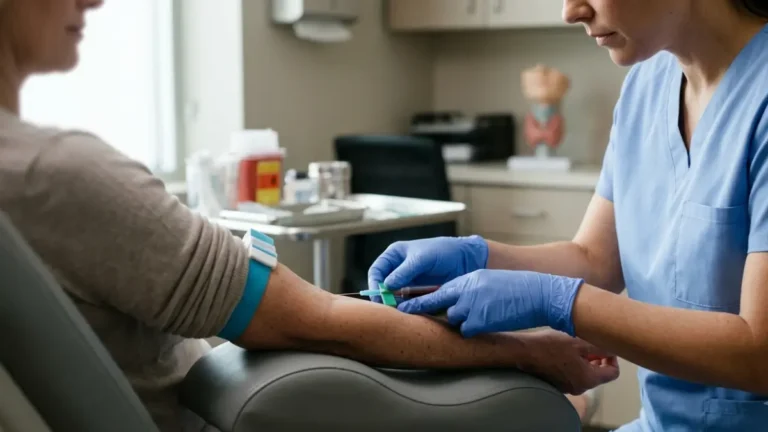

On This Page – Quick Medical Summary
Your thyroid-stimulating hormone came back flagged, slightly above your lab’s upper limit, and your follow-up appointment is still days away. A single raised TSH is a starting point, not a diagnosis.
Where to go from here. If you have an appointment booked and want the words to use, go to the six questions. If you are pregnant or trying to conceive, read the final section first, because your timeline is different. If you are reading this for a parent over 65, that section is yours too.
One piece of background makes the rest easier: TSH is made by your pituitary gland, not your thyroid, so a high reading means the pituitary is asking for more.
ℹ️ Medical Disclaimer: This article explains laboratory reference ranges, the diagnosis of subclinical hypothyroidism, prescription thyroid medication, thyroid testing in pregnancy and in older adults, and supplement and drug interference with thyroid assays. It is general education and cannot interpret your individual result. Review your results with your primary care physician or a board-certified endocrinologist before acting on anything here.
What a borderline TSH actually means on your report
A borderline TSH sits above your lab’s upper limit but below 10 mIU/L with a normal free T4 — what clinicians call subclinical hypothyroidism.
Why 4.5 to 10 is the band that gets called borderline
Evidence reviews split raised results into a mild band of roughly 4.5 to 10 mIU/L and a markedly raised band above 10, as the AHRQ evidence review on subclinical thyroid dysfunction sets out.
Free T4 is the number that decides whether it’s “subclinical”
Free T4 is your thyroid’s own output. If TSH is raised and free T4 is still normal, the gland is keeping up under extra pressure.
Your lab’s range is an assay range, not a treatment line
That printed range is the assay’s reference interval, and upper limits differ between assays — it is not a treatment threshold. Your decade’s figures are in the full TSH levels chart by age.
🔬 How It Works: A small drop in thyroid output produces a proportionally larger rise in TSH, which is why the number moves before symptoms do.
Six questions to ask about a borderline TSH result
Ask your doctor these six questions about a borderline TSH result.

The three questions about the result itself
- Was free T4 run, and what was it? The answer separates subclinical from overt.
- How far above range am I, and which range did this lab use?
- Could a supplement, a recent illness, or one of my medications have affected this sample?
The three questions about what happens next
- Should this be repeated before we decide anything, and on what date?
- Would checking thyroid antibodies change how closely you watch it?
- If we do nothing now, what number or symptom would change your mind?
What to write down before you leave
Your TSH value, your free T4 if it was run, the date of the repeat draw, and who calls you with the result.
✅ Patient Action: Put question four to your primary care physician first — the repeat date is the one thing you should not leave without.
What can push a TSH result off, and why it matters here
Ordinary things move a TSH result, which is why one reading rarely settles the question.
Supplements: the biotin problem
High-dose biotin — the vitamin in hair, skin and nail products — interferes with the immunoassays many labs use, and the FDA’s warning that biotin may interfere with lab tests tells clinicians to ask patients about it.
Recent illness and other medications
Illness unrelated to the thyroid, and some medications, can raise TSH and should be excluded before a diagnosis is made. More on those in our guide to causes of a high TSH beyond the thyroid.
Why timing and normal day-to-day variation matter
Each person has their own TSH set point, and the population range is far wider than your own — so a borderline value can drift across the line between two honest draws.
⚠️ Clinical Warning: Biotin can push results in either direction, so do not assume yours is falsely high. Tell the lab or the ordering clinician about any biotin-containing supplement before the repeat draw.
What usually happens next: the repeat test and what’s added to it
Guidelines advise confirming a raised TSH on a second sample before any treatment decision.
Why a second test comes before any treatment decision
A meaningful share of raised results return to normal on their own, so watchful waiting comes first; StatPearls on subclinical hypothyroidism describes repeating the TSH test at two to three months to confirm a sustained elevation before replacement is started.
What free T4 and TPO antibodies add
TPO antibodies do not change today’s number — they change how closely it is watched. The surveillance strategy in the AHRQ review rechecks antibody-positive patients yearly and antibody-negative patients far less often. Our guide to Hashimoto’s, TSH and TPO antibodies covers what a positive result means.
How often it gets rechecked after that
That same strategy moves to treatment if TSH passes 10 or hypothyroid findings develop.
🩺 Editor’s Note: A recheck in three months is the plan, not a brush-off — confirming the number is what stops a one-off reading from becoming a lifelong prescription.
Will you be put on medication, and what does the evidence show?
For most people in the mild band, the answer today is no.
Where the treatment threshold sits, and why
Levothyroxine is recommended in defined scenarios, with a TSH above 10 the common threshold — covered in depth in why 10 is the number that changes the conversation.
What the trials found in people with mild elevations
For results between 4.5 and 10, the AHRQ review found evidence of treatment benefit insufficient or absent.
📊 Clinical Data Point: In the TRUST trial, 737 adults aged 65 and over with TSH between 4.60 and 19.99 mIU/L and normal free T4 showed no difference in hypothyroid symptom or tiredness scores after one year of low-dose levothyroxine versus placebo — Source: TRUST trial, reported in StatPearls, NIH Bookshelf, 2024.
What to ask if you want to try treatment anyway
Some people with persistent symptoms still discuss a trial.
✅ Patient Action: Ask a board-certified endocrinologist: given my number, my antibody status and my symptoms, what would treatment be aiming to change?
When a borderline TSH is handled differently
Three situations do not follow the wait-and-recheck path above.
Pregnancy and trying to conceive
Pregnancy ranges differ and testing happens early in women with risk factors. Contact your obstetric clinician now rather than waiting for a scheduled recheck — see TSH levels in pregnancy.
Adults over 65
TSH drifts upward with age, so a flagged value may be age-appropriate; overtreatment, not undertreatment, is the usual risk here.
Symptoms that shouldn’t wait for a recheck
⚠️ Clinical Warning: Marked slowing, confusion, severe cold intolerance or a drop in alertness are not “borderline” findings. Seek same-day medical assessment rather than waiting for the repeat draw.
Borderline TSH: quick answers
1. Is a TSH of 5 or 6 something to worry about?
That sits in the mild band with normal free T4, which guidelines monitor rather than treat automatically.
2. Will a borderline TSH go back to normal on its own?
A meaningful share of raised results normalize without treatment, which is why a repeat test comes first.
3. Do I need medication for a borderline TSH?
Usually not below a TSH of 10, where trial evidence of benefit is insufficient. Discuss your own case with your physician.
4. What is free T4 and why does it matter?
Free T4 is your thyroid’s output; normal free T4 with raised TSH is what makes a result subclinical.
5. Should I ask for thyroid antibody testing?
Antibodies change how often your borderline TSH is rechecked, not today’s result. Ask your physician whether it fits your case.
6. Can supplements affect a thyroid test?
Yes — high-dose biotin interferes with the immunoassays labs use, which the FDA has warned clinicians about.
7. Does day-to-day variation affect a TSH result?
Yes. Your own set point is narrower than the population range, so borderline values can cross the line between draws.
8. How long should I wait before the repeat test?
Published guidance repeats the TSH at two to three months to confirm a sustained elevation.
9. Is borderline TSH different when you’re pregnant?
Yes — pregnancy ranges differ and testing happens earlier. Contact your obstetric clinician promptly rather than waiting.
10. Is a mildly high TSH normal in older adults?
TSH drifts upward with age, so a flagged value in someone over 65 may be age-appropriate.
11. Should I ask for a referral to an endocrinologist?
Reasonable if the elevation persists, antibodies are positive, or symptoms continue. Ask your primary care physician what would trigger referral.
Before your appointment
Take the six questions with you, written down, and leave with two things: the date of your repeat test and the name of whoever will call you with the result. A borderline number is a question your clinician is being asked to answer with you, and walking in with the question already framed is the whole advantage.
About this content
How this article was put together: researched from recognised health sources, drafted with the help of AI tools, and edited by hand, with sources linked throughout.

Sameer Patel is the founder and editor of My Medicine Advisor. He is not a doctor or medical professional — before starting this site he worked in banking,…
Medical disclaimer
The content on MyMedicineAdvisor is provided for general informational and educational purposes only and is not a substitute for professional medical advice, diagnosis, or treatment. Health information on this website should not be used to diagnose, treat, cure, or prevent any condition without guidance from a qualified healthcare professional. Always seek the advice of your doctor, physician, or another licensed healthcare provider with any questions you may have regarding a medical condition, symptoms, medications, or treatment decisions.