
On This Page – Quick Medical Summary
The American Thyroid Association estimates that about 20 million Americans have some form of thyroid disease, and that up to 60% of them do not know it. That figure appears in awareness campaigns, news stories, and lab-testing ads. Almost no one explains where it came from.
Here is how to use this page. If you want the source behind the number, the next two sections trace it. If you are wondering whether this could be you, move to the risk profile and the testing section. If you already have a result in hand, the testing section matters most.
ℹ️ Medical Disclaimer: This page explains population statistics and diagnostic testing for general education. It does not diagnose thyroid disease, interpret an individual lab result, recommend treatment or medication, or advise on insurance coverage. Prevalence figures describe groups, not individuals. Before acting on anything here, consult a board-certified primary care physician or endocrinologist.
Where the 60% figure actually comes from
The number is real, published, and widely repeated. It is also an estimate rather than a measurement, and that distinction changes how much weight it carries.
Who publishes the number
The 60% figure comes from the American Thyroid Association, which pairs it with two related estimates: that more than 12% of Americans will develop a thyroid condition in their lifetime, and that women are five to eight times more likely than men to have thyroid problems. It is awareness-campaign material, not a study result.
What research sits behind it
The peer-reviewed evidence underneath is older and narrower. The Colorado Thyroid Disease Prevalence Study (2000) extrapolated that more than 13 million Americans were unaware they had a thyroid condition. A 2014 meta-analysis of European populations found roughly half of people with thyroid dysfunction had never been diagnosed.

| Statistic | Who states it | Key clinical detail |
|---|---|---|
| 20 million affected; up to 60% unaware | American Thyroid Association | Awareness estimate, no single study cited |
| ~13 million unaware | Colorado study, 2000 | Extrapolated from one state screening program |
| ~5 in 100 have hypothyroidism | NIDDK’s hypothyroidism overview | Most cases mild or with few obvious symptoms |
Sources verified against each named institution, September 2026.
What happened when researchers tested everyone
When a national survey measured thyroid blood levels rather than asking people about diagnoses, the picture sharpened considerably.
The NHANES III breakdown
NHANES III tested 17,353 people aged 12 and older and found:
- 0.3% with overt hypothyroidism
- 4.3% with subclinical hypothyroidism
- 0.5% with overt hyperthyroidism
- 0.7% with subclinical hyperthyroidism
📊 Clinical Data Point: Hypothyroidism was found in 4.6% of the US population and hyperthyroidism in 1.3% — Source: the NHANES III thyroid analysis, Hollowell et al., Journal of Clinical Endocrinology & Metabolism, 2002.
Why undiagnosed usually means subclinical
The hidden burden is dominated by subclinical hypothyroidism — an elevated TSH with a normal free T4, as the federal evidence review on thyroid screening defines it. Undiagnosed rarely means severely ill and untreated. Those survey years were 1988 to 1994, and NHANES stopped collecting thyroid profiles after 2012, so no newer national lab-measured figure exists.
Why thyroid problems stay hidden for years
Thyroid disease goes undiagnosed for three main reasons: it develops slowly, its symptoms overlap with everyday complaints, and no one is routinely screened for it.
Symptoms that look like everything else
Because hypothyroidism develops gradually, NIDDK notes that symptoms may go unnoticed for months or years. Fatigue, weight gain, cold intolerance, joint pain, dry skin, and low mood are the usual list — and NIDDK is explicit that these are common complaints that do not necessarily indicate a thyroid problem. That cuts both ways, which is why symptoms get blamed on stress or aging for years.

Why there’s no routine thyroid screening
In 2015 the US Preventive Services Task Force concluded that evidence was insufficient to assess the balance of benefits and harms of screening nonpregnant, asymptomatic adults. That is a finding of uncertainty, not of neglect, and it explains why current thyroid screening guidelines differ between organizations. Testing someone who has symptoms is a separate matter from screening everyone.
Who is most likely to have an undiagnosed thyroid problem
Some groups carry far more of the undiagnosed burden than others.
Sex and age
NIDDK reports that women are much more likely than men to develop hypothyroidism, and that it is more common after age 60. The ATA puts the sex difference at five to eight times, and estimates one in eight women will develop a thyroid disorder in her lifetime.
Medical history that raises the odds
According to NIDDK, you are more likely to have hypothyroidism if you:
- had a previous thyroid problem, such as a goiter
- had thyroid surgery or radioactive iodine treatment
- received radiation to the thyroid, neck, or chest
- have a family history of thyroid disease
- were pregnant in the past six months
- have celiac disease, Sjögren’s syndrome, or Turner syndrome
Hyperthyroidism is less common — roughly 1 in 100 people aged 12 and older, per NIDDK’s hyperthyroidism page — but it moves faster. If you are unsure how your own complaints stack up, our symptom checker can help you organise them before an appointment.
✅ Patient Action: Ask your primary care physician: “Given my family history and age, is a TSH test reasonable at this visit?”
How an undiagnosed thyroid problem gets confirmed
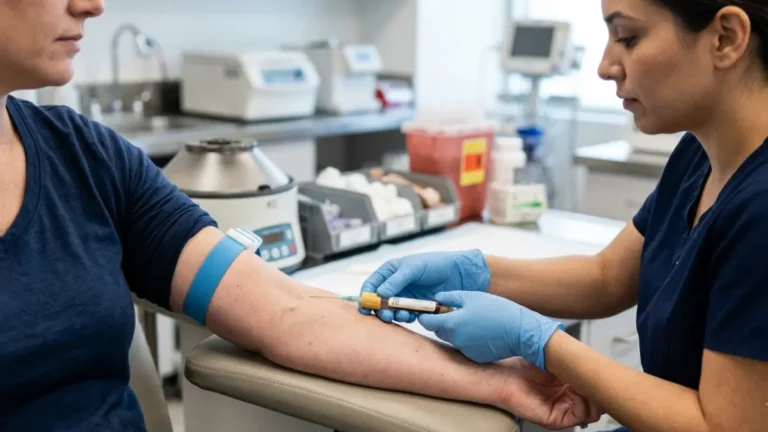
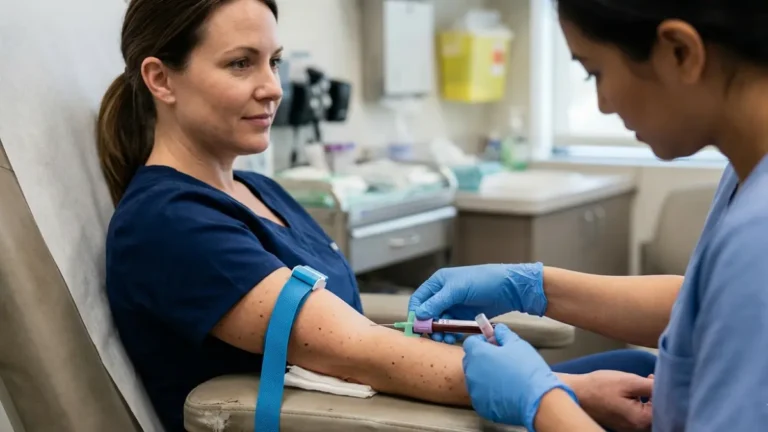
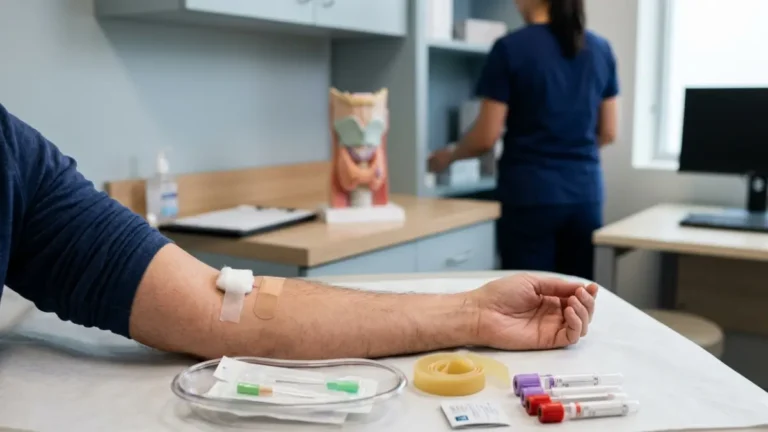
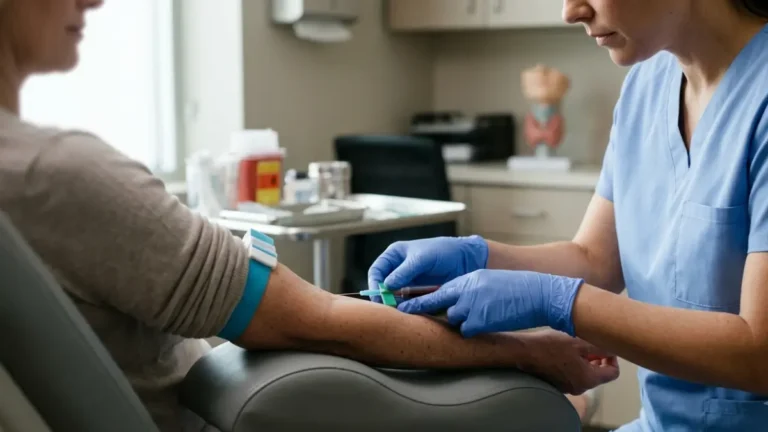
A TSH blood test comes first. It is a single ordinary blood draw, and it is the test that closes most of the diagnostic gap described on this page.
The TSH test comes first
🔬 How It Works: The pituitary gland releases thyroid-stimulating hormone to tell the thyroid to produce more hormone. When thyroid output drops, the pituitary pushes harder and TSH rises. That is why a high TSH points to an underactive thyroid rather than an overactive one.
MedlinePlus explains what a TSH test measures and how the sample is taken.
What happens if your TSH is out of range
An abnormal result is usually repeated, and free T4 or thyroid antibodies may be added to clarify the picture. Reference ranges also shift with age, which is why our TSH levels chart by age is context rather than a verdict. A NIDDK program director has stated plainly that the only accurate way to diagnose an underactive thyroid is to consult a health professional.
What’s at stake when a thyroid problem goes untreated
The consequences are real, but they are not uniform. Most undiagnosed cases are mild, and NIDDK notes most hypothyroidism is mild or produces few obvious symptoms.
Untreated hypothyroidism
The ATA states that undiagnosed thyroid disease may raise the risk of conditions including cardiovascular disease, osteoporosis, and infertility. That is the association’s framing of the risk, and it is worth knowing without being read as a prediction.
Pregnancy and the gap
⚠️ Clinical Warning: NIDDK reports that untreated hypothyroidism in pregnancy is linked to high blood pressure late in pregnancy, anemia, miscarriage, low birth weight, and stillbirth. If you are pregnant or planning to be, raise thyroid testing with your obstetric provider rather than waiting for symptoms.
Common questions about undiagnosed thyroid disease
1. How many Americans have undiagnosed thyroid disease?
The American Thyroid Association estimates up to 60% of the roughly 20 million Americans with thyroid disease are unaware of it.
2. Is the 60% statistic accurate?
It is an ATA awareness estimate, not a single study result. Peer-reviewed surveys support a large gap but measure it differently.
3. How common is hypothyroidism in the US?
Nearly 5 out of 100 Americans aged 12 and older have hypothyroidism, and most cases are mild or barely noticeable.
4. What is subclinical hypothyroidism?
Subclinical hypothyroidism means TSH is elevated while free T4 stays in the reference range. Your clinician decides whether it needs treatment.
5. Why do thyroid symptoms get missed?
Symptoms like fatigue and weight gain are common and nonspecific, and hypothyroidism develops slowly enough to go unnoticed for years.
6. Is thyroid screening recommended for everyone?
No. The USPSTF found evidence insufficient either way for nonpregnant, asymptomatic adults. Testing someone with symptoms is a different question.
7. Are women more likely to have thyroid disease?
The ATA reports women are five to eight times more likely than men to have thyroid problems, and one in eight develops one.
8. At what age does thyroid disease become more common?
Hypothyroidism becomes more common after age 60, according to NIDDK, though undiagnosed thyroid disease can appear at any adult age.
9. What test detects an undiagnosed thyroid problem?
A TSH blood test comes first, sometimes with free T4. Ask your primary care clinician whether testing fits your symptoms.
10. Can you have a thyroid problem with a normal TSH?
Possibly. Free T4, thyroid antibodies, and symptoms all matter, so discuss persistent symptoms with an endocrinologist rather than stopping at one result.
11. What happens if thyroid disease is left untreated?
Untreated hypothyroidism in pregnancy is linked to miscarriage, low birth weight, and stillbirth. Raise any symptoms with your obstetric provider.
The gap between people who have thyroid dysfunction and people who know it is real, well documented, and mostly made up of mild cases that produce quiet symptoms. One blood draw resolves the question for most people. If your symptoms have lasted months, bring them to a primary care physician and ask whether a TSH test fits your situation.
About this content
How this article was put together: researched from recognised health sources, drafted with the help of AI tools, and edited by hand, with sources linked throughout.

Sameer Patel is the founder and editor of My Medicine Advisor. He is not a doctor or medical professional — before starting this site he worked in banking,…
Medical disclaimer
The content on MyMedicineAdvisor is provided for general informational and educational purposes only and is not a substitute for professional medical advice, diagnosis, or treatment. Health information on this website should not be used to diagnose, treat, cure, or prevent any condition without guidance from a qualified healthcare professional. Always seek the advice of your doctor, physician, or another licensed healthcare provider with any questions you may have regarding a medical condition, symptoms, medications, or treatment decisions.