

On This Page – Quick Medical Summary
What you can feel, and what you cannot
If you have chest discomfort, pressure, or shortness of breath as you read this, call 911 now. MedlinePlus is explicit that chest pain or other heart attack warning signs need care right away.
For everyone else the answer is short. High cholesterol symptoms do not exist in the way the question assumes — the CDC states plainly that there are usually no warning signs, which is the whole reason a blood test exists for it.
Most readers arrive one of three ways. If a lipid panel came back flagged and you feel well, sections two and three are yours; if you noticed something — a yellow patch near an eye, a thickened heel cord, a pale ring around the iris — section four is where it belongs. If a parent or sibling was just diagnosed, section six matters most.
None of those routes ends in a symptom list, because there isn’t one. What exists instead is a small set of things a body can show, and one question worth asking. Start from your own report: what each flag on a lipid panel can mean and which of your lipid numbers were measured and which were calculated.
ℹ️ Medical Disclaimer: This article is general education about cholesterol testing, physical findings and cardiovascular risk — it does not diagnose anything, interpret your results, or recommend any medication, procedure or screening schedule. Only a clinician who can see your history and your actual numbers can do that. Discuss your results and any finding described here with your primary care physician or a cardiologist before acting on it.
Why a number this important cannot be felt
Cholesterol settles gradually into artery walls, forming a deposit called plaque buildup. The CDC describes the sequence directly: as plaque accumulates the artery narrows, and narrowing restricts blood flow to the heart and other organs.
The silence is structural. An artery cannot report that it has narrowed, and the heart muscle does not complain while it is still getting the blood it needs. Atherosclerosis is genuinely dangerous and it does not hurt.

🔬 How It Works: Sensation in the cardiovascular system comes from a shortage of blood supply, not from the process causing the shortage. So the narrowing stays asymptomatic for decades, and the first thing a person notices is the moment demand outstrips supply — chest pain on exertion, which the CDC calls angina, or a blockage.
That is why the CDC’s answer to “would I be able to feel it” is that you may not know until a heart attack or stroke. You can read the CDC’s plain answer on whether high cholesterol can be felt in full, and what a lipid panel actually measures is the shortest route to what your report is looking at.
Which number on your report could you ever notice?
“Cholesterol” covers several measurements and they do not behave alike. Only one line on a standard lipid panel has a complication that reliably makes itself known, and it is not a cholesterol value.
| Value on your report | Could you feel it? | What can show, and when |
|---|---|---|
| Total cholesterol | No | Nothing of its own — a sum of other values, not a sensation |
| LDL cholesterol | No | After many years at very high levels, deposits in skin, tendons or the eye |
| HDL cholesterol | No | Nothing visible or noticeable at any level |
| Non-HDL cholesterol | No | Nothing of its own — calculated from two other numbers |
| Triglycerides | Not usually | At extreme levels only, the one lipid complication that announces itself |
Sources: CDC cholesterol pages and MedlinePlus, as cited above and below. The third column describes what can appear over years of exposure — it is not a checklist for reading today’s result.
The triglyceride row is the exception worth understanding rather than fearing, covered in what a high triglyceride reading means and triglycerides above 500 and pancreatitis risk.
Everything else there is silent by design. If a value is missing from your report altogether, why an LDL number can be absent explains the arithmetic — another reminder that these are laboratory quantities, not sensations.
What high cholesterol can actually show on a body
Some people do develop visible cholesterol deposits, and this is where the photographs in every “signs on your face” article come from. What those articles leave out is how often the finding means what they imply.
📊 Clinical Data Point: Tendon deposits were historically described in 30%–50% of people with inherited high cholesterol, with more recent studies showing a lower figure, likely because of widespread statin use; pale corneal rings appear in an estimated 7%–30% of people with the inherited form. — Source: GeneReviews, Familial Hypercholesterolemia (NCBI Bookshelf, revised January 2025)
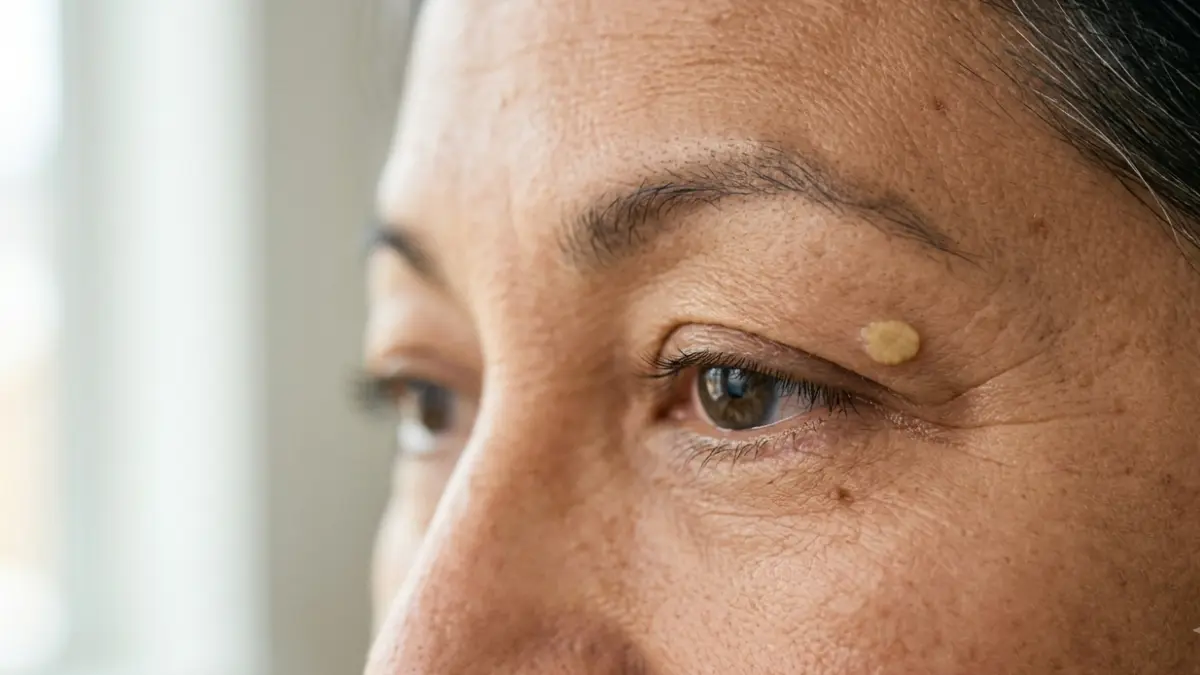
Yellow patches around the eyes
Xanthelasma is a soft, yellow deposit on the eyelid, and the most-searched sign on this topic. MedlinePlus describes it as a common type of xanthoma that usually occurs without any underlying medical condition. So the most photographed “sign of high cholesterol” is, most of the time, not one — though still worth mentioning, because sometimes it is.
Thickening in the tendons
A tendon xanthoma is a firm deposit in a tendon rather than the skin — most often the Achilles, and also the hands, elbows, knees and feet. MedlinePlus notes deposits next to tendons may not change skin color at all, so these are felt as a thickening rather than seen.
🔬 How It Works: These are not the cholesterol in your blood today but the residue of years of exposure to very high levels — which is why GeneReviews notes they worsen with age when untreated, and can shrink once treatment brings levels down.
The ring around the iris
Corneal arcus is a white, gray or blue ring at the edge of the cornea. GeneReviews describes it as developing with age and concerning for the inherited form mainly when it appears before age 45, while noting it is present in only an estimated 7%–30% of people who have that condition.
Read that in both directions: having the ring most often reflects age rather than a lipid disorder, and not having it rules nothing out, because most people with the inherited form never develop one. Unlike the skin deposits, arcus does not resolve with treatment.
✅ Patient Action: Noticed any of these? Ask your primary care physician: “Is this a lipid deposit, and does it change which tests you would run?” MedlinePlus advises contacting a provider if xanthomas develop, since they can point to an underlying disorder. See what these deposits look like in plain language, xanthoma as a skin finding and the reference description of the physical findings in inherited high cholesterol.
What is genuinely worth watching for
If the number is unnoticeable, the honest answer to “what should I watch for” is the events untreated risk eventually produces. That is a different thing from a symptom, and treating it as one is where most pages on this topic go wrong.
⚠️ Clinical Warning: The American Heart Association’s guidance is that most heart attacks involve discomfort in the center of the chest lasting more than a few minutes or coming and going, which can also appear in one or both arms, the back, neck, jaw or stomach, with or without shortness of breath; for stroke it now teaches B.E. F.A.S.T. — balance, eye, face, arm, speech, time. Call 911 if these appear, including if they stop. That summary is not a complete list and must not be used as one — the American Heart Association’s published recognition lists are the reference.

Presentations vary, and a heart attack does not always arrive dramatically; the quieter presentations worth knowing about covers that ground.
There is a slower category too. MedlinePlus lists cramping in one or both calves when walking, and sores on the toes that do not heal — signs that arteries have already been affected rather than signs of a cholesterol level, and they belong in a scheduled appointment. Risk rarely travels alone, which is why the cluster of findings that tend to appear together is worth a look if more than one result was flagged.
The question worth asking instead of watching
Watching is passive, and on this result close to useless. There is one productive thing to do with a symptomless number, and it takes a single conversation.

Familial hypercholesterolemia is an inherited condition that raises LDL cholesterol from birth. MedlinePlus describes it as autosomal dominant — one affected parent is enough — and as capable of causing heart attacks at an early age.
📊 Clinical Data Point: Prevalence of the heterozygous form was traditionally cited as 1 in 500, and data suggest it may be as high as approximately 1 in 250; roughly one in ten people with a history of early-onset heart attack have the condition. — Source: GeneReviews, Familial Hypercholesterolemia (NCBI Bookshelf, revised January 2025)
Why an inherited cause hides in plain sight
GeneReviews notes that a family history can look negative for three ordinary reasons: relatives were never recognized as having it, nobody knows what their levels or heart history were, or relatives who took statins for years never developed early heart disease. So “it doesn’t run in my family” is often a statement about what a family knows rather than what a family has.
The CDC classifies this as a condition where family-based cascade screening carries significant benefit, because testing relatives finds people with no reason to suspect anything. MedlinePlus advises that people from families with a strong history of early heart attacks should have their lipid levels tested, and GeneReviews notes that children in an affected family are monitored from early childhood.
✅ Patient Action: Ask your primary care physician or a lipid specialist: “Given my result and my family history, is inherited high cholesterol worth ruling out in me and in my first-degree relatives?” What follows is a separate decision — see what actually decides medication and how often the test is repeated.
What this page cannot tell you
Three limits. This page cannot tell you whether your number is high, because that depends on your report and your other risk factors. It cannot tell you whether your arteries have narrowed, because no blood test shows that, and it cannot tell you whether the thing you noticed in the mirror is a lipid deposit — only an examination can.
It also sells you nothing, deliberately. A home cholesterol kit marketed on a page explaining that you cannot feel this condition converts worry into a purchase, and the CDC’s answer here is to have it checked by your health care team, who can act on the result. How risk is now estimated is covered in what the current cholesterol guideline changed.
Three questions worth taking to the appointment
- “Given my numbers and my family history, what is my actual cardiovascular risk — not just whether one value is flagged?”
- “Should any of my first-degree relatives have their cholesterol tested?”
- “Is there anything in my history that would make you check for an inherited cause?”
Frequently asked questions
1. Does a ring around the iris mean I have high cholesterol?
Usually not on its own — corneal arcus develops with age, so in an older adult it most often reflects age rather than a lipid disorder. It is more concerning for an inherited cause when it appears before 45, and it is present in only an estimated 7%–30% of people with that condition. Ask your physician whether yours warrants lipid testing.
2. What is the first sign of high cholesterol?
For most people there is no early sign at all, which is why the CDC says you may not know your levels are unhealthy until a heart attack or stroke happens. A blood test is the only thing that detects it beforehand. Skin, tendon or eye deposits appear in some people, but they reflect years of very high levels rather than early change.
3. Should my children be tested if I have high cholesterol?
Possibly, and it is a reasonable question to raise. Inherited high cholesterol is passed down in a pattern where one affected parent is enough, and children in affected families are monitored from early childhood rather than from adulthood. Your physician or a lipid specialist can advise whether your family history warrants cholesterol testing for children in your family.
The useful thing to do next
Feeling fine is not evidence about your cholesterol, and it never was. The number is silent by design, the visible deposits are rarer and less conclusive than the photographs suggest, and the events worth recognizing belong to the heart and brain rather than to the lab result.
That leaves one action that helps: bring your report and your family history to the same conversation, and ask whether an inherited cause is worth ruling out. To understand the report itself, start with which of your lipid numbers were measured and which were calculated.
About this content
How this article was put together: researched from recognised health sources, drafted with the help of AI tools, and edited by hand, with sources linked throughout.

Sameer Patel is the founder and editor of My Medicine Advisor. He is not a doctor or medical professional — before starting this site he worked in banking,…
Medical disclaimer
The content on MyMedicineAdvisor is provided for general informational and educational purposes only and is not a substitute for professional medical advice, diagnosis, or treatment. Health information on this website should not be used to diagnose, treat, cure, or prevent any condition without guidance from a qualified healthcare professional. Always seek the advice of your doctor, physician, or another licensed healthcare provider with any questions you may have regarding a medical condition, symptoms, medications, or treatment decisions.