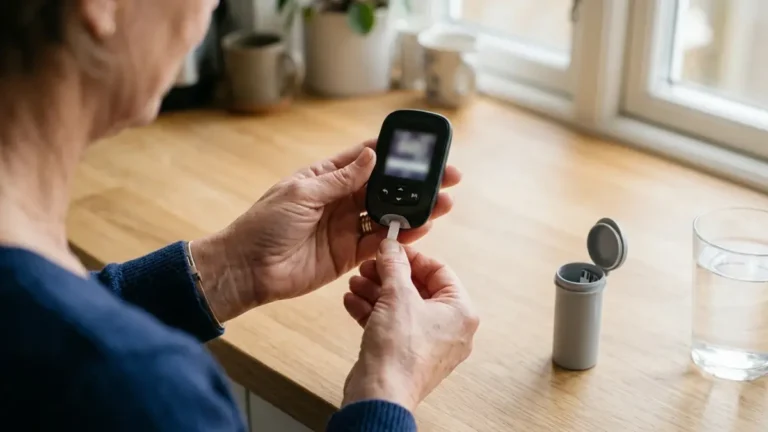
Check your type 2 diabetes risk
Answer the 7 questions from the American Diabetes Association (ADA) and CDC risk test to get your score out of 10, then see whether screening rules say you're due for a blood sugar test.
1. The 7 scored questions
These are the questions the ADA and CDC test scores. Each answer adds 0 to 3 points.
2. Other things doctors check
These don't change your score, but the ADA uses them to decide who should be tested and how often. Tick any that apply.
3. Symptoms right now
Type 2 diabetes often causes no symptoms at first. If you do have these, testing shouldn't wait for a routine visit.
Signs of a blood sugar emergency
Your result
Answer the questions above, then select See my result.
Risk score
-
What the score means
-
Testing advice
-
Your BMI
-
Summary
How your points add up
| Question | Your answer | Points |
|---|
Why this advice
Questions to ask your clinician
Blood test results the ADA uses
| Test | Normal | Prediabetes | Diabetes |
|---|---|---|---|
| A1C | Below 5.7% | 5.7% to 6.4% | 6.5% or higher |
| Fasting plasma glucose | Below 100 mg/dL (5.6 mmol/L) | 100 to 125 mg/dL (5.6 to 6.9 mmol/L) | 126 mg/dL (7.0 mmol/L) or higher |
| 2-hour glucose tolerance test | Below 140 mg/dL (7.8 mmol/L) | 140 to 199 mg/dL (7.8 to 11.0 mmol/L) | 200 mg/dL (11.1 mmol/L) or higher |
A result in the diabetes range is usually confirmed with a second test unless blood sugar is clearly very high. Home meter and smartwatch readings can't diagnose diabetes. Need to switch units? Use the blood sugar converter.
How this check works
The score
- Age: under 40 = 0, 40 to 49 = 1, 50 to 59 = 2, 60 or older = 3 points.
- Male = 1 point. Female = 0, or 1 if you've had gestational diabetes.
- Parent, brother, or sister with diabetes = 1. High blood pressure = 1. Not physically active = 1.
- BMI under 25 (under 23 with Asian ancestry) = 0; 25 to 29.9 (23 to 29.9) = 1; 30 to 39.9 = 2; 40 or higher = 3.
- A total of 5 or more is the ADA and CDC cut-off for high risk.
The testing advice
- Every adult from age 35, then at least every 3 years if normal.
- Any age with a BMI of 25 or more (23 with Asian ancestry) plus at least one other risk factor from section 2 or the scored questions.
- Every year after a prediabetes result; at least every 3 years after gestational diabetes.
- Symptoms move testing forward. Emergency signs mean emergency care, not a test appointment.
What it can't do: diagnose diabetes, predict type 1 diabetes, or replace advice from a clinician who knows your history. Your answers are processed in your browser and aren't sent or stored.
- Scoring: CDC, How Your Test Is Scored (adapted from the ADA risk test)
- Testing rules and blood test cut-offs: ADA, Diagnosis and Classification of Diabetes: Standards of Care in Diabetes 2026
- Screening ages 35 to 70: USPSTF recommendation, 2021
- Emergency signs: CDC, Diabetic Ketoacidosis
On This Page – Quick Medical Summary
A score of 5 or more on the 10-point diabetes risk assessment puts you in the high-risk group for prediabetes, the cut-off the American Diabetes Association (ADA) and the CDC use for their risk test (CDC scoring guide). A score from 0 to 4 sits below that line, though it doesn’t clear you.
What a diabetes risk assessment score of 5 means
The score is built from seven answers about age, sex, family history, blood pressure, activity and weight. It never measures blood sugar, so it can’t tell you whether you have prediabetes or diabetes. What it can do is sort people into those who should be tested soon and those who can follow the routine schedule.
| Score | What it means | Usual next step |
|---|---|---|
| 0–4 | Below the ADA and CDC high-risk cut-off | Follow the age-based testing schedule below |
| 5–10 | High risk for prediabetes | Ask for an A1C or fasting plasma glucose test |
Source: CDC, How Your Test Is Scored
A high score is a reason to book a blood test, nothing more.
7 questions and how each one scores
Take a sample person: a 52-year-old man who isn’t physically active, has no family history of diabetes and no high blood pressure, and is 5 ft 10 in tall at 190 lb. His age earns 2 points. Being male adds 1, inactivity adds 1, and his BMI of 27.3 adds 1. He lands at 5, right on the cut-off.
| Question | Answer that scores | Points |
|---|---|---|
| Age | Under 40 / 40 to 49 / 50 to 59 / 60 or older | 0 / 1 / 2 / 3 |
| Sex | Man; or woman with past gestational diabetes | 1 |
| Mother, father, sister or brother with diabetes | Yes | 1 |
| Ever diagnosed with high blood pressure | Yes | 1 |
| Physically active | No | 1 |
| BMI | 25 to 29 (23 to 29 with Asian ancestry) / 30 to 39 / 40 or higher | 1 / 2 / 3 |
Source: CDC, How Your Test Is Scored

Age carries the most weight. Risk starts to climb around 45 and rises sharply after 65, which is why the oldest band is worth 3 points on its own.
Only two rows can change: weight and activity. Between them they account for up to 4 of the 10 points.
The lower BMI line for people of Asian ancestry is deliberate. Asian Americans are at higher risk of type 2 diabetes at lower weights than other groups, so a BMI of 23 already counts.
A low score doesn’t rule out prediabetes
Seven questions leave out several risk factors that doctors use. The ADA’s screening criteria also list heart disease, an HDL cholesterol below 35 mg/dL or triglycerides above 250 mg/dL, polycystic ovary syndrome (PCOS), acanthosis nigricans (dark, velvety skin on the neck or armpits), and belonging to a higher-risk group such as African American, Latino, Native American, Asian American or Pacific Islander people (ADA Standards of Care 2024, Table 2.4).
None of those changes the score. A 34-year-old woman with PCOS and a BMI of 28 scores just 1 point, yet she meets the ADA’s rule for testing now.
The ADA also lists HIV, exposure to high-risk medicines and a history of pancreatitis as reasons to consider testing.
When should you get a blood sugar test?
Age 35 is the ADA’s starting point for everyone, with a repeat at least every 3 years when results are normal. Some people need to start earlier or test more often.
| Your situation | When to test |
|---|---|
| No other risk factors | From age 35, then at least every 3 years if normal |
| BMI of 25 or more (23 or more if Asian American) plus at least one risk factor | At any age |
| Past prediabetes result (A1C of 5.7% or higher) | Every year |
| Past gestational diabetes | At least every 3 years, for life |
Source: ADA Standards of Care 2024, Table 2.4
Risk factors in the second row include a parent or sibling with diabetes, high blood pressure (130/80 mm Hg or higher, or treated), physical inactivity and the conditions in the section above.
The tool on this page compares this schedule with the date of your last test. That is why it can call a test due even when your score is 2. For the age rules applied to the A1C specifically, see when A1C screening usually starts.
Only a blood test can confirm the result
Confirmation means a lab measurement of blood sugar. The ADA uses the same cut-offs for all three standard tests, whichever one your clinician orders (ADA, Diagnosis).
| Test | Normal | Prediabetes | Diabetes |
|---|---|---|---|
| A1C | Below 5.7% | 5.7% to 6.4% | 6.5% or higher |
| Fasting plasma glucose | Below 100 mg/dL (5.6 mmol/L) | 100 to 125 mg/dL (5.6 to 6.9 mmol/L) | 126 mg/dL (7.0 mmol/L) or higher |
| 2-hour oral glucose tolerance test | Below 140 mg/dL (7.8 mmol/L) | 140 to 199 mg/dL (7.8 to 11.0 mmol/L) | 200 mg/dL (11.1 mmol/L) or higher |
Source: American Diabetes Association, Diagnosis. mmol/L values converted at 18.016 mg/dL per mmol/L.
The reference range printed on your own lab report may differ slightly, but diagnosis rests on these ADA cut-offs. A single result in the diabetes range is usually repeated on a second day. The repeat may be skipped when blood sugar is very high, or when classic symptoms come with one positive result.
The ADA says diagnostic testing should happen in a healthcare setting, so a home meter or smartwatch reading isn’t a diagnosis. A fasting result in the middle band has its own causes and follow-up, covered in what a fasting glucose of 100 to 125 means. For every number on a glucose report, the glucose levels chart lays out each range, and the blood sugar converter switches a result between mg/dL and mmol/L.
Symptoms that call for testing now
Get emergency care now if: your breath smells fruity, you’re vomiting and can’t keep food or drinks down, you’re having trouble breathing, a home blood sugar reading stays at 300 mg/dL or above, or you have several signs of diabetic ketoacidosis at once. Call 911 or go to the nearest emergency room.
Diabetic ketoacidosis (DKA) is a buildup of acids called ketones that happens when the body doesn’t have enough insulin to use blood sugar for energy (CDC, Diabetic Ketoacidosis). It is most common in type 1 diabetes, but people with type 2 can develop it too. The warning signs and how quickly they progress are covered in DKA symptoms and when to act.
Short of an emergency, the CDC’s list of diabetes symptoms includes frequent urination, increased thirst and hunger, weight loss without trying, tiredness and blurry vision. Frequent urinary tract or yeast infections, cuts that are slow to heal, numbness or tingling in the hands or feet, and dark skin patches on the neck or armpits are more typical of type 2 (CDC, Symptoms of Diabetes).
Several of these together are a reason to get tested now, whatever your score. Feeling well proves little, though. Type 2 symptoms often take several years to develop, and some people don’t notice any at all.
Ask for an A1C or fasting glucose test
Book a visit with your primary care clinician if your score is 5 or more, the schedule above says you’re due, or you have symptoms. Bring your score and the answers behind it. Questions worth taking with you:
- Is an A1C, a fasting plasma glucose, or both the better test for me, and do I need to fast?
- With my risk factors, should I be retested every year or every 3 years?
- If a result is borderline, when should it be repeated?
- If I have prediabetes, would a CDC-recognized lifestyle change program fit me?
If cost is what’s holding you back, check the free A1C screening options before you skip the test.
Questions people ask about the risk test
Is the diabetes risk test accurate?
It is a screening estimate designed to flag who should have blood sugar checked, and it never measures blood sugar itself. It also leaves out PCOS, heart disease and cholesterol levels, so it can miss some people at risk.
Can this test predict type 1 diabetes?
No. Every scored question covers a type 2 risk factor (age, sex, family history, blood pressure, activity and weight), so the result says nothing about type 1.
Want to see our guides first on Google?
Found this helpful? See more of our guides on Google.
About this content
How this article was put together: researched from recognised health sources, drafted with the help of AI tools, and edited by hand, with sources linked throughout.

Dr. Pooja Sahu, MBBS, is a medical reviewer for MyMedicineAdvisor. She is a clinical physician whose experience includes serving as a Junior Resident in Nephrology at Dr. Ram…
Medical disclaimer
The content on My Medicine Advisor is provided for general informational and educational purposes only and is not a substitute for professional medical advice, diagnosis, or treatment. Health information on this website should not be used to diagnose, treat, cure, or prevent any condition without guidance from a qualified healthcare professional. Always seek the advice of your doctor, physician, or another licensed healthcare provider with any questions you may have regarding a medical condition, symptoms, medications, or treatment decisions.