Keto Calculator
Estimate keto calories, fat, protein, net carbs, macro ratios, meal splits, goal timeline, BMI, and progress projections in one detailed mobile-friendly tool.
Inputs
Results
Calorie target
—
Fat target
—
Protein target
—
Net carb target
—
Macro ratio
—
Maintenance calories
—
Estimated BMR
—
Selected keto style
—
Estimated weekly change
—
Goal ETA
—
Target date: —
Current BMI
—
Goal BMI
—
Activity: —
Pace check
Macro comparison across keto carb levels
| Plan | Net carbs | Protein | Fat | Carb % | Protein % | Fat % |
|---|
Meal split ideas
| Meals/day | Calories/meal | Fat/meal | Protein/meal | Net carbs/meal |
|---|
Goal milestones
| Milestone | Target weight | Change from today | Estimated time | Estimated date |
|---|
Monthly projection
| Month | Estimated end weight | Change from today | BMI | Status |
|---|
Results appear after you click “Calculate.”
Guide
How to use the tool
- Enter your body details, activity level, and the calorie strategy that matches your goal.
- Pick a net-carb target such as strict, standard, or liberal keto.
- Choose a protein level based on how active you are and how high you want protein to be.
- Check the macro table to compare 20 g, 30 g, and 50 g carb setups at the same calorie level.
- Use the meal table and projection table to turn the numbers into a practical daily plan.
When extra care is needed
- You use insulin, sulfonylureas, blood-pressure medicines, or diuretics.
- You are pregnant, breastfeeding, under 18, or have a history of an eating disorder.
- You have kidney disease, liver disease, pancreatitis, or another major medical condition.
- You feel unwell, dizzy, excessively fatigued, or unable to meet protein and calorie needs.
- You want a personalized nutrition plan for athletic performance, body composition, or obesity treatment.
On This Page – Quick Medical Summary
Your free keto calculator above delivers your exact daily fat, protein, net carbs, calories, BMR, TDEE, goal timeline, and projected BMI — personalized to your body in seconds.
Marcus, a 41-year-old teacher from Ohio, tried three different diet apps before entering his numbers here. By week two on his personalized keto macros, he confirmed nutritional ketosis for the first time. The difference was not willpower — it was precision. This MD-verified tool and guide give you everything you need to calculate keto macros correctly, understand what those numbers mean, and actually use them in your daily life.
How to Use This Keto Calculator — 5 Inputs, Instant Keto Macros
Getting accurate keto macros starts with understanding what each input does to the formula. Most keto calculator pages give you a result without explaining the math — leaving users confused and recalculating endlessly.
Here is exactly what each field does:
What Each Input Field Means
| Input | What It Does |
|---|---|
| Age & Sex | Determines your BMR baseline using the Mifflin-St Jeor equation |
| Height & Weight | Refines your BMR — larger bodies burn more calories at rest |
| Goal Weight | Calculates projected timeline and milestone dates |
| Activity Level | Multiplies your BMR to produce your TDEE |
| Calorie Strategy | Adds or subtracts calories from TDEE to set your target |
| Net Carb Target | Sets your ketosis threshold (20g, 30g, or 50g) |
| Protein Mode | Determines grams of protein per kg of your body weight |
Our BMR Calculator can independently verify your basal metabolic rate before you enter it here for maximum accuracy.
Choosing Your Activity Level
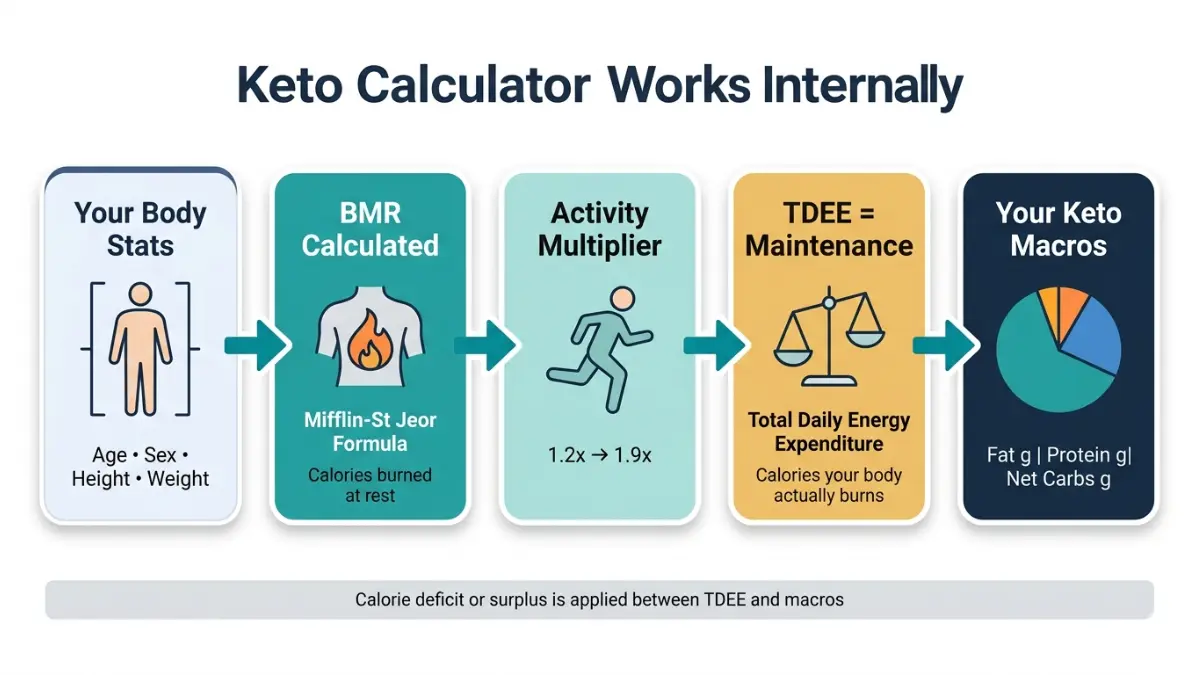
This is where most people make their first mistake. Activity level multiplies your BMR to produce your TDEE (Total Daily Energy Expenditure) — the actual number of calories your body burns per day.
- Sedentary (1.2x): Desk job, little to no exercise
- Lightly Active (1.375x): 1–3 days of exercise per week
- Moderately Active (1.55x): 3–5 days per week — the most common starting point
- Active (1.725x): Hard exercise 6–7 days per week
- Very Active (1.9x): Physical labor job plus daily training
Key takeaway: Choosing “very active” when you’re sedentary will overestimate your TDEE by 400–600 calories — and stall your weight loss from day one.
Choosing Your Calorie Strategy
Your calorie strategy tells the calculator how many calories to add or remove from your TDEE:
- Gentle fat loss (−250 cal/day): ~0.5 lb/week loss — best for those close to goal weight
- Standard fat loss (−500 cal/day): ~1 lb/week — the clinical sweet spot recommended by NCBI StatPearls
- Aggressive fat loss (−750 cal/day): ~1.5 lb/week — use with caution
- Maintenance (0 cal/day): Eating at TDEE, no weight change
- Lean gain (+250 to +400 cal/day): Muscle building on keto
Reading Your Keto Macro Results
After clicking Calculate, you will see:
- Calorie target — your daily energy goal
- Fat grams — the largest portion of your keto plate
- Protein grams — based on your activity level and body weight
- Net carbs — your ketosis trigger number
- Macro ratio — Fat % / Protein % / Carbs %
- Goal ETA and projected date — based on your selected deficit
Use the meal split table and monthly projection in the tool to convert these numbers into a week-by-week plan.
Understanding Your Keto Macro Results — What These Numbers Actually Mean
Seeing “Fat: 142g | Protein: 118g | Net Carbs: 30g” on a screen means nothing if you do not understand the science behind it. This section is what every competitor skips — and why their readers leave confused.
What Is BMR vs. TDEE?
Your Basal Metabolic Rate (BMR) is the number of calories your body burns at complete rest — to breathe, pump blood, regulate temperature, and maintain organ function.
Your Total Daily Energy Expenditure (TDEE) is BMR multiplied by your activity factor. It represents the total calories your body actually burns in a full day. TDEE is the number that drives every macro calculation in this keto calculator.
For reference — a moderately active 35-year-old woman weighing 75 kg at 165 cm has a BMR of approximately 1,490 calories and a TDEE near 2,310 calories. A 500-calorie deficit puts her keto target at ~1,810 calories per day.
Your Keto Macro Ratio Explained
According to the NCBI StatPearls 2026 clinical review, standard nutritional ketosis is achieved with approximately:
- 55–60% of calories from fat
- 30–35% of calories from protein
- 5–10% of calories from carbohydrates
This is your macro ratio. The keto calculator sets these percentages dynamically — they shift based on your calorie target, protein mode, and net carb selection.
Net Carbs vs. Total Carbs — The Distinction That Determines Ketosis
Total carbs include all carbohydrates in a food, including fiber. Net carbs subtract fiber (and sometimes sugar alcohols) from total carbs — because fiber does not raise blood glucose or trigger an insulin response.
Only net carbs count toward your keto limit. This is why 30g of net carbs from leafy greens behaves very differently from 30g of net carbs from white bread.
Strict vs. Standard vs. Liberal Keto: Which Is Right for You?
| Keto Style | Net Carbs/Day | Best For |
|---|---|---|
| Strict Keto | 20g | Epilepsy management, rapid initial fat loss |
| Standard Keto | 30g | Most US adults — recommended starting point |
| Liberal Keto | 50g | Endurance athletes, active individuals |
For non-keto macro comparisons, our free Macro Calculator lets you explore balanced splits alongside keto ratios.
The Science Behind Ketosis — What 2026 Clinical Research Actually Shows
This is the section no competitor has. Every other keto calculator page either ignores the clinical evidence completely or presents a one-sided view. Here is the honest, balanced, MD-reviewed picture.
What Happens in Your Body When You Enter Ketosis
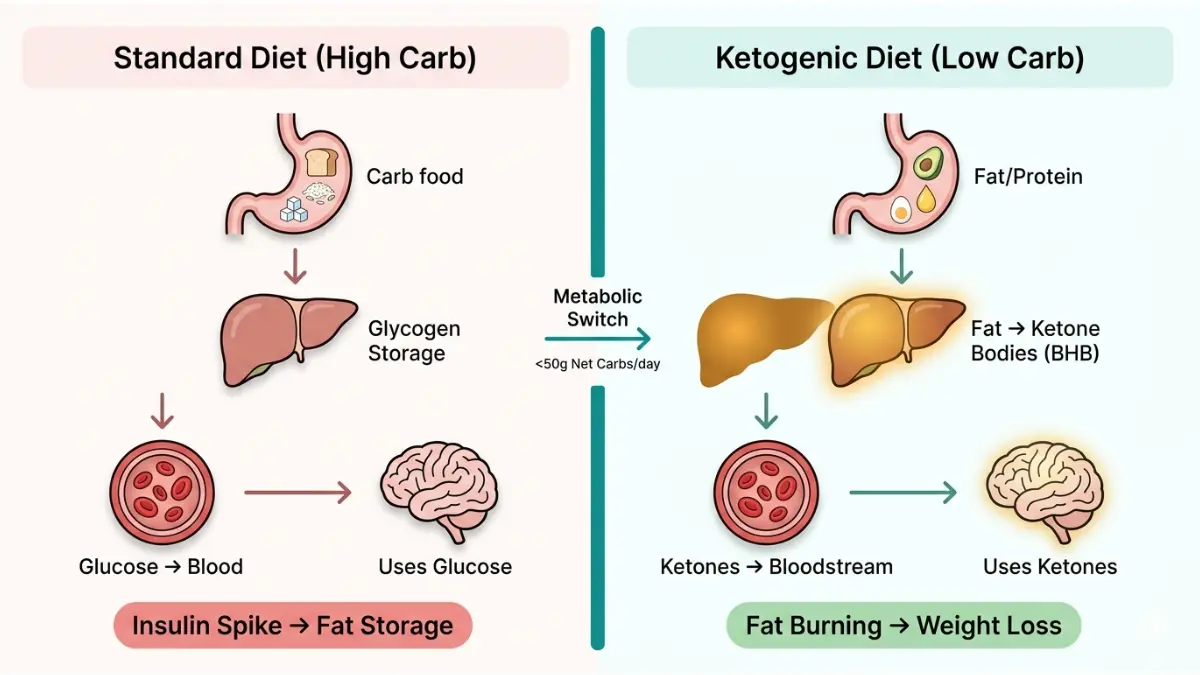
When your net carb intake drops below 50g per day — typically within 2 to 4 days — your liver depletes glycogen stores and begins converting fat into ketone bodies: acetone, acetoacetate, and beta-hydroxybutyrate (BHB).
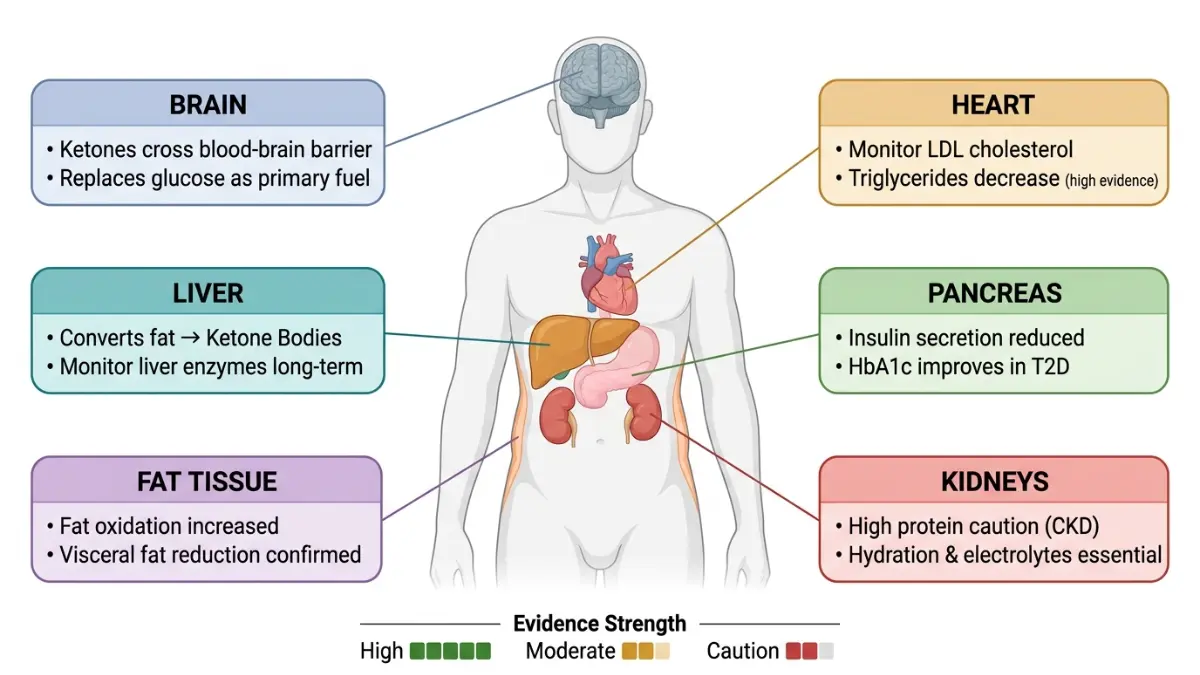
These ketones cross the blood-brain barrier and replace glucose as the primary energy source for the brain. This metabolic shift is what the keto calculator is designed to trigger through precise macro targeting.
Proven Benefits: What Peer-Reviewed Research Confirms (2025–2026)
A major umbrella review published in BMC Medicine — synthesizing multiple randomized controlled trials — confirmed these associations with moderate-to-high evidence:
| Health Outcome | Evidence Level | Key Finding |
|---|---|---|
| Weight loss | Moderate–High | Significant reduction vs. standard diets |
| HbA1c reduction | Moderate | Clinically meaningful in Type 2 Diabetes |
| Triglyceride reduction | Moderate–High | Consistent improvement |
| Seizure frequency | High | Established since the 1920s |
| LDL cholesterol | ⚠️ Caution | May increase — requires monitoring |
A 2025 narrative review published in PMC/NCBI studying 491 adults over 9 months confirmed meaningful reductions in body weight, BMI, waist circumference, and fat mass when ketosis was verified via blood ketone markers.
2026 Research Update: The Long-Term Question
A January 2026 study from the University of Utah (published in Science Advances) found that long-term keto in animal models produced signals of hyperlipidemia, liver stress, and impaired insulin secretion. Researchers called for more long-term human trials before broad clinical endorsement of extended keto protocols.
What this means for you: Short-term keto (up to 12 months) has strong safety and efficacy data. Long-term use beyond 12 months should be done under physician supervision — particularly if you are monitoring lipid panels or liver enzymes.
If you are tracking diabetes markers alongside your keto plan, our Blood Sugar Converter can help you monitor fasting glucose trends in context.
Who Should NOT Start Keto Without a Doctor
Certain populations carry elevated risk and require medical clearance before using any keto calculator output:
- Type 1 Diabetics — ketosis can trigger dangerous ketoacidosis
- Individuals on insulin or sulfonylureas — medication dosing requires adjustment
- Kidney disease patients — high protein targets may accelerate progression
- Pregnant or breastfeeding women — use our Pregnancy Weight Gain Calculator for safe gestational guidance instead
- Anyone with a history of eating disorders — macro tracking may be contraindicated
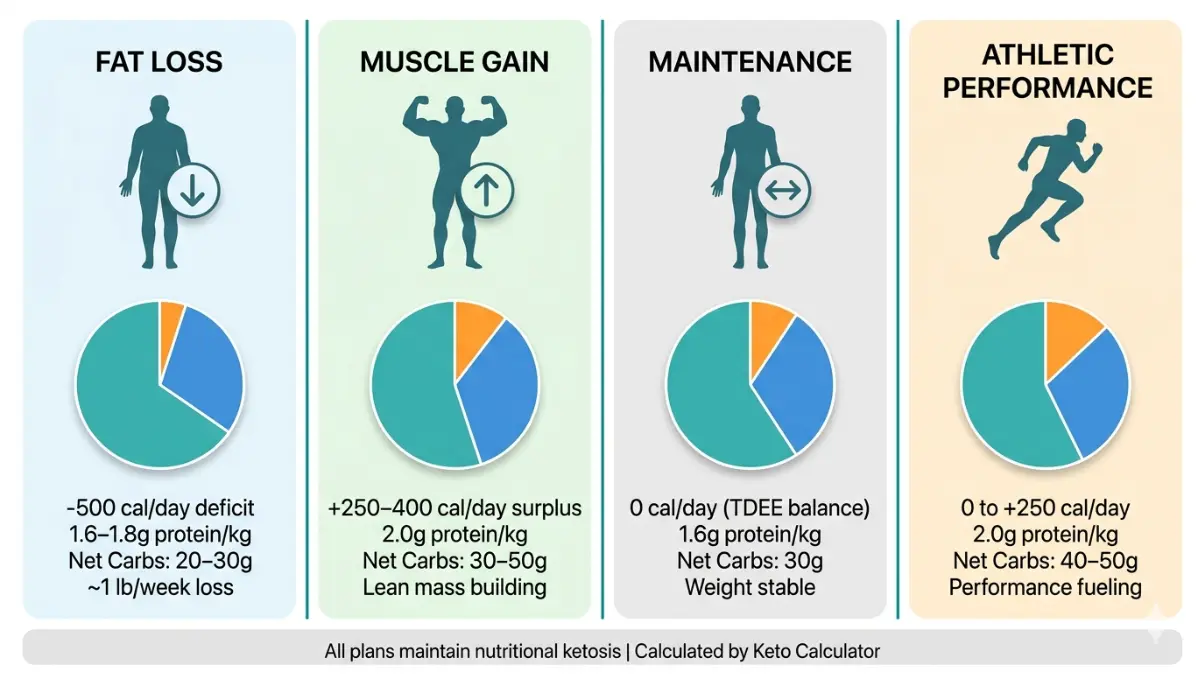
Keto Macros by Goal — Weight Loss, Muscle Gain, and Maintenance
The biggest gap in every competitor’s keto calculator page: they give you one generic output and leave you to figure out the rest. Here, we break down keto macros by your specific goal — because a 28-year-old woman trying to lose 20 lbs needs completely different numbers than a 45-year-old man building muscle.
Goal-Based Keto Macro Reference Table
| Goal | Calorie Strategy | Protein Target | Net Carbs/Day |
|---|---|---|---|
| Fat Loss | −500 cal/day | 1.6–1.8 g/kg body weight | 20–30g |
| Muscle Gain | +250–400 cal/day | 2.0 g/kg body weight | 30–50g |
| Maintenance | 0 cal/day | 1.6 g/kg body weight | 30g |
| Athletic Performance | 0 to +250 cal/day | 2.0 g/kg body weight | 40–50g |
Keto Calculator for Women: Why Results Differ From Men
The Mifflin-St Jeor formula subtracts 161 from the BMR equation for women (versus adding 5 for men). This reflects the biological difference in lean muscle mass and metabolic rate.
In practice, a 35-year-old woman and a 35-year-old man with identical height, weight, and activity levels will have a BMR difference of approximately 160–180 calories per day. The keto calculator accounts for this automatically — which is why entering your sex correctly is non-negotiable.
Keto for Weight Loss: Maximizing Fat Loss Without Losing Muscle
The clinical sweet spot for sustainable fat loss is a 500-calorie daily deficit — producing approximately 1 lb per week. Aggressive deficits (750+ calories) accelerate weight loss but increase the risk of lean muscle mass loss, reduced energy, and hormonal disruption.
To protect muscle on keto while cutting:
- Keep protein at 1.6–1.8 g/kg of body weight (use the “Active” protein mode)
- Do not drop net carbs below 20g unless medically supervised
- Recheck your TDEE every 4–6 weeks as your weight changes
Our Weight Loss Calculator and Calorie Deficit Calculator work alongside this keto calculator to give you a complete fat-loss picture.
Keto for Muscle Gain: High Protein, Calorie Surplus
Gaining muscle on keto is possible but requires specific adjustments. You need:
- A calorie surplus of 250–400 calories above TDEE
- Protein at 2.0 g/kg body weight to support muscle protein synthesis
- Liberal keto (50g net carbs) to fuel training sessions without breaking ketosis
Use our Protein Intake Calculator to verify your muscle-building protein target independently.
Keto for Athletes: Why the 50g Carb Ceiling Makes Sense
Endurance athletes and CrossFitters can benefit from the liberal keto setting (50g net carbs). Research confirms that athletic performance adapts to fat-oxidation within 4–6 weeks. Higher carb ceiling allows for more dietary flexibility around training windows without exiting ketosis entirely.
Our Heart Rate Zone Calculator can help you calibrate training intensity alongside your keto macro strategy.
How to Use Your Keto Calculator Results to Plan Real Meals
Calculating your keto macros is step one. Turning those numbers into food on a plate is where most people get stuck — and where every competitor’s content completely fails.
Keto Meal Split Guide: 2, 3, 4, or 5 Meals a Day?
The keto calculator’s built-in meal split table does this math for you automatically. Here is a reference example for a 1,800-calorie target with 140g fat, 112g protein, and 30g net carbs:
| Meals/Day | Calories/Meal | Fat/Meal | Protein/Meal | Net Carbs/Meal |
|---|---|---|---|---|
| 2 meals | ~900 | ~70g | ~56g | ~15g |
| 3 meals | ~600 | ~47g | ~37g | ~10g |
| 4 meals | ~450 | ~35g | ~28g | ~7.5g |
| 5 meals | ~360 | ~28g | ~22g | ~6g |
Most US adults on keto do best with 3 meals per day — keeping insulin spikes minimal and aligning naturally with daily schedules.
Pairing keto with intermittent fasting is increasingly popular. Our Intermittent Fasting Calculator helps you identify the best eating window for your lifestyle.
What 47g of Fat, 37g of Protein, and 10g Net Carbs Looks Like on a Plate
A single 600-calorie keto meal (3-meal plan) might look like this:
- 2 eggs scrambled in 1 tbsp butter — 14g fat, 12g protein, 0.4g net carbs
- 3 oz salmon fillet — 9g fat, 17g protein, 0g net carbs
- ½ avocado — 11g fat, 1g protein, 1.5g net carbs
- 1 cup sautéed spinach in olive oil — 7g fat, 2g protein, 0.5g net carbs
- 1 oz cheddar cheese — 9g fat, 7g protein, 0g net carbs
Total: ~50g fat, ~39g protein, ~2.4g net carbs ✅
Keto Flu: What Happens in Week 1 and How to Manage It
Most keto beginners experience keto flu within 48–72 hours of cutting carbs. This is your body depleting glycogen and shifting fuel sources — not a sign something is wrong.
Common symptoms include:
- Headache and brain fog
- Fatigue and muscle weakness
- Nausea and irritability
- Difficulty sleeping
Evidence-based management:
- Increase sodium intake (add salt to meals or drink broth)
- Supplement with magnesium and potassium
- Stay hydrated — use our Water Intake Calculator to determine your exact daily fluid target
- Rest — use our Sleep Calculator to optimize recovery
Symptoms typically resolve within 5–7 days as ketone adaptation occurs.
When to Adjust Your Keto Macros — And When to See a Doctor
Your keto macro results are a starting estimate, not a permanent prescription. Real bodies adapt, metabolisms shift, and goals evolve. Here is how to know when your numbers need updating.
Signs Your Keto Macros Need Adjustment
Adjust your keto calculator inputs if:
- ✅ You have lost or gained more than 5 lbs since last calculation
- ✅ Your weight loss has stalled for 3+ consecutive weeks
- ✅ Your energy levels are chronically low despite adequate calories
- ✅ You are not entering ketosis (blood ketones below 0.5 mmol/L)
- ✅ You are experiencing persistent muscle loss alongside fat loss
Plateau protocol: Recalculate your TDEE using your current weight, not your starting weight. As you lose mass, your BMR decreases — meaning yesterday’s deficit may be today’s maintenance level. Our BMI Calculator can help you track body composition progress during recalibration.
Medical Conditions That Require MD Supervision on Keto
The following conditions require physician involvement — a keto calculator alone is not sufficient guidance:
- Type 2 Diabetes on medication — blood sugar medications require dose adjustments as carbs drop
- Hypertension on diuretics — keto causes significant sodium and fluid shifts
- Kidney disease (any stage) — high protein targets may accelerate glomerular filtration decline
- Liver disease — ketone metabolism occurs in the liver; disease may impair this process
- History of pancreatitis — high-fat diets carry elevated risk of flare
If you are managing a metabolic condition alongside keto, explore our Genetic Risk Assessment Tool — which can flag inherited metabolic risk factors relevant to dietary intervention.
How to Monitor Keto Progress Beyond the Scale
Weight is a lagging indicator. Use these markers alongside your keto calculator results:
- Blood ketones: Target 0.5–3.0 mmol/L for nutritional ketosis (measured by finger-prick meter)
- Fasting glucose: Should decrease on keto — track with our Blood Sugar Converter
- Body fat percentage: Use our Body Fat Calculator to track fat loss vs. muscle preservation
- Waist circumference: A more reliable metabolic health marker than BMI alone
- Energy and sleep quality: Subjective but clinically meaningful
Expert Panel Review — mymedicineadvisor.com
This keto calculator and supporting content have been reviewed by the mymedicineadvisor.com Expert Panel, including specialists in Internal Medicine, Endocrinology, and Clinical Nutrition. Our panel of 21 internationally credentialed experts reviews all tool-based content for clinical accuracy, YMYL compliance, and patient safety.
No single calculator replaces individualized medical nutrition therapy. If you are unsure whether keto is right for your specific health profile, use our Symptom Checker as a starting point — then consult your physician.
Frequently Asked Questions: Keto Calculator (2026)
1. How accurate is a keto calculator?
Keto calculators using the Mifflin-St Jeor formula are clinically validated for estimating BMR with a margin of error of approximately 10%. They provide a reliable starting point — but real-world results vary based on hormones, medications, sleep quality, and metabolic adaptation.
2. What is the standard keto macro ratio?
According to NCBI StatPearls (updated December 2025), the standard nutritional keto macro ratio is approximately 55–60% fat, 30–35% protein, and 5–10% carbohydrates. Your personal ratio will shift based on your body weight, protein mode, and net carb target.
3. How many net carbs per day to stay in ketosis?
Most adults achieve and maintain nutritional ketosis at 20–50g of net carbs per day. Strict keto uses 20g, standard keto uses 30g, and liberal keto allows up to 50g. Individual tolerance varies — some people maintain ketosis at 50g while others require under 25g.
4. Can I use a keto calculator for weight loss?
Yes. Set your calorie strategy to a deficit (−250 to −500 cal/day), choose standard or strict keto, and use the goal weight and projection tables to set a realistic timeline. A 500-calorie daily deficit produces approximately 1 lb of fat loss per week.
5. Why do men and women get different keto macro results?
The Mifflin-St Jeor BMR formula applies a biological correction factor for sex. Women have lower BMR values on average due to differences in lean muscle mass, hormonal profiles, and body composition. The keto calculator adjusts all downstream macros — calories, fat, protein — based on this BMR difference.
6. What is BMR and why does the keto calculator need it?
BMR (Basal Metabolic Rate) is the minimum energy your body needs at complete rest. Every macro calculation — fat, protein, carbs, and total calories — is derived from your BMR multiplied by your activity factor. Without an accurate BMR, all subsequent keto targets will be miscalculated.
7. How long does it take to enter ketosis?
Most people enter nutritional ketosis within 2–4 days of restricting net carbs to 20–30g per day, provided they are in a calorie deficit or at maintenance. Glycogen depletion is the first step — once liver and muscle glycogen is used, the liver begins ketone production.
8. Can I use this keto calculator if I have Type 2 Diabetes?
You can use the calculator to understand macros — but do not implement keto without physician clearance if you take insulin, metformin, or any blood-glucose-lowering medication. Keto dramatically lowers blood sugar, which can cause dangerous hypoglycemia when combined with certain medications.
9. What happens if I eat too much protein on keto?
Excess protein undergoes gluconeogenesis — conversion to glucose in the liver. In most people, this process is demand-driven and does not significantly disrupt ketosis. However, at very high protein intakes (above 2.5 g/kg), blood glucose may rise enough to reduce ketone production. The keto calculator’s protein modes are calibrated to avoid this threshold.
10. How often should I recalculate my keto macros?
Recalculate every 4–6 weeks, or whenever your weight changes by more than 5 lbs. As body weight drops, BMR decreases — your original calorie target may no longer represent a deficit. Failing to recalculate is one of the most common reasons keto weight loss plateaus.
11. Is keto safe long-term according to doctors?
Short-term keto (up to 12 months) has strong safety and efficacy data from multiple randomized controlled trials. Long-term safety beyond 12–24 months is still under investigation, with a January 2026 University of Utah study flagging potential signals around lipids and liver function in animal models. Most clinicians recommend periodic bloodwork (lipid panel, liver enzymes, kidney function) for anyone following keto beyond 6 months.
This article is for educational purposes only and does not constitute medical advice. Consult a licensed healthcare provider before starting a ketogenic diet, particularly if you have a diagnosed medical condition or take prescription medications.
About this content
How this article was put together: researched from recognised health sources, drafted with the help of AI tools, and edited by hand, with sources linked throughout.

Sameer Patel is the founder and editor of My Medicine Advisor. He is not a doctor or medical professional — before starting this site he worked in banking,…
Medical disclaimer
The content on MyMedicineAdvisor is provided for general informational and educational purposes only and is not a substitute for professional medical advice, diagnosis, or treatment. Health information on this website should not be used to diagnose, treat, cure, or prevent any condition without guidance from a qualified healthcare professional. Always seek the advice of your doctor, physician, or another licensed healthcare provider with any questions you may have regarding a medical condition, symptoms, medications, or treatment decisions.