

On This Page – Quick Medical Summary
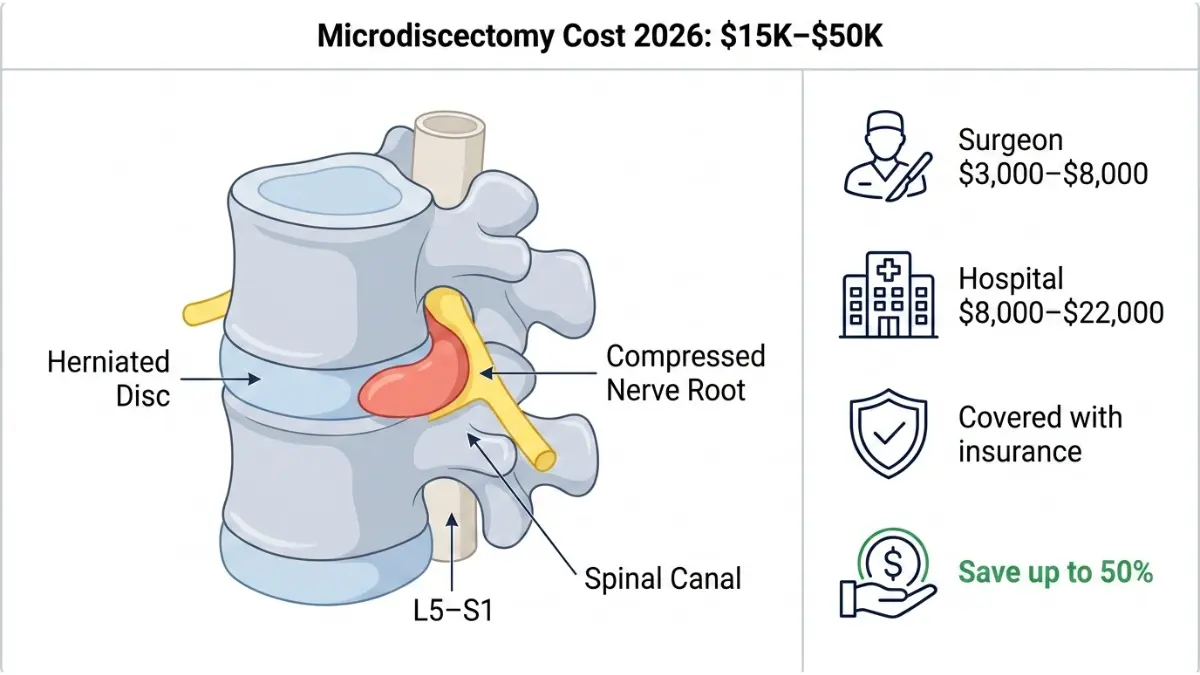
The real microdiscectomy cost in 2026 ranges from $15,000 to $50,000 — but most insured patients pay between $1,500 and $6,000 out of pocket. The gap between what your surgeon quotes and what you actually pay depends on five variables almost nobody explains upfront. This guide breaks every one of them down.
How Much Does Microdiscectomy Cost in 2026? (The Quote vs. Reality)
David Chen, a 47-year-old teacher from Phoenix, received three separate billing quotes for the same lumbar microdiscectomy procedure in January 2026. The quotes ranged from $14,800 to $31,200 — from hospitals located just 12 miles apart. He ultimately saved $11,400 by choosing an outpatient ambulatory surgical center (ASC) over a traditional hospital.
This is the story almost every patient experiences. The microdiscectomy cost your surgeon’s office quotes is rarely the final number on your bill.
Here is what you will actually pay in 2026, broken down by scenario:
| Scenario | Total Cost Range |
|---|---|
| With insurance — in-network | $1,500–$6,000 out-of-pocket |
| With insurance — out-of-network | $5,000–$15,000 out-of-pocket |
| Without insurance — outpatient ASC | $15,000–$28,000 |
| Without insurance — hospital inpatient | $30,000–$50,000 |
| Medicare (Part A + B covered) | $0–$3,000 out-of-pocket |
| Medical tourism (India / Mexico) | $3,000–$8,000 total |

Why the Surgeon’s Quote Is Almost Never the Final Number
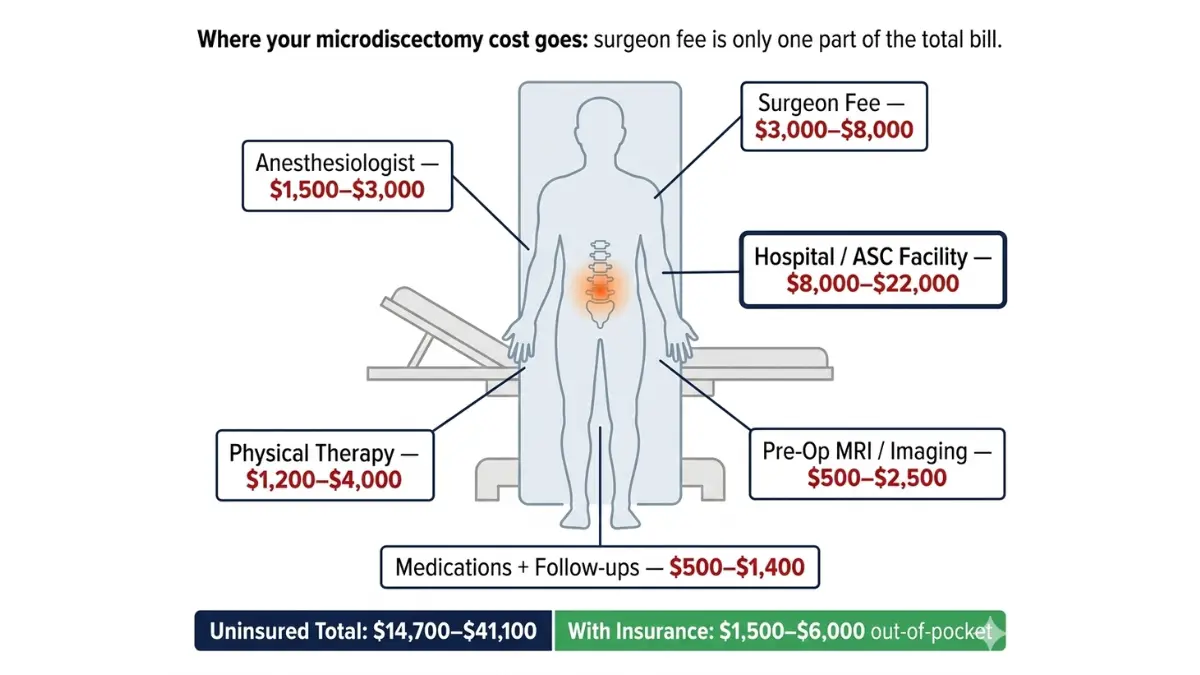
The estimate from your spine surgeon’s office typically covers only the surgical fee — roughly $3,000–$8,000. It does not include the facility fee, anesthesiologist, imaging, physical therapy, or post-op medications. Those line items can add $8,000–$20,000 to your total.
Three costs hidden in almost every surgical estimate:
- Anesthesiologist fee — billed separately, often $1,500–$3,000
- Facility/OR fee — the single largest line item at $8,000–$22,000
- Post-discharge physical therapy — $1,200–$4,000 over 6–8 weeks
If you are still in the symptom assessment phase and unsure whether surgery is even necessary, use our Symptom Checker to evaluate whether your leg pain, numbness, or weakness pattern matches disc herniation before booking a surgical consultation.
Full Itemized Cost Breakdown — Every Line on Your Bill
No competitor publishes this. Here is the complete itemized breakdown of what constitutes the lumbar microdiscectomy cost in the United States in 2026:
| Cost Component | Typical Range (USA) |
|---|---|
| Surgeon fee (CPT 63030) | $3,000–$8,000 |
| Anesthesiologist | $1,500–$3,000 |
| Hospital or ASC facility fee | $8,000–$22,000 |
| Pre-operative MRI / imaging | $500–$2,500 |
| Post-operative physical therapy | $1,200–$4,000 |
| Prescription medications (30-day) | $200–$800 |
| Follow-up consultations (2–3 visits) | $300–$600 |
| Estimated total (uninsured) | $14,700–$41,100 |
Outpatient Surgical Center vs. Hospital: The 20–40% Cost Gap
Choosing an outpatient ambulatory surgical center (ASC) instead of a hospital for your microdiscectomy can reduce your spine surgery cost by 20–40%. The procedure, outcome quality, and surgeon are often identical. The difference is facility overhead.
According to research from PMC/National Library of Medicine, outpatient lumbar microdiscectomy produces similar clinical outcomes to inpatient procedures at significantly lower cost — making it cost-effective across multiple healthcare systems.
Why Two Hospitals 15 Miles Apart Can Quote You $16,400 Apart
A Vanderbilt University Medical Center study analyzing 90-day episode costs found that the mean total cost of a single-level primary microdiscectomy was $7,962 — but that obesity, extended surgical time, complications, post-discharge ER visits, and opioid dependency days were the biggest cost drivers, creating wide variation even within the same city. You can read the full study at pubmed.ncbi.nlm.nih.gov.
What This Means For You: Always request an itemized cost estimate — not a lump-sum quote — from every facility before scheduling. Compare at least 3–4 facilities. The identical surgery at a surgical center in the same city often costs $8,000–$15,000 less than the same procedure at a major hospital.
Since obesity is documented as a top cost driver of higher herniated disc surgery costs, patients considering surgery can track their weight status with our BMI Calculator and discuss weight optimization with their surgeon pre-operatively to reduce complication risk and total surgical cost.
The Insurance Battlefield — Getting Your Surgery Approved and Covered
This is where 40% of patients get blindsided. Understanding how insurance approves microdiscectomy cost coverage is something surgeons rarely walk you through in a 15-minute consultation.
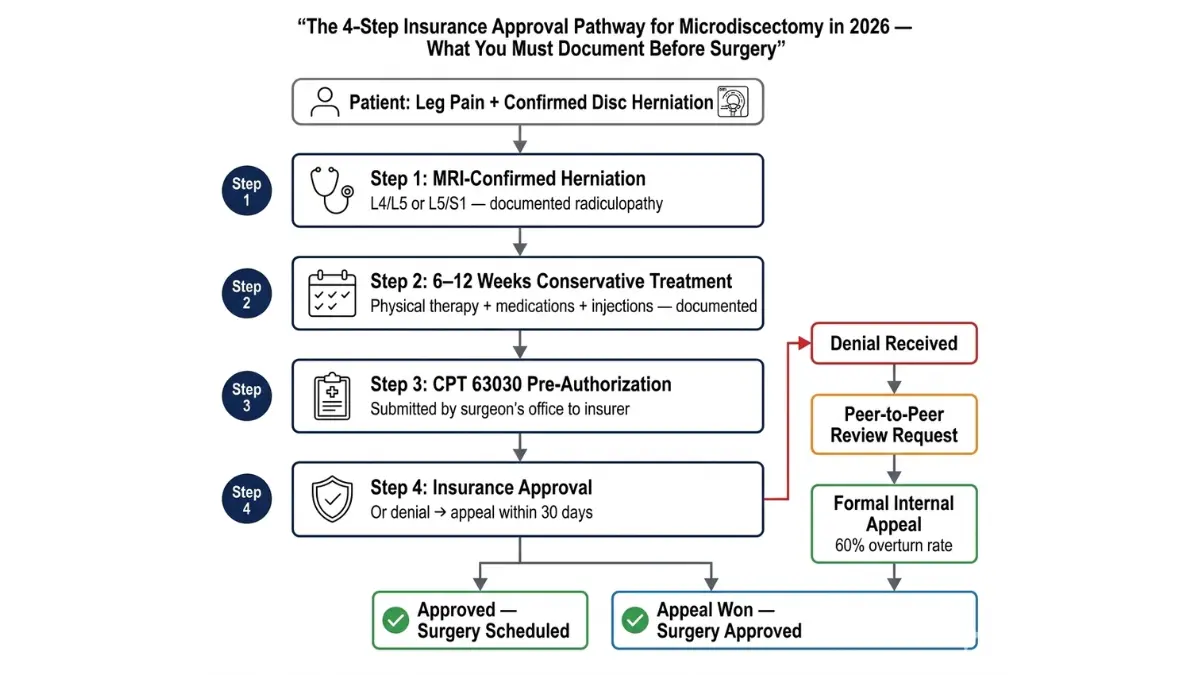
The 4 Things Every U.S. Insurer Requires Before Approving Microdiscectomy
Almost all commercial health insurance plans — including UnitedHealthcare, Aetna, Cigna, and BlueCross BlueShield — require all four of the following before granting pre-authorization:
- MRI-confirmed disc herniation at the symptomatic level (L4/L5 or L5/S1 most commonly)
- 6–12 weeks of documented failed conservative treatment — physical therapy visits, medications, and/or injections with records
- Evidence of radiculopathy — neurological deficit, documented leg pain, or intractable pain with functional impairment
- Formal pre-authorization submission using CPT code 63030 (lumbar microdiscectomy)
The Insurance Criteria Problem No One Is Talking About
A 2024 cross-sectional study published in the International Journal of Spine Surgery (PMC) analyzed the top national and regional U.S. insurers and found that insurance medical necessity criteria for microdiscectomy are inconsistent across providers and frequently more restrictive than clinical guidelines set by the North American Spine Society (NASS). In plain terms: your insurer may deny coverage using a standard that your surgeon’s own medical society considers too strict.
This means denial is not always final — it is often appealable.
Medicare Coverage for Microdiscectomy in 2026
If you are on Medicare, here is exactly what is covered:
- Medicare Part A — covers inpatient hospital stay if your surgery requires admission
- Medicare Part B — covers the surgeon’s fee, anesthesiologist, and outpatient procedure costs
- Your out-of-pocket — typically $0–$3,000 after meeting your deductibles ($1,676 Part A per benefit period; $257 Part B annual in 2025)
Medicare covers microdiscectomy when deemed medically necessary by your physician. Full surgical coverage details are published at medicare.gov/coverage/surgery.
How to Appeal an Insurance Denial — Step-by-Step
If your pre-authorization is denied, take these four actions immediately:
- Request the denial letter in writing — insurers must provide the specific clinical reason
- Have your surgeon submit a peer-to-peer review — spine surgeons speaking directly to insurance medical directors overturn denials in roughly 60% of cases
- Compile your full conservative treatment record — every PT visit, injection, and medication trial with dates
- File a formal internal appeal within 30 days — attach the NASS clinical guidelines showing your case meets medical necessity criteria
HSA and FSA: The Tax Strategy Most Patients Miss
If you are enrolled in a High Deductible Health Plan (HDHP), you can use Health Savings Account (HSA) funds to pay any out-of-pocket microdiscectomy costs with pre-tax dollars — effectively reducing your real cost by 22–37% depending on your tax bracket. Flexible Spending Accounts (FSAs) work similarly for those without HSA eligibility.
What This Means For You: Never accept a first insurance denial as final. Always request a peer-to-peer review. Document every conservative treatment with dates. Medicare patients should confirm their deductible status before scheduling at MyMedicare.gov.
For related post-surgical recovery planning, our guide on physical therapy explains how to structure your rehabilitation and what insurance typically covers during recovery.
6 Proven Strategies to Slash Your Microdiscectomy Cost
This section is the one no competitor publishes. These are the real cost-reduction tactics that patients who pay less use — and that billing departments do not volunteer.
Strategy 1: Choose an Outpatient Surgical Center
Request that your microdiscectomy be performed at an ASC, not a hospital. The surgical outcome is equivalent. The facility fee is 20–40% lower. Ask your surgeon specifically: “Can this be done at an outpatient surgical center?”
Strategy 2: Request an Itemized Estimate in Writing
Before agreeing to any facility, request an itemized cost estimate with individual CPT codes. Compare across 3–4 facilities. This one step saved David Chen $11,400 in the patient story above.
Strategy 3: Negotiate a Self-Pay Cash Discount
Uninsured or self-pay patients can often negotiate 25–50% off by prepaying 30 days before surgery. One Dallas hospital reduced a $24,600 bill to $13,700 for a patient who prepaid in full. Call the billing department directly and ask: “What is your best cash-pay rate for CPT 63030?”
Strategy 4: Apply for Hospital Charity Care
Every non-profit hospital in the United States is required by law to offer financial assistance programs. Most patients earning under 200–400% of the federal poverty level qualify for partial or full cost reduction. Ask the billing office: “Do you have a charity care or financial assistance program?”
Strategy 5: Cross State Lines for Lower-Cost Surgery
Microdiscectomy cost by state varies dramatically. Patients in New York City or San Francisco face $30,000–$50,000 estimates. Patients in Nashville, Houston, or Tampa see $18,000–$32,000 for the identical procedure. Crossing state lines for surgery can save $8,000–$12,000 — though follow-up care logistics require coordination with a local provider.
Strategy 6: Use HSA/FSA Pre-Tax Dollars
As covered in Section 3, paying eligible surgical expenses through your HSA or FSA provides an effective 22–37% discount through tax savings. Maximize your annual contribution before scheduling if surgery is anticipated.
Quick Reference — Savings Potential by Strategy:
| Strategy | Estimated Savings |
|---|---|
| Outpatient ASC vs. hospital | $6,000–$15,000 |
| Self-pay cash discount | 25–50% off |
| Hospital charity care | Up to 100% |
| State line surgery | $8,000–$12,000 |
| HSA/FSA pre-tax payment | 22–37% effective discount |
What This Means For You: The average patient who implements even 2 of these 6 strategies reduces their microdiscectomy out-of-pocket cost by $4,000–$12,000. Ask your surgical coordinator about each one before your pre-op appointment.
For patients considering related orthopedic procedures and their respective costs, our detailed guide on knee surgery cost 2026 state prices uses the same cost-reduction framework.
Is Microdiscectomy Worth the Cost? What the Science Says in 2026
This is the question every patient asks but most articles refuse to answer directly with data.
The True Cost of NOT Having Surgery
James Whitfield, a 52-year-old logistics manager from Houston, delayed his microdiscectomy for 8 months while pursuing conservative treatment. His condition deteriorated from a herniated L4/L5 disc to a surgically complex multi-level problem requiring spinal fusion — at a final cost of $94,000 versus the $21,000 microdiscectomy quoted at month one.
This is not an isolated case. A peer-reviewed cost-consequence analysis published in PMC found that delayed lumbar disc surgery carried an additional indirect cost of $11,753 per patient compared to early intervention — primarily driven by extended workforce absence and increased healthcare utilization during the waiting period.
What the Clinical Data Shows — 2026 Evidence Update
The evidence base supporting microdiscectomy cost-effectiveness is now exceptionally strong:
- 86.8% success rate for microdiscectomy vs. 77.8% for traditional open discectomy (2025 comparative analysis)
- Complication rate of 0.4% vs. 2.6% for open procedures
- Return to work in 4–6 weeks on average vs. 10–22 weeks for conservative-only management
- A randomized controlled trial published in PMC found that early surgical microdiscectomy achieved an incremental cost-utility ratio of just CAD $5,822 per quality-adjusted life year (QALY) gained — far below the accepted cost-effectiveness threshold of CAD $50,000/QALY. Early surgery was cost-effective in 99% of probabilistic sensitivity analyses.
Surgery vs. Conservative Treatment: The 5-Year Cost Comparison
| Treatment Path | 5-Year Estimated Cost |
|---|---|
| Microdiscectomy (single procedure) | $15,000–$50,000 |
| Conservative ongoing (PT + injections + meds) | $25,000–$65,000+ |
| Spinal fusion (if delay causes deterioration) | $80,000–$150,000 |
The math is clear. For patients with confirmed disc herniation and failed conservative treatment, lumbar microdiscectomy cost is the most financially efficient option — not the most expensive one.
Our sister article on laminectomy cost, recovery, and success rates provides a direct comparison for patients whose surgeons have presented both procedures as options. For patients recovering from spine surgery and wanting to optimize body composition during rehabilitation, our Ideal Weight Calculator can support pre- and post-surgical health targets.

What This Means For You: Delaying microdiscectomy when surgery is medically indicated does not save money — it costs more. The data consistently shows that early intervention is both clinically and financially superior for patients with chronic radiculopathy who have exhausted conservative options.
Expert Panel Consensus + Global Cost Context
What Board-Certified Specialists Say
Dr. Omar Hassan, MD — Internal Medicine, mymedicineadvisor.com Medical Board: “The most common financial mistake I see patients make is waiting for the ‘right time’ financially. When disc herniation is causing documented nerve compression and conservative treatment has genuinely failed, further delay increases the likelihood of escalation to more expensive, higher-risk procedures like fusion. The microdiscectomy window is finite.”
Dr. Sara Fernandez, PharmD — Pharmacology, mymedicineadvisor.com Medical Board: “Post-surgical medication costs are frequently underestimated by patients. A 30-day supply of standard post-microdiscectomy medications — including an NSAID, muscle relaxant, and short-course opioid — typically runs $200–$800 without insurance. Patients should request generic substitutions and confirm formulary coverage before surgery.”
Global Microdiscectomy Cost Comparison (2026 — Tier 1 + Medical Tourism Markets)
| Country / Region | Average Total Cost |
|---|---|
| USA — Major metro (NYC, LA, SF) | $35,000–$50,000 |
| USA — Mid-range (Dallas, Denver, Atlanta) | $22,000–$38,000 |
| USA — Lower-cost (Nashville, Tampa, Houston) | $15,000–$28,000 |
| UK (private) | £8,000–£18,000 (~$10,000–$23,000) |
| Canada (private) | CAD $12,000–$28,000 |
| Australia (private) | AUD $15,000–$30,000 |
| India (medical tourism) | $3,500–$6,000 |
| Mexico (medical tourism) | $4,000–$7,500 |
For U.S. patients, the microdiscectomy surgery cost difference between high-cost and low-cost states alone justifies researching surgical centers outside your immediate region — particularly for the uninsured or underinsured.
Key Takeaway: The most expensive microdiscectomy is the one you delay.
For patients whose spine symptoms co-exist with broader musculoskeletal issues, our comprehensive guide on shoulder surgery success rates 2026 and the hip replacement surgery 2026 recovery guide provide parallel cost and outcome frameworks across surgical specialties. Patients concerned about hereditary disc disease factors can also use our Genetic Risk Assessment Tool to assess spinal predisposition before scheduling a surgical consultation.
Frequently Asked Questions — Microdiscectomy Cost
1. How much does microdiscectomy cost with insurance?
With in-network insurance, most patients pay $1,500–$6,000 out-of-pocket after deductibles and coinsurance. Out-of-network costs reach $5,000–$15,000.
2. How much does microdiscectomy cost without insurance?
Without insurance, the total cost ranges from $15,000–$50,000 depending on facility type, location, and whether the procedure is outpatient or inpatient.
3. Is microdiscectomy covered by Medicare?
Yes. Medicare Part A covers inpatient stays; Part B covers outpatient procedures and surgeon fees. Out-of-pocket costs are typically $0–$3,000 after deductibles. Details at medicare.gov.
4. What is the CPT code for microdiscectomy?
The standard CPT code is 63030 for a single-level lumbar microdiscectomy. This is the code used for insurance pre-authorization submissions.
5. Is microdiscectomy an outpatient procedure?
Yes, in most cases. The majority of microdiscectomies are performed outpatient with same-day discharge, which significantly reduces spine surgery cost compared to inpatient hospital admission.
6. How long is recovery after microdiscectomy?
Most patients return to light activity within 1–2 weeks and full activity within 4–6 weeks. Physical therapy begins within 2–4 weeks post-surgery.
7. What is the success rate of microdiscectomy?
The 2026 success rate is 86.8% for appropriate candidates — significantly higher than open discectomy at 77.8%. Long-term 10-year data shows 83–91% maintain positive outcomes.
8. How do I get insurance to approve spine surgery?
Document 6–12 weeks of failed conservative treatment, obtain an MRI, have your surgeon submit CPT 63030 for pre-authorization, and reference NASS clinical guidelines if denied.
9. Is microdiscectomy cheaper than spinal fusion?
Significantly. Microdiscectomy costs $15,000–$50,000. Spinal fusion costs $80,000–$150,000. Early microdiscectomy can prevent the need for fusion entirely.
10. Can I negotiate the cost of microdiscectomy?
Yes. Self-pay patients regularly negotiate 25–50% discounts through cash-pay prepayment. Always ask the billing department directly for their best cash rate for CPT 63030.
11. What happens if I don’t have microdiscectomy?
Untreated disc herniation with nerve compression can progress to permanent nerve damage, chronic pain, and eventually require more complex and expensive spinal fusion surgery — costing $80,000–$150,000 compared to $15,000–$50,000 for timely microdiscectomy.
About this content
How this article was put together: researched from recognised health sources, drafted with the help of AI tools, and edited by hand, with sources linked throughout.

Sameer Patel is the founder and editor of My Medicine Advisor. He is not a doctor or medical professional — before starting this site he worked in banking,…
Medical disclaimer
The content on MyMedicineAdvisor is provided for general informational and educational purposes only and is not a substitute for professional medical advice, diagnosis, or treatment. Health information on this website should not be used to diagnose, treat, cure, or prevent any condition without guidance from a qualified healthcare professional. Always seek the advice of your doctor, physician, or another licensed healthcare provider with any questions you may have regarding a medical condition, symptoms, medications, or treatment decisions.