


On This Page – Quick Medical Summary
Quick Answer: The ESR blood test (erythrocyte sedimentation rate) measures how fast your red blood cells sink in a test tube over one hour. A faster rate signals inflammation somewhere in your body. Normal ESR is 0–15 mm/hr for men and 0–20 mm/hr for women under 50. It cannot diagnose a specific disease — but it tells your doctor that further investigation is needed.
What Is an ESR Blood Test? The Real Explanation
Marcus, 44, received his annual blood panel results on a Tuesday morning. His ESR read 52 mm/hr. His doctor had circled it in red. He spent three hours searching the internet — finding only clinical jargon that told him nothing useful.
That’s exactly why this guide exists.
What Does the ESR Blood Test Actually Measure?
The ESR blood test — formally called the erythrocyte sedimentation rate test — measures the speed at which your red blood cells (erythrocytes) sink to the bottom of a vertical test tube over 60 minutes. The result is recorded in millimeters per hour (mm/hr).
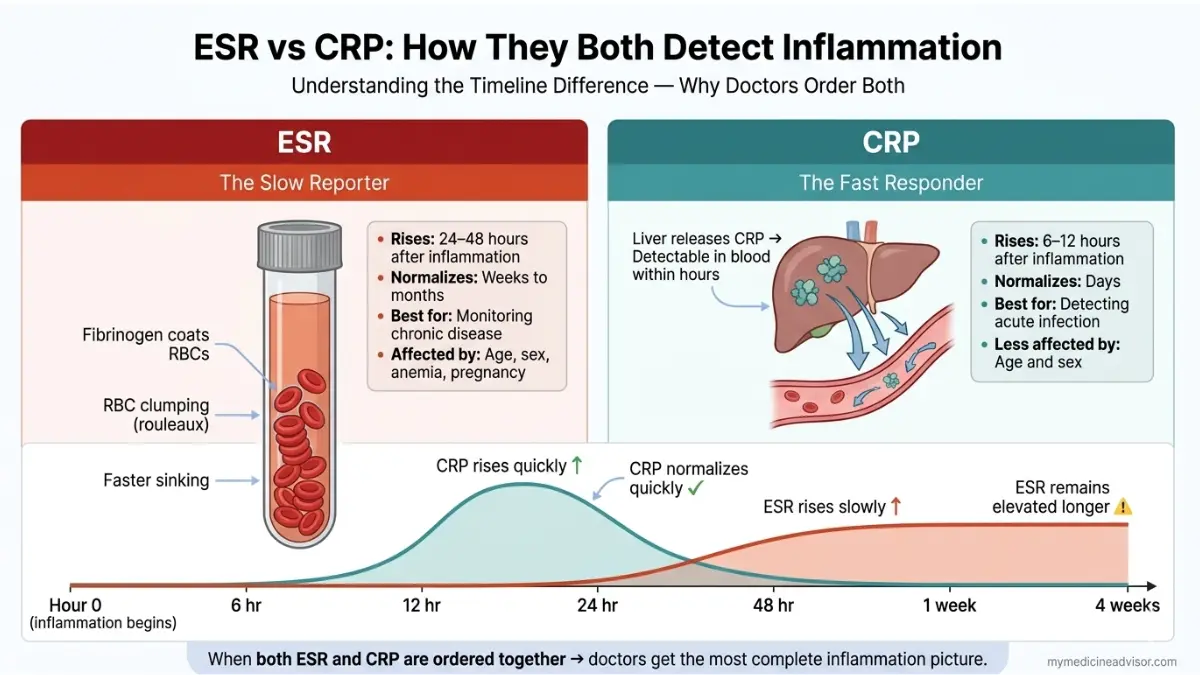
In a healthy person, red blood cells fall slowly. When inflammation is present, your body releases proteins — especially fibrinogen — into the bloodstream. These proteins cause red blood cells to clump together into coin-like stacks called rouleaux. Heavier clumps sink faster, producing a higher ESR reading.
According to MedlinePlus (National Library of Medicine), the ESR test is one of the oldest and most widely used inflammation screening tools in clinical medicine.
How Is the ESR Test Performed?
The procedure is straightforward:
- A small blood sample is drawn from a vein in your arm (takes under 2 minutes)
- The sample is placed in a long, thin Westergren tube — the gold-standard method endorsed by the International Committee for Standardization in Haematology (ICSH)
- The tube stands upright at room temperature for exactly 60 minutes
- A lab technician measures how far the red blood cells have fallen, in millimeters
No fasting is required. No special preparation is needed in most cases.
What the ESR Test Can and Cannot Do
The ESR blood test CAN:
- Detect the presence of inflammation in your body
- Monitor whether a known inflammatory disease is responding to treatment
- Flag the need for further diagnostic testing
The ESR blood test CANNOT:
- Identify where the inflammation is located
- Diagnose a specific disease on its own
- Replace other targeted blood tests like CRP or CBC
Key Takeaway: The ESR blood test is a signal, not a diagnosis. Think of it as your body’s smoke alarm — it tells you there may be a fire, but not where it is or how serious it is.
If you’re unsure whether your current symptoms warrant blood testing, our Symptom Checker can help you map your symptoms before your appointment.
ESR Normal Range — Complete Chart by Age, Sex, and Pregnancy (2026)
The most common mistake people make when reading an ESR result is comparing their number to the wrong baseline.
Your “normal” isn’t everyone’s normal. Age, sex, and pregnancy all shift your reference range significantly.
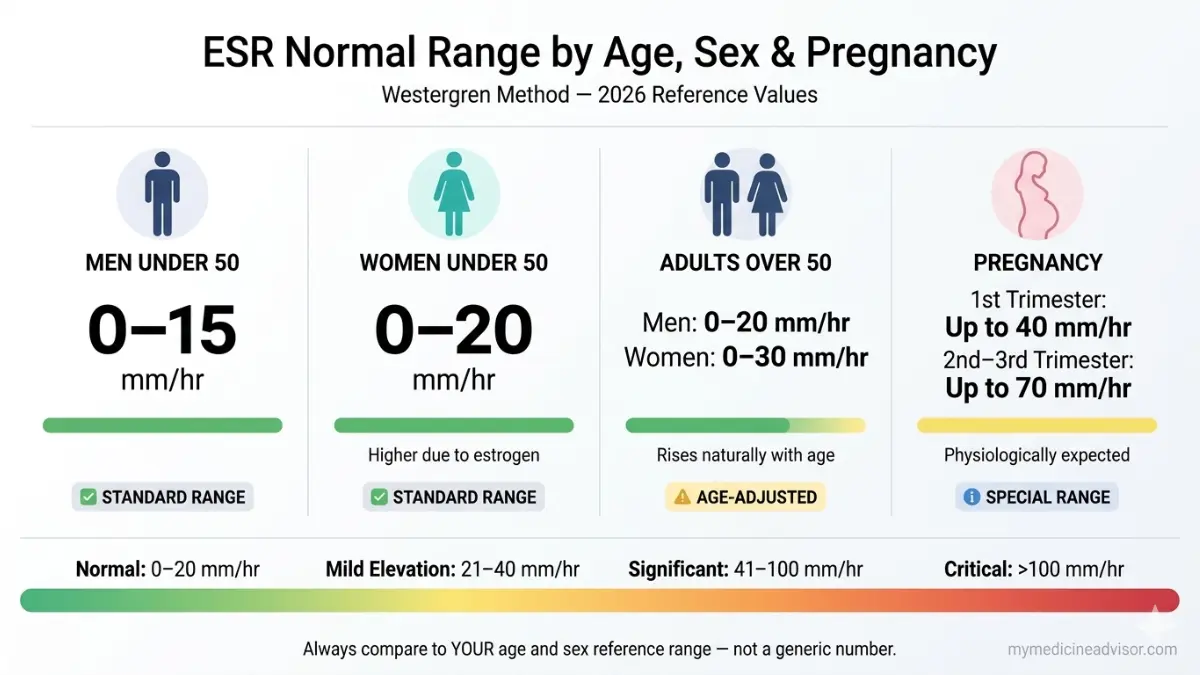
ESR Normal Range Table (Westergren Method — 2026 Clinical Reference)
| Group | Normal ESR Range | Notes |
|---|---|---|
| Men under 50 | 0–15 mm/hr | Standard male reference |
| Men 50 and older | 0–20 mm/hr | Rises naturally with age |
| Women under 50 | 0–20 mm/hr | Higher than men due to hormones |
| Women 50 and older | 0–30 mm/hr | Post-menopausal shift |
| Children (under 18) | 0–10 mm/hr | Lower baseline in pediatrics |
| Pregnancy (1st trimester) | Up to 40 mm/hr | Physiological increase |
| Pregnancy (2nd–3rd trimester) | Up to 70 mm/hr | Expected, not alarming |
| Elderly (age 70+) | Up to 40–50 mm/hr may be normal | Limited diagnostic value in this group |
Source: StatPearls, NCBI Bookshelf (2026) — continuously updated clinical reference
Why Women Have Higher ESR Than Men
Estrogen and progesterone increase fibrinogen levels in the blood, which promotes rouleaux formation and accelerates sedimentation. This is a normal physiological difference — not a cause for alarm on its own.
A 2019 population-based study published via PMC (NCBI) confirmed that sex and age are the two strongest predictors of ESR values in healthy adults, independent of other health factors.
ESR in Pregnancy — What’s Normal vs. Concerning
During pregnancy, ESR rises naturally due to increased fibrinogen and plasma volume. An ESR of 40–70 mm/hr in the second or third trimester is typically expected and not indicative of disease.
However, if your ESR is elevated alongside symptoms like severe joint pain, persistent fever, or unusual fatigue, your doctor will investigate further. If you’re tracking pregnancy-related health metrics, our Pregnancy Weight Gain Calculator can help you monitor your overall health during each trimester.
The Elderly Exception
Research published in PubMed on elderly populations found that ESR values above the standard adult range may be consistent with continued good health in people over 70. In this age group, the test has limited diagnostic value unless ESR is dramatically elevated (>60–70 mm/hr).
Key Takeaway: Always compare your ESR to the reference range for your specific age group and sex. A result of 28 mm/hr is completely normal for a 60-year-old woman — but would warrant attention in a 25-year-old man.
High ESR Results — What Each Level Actually Signals
This is the section most people actually need — and the one every competitor gets wrong.
They give you vague descriptions. We give you a clinically grounded interpretation framework.
ESR Level Urgency Table — 2026 Clinical Guide
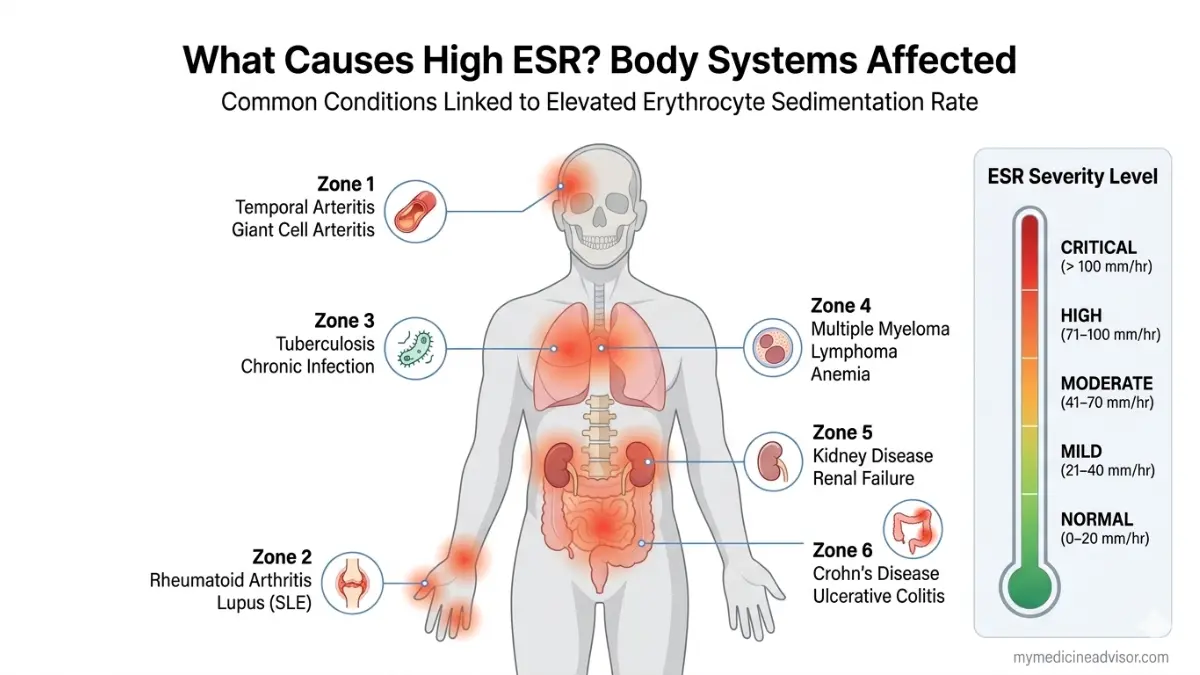
| ESR Level | What It May Indicate | Recommended Action |
|---|---|---|
| Slightly high (21–40 mm/hr) | Minor infection, anemia, obesity, early pregnancy, recent illness | Retest in 4–6 weeks; discuss with doctor |
| Moderately high (41–70 mm/hr) | Active inflammatory condition, autoimmune disease, significant infection | See your doctor within 1–2 weeks |
| Significantly high (71–100 mm/hr) | Active systemic disease, chronic infection, early malignancy | See your doctor promptly — within days |
| Dangerously high (>100 mm/hr) | 90% probability of serious underlying disease | Seek medical attention urgently |
The 90% Rule — Why ESR Over 100 mm/hr Is a Red Flag
This is what your search results probably haven’t told you.
According to research cited in Mayo Clinic’s clinical resources, an ESR exceeding 100 mm/hr carries a 90% predictive value for serious underlying disease.
The breakdown of causes at this level (from U.S. clinical studies):
- Infection — 33% of cases
- Cancer (including multiple myeloma, lymphoma) — 17%
- Kidney disease — 17%
- Non-infectious inflammatory disorders — 14%
This doesn’t mean your ESR of 110 mm/hr means you have cancer. It means your doctor has strong clinical reason to investigate — and they should.
What Causes High ESR? — The Complete List
Inflammatory and autoimmune conditions:
- Rheumatoid arthritis
- Systemic lupus erythematosus (SLE)
- Temporal arteritis (giant cell arteritis)
- Polymyalgia rheumatica
- Inflammatory bowel disease (Crohn’s, ulcerative colitis)
Infections:
- Bacterial infections (including tuberculosis)
- Sepsis
- Chronic viral infections
Cancers:
- Multiple myeloma
- Lymphoma
- Metastatic solid tumors
Other causes:
- Anemia (lowers RBC count, falsely accelerates sedimentation)
- Obesity (chronic low-grade inflammation)
- Pregnancy
- Kidney disease
- Thyroid disorders
For context on how related inflammation markers appear in your results, our article on CRP test results explains how CRP and ESR are typically read together.
High ESR in Women — Special Considerations
Women consistently show higher ESR baselines due to hormonal fluctuations. Specifically:
- During menstruation: ESR can temporarily rise
- On oral contraceptives: Estrogen increases fibrinogen, raising ESR
- After menopause: ESR reference range shifts upward
A mildly elevated ESR in a woman with no symptoms is far less concerning than the same number in an asymptomatic man.
Key Takeaway: Context is everything. An ESR of 45 mm/hr in a healthy pregnant woman is expected. The same result in a 35-year-old man with joint pain and fatigue should prompt immediate investigation.
If joint pain is part of your symptom picture alongside elevated ESR, also review our guide on D-dimer range chart to understand how inflammation markers interact.
Low ESR, Medications That Skew Your Test, and What Comes Next
Most online articles spend all their time on high ESR. But low ESR and medication interference are just as clinically important — and almost universally ignored.
What Does a Low ESR Mean?
A low ESR (below 0 mm/hr or unusually close to zero) is less common but clinically relevant.
Conditions associated with low ESR:
| Condition | Why ESR Is Low |
|---|---|
| Sickle cell disease | Abnormally shaped RBCs can’t form rouleaux stacks |
| Polycythemia vera | Too many RBCs increases blood viscosity, slowing sedimentation |
| Congestive heart failure | Altered plasma proteins affect sedimentation dynamics |
| Hyperviscosity syndromes | Thicker blood resists sedimentation |
A low ESR is not generally a reassuring finding by itself — it simply means the test has limited usefulness in that clinical context.
Medications That Can FALSELY Raise or Lower Your ESR
This is the information no competitor is giving you clearly — and it’s critical.
Medications that raise ESR (may produce a falsely high result):
- Birth control pills (oral contraceptives)
- Dextran (plasma expander)
- Methyldopa (Aldomet) — a blood pressure medication
- Theophylline (used for asthma)
- Vitamin A in high doses
Medications that lower ESR (may mask inflammation):
- Aspirin
- Corticosteroids (prednisone, dexamethasone)
- Quinine
- NSAIDs (ibuprofen, naproxen)
- High-dose statins
Key Takeaway: Always tell your doctor every medication, supplement, and herbal product you take before an ESR test. A falsely elevated or suppressed result can delay your diagnosis significantly.
What Tests Does Your Doctor Order After an Abnormal ESR?
When your ESR blood test comes back abnormal, it’s rarely the end of the diagnostic journey — it’s the beginning.
Common follow-up tests include:
- CRP (C-reactive protein): A faster-responding inflammation marker, often ordered alongside ESR
- CBC (Complete blood count): Checks red cells, white cells, and platelets for signs of infection or blood disorders — see our detailed CBC blood test results guide
- ANA (Antinuclear antibody): Screens for autoimmune conditions like lupus
- Ferritin and iron studies: Rules out anemia as the cause of elevated ESR
- Liver function tests (LFT): Inflammatory conditions can affect liver enzymes
- TSH (thyroid-stimulating hormone): Thyroid disease can elevate ESR — our TSH test guide explains normal ranges in detail
If metabolic factors like weight may be contributing to chronic low-grade inflammation, our BMI Calculator can help you establish your baseline health metrics.
ESR vs. CRP — Which Inflammation Marker Should You Trust?
Your doctor may order both the ESR blood test and a CRP test at the same time. Patients frequently ask: “Why do I need both? Aren’t they the same thing?”
They’re not. And understanding the difference could change how you interpret your results.
ESR vs. CRP: Side-by-Side Comparison Table
| Feature | ESR (Sed Rate) | CRP (C-Reactive Protein) |
|---|---|---|
| What it measures | RBC sedimentation speed (indirect) | Liver-produced acute-phase protein (direct) |
| Rises after inflammation begins | 24–48 hours | 6–12 hours |
| Returns to normal after treatment | Weeks to months | Days |
| Best clinical use | Monitoring chronic inflammatory disease | Detecting acute infection or injury |
| Affected by age and sex | Yes — significantly | Less so |
| Falsely elevated by | Anemia, pregnancy, obesity, certain drugs | Obesity, smoking |
| Misses early inflammation? | More likely to (slow to rise) | Less likely to (rises fast) |
Reference: PMC — ESR and CRP: Clinical Utility Review
When Doctors Use Both Tests Together
Neither test alone tells the complete story. Ordering both gives physicians a temporal snapshot of inflammation:
- CRP high, ESR normal: Acute, very recent inflammation — CRP rose before ESR could catch up
- ESR high, CRP normal: Chronic, low-grade inflammation — CRP has normalized but ESR lags behind
- Both elevated: Active, ongoing inflammatory process requiring investigation
- Both normal: Inflammation unlikely, but not impossible (some conditions produce neither)
Post-COVID ESR — What 2024–2026 Data Shows
Emerging research from 2024–2026 has identified persistently elevated ESR in patients with Long COVID — defined as symptoms lasting beyond 12 weeks after acute SARS-CoV-2 infection.
Studies indicate that ESR, alongside CRP and ferritin, remains elevated in a subset of Long COVID patients experiencing fatigue, joint pain, and cognitive symptoms. This is an evolving area of research, and clinicians are increasingly ordering ESR panels as part of Long COVID workups.
If you’re monitoring cardiovascular health markers alongside inflammation panels, our Heart Rate Zone Calculator can help you track exercise-related cardiac metrics during recovery.
Key Takeaway: ESR is better for monitoring; CRP is better for detecting. Used together, they give your doctor the most complete picture of what’s happening in your body.
When to Worry, What to Tell Your Doctor, and Your Action Plan
This is the section every competitor skips. They describe the test. They list causes. Then they leave you with nothing.
Here’s exactly what to do.
The Worry vs. Wait Framework
✅ Usually safe to monitor and retest:
- ESR slightly above range (by 5–10 mm/hr) with no symptoms
- Elevated ESR in confirmed pregnancy (within expected ranges for trimester)
- Known anemia being treated — ESR will normalize as hemoglobin improves
- Recent illness (flu, minor infection) — retest in 4–6 weeks
⚠️ See your doctor within 1–2 weeks:
- ESR 40–70 mm/hr with symptoms: unexplained fatigue, joint pain, morning stiffness
- ESR rising on serial tests over several months
- ESR elevated alongside abnormal CRP or CBC
🔴 Seek prompt medical attention:
- ESR above 100 mm/hr — regardless of symptoms
- ESR elevated with unexplained fever, significant weight loss, or severe headache (especially in adults over 50 — temporal arteritis risk)
- ESR elevated alongside bone pain or night sweats (possible hematologic malignancy)

5 Things to Tell Your Doctor Before Your ESR Test
- All medications — including over-the-counter drugs, supplements, and herbal products
- Menstrual cycle timing — if applicable; ESR can rise 5–10 mm/hr during menstruation
- Pregnancy status — even early pregnancy significantly shifts the reference range
- Recent illness — a cold two weeks ago can still elevate ESR
- Known conditions — anemia, kidney disease, or obesity all affect baseline ESR values
Can You Lower a High ESR Naturally?
ESR is not a standalone number to “fix” — it reflects your body’s underlying state. The only reliable way to normalize a high ESR is to treat the root cause.
That said, these modifiable lifestyle factors are independently associated with elevated ESR:
- Obesity — chronic adipose tissue inflammation raises baseline ESR
- Smoking — promotes systemic inflammation
- Sedentary behavior — associated with higher inflammatory markers
- Uncontrolled chronic disease — hypertension, diabetes, thyroid disorders
If obesity may be contributing to your inflammatory baseline, use our BMI Calculator to assess your current BMI, or track your ideal weight against clinical benchmarks.
For a complete picture of your blood test results in context, our companion article on CRP test results and the detailed CBC blood test guide are essential reading.
Key Takeaway: High ESR is a signal, not a sentence. The right next step is always a conversation with your doctor — armed with your full medication list, symptom timeline, and any recent illnesses.
Frequently Asked Questions — ESR Blood Test
1. What is a normal ESR level?
Normal ESR is 0–15 mm/hr for men under 50 and 0–20 mm/hr for women under 50. Ranges rise with age — men over 50 are normal up to 20 mm/hr; women over 50 up to 30 mm/hr. Pregnancy significantly raises expected values.
2. What does a high ESR mean?
A high ESR indicates elevated inflammation somewhere in your body. It does not diagnose a specific disease. Common causes include infection, autoimmune conditions like rheumatoid arthritis, anemia, and in high levels, malignancy.
3. What ESR level is considered dangerous?
An ESR above 100 mm/hr carries a 90% probability of serious underlying disease, according to published clinical research. At this level, urgent medical evaluation is warranted regardless of whether symptoms are present.
4. Can ESR be high without serious disease?
Yes. Mildly elevated ESR (up to 40 mm/hr) can result from anemia, pregnancy, obesity, smoking, menstruation, or recent minor illness. Always interpret results in context with symptoms and other test findings.
5. What is a normal ESR for a woman?
Women under 50: 0–20 mm/hr. Women over 50: 0–30 mm/hr. During pregnancy, values up to 70 mm/hr in the second/third trimester are considered within expected physiological range.
6. Does high ESR always mean cancer?
No. Cancer accounts for approximately 17% of cases where ESR exceeds 100 mm/hr — infection is actually the most common cause at 33%. Most moderately elevated ESR results are explained by inflammatory or autoimmune conditions.
7. How is the ESR test done?
A small blood sample is taken from a vein in your arm. It is placed in a Westergren tube and left upright for 60 minutes. The distance red blood cells have fallen is measured in millimeters. No fasting is required.
8. What is the difference between ESR and CRP?
CRP rises within 6–12 hours of inflammation onset and normalizes quickly. ESR takes 24–48 hours to rise and may stay elevated for weeks. CRP is better for acute detection; ESR is better for monitoring chronic conditions.
9. Do I need to fast before an ESR test?
No. Fasting is not required for an ESR blood test. However, eating a high-fat meal beforehand may slightly affect blood viscosity. If other tests are ordered alongside ESR, your doctor will advise on fasting requirements.
10. What medications can affect ESR results?
Birth control pills, dextran, methyldopa, and theophylline can raise ESR. Aspirin, corticosteroids, quinine, and NSAIDs can lower it. Always disclose every medication to your doctor before testing.
11. Can high ESR go back to normal?
Yes — once the underlying cause is treated, ESR typically normalizes. This can take days to weeks for acute infections, or months for chronic inflammatory conditions. Serial ESR testing is commonly used to track treatment response.
This article is for educational purposes only and does not constitute medical advice. Always consult a qualified healthcare professional for diagnosis and treatment decisions.
About this content
How this article was put together: researched from recognised health sources, drafted with the help of AI tools, and edited by hand, with sources linked throughout.

Sameer Patel is the founder and editor of My Medicine Advisor. He is not a doctor or medical professional — before starting this site he worked in banking,…
Medical disclaimer
The content on MyMedicineAdvisor is provided for general informational and educational purposes only and is not a substitute for professional medical advice, diagnosis, or treatment. Health information on this website should not be used to diagnose, treat, cure, or prevent any condition without guidance from a qualified healthcare professional. Always seek the advice of your doctor, physician, or another licensed healthcare provider with any questions you may have regarding a medical condition, symptoms, medications, or treatment decisions.