
On This Page – Quick Medical Summary
Can you really check your liver at home?
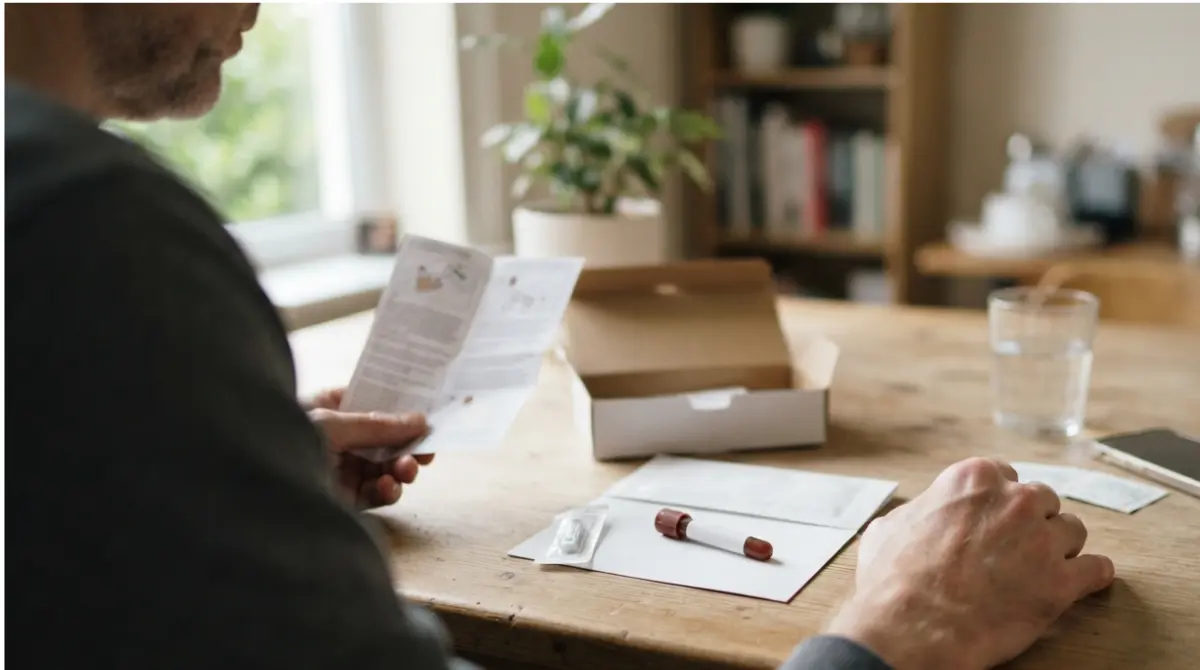
You can collect blood at home and get liver numbers back, but an at home liver test shows only a narrow slice of liver health. Some kits send your sample to a lab; others give a rapid reading on the spot. Where you start depends on where you are:
- Deciding whether to buy a kit? Start with the FDA section.
- Already have a result? Read the sections on normal ranges and what normal can miss, plus what your ALT blood test number really tells you.
- Have symptoms? Skip to the last section.
ℹ️ Medical Disclaimer: This article is general education about diagnosis and testing, not a diagnosis, treatment plan, or instruction to start, stop, or change any medication. Interpreting liver blood tests, deciding on follow-up, and acting on symptoms should be done with a licensed primary care physician, gastroenterologist, or hepatologist.
What does an at-home liver test actually measure?
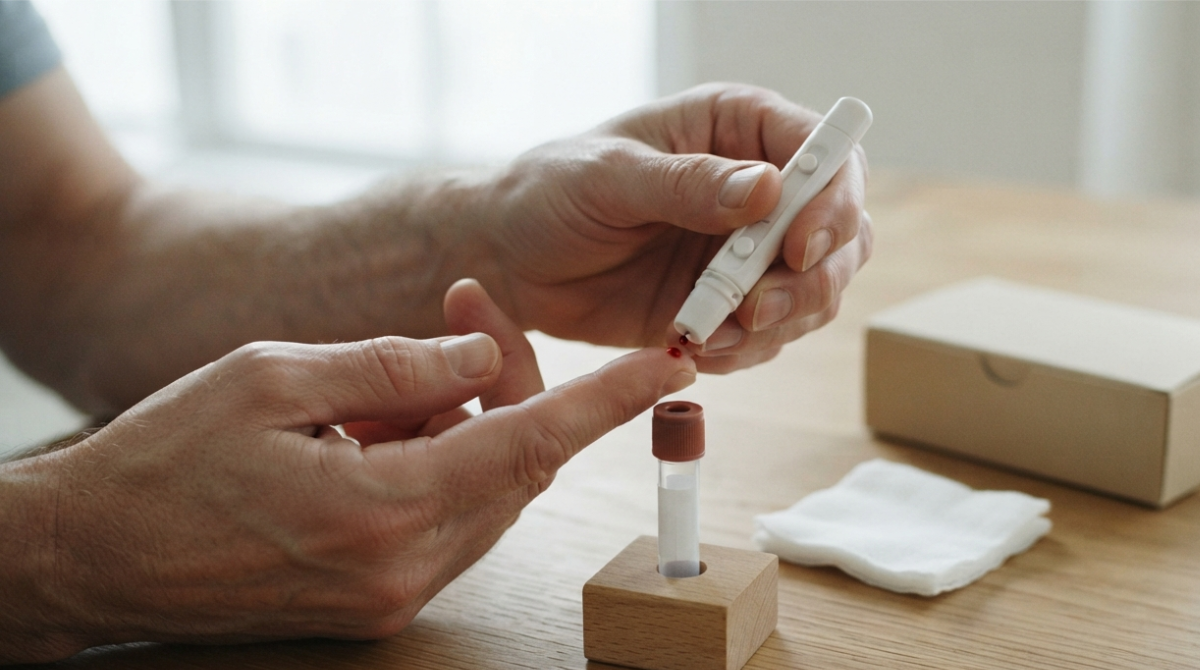
Most liver panels report these markers, though kits differ:
- ALT and AST: enzymes released when liver cells are injured
- Bilirubin: a pigment the liver clears from the blood
- Albumin: a protein the liver makes
ALT and AST: signs of liver-cell injury
The American College of Gastroenterology (ACG) calls ALT and AST markers of liver injury, not liver function; ALT is more liver-specific than AST (AST vs ALT).
🔬 How It Works: Injured liver cells leak ALT and AST into the blood, so higher levels point to damage rather than measuring how well the liver works.
Bilirubin and albumin: clues to function
Albumin reflects protein production and bilirubin reflects waste clearance. MedlinePlus’s liver function tests page notes these tests alone usually can’t diagnose a specific disease.
Are at-home liver tests FDA-cleared and accurate?

Accuracy depends on the specific test and on following its instructions exactly. FDA says all tests can give false results, and for an unregulated test the government hasn’t judged safety or effectiveness.
How to check whether a test is FDA-regulated
FDA explains how to search its over-the-counter test database: enter the test’s name, and if no record appears, the test may not be regulated by FDA. Check each kit individually, and treat marketing phrases like “clinical-grade” as claims to verify, not proof.
What to look for in a mail-in kit
Ask which laboratory processes a mail-in sample, which markers it reports, and whether a clinician reviews results.
✅ Patient Action: Search the database for your exact kit name before buying, and screenshot the result to show your doctor.
Can a normal liver test still miss liver disease?
Yes: ACG’s guideline states a normal ALT may not exclude significant liver disease.
What one biopsy study found
In a retrospective liver biopsy study of 51 people with fatty liver disease and normal ALT, 12 had bridging fibrosis (advanced scarring) and 6 had cirrhosis. It was small, and people had biopsies for specific reasons, so it can’t show how common this is.
Why doctors also use fibrosis scores
Doctors may calculate FIB-4, a score built from age, platelets, AST, and ALT, because an elevated result can prompt further evaluation even when enzymes look normal (how FIB-4 works).
✅ Patient Action: Ask your primary care physician or hepatologist whether a fibrosis assessment such as FIB-4 fits your risk factors.
Why your ALT result may not match the “normal” range
In people without liver disease risk factors, ACG defines a healthy ALT more narrowly than many labs do.
ACG healthy ALT thresholds for men and women
| Group | Healthy ALT (ACG) | Key Clinical Detail |
|---|---|---|
| Men | 29–33 IU/L | Assess if higher |
| Women | 19–25 IU/L | Assess if higher |
Source: ACG Clinical Guideline, 2017.
📊 Clinical Data Point: One statewide study of 67 reference laboratories found ALT upper limits ranging from 31 to 72 U/L — Source: ACG Clinical Guideline (Kwo et al., Am J Gastroenterol, 2017), citing that study.
Some laboratory experts have questioned the lower cutoffs.
Why a high AST isn’t always the liver
AST is also found in muscle, and ACG notes an AST rise without an ALT rise suggests cardiac or muscle disease.
✅ Patient Action: Ask your primary care physician which ALT range your lab uses and how your result compares; see the normal ALT range guide.
What to do with your at-home liver test result
A home result is a starting point; FDA says most tests are best read with your medical history, a physical exam, and other testing.
Before you test: follow the kit exactly
FDA’s home-test guidance notes most home tests need specific timing, materials, and sample amounts, and that you must follow all instructions for an accurate result.
After an abnormal result: what to ask your doctor
Abnormal results don’t always mean a liver problem, and your clinician may repeat the panel to confirm them. FDA advises against changing medications or doses based on a home result without first checking with the clinician who prescribed them.
✅ Patient Action: Ask your primary care physician or hepatologist which follow-up tests you need, such as viral hepatitis or metabolic testing, and when to repeat.
Symptoms that mean skip the kit and see a doctor
Some symptoms call for a clinician, not a kit.
Symptoms that need a prompt medical visit
Jaundice, a yellow tint to the skin or eyes, means contacting your provider, MedlinePlus advises. Dark urine, pale stools, itching, and abdominal pain or swelling also warrant evaluation.
When to seek urgent care
⚠️ Clinical Warning: Sudden jaundice with new confusion may signal acute liver failure, which ACG says needs immediate evaluation; call emergency services or go to an emergency department.
✅ Patient Action: Tell your primary care physician which symptoms you have and ask which liver tests are appropriate; our Symptom Checker can help you organize them.
At-home liver test FAQs
1. Can you test your liver at home?
An at home liver test uses a blood sample you collect yourself; confirm it’s FDA-regulated and review results with your doctor.
2. Is an at home liver test accurate?
Accuracy varies, and FDA says all tests can give false results, so confirm any worrying at home liver test result with your doctor.
3. What does an at home liver test measure?
A typical at home liver test reports ALT and AST, sometimes bilirubin or albumin; the panel varies by kit, so check the label.
4. Can an at home liver test diagnose liver disease?
No. An at home liver test flags possible injury or reduced function; diagnosis needs history, an exam, and often more testing by a clinician.
5. What is a normal ALT level on a home liver test?
On a home liver test, ACG defines healthy ALT as 29–33 IU/L for men and 19–25 for women; your lab’s range may differ.
6. Can a normal at home liver test result still miss liver disease?
Yes. In one biopsy study, some people with fatty liver and normal ALT had advanced scarring; ask your doctor about any at home liver test.
7. Why is AST high on my home liver test?
AST is also found in muscle, so a high AST on an at home liver test doesn’t always mean liver damage; ask your doctor.
8. Do I need to fast or prepare for an at home liver test?
Follow your kit’s instructions; FDA notes most home tests need specific timing and sample amounts, so errors can skew at home liver test results.
9. Should I stop a medication after an abnormal at home liver test result?
No. FDA advises against changing medications or doses based on a home result without first checking with your prescriber.
10. Which symptoms mean I should see a doctor instead of using an at home liver test?
Yellow skin or eyes mean contacting a provider; dark urine, pale stools, or abdominal pain also warrant evaluation, rather than an at home liver test.
11. What do bilirubin and albumin show on a liver panel?
Bilirubin reflects clearance of a waste pigment and albumin reflects protein production, adding context beyond the enzymes in an at home liver test.
What to do next
A home test can flag a possible problem, but it can’t diagnose liver disease, and a normal result isn’t an all-clear. If you have a result you’re unsure about, or any warning symptoms, book a standard liver panel with your primary care physician. Bring the kit’s name and your result to the appointment.
About this content
How this article was put together: researched from recognised health sources, drafted with the help of AI tools, and edited by hand, with sources linked throughout.

Sameer Patel is the founder and editor of My Medicine Advisor. He is not a doctor or medical professional — before starting this site he worked in banking,…
Medical disclaimer
The content on MyMedicineAdvisor is provided for general informational and educational purposes only and is not a substitute for professional medical advice, diagnosis, or treatment. Health information on this website should not be used to diagnose, treat, cure, or prevent any condition without guidance from a qualified healthcare professional. Always seek the advice of your doctor, physician, or another licensed healthcare provider with any questions you may have regarding a medical condition, symptoms, medications, or treatment decisions.