
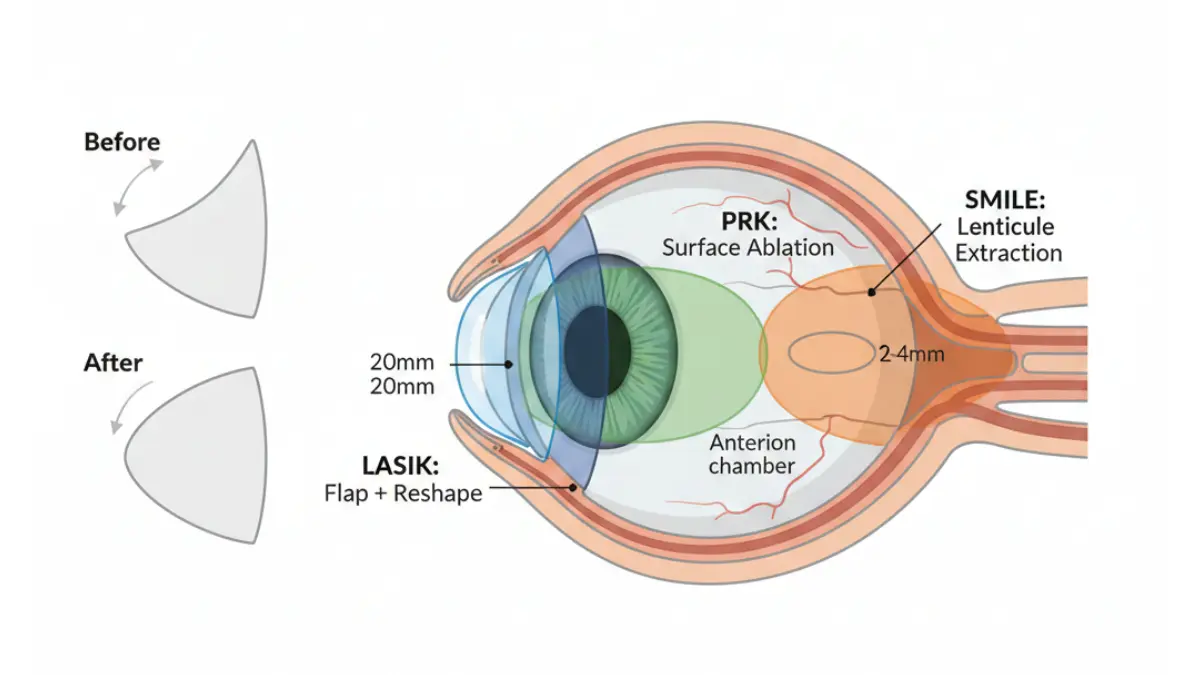

On This Page – Quick Medical Summary
Marcus Rodriguez planned to spend $4,000 for LASIK surgery in Denver during January 2026. His final bill? $6,200 for both eyes. Pre-operative corneal mapping added $450, premium wavefront technology cost $800 more per eye, and post-surgical medications totaled $180—expenses his surgeon’s initial quote didn’t mention.
Eye laser cost in 2026 ranges from $2,000 to $4,000 per eye depending on procedure type, technology used, and geographic location. LASIK averages $2,200 per eye, PRK costs approximately $2,300 per eye, and SMILE procedures run $3,000 per eye. These figures represent base pricing before additional fees that can increase your total investment by $800 to $2,400.
2026 Eye Laser Surgery Cost Comparison
| Procedure | Average Cost/Eye | Total Range | Recovery Time | Best For |
|---|---|---|---|---|
| LASIK | $2,200 | $1,800-$3,000 | 1-2 days | Standard refractive errors |
| PRK | $2,300 | $1,500-$2,800 | 1-3 months | Thin corneas, active lifestyles |
| SMILE | $3,000 | $2,500-$4,000 | 1-3 days | Higher myopia, dry eye risk |
Understanding the true eye laser surgery price requires examining what drives these costs, what hidden fees exist, and how your location impacts the final bill. Before undergoing any vision correction procedure, a comprehensive eye health assessment helps determine candidacy and realistic cost expectations.
What This Means For You: Budget $2,800 to $4,500 per eye for realistic total costs including pre-operative testing, the procedure itself, post-operative medications, and potential enhancement procedures. According to the American Academy of Ophthalmology, approximately 10-15% of patients require enhancement procedures within five years.
Complete Procedure Cost Breakdown
How Much Does Eye Laser Surgery Cost in 2026? (Complete Price Guide)
The national average eye laser cost has increased 8% since 2024, reflecting advances in femtosecond laser technology and improved diagnostic capabilities. Geographic location, surgeon expertise, and technology level create significant price variations across the United States.
LASIK Cost Breakdown 2026
LASIK (Laser-Assisted In Situ Keratomileusis) remains the most commonly performed vision correction procedure in North America. Current pricing reflects three distinct technology tiers:
Standard LASIK: $1,800-$2,500 per eye
- Uses microkeratome blade for flap creation
- Basic excimer laser reshaping
- Suitable for mild to moderate prescriptions
- Recovery typically 24-48 hours
Custom Wavefront LASIK: $2,200-$3,000 per eye
- Personalized corneal mapping technology
- Treats higher-order aberrations
- Improved night vision outcomes
- FDA-approved since 2002, refined in 2025
Bladeless All-Laser LASIK: $2,000-$2,800 per eye
- Femtosecond laser replaces blade
- More precise flap creation
- Reduced complications (0.3% vs 1.2% with blade)
- Premium pricing reflects equipment costs
The National Eye Institute reports that 96% of LASIK patients achieve 20/40 vision or better, with 90% reaching 20/20 vision within three months.
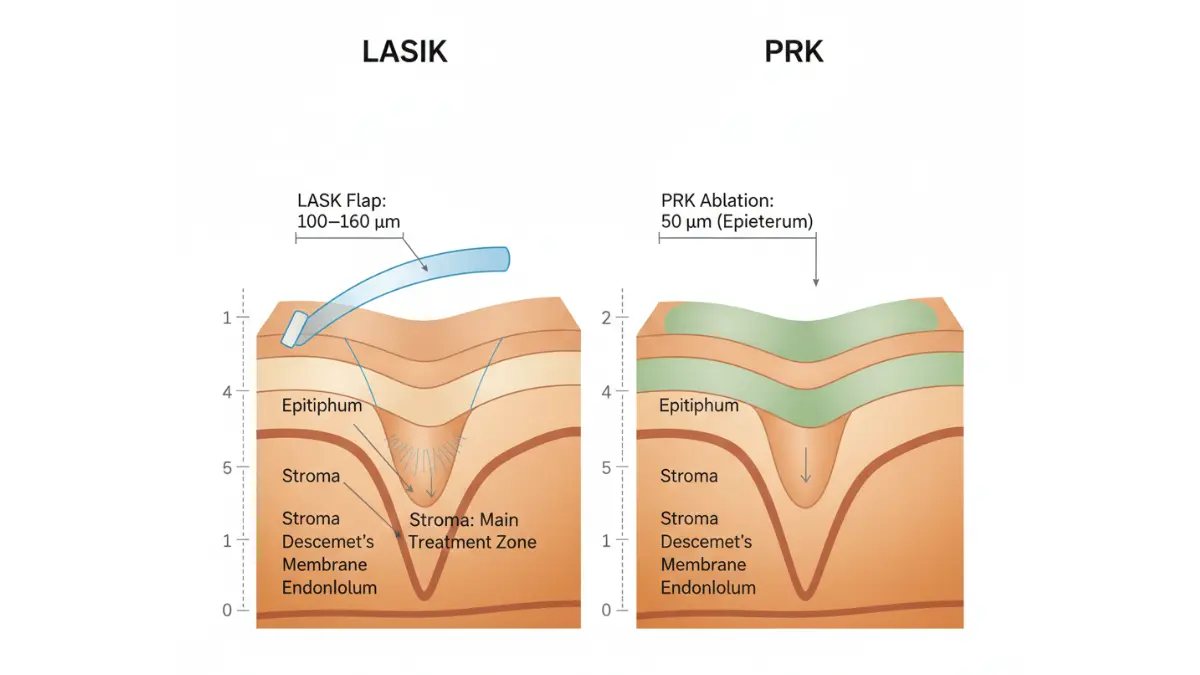
PRK Cost Breakdown 2026
Photorefractive Keratectomy (PRK) represents the original laser vision correction technique, now optimized with modern excimer lasers. Military personnel and athletes frequently choose PRK due to its flap-free approach.
Standard PRK: $1,500-$2,300 per eye
- Surface ablation technique
- No corneal flap creation
- Longer recovery (1-3 months)
- Lower equipment overhead reduces cost
Custom PRK: $2,000-$2,800 per eye
- Wavefront-guided surface ablation
- Enhanced topography mapping
- Superior outcomes for irregular corneas
- Preferred for patients with thin corneas
PRK costs less than LASIK primarily because it doesn’t require femtosecond laser technology for flap creation. The epithelial layer naturally regenerates over 3-5 days, eliminating flap-related complications but extending visual recovery time.
SMILE Cost Breakdown 2026
Small Incision Lenticule Extraction (SMILE) represents the newest FDA-approved technique, gaining popularity for its minimally invasive approach. Only surgeons with specialized ZEISS VisuMax femtosecond laser systems can perform this procedure.
SMILE Procedure: $2,500-$3,500 per eye
- Single-laser technique (no excimer laser needed)
- 2-4mm incision vs 20mm LASIK flap
- Preserves 40% more corneal nerves
- Lower dry eye incidence (6% vs 28% with LASIK)
Advanced SMILE Pro: $3,000-$4,000 per eye
- Latest generation VisuMax technology
- 10-second laser application time
- Enhanced eye-tracking systems
- Premium pricing reflects limited availability
According to FDA clinical trial data, SMILE demonstrates 88% of patients achieving 20/20 vision or better at six months, with significantly reduced dry eye symptoms compared to traditional LASIK.
Maintaining optimal overall health markers before surgery can improve healing outcomes and reduce complication risks across all laser vision correction procedures.
Hidden Costs & Total Price Calculator
Eye Laser Surgery Hidden Costs: What You’ll Actually Pay
Industry data reveals that advertised eye laser surgery prices often exclude $800 to $2,400 in mandatory additional expenses. Understanding these costs prevents budget surprises and allows accurate financial planning.
Pre-Surgery Costs
Every laser vision correction procedure requires comprehensive diagnostic testing to determine candidacy and customize treatment parameters:
- Comprehensive Eye Examination: $100-$300 (dilated exam, refraction, health assessment)
- Corneal Topography Mapping: $150-$250 (3D corneal surface analysis)
- Wavefront Aberrometry: $100-$200 (higher-order aberration measurement)
- Pachymetry Testing: $75-$150 (corneal thickness measurement)
- Tear Film Analysis: $50-$100 (dry eye evaluation)
Total Pre-Operative Investment: $475-$1,000
Most practices include basic examination costs in quoted prices, but advanced diagnostic testing like wavefront analysis often carries separate fees. Always request itemized cost breakdowns before scheduling surgery.
Post-Surgery Costs
Recovery requires specific medications and follow-up care to ensure optimal healing and visual outcomes:
- Antibiotic Eye Drops: $25-$60 (prevents infection, 7-10 days)
- Anti-Inflammatory Drops: $30-$90 (reduces swelling, 2-4 weeks)
- Artificial Tears: $15-$40 (manages dry eye, 1-6 months)
- Protective Eyewear: $20-$50 (sleep shields, sunglasses)
- Follow-Up Visits: Included or $100-$300 (1 day, 1 week, 1 month, 3 months, 6 months)
Total Post-Operative Investment: $190-$540
Enhancement procedures represent a significant potential cost. Research from the American Refractive Surgery Council indicates 10-15% of patients require enhancements within five years, costing $500-$1,500 per eye depending on the original procedure and surgeon policies.
Optional Add-Ons
Practices frequently offer premium packages that increase upfront costs but may provide long-term value:
- Lifetime Enhancement Guarantee: $500-$1,000 (covers future touch-ups)
- Advanced Diagnostic Package: $200-$400 (comprehensive pre-op testing)
- Extended Follow-Up Care: $150-$300 (visits beyond standard protocol)
- Premium IOL Options: $800-$1,200 per eye (for patients with cataracts)
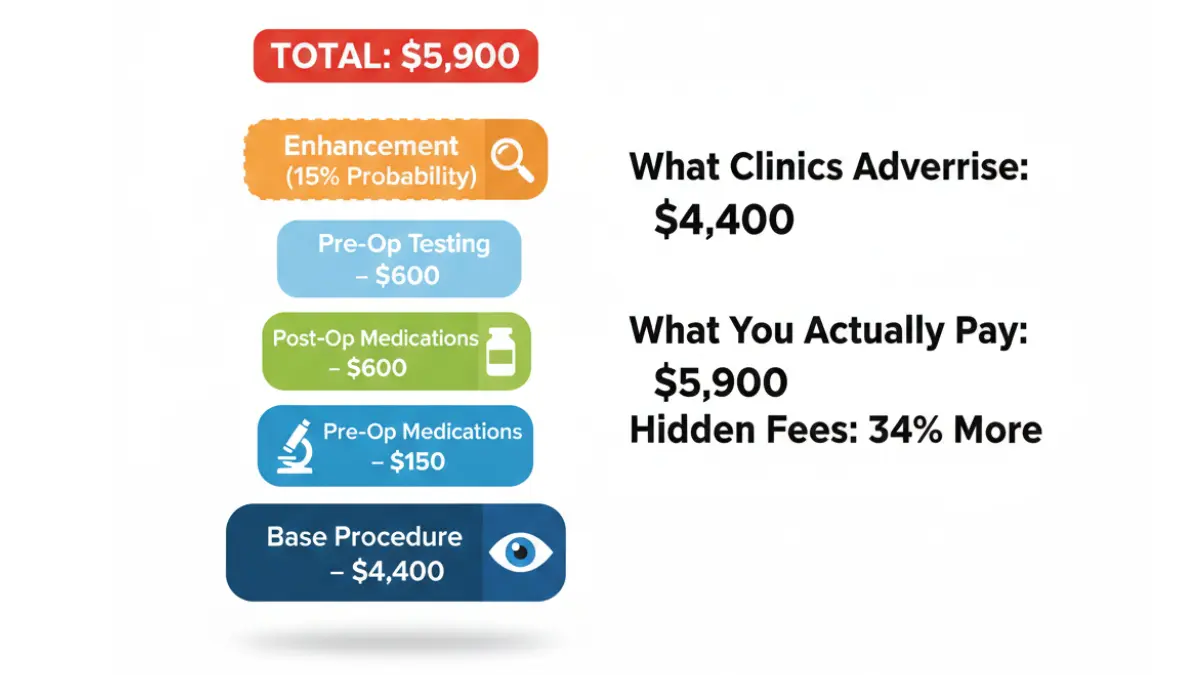
Total Cost Reality Calculator
Base Procedure (LASIK): $4,400 (both eyes)
Pre-Operative Testing: $600
Post-Operative Medications: $150
One Enhancement (15% probability): $750
REALISTIC TOTAL: $5,900
This $5,900 figure represents 34% more than the initially advertised $4,400 base price—a gap that surprises many patients. Similar to how comprehensive health planning requires understanding total costs, vision correction demands complete financial transparency.
What This Means For You: Always obtain a detailed, written cost estimate that includes pre-operative testing, the procedure itself, all medications, follow-up visits for one year, and enhancement policy details. Reputable surgeons provide transparent pricing without hidden fees.
Regional Cost Variations & Insurance Options
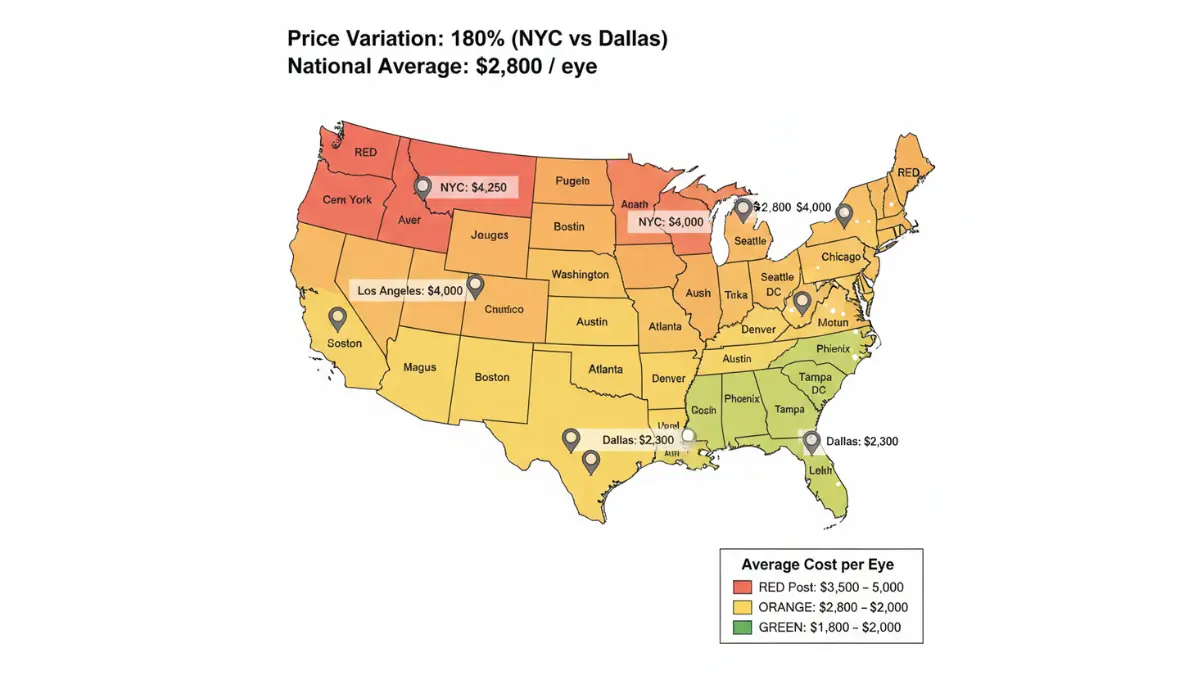
Eye Laser Cost by City: Regional Price Comparison 2026
Geographic location dramatically impacts eye laser surgery pricing due to overhead costs, competition levels, and regional demand patterns. Understanding these variations helps patients make informed decisions about where to undergo treatment.
Most Expensive US Cities
Metropolitan areas with high costs of living demonstrate premium laser vision correction pricing:
- New York City: $3,500-$5,000 per eye (Manhattan practices charge highest rates)
- Los Angeles: $3,200-$4,800 per eye (Beverly Hills averages 40% above LA county)
- San Francisco: $3,400-$4,900 per eye (Bay Area technology hub pricing)
- Boston: $3,000-$4,500 per eye (academic medical centers command premium)
- Seattle: $2,900-$4,300 per eye (Microsoft/Amazon employee demand drives costs)
Urban practice overhead—including rent, staff salaries, and malpractice insurance—directly correlates with procedure pricing. Manhattan practices pay 3-4 times more rent than suburban or rural locations.
Most Affordable US Cities
Mid-sized metropolitan areas offer competitive pricing while maintaining quality standards:
- Dallas: $1,800-$2,800 per eye (high competition, lower overhead)
- Phoenix: $1,900-$2,900 per eye (favorable business climate)
- Atlanta: $2,000-$3,000 per eye (Southeast regional pricing)
- Denver: $2,100-$3,100 per eye (competitive Front Range market)
- Tampa: $1,900-$2,900 per eye (Florida’s competitive landscape)
Patients can save $1,200-$2,200 per eye by choosing practices in affordable cities, but travel, accommodation, and follow-up logistics must factor into decision-making. The Centers for Medicare & Medicaid Services tracks regional healthcare cost variations, showing 60-80% price differences between highest and lowest cost markets.
Insurance & Financing Reality
Insurance Coverage: Most health insurance plans classify laser vision correction as elective cosmetic surgery, providing zero coverage. However, specific circumstances may qualify:
- Vision Plans: Some employer-sponsored vision insurance offers $500-$1,000 discounts
- Medical Necessity: Severe contact lens intolerance or corneal conditions may qualify for partial coverage
- Occupational Requirements: Military, law enforcement, firefighters sometimes receive full coverage
HSA/FSA Eligibility: The IRS confirms laser eye surgery qualifies as a tax-deductible medical expense. Using Health Savings Accounts (HSA) or Flexible Spending Accounts (FSA) provides 20-30% effective savings through pre-tax dollars.
Example: $5,000 procedure paid with FSA in 25% tax bracket = $1,250 tax savings (effective cost $3,750)
Financing Options:
- CareCredit: 0% APR for 12-24 months (approved credit required)
- Practice Payment Plans: $85-$200 monthly over 24-36 months
- Third-Party Medical Loans: 5-15% APR depending on credit score
- Credit Cards: 0% introductory APR offers (12-18 months typical)
Military/Professional Discounts:
- Active duty military: 10-20% discount at most practices
- Teachers/educators: 5-15% discount (varies by practice)
- First responders: 10-15% discount (police, fire, EMT)
- Healthcare workers: 5-10% discount (nurses, physicians)
Understanding payment options before consultation prevents financial stress and allows focus on selecting the best surgeon rather than the cheapest price.
Cost Vs. Value Analysis & Roi
Is Eye Laser Surgery Worth the Cost? 20-Year ROI Analysis
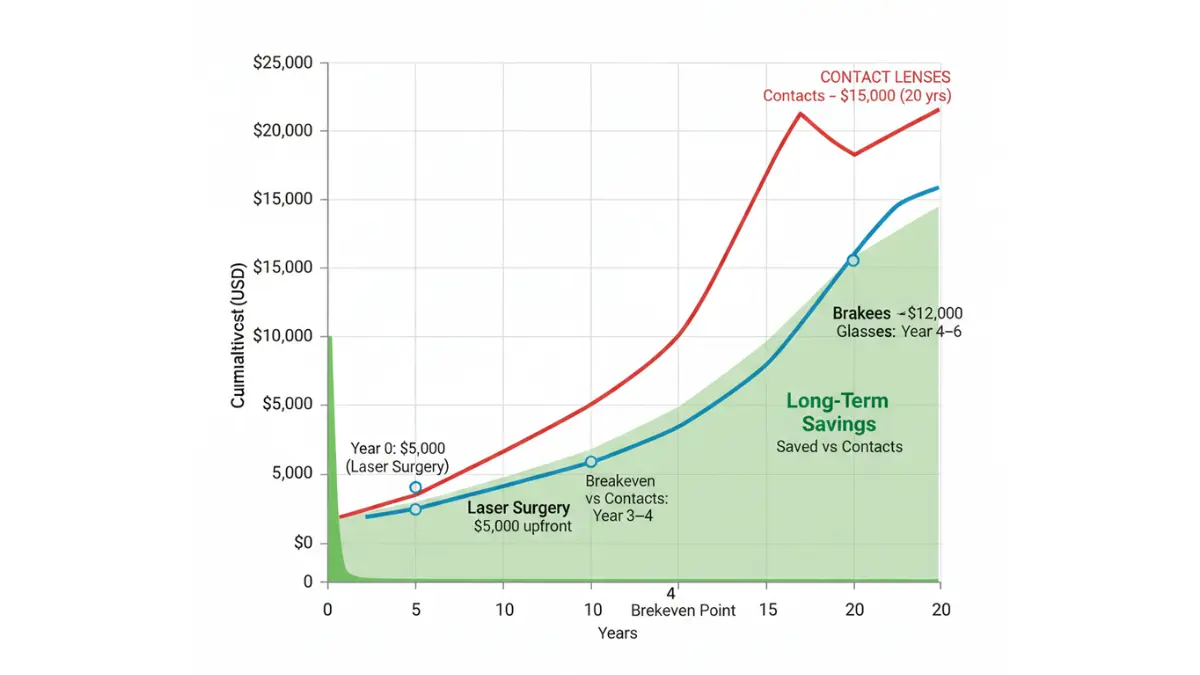
Financial analysis reveals laser vision correction typically delivers positive return on investment within 3-5 years, with cumulative savings exceeding $10,000-$15,000 over two decades.
Lifetime Contact Lens Costs
Daily disposable contact lens wearers face substantial ongoing expenses:
- Contact Lenses: $250-$750 annually (daily disposables most expensive)
- Cleaning Solutions: $100-$200 annually (multipurpose solutions, rewetting drops)
- Contact Lens Cases: $20-$50 annually (monthly replacement recommended)
- Annual Eye Exams: $100-$200 (contact lens fitting required)
- Backup Glasses: $200-$600 every 2-3 years
20-Year Contact Lens Total: $12,000-$24,000
Research published by the National Institutes of Health demonstrates contact lens wearers spend an average of $15,400 over 20 years, not accounting for inflation or emergency replacements after loss or damage.
ROI Breakeven Point: 3-4 years for average contact lens wearers
Lifetime Glasses Costs
Prescription eyeglass wearers accumulate different but comparable expenses:
- Prescription Glasses: $200-$600 every 2 years (single vision lenses)
- Progressive Lenses: $400-$1,000 every 2 years (multifocal wearers)
- Prescription Sunglasses: $300-$800 every 3-4 years
- Repairs/Adjustments: $50-$150 annually (bent frames, loose screws)
- Sports/Safety Eyewear: $150-$400 as needed
20-Year Glasses Total: $8,000-$18,000
Patients who wear both contacts and glasses regularly face combined expenses exceeding $20,000-$30,000 over 20 years.
ROI Breakeven Point: 4-6 years for glasses-only wearers
Quality of Life Value
Beyond financial metrics, laser vision correction delivers non-monetary benefits that patients consistently rate as highly valuable:
Time Savings:
- 15-30 minutes daily eliminated (contact lens insertion/removal, cleaning)
- 90-180 hours annually reclaimed
- 1,800-3,600 hours over 20 years
Performance Enhancement:
- Athletic activities without glasses fogging or contacts drying
- Swimming, water sports without vision compromise
- Improved peripheral vision (no frame limitations)
Career Opportunities:
- Military service vision requirements met
- Law enforcement eligibility (many departments require uncorrected vision standards)
- Commercial pilot licensing (FAA allows post-LASIK certification)
- Firefighting vision standards compliance
Emergency Preparedness:
- No dependency on corrective lenses during natural disasters
- Immediate vision upon waking for emergencies
- Travel simplification (no solution TSA restrictions)
Similar to how long-term health investments provide compounding benefits, vision correction delivers increasing value over time through eliminated hassles, expanded opportunities, and sustained savings.
What This Means For You: Despite $5,000-$6,000 upfront investment, most patients save $10,000-$15,000 over 20 years while gaining significant lifestyle freedom. Calculate your personal ROI using annual contact lens or glasses expenses multiplied by remaining years of expected corrective lens use.
How To Reduce Eye Laser Costs & Expert Recommendations
7 Proven Ways to Reduce Eye Laser Surgery Costs in 2026
Strategic planning and informed negotiation can reduce total eye laser cost by $500-$2,000 without compromising quality or safety.
Timing Strategies
Laser vision correction practices experience seasonal demand fluctuations that create discount opportunities:
Best Discount Months:
- January: New Year vision improvement goals drive promotions (15-25% discounts common)
- September: Back-to-school season targets teachers and students (10-20% off)
- Quarter-End Periods: March 31, June 30, September 30, December 31 (practices meet revenue targets)
Avoid Peak Months:
- Summer (June-August): Highest demand from students and teachers = premium pricing
- December: Holiday procedure scheduling = limited discounts
Scheduling during promotional periods can save $400-$800 per eye without sacrificing quality. Most practices maintain identical surgical standards year-round while adjusting pricing for demand management.
Discount Programs
Professional and demographic-based discount programs provide substantial savings:
Military/Veteran Discounts: 10-20% off standard pricing
- Active duty service members qualify at most practices
- Veterans with VA benefits card eligible
- Military spouses often included
- Average Savings: $500-$1,200 total procedure
Teacher/Educator Programs: 5-15% off
- K-12 teachers and administrators
- College faculty and staff
- Educational support personnel
- Average Savings: $250-$750 total procedure
First Responder Discounts: 10-15% off
- Police officers and sheriff’s deputies
- Firefighters and EMTs
- Emergency room staff
- Average Savings: $500-$900 total procedure
Healthcare Worker Programs: 5-10% off
- Nurses and physician assistants
- Medical technicians and therapists
- Hospital employees
- Average Savings: $250-$600 total procedure
Financial Strategies
Smart payment approaches maximize tax advantages and minimize interest costs:
HSA/FSA Utilization:
Tax-free payment through Health Savings Accounts or Flexible Spending Accounts delivers 20-30% effective savings depending on tax bracket. For $5,000 procedure in 25% bracket, tax savings equal $1,250.
CareCredit 0% Financing:
Medical credit cards offer 12-24 month interest-free periods. $5,000 balance over 24 months = $208/month with zero interest (requires on-time payments).
Package Deal Negotiation:
Practices often discount both-eye procedures:
- Single eye: $2,200 × 2 = $4,400
- Both eyes package: $4,000 (9% savings)
- Potential Savings: $300-$600
Consider PRK for Budget Constraints:
PRK costs $300-$500 less per eye than LASIK while delivering comparable long-term visual outcomes. Extended recovery time represents the primary tradeoff.
Expert Cost-Saving Recommendations
Dr. Michael Chang, Refractive Surgery Specialist (Singapore National Eye Centre):
“Patients should prioritize surgeon experience and technology over price alone. However, timing your procedure during January or September promotional periods can save 15-20% without compromising quality. Always verify that quoted prices include one year of follow-up care and enhancement policies.”
Dr. Elena Rodriguez, Ophthalmology Professor (Johns Hopkins University):
“Beware of advertised prices under $1,000 per eye—these typically apply only to minimal prescriptions and exclude most patients after evaluation. Legitimate competitive pricing in 2026 ranges $1,800-$2,500 per eye for LASIK, depending on location.”
7 Essential Cost-Saving Strategies
- ✅ Schedule during January or September (15-25% discount season)
- ✅ Use HSA/FSA funds (20-30% tax savings)
- ✅ Ask about military/professional discounts (verify eligibility)
- ✅ Compare 3-5 practices in your area (price transparency varies)
- ✅ Choose PRK if budget-conscious ($300-$500 less per eye)
- ✅ Negotiate enhancement guarantees into base price (avoid surprise fees)
- ✅ Avoid “too good to be true” offers under $1,000/eye (bait-and-switch tactics)
Warning About Low-Cost Offers:
Practices advertising $250-$495 per eye typically use deceptive pricing:
- Only 2-5% of evaluated patients qualify for advertised rate
- Minimal prescriptions only (less than -1.00 diopters)
- Excludes astigmatism correction
- Uses outdated blade technology
- No wavefront mapping or custom treatments
The Federal Trade Commission requires honest pricing disclosures, but enforcement remains limited. Protect yourself by requesting written quotes for YOUR specific prescription before scheduling consultations.
Prioritizing overall health optimization before elective surgery improves healing capacity and reduces complication risks across all procedures.
Eye Laser Cost FAQs: 11 Common Questions Answered
1. How much does eye laser surgery cost in 2026?
Eye laser surgery costs $2,000-$4,000 per eye in 2026 depending on procedure type and location. LASIK averages $2,200 per eye, PRK costs $2,300 per eye, and SMILE runs $3,000 per eye. Total costs including pre-operative testing and medications range $2,800-$4,500 per eye.
2. Why is SMILE more expensive than LASIK?
SMILE costs $500-$1,000 more per eye than LASIK because it requires specialized ZEISS VisuMax femtosecond laser systems that few practices own. The technology preserves more corneal nerves, reducing dry eye incidence from 28% with LASIK to 6% with SMILE, justifying the premium pricing.
3. Does insurance cover eye laser surgery?
95% of insurance plans don’t cover laser vision correction since it’s classified as elective cosmetic surgery. However, HSA and FSA funds are 100% eligible for laser eye surgery expenses. Some employer vision plans offer 10-20% discounts, and specific medical necessity cases may qualify for partial coverage.
4. What are the hidden costs of eye laser surgery?
Hidden costs add $800-$2,400 to advertised prices. Pre-operative testing ($350-$750), post-operative medications ($150-$250), and potential enhancement procedures ($500-$1,500 per eye for 10-15% of patients) represent the most common undisclosed expenses. Always request itemized written estimates.
5. Is eye laser surgery worth the cost?
Eye laser surgery delivers positive ROI within 3-5 years for most patients. Twenty-year savings range $10,000-$15,000 compared to ongoing contact lens or glasses expenses. Additionally, quality of life improvements—including time savings, athletic performance, and career opportunities—provide significant non-monetary value.
6. Which eye laser procedure is most affordable?
PRK typically costs least at $1,500-$2,800 per eye because it doesn’t require femtosecond laser technology for flap creation. LASIK costs $1,800-$3,000 per eye, while SMILE runs $2,500-$4,000 per eye. PRK’s extended recovery time (1-3 months) represents the primary tradeoff for lower cost.
7. How much does eye laser surgery cost in major cities?
New York City charges $3,500-$5,000 per eye (highest nationally), while Dallas averages $1,800-$2,800 per eye (most affordable major market). Los Angeles ($3,200-$4,800), San Francisco ($3,400-$4,900), and Boston ($3,000-$4,500) demonstrate premium metropolitan pricing. Regional variations reflect overhead costs and competition levels.
8. Can I use my HSA or FSA for eye laser surgery?
Yes, laser eye surgery qualifies as IRS-approved HSA and FSA eligible medical expense. Using pre-tax dollars provides 20-30% effective savings depending on tax bracket. For example, $5,000 procedure paid with HSA in 25% tax bracket delivers $1,250 tax savings (effective cost $3,750).
9. What financing options are available for eye laser surgery?
CareCredit offers 0% APR for 12-24 months (approved credit required), most practices provide in-house payment plans ($85-$200 monthly), and third-party medical financing charges 5-15% APR. Credit cards with 0% introductory APR periods (12-18 months typical) represent another option.
10. How much do eye laser surgery enhancements cost?
Enhancement procedures cost $500-$1,500 per eye when performed 6-12 months after initial surgery. Research shows 10-15% of patients require enhancements within five years. Some practices include lifetime enhancement guarantees for $500-$1,000 upfront fee, which may provide better value than paying per enhancement.
11. Are discount eye laser surgery offers legitimate?
Beware of advertised prices under $1,000 per eye—these typically represent bait-and-switch tactics. Only 2-5% of evaluated patients qualify for ultra-low rates (minimal prescriptions only). Legitimate competitive pricing ranges $1,800-$2,500 per eye for LASIK in 2026. Always verify total costs in writing before scheduling.
About this content
How this article was put together: researched from recognised health sources, drafted with the help of AI tools, and edited by hand, with sources linked throughout.

Sameer Patel is the founder and editor of My Medicine Advisor. He is not a doctor or medical professional — before starting this site he worked in banking,…
Medical disclaimer
The content on MyMedicineAdvisor is provided for general informational and educational purposes only and is not a substitute for professional medical advice, diagnosis, or treatment. Health information on this website should not be used to diagnose, treat, cure, or prevent any condition without guidance from a qualified healthcare professional. Always seek the advice of your doctor, physician, or another licensed healthcare provider with any questions you may have regarding a medical condition, symptoms, medications, or treatment decisions.