

On This Page – Quick Medical Summary
What Is Skinoren Cream? (The Answer in 60 Words)
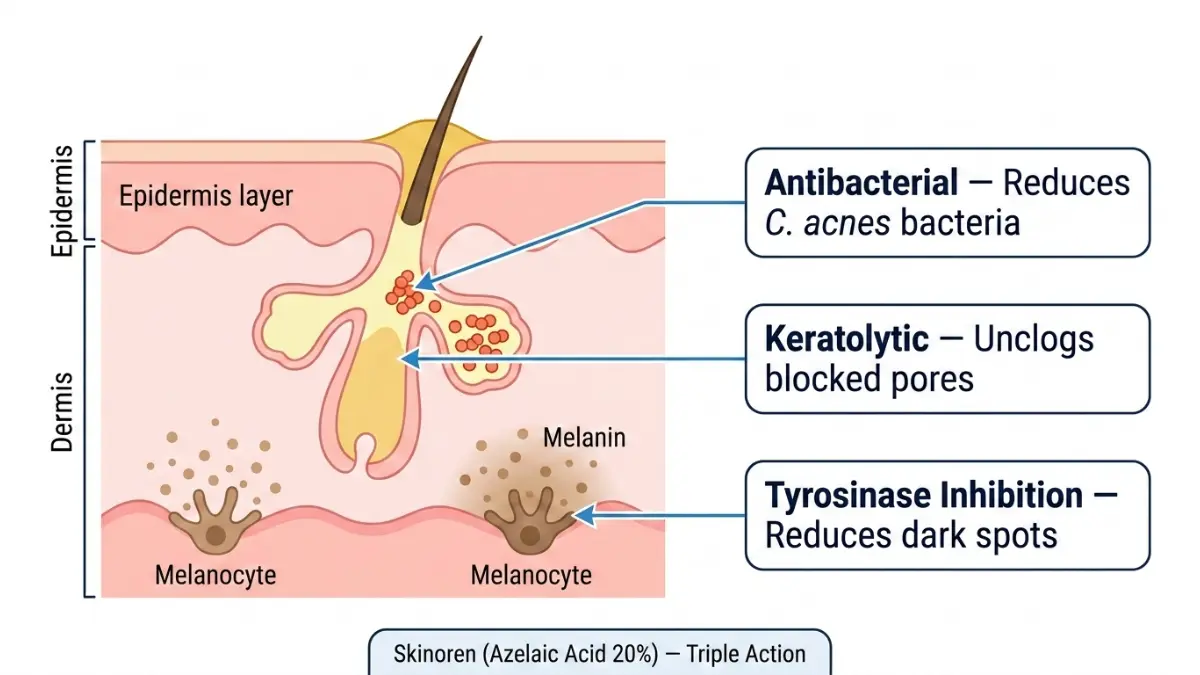
Skinoren cream is a prescription topical treatment containing 20% azelaic acid, used to treat acne vulgaris, rosacea, and post-acne dark spots. It works through three clinically proven mechanisms: killing acne-causing bacteria, normalizing skin cell turnover to unblock pores, and inhibiting melanin overproduction to fade dark marks. Most patients notice visible improvement within 4–8 weeks of consistent twice-daily use.
Quick-Reference: Skinoren Cream at a Glance
| Feature | Detail |
|---|---|
| Active Ingredient | Azelaic Acid 20% |
| Manufacturer | LEO Pharma |
| Available Forms | Cream (20%), Gel (15% — brand name Finacea) |
| Prescription Required | Yes (in the US, UK, Australia, Canada) |
| Minimum Age | 12 years and above |
| Safe in Pregnancy | Yes — FDA Pregnancy Category B |
| Maximum Continuous Use | 12 months |
| Primary Conditions Treated | Acne vulgaris, rosacea, post-inflammatory hyperpigmentation |
What This Means For You: Unlike most acne treatments that tackle only one problem, Skinoren cream simultaneously treats active spots, prevents new breakouts, and fades the dark marks they leave behind — all in one tube.
If you’re unsure whether your skin symptoms point to acne, rosacea, or another condition, use our Symptom Checker to help clarify before speaking with your doctor.
How Skinoren Cream Actually Works — The Science They Skip
Most pharmacy websites mention “kills bacteria” and stop there. The full picture is far more impressive — and understanding it explains why Skinoren cream outperforms many single-action treatments.
Mechanism 1: Antibacterial Action Against Acne Bacteria
Skinoren cream directly targets Cutibacterium acnes (formerly Propionibacterium acnes) — the bacteria most responsible for inflamed acne lesions. It does this by blocking bacterial protein synthesis, reducing bacterial density in the follicle and cutting off the inflammatory chain that leads to pustules and nodules.
This antibacterial effect is also non-antibiotic, meaning it does not contribute to antibiotic resistance — a major clinical advantage over topical clindamycin. According to a comprehensive review published on PubMed (NCBI), azelaic acid’s antimicrobial and anti-inflammatory properties are among the strongest evidence-backed in topical dermatology.
Mechanism 2: Keratolytic Action — Unclogging Pores at the Root
Azelaic acid normalizes the abnormal proliferation of keratinocytes — the skin cells lining the follicle that, when overproduced, mix with sebum and block pores. This is what causes whiteheads and blackheads.
In a landmark study of 289 patients comparing 20% azelaic acid cream to 0.05% tretinoin over 6 months, published in PubMed, both treatments were equally effective for comedonal acne — but Skinoren caused significantly fewer local side effects than tretinoin. If you’ve struggled with tretinoin irritation, this is critical information. Our related guide on retinoids explains how Skinoren and retinoids compare for different acne types.
Mechanism 3: Tyrosinase Inhibition — The Dark Spot Secret Most Sites Skip
This is the mechanism almost no pharmacy or online doctor page explains — and it’s why Skinoren cream is especially valuable for patients with darker skin tones or persistent post-acne marks.
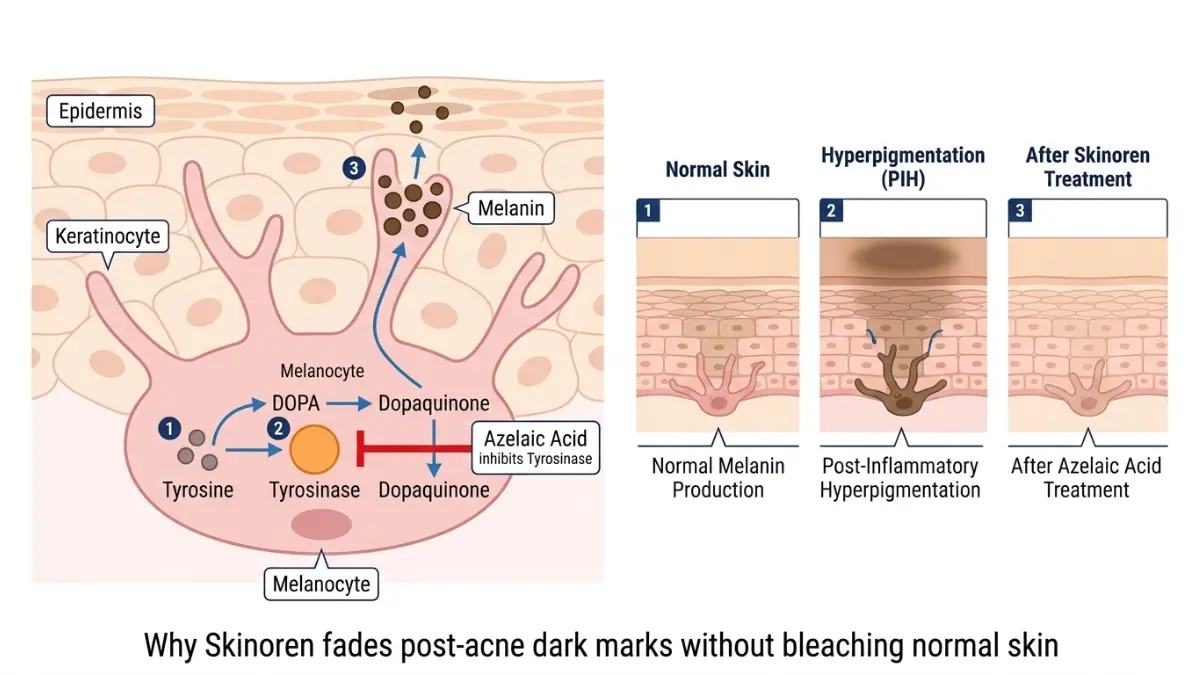
Azelaic acid inhibits tyrosinase, the enzyme that drives melanin overproduction in damaged skin cells. It selectively targets only hyperactive melanocytes, meaning it fades dark spots without bleaching surrounding healthy skin. A multicenter randomized trial specifically in darker-skinned patients (phototypes IV–VI), published in PubMed, confirmed significant improvement in hyperpigmentation with an excellent safety profile.
For deeper reading on the condition Skinoren helps treat, see our expert guide on melasma causes and treatment.
The 3-Mechanism Summary
| Mechanism | Biological Action | Visible Skin Benefit |
|---|---|---|
| Antibacterial | Kills Cutibacterium acnes | Fewer spots, less inflammation |
| Keratolytic | Normalizes skin cell turnover | Unclogs pores, clears blackheads |
| Tyrosinase Inhibition | Blocks melanin overproduction | Fades dark spots, evens skin tone |
How to Use Skinoren Cream Correctly — The Step-by-Step They Get Wrong
James, a 31-year-old marketing professional, used Skinoren cream for 7 weeks with almost no results. His dermatologist’s one discovery: he was applying it immediately after washing his face — to still-damp skin. Within 3 weeks of correcting his technique, his breakouts decreased by more than half.
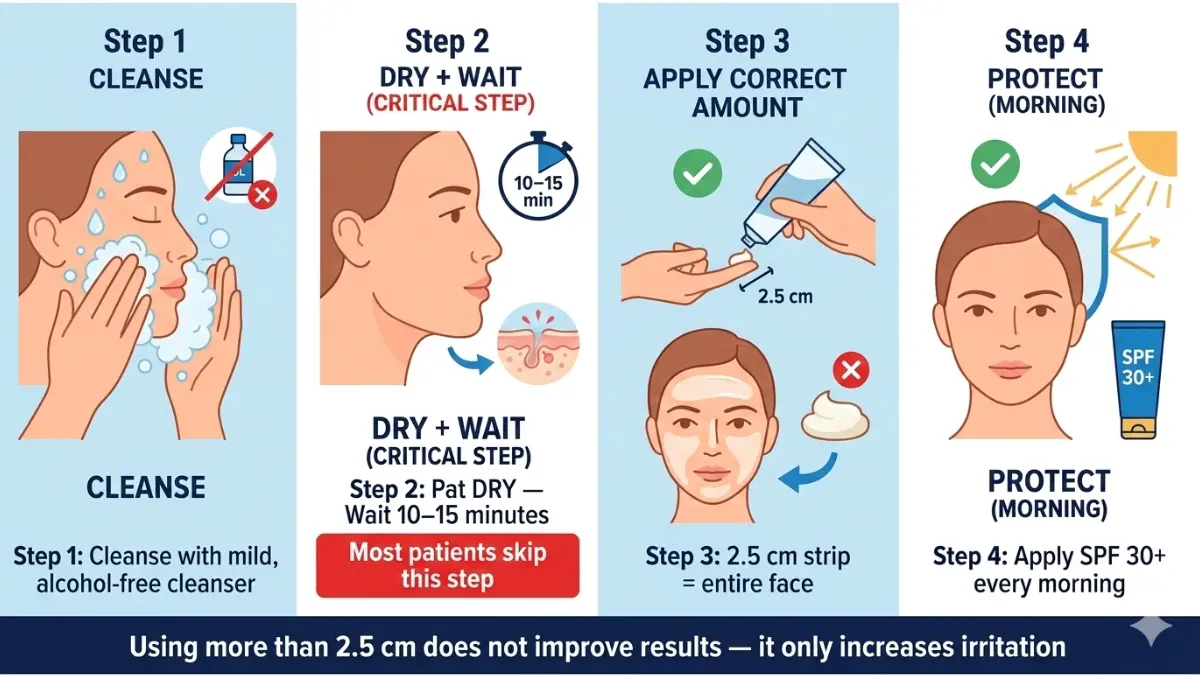
The “dry skin” rule is the most skipped instruction in all of skinoren cream use — and it’s responsible for more failures and irritation complaints than any other factor.
The Correct Application Protocol (Step-by-Step)
- Wash the affected area with plain water or a mild, non-alcoholic, fragrance-free cleanser
- Pat completely dry — then wait 10–15 minutes before applying (critical step most patients skip)
- Measure your dose — a 2.5cm strip of cream covers the entire face; adjust for back/chest
- Apply a thin layer to affected areas only — not all over unaffected skin
- Massage gently until fully absorbed — do not rub hard or aggressively
- Wash hands thoroughly immediately after application
- Follow with an oil-free, non-comedogenic moisturizer if skin feels dry (wait 5–10 min after Skinoren absorbs)
- Apply broad-spectrum SPF 30+ in the morning — azelaic acid increases mild photosensitivity
Dosage by Skin Type and Timeline
| Skin Type | Week 1 | Week 2 Onward |
|---|---|---|
| Normal / Combination / Oily | Twice daily (AM + PM) | Twice daily (AM + PM) |
| Sensitive | Once daily (PM only) | Twice daily from Week 2 |
| Very Sensitive / Reactive | Once daily (PM only) | Once daily — ongoing |
3 Critical Mistakes That Cause Skinoren to Fail
- ❌ Applying to damp skin — massively increases burning and stinging sensation
- ❌ Using too much — more than 2.5cm on the face causes irritation without added benefit
- ❌ Stopping within 3–4 weeks — the majority of patients quit right before results begin
Staying consistent with skin-supportive habits during treatment matters. Our Water Intake Calculator can help you maintain optimal hydration, which directly supports skin barrier recovery during active topical treatment.
Skinoren Cream Results — The Week-by-Week Timeline No One Shows You
This is the section most patients search for — and the one almost no competitor actually provides with clinical data behind it.
Here’s what dermatologists see in their patients, backed by clinical trial evidence.
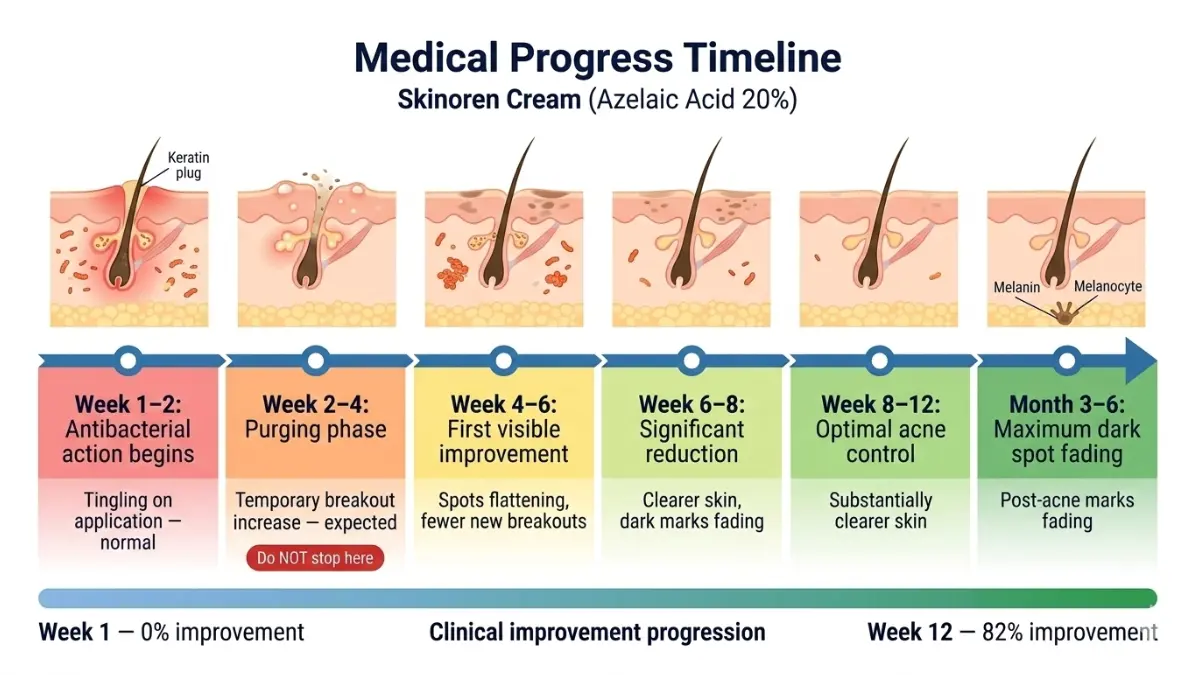
The Real Skinoren Cream Results Timeline
| Time Period | What’s Happening Biologically | What You’ll Actually See |
|---|---|---|
| Week 1–2 | Antibacterial action begins | Tingling/stinging on application; possible mild redness — normal |
| Week 2–4 | Purging phase begins | Temporary increase in surface breakouts as pores clear — expected |
| Week 4–6 | First measurable improvement | Existing spots flattening; fewer new breakouts forming |
| Week 6–8 | Significant reduction | Noticeably clearer skin; early fading of dark marks begins |
| Week 8–12 | Optimal acne control | Substantially clearer skin; PIH marks visibly lighter |
| Month 3–6 | Maximum dark spot fading | Post-inflammatory hyperpigmentation continues to fade significantly |
What the Clinical Evidence Actually Shows
A rigorous real-world study of 251 adult women using Skinoren 20% azelaic acid cream found that after 12 weeks, 82% achieved nearly clear or mild acne on the face, with quality-of-life scores improving significantly, as documented in this peer-reviewed PubMed study.
What This Means For You: If you’re at week 3 and feeling discouraged — that’s exactly when most successful patients are in their purging phase. The data says: hold on for week 8 before evaluating whether it’s working.
Does Skinoren Cream Cause Purging?
Yes — and this is the information no UK pharmacy page explains properly.
Purging (temporary worsening in weeks 2–4) is a sign Skinoren is working. It occurs as the keratolytic action accelerates pore-clearing, bringing blocked material to the surface faster than normal skin cycling would.
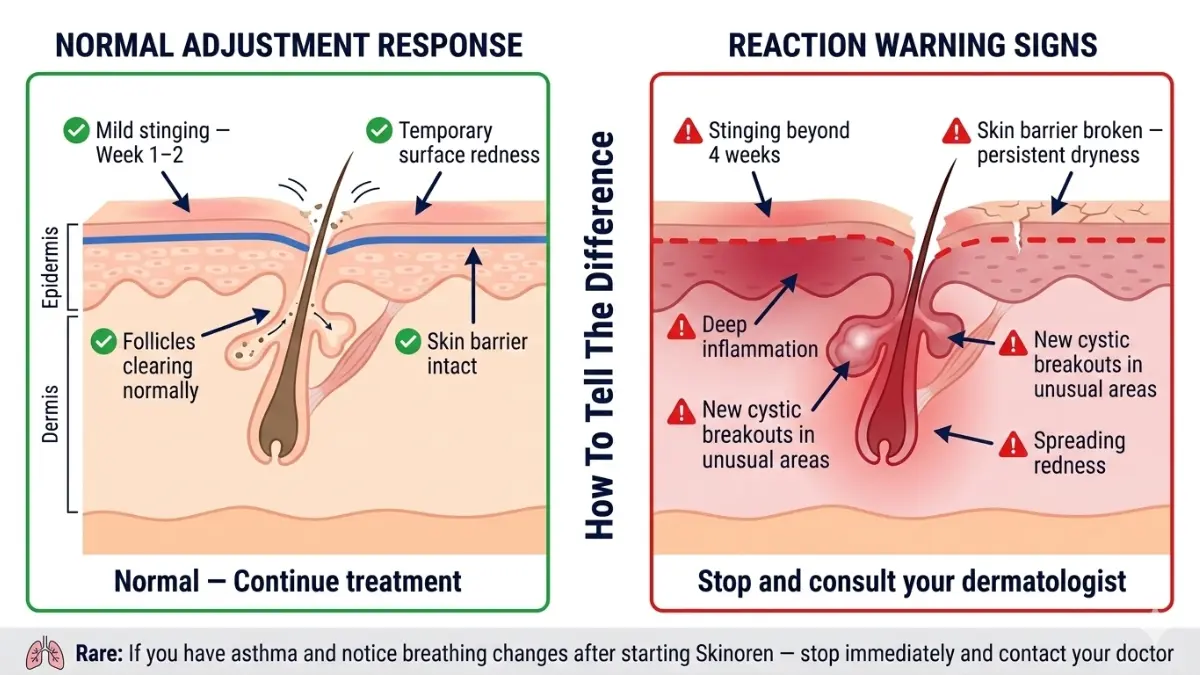
Purging vs. Reaction — How to Tell the Difference:
| Sign | Purging (Normal) | Reaction (See a Doctor) |
|---|---|---|
| Timing | Weeks 1–4 | Persists beyond 4–6 weeks |
| Breakout Type | Small surface spots in usual acne zones | New cystic spots in unusual locations |
| Redness | Mild, temporary | Persistent, spreading |
| Skin Barrier | Stable | Increasingly dry, tight, compromised |
For broader context on safe exfoliation during treatment, our facial exfoliator guide explains which products to avoid layering with Skinoren.
Skinoren Cream Side Effects and Safety — What the Leaflet Buries
Most patients receive Skinoren with a leaflet that lists side effects in clinical language with no practical context. Here’s the plain-English safety picture your dermatologist’s busy schedule may not have covered.
Side Effect Frequency Table (Based on Clinical Trial Data)
| Side Effect | How Common | What To Do |
|---|---|---|
| Burning / stinging on application | Very common (>1 in 10) | Always apply to fully dry skin; buffer over moisturizer if severe |
| Itching / erythema (redness) | Very common | Use a ceramide-rich, fragrance-free moisturizer; reduce to once daily |
| Skin dryness / scaling | Common (up to 1 in 10) | Apply oil-free moisturizer 5–10 min after Skinoren absorbs |
| Skin discolouration (lightening) | Rare | Contact your doctor if noticeable changes occur in unaffected skin |
| Worsening of asthma | Very rare | Stop immediately and consult your doctor |
Is Skinoren Cream Safe During Pregnancy?
Yes — and it’s one of the very few prescription acne treatments that is.
According to a comprehensive narrative review published in PMC (National Institutes of Health), azelaic acid is a first-line treatment recommendation for mild-to-moderate acne during all phases of pregnancy and lactation — one of only a handful of topical treatments with this designation.
Key pregnancy-specific guidance:
- Classified FDA Pregnancy Category B — no evidence of fetal harm in animal studies
- Only ~4% is absorbed systemically after topical application — extremely low systemic exposure
- Do not apply to the chest or breast area during breastfeeding
- Always discuss first-trimester use with your OB-GYN or dermatologist
The American Academy of Dermatology’s guidance on acne treatment in pregnancy also lists azelaic acid as among the safest available options for pregnant patients.
Expectant mothers tracking pregnancy health may also find our Pregnancy Weight Gain Calculator and Pregnancy Due Date Calculator useful during this period.
Does Skinoren Cream Bleach Normal Skin?
No — and this is one of the most important misconceptions to correct.
Azelaic acid selectively targets only overactive, hyperpigmented melanocytes. It does not affect normal melanocyte function in surrounding healthy skin. A multicenter, double-masked randomized trial in darker-skinned patients specifically (phototypes IV–VI), published on PubMed, confirmed significant reduction in hyperpigmentation with no bleaching of normal skin over 24 weeks.
This makes Skinoren cream particularly valuable for Black, Asian, Hispanic, and South Asian skin tones, where post-acne dark marks are both more common and more persistent.
The Asthma Warning Almost No Website Mentions
Post-marketing surveillance data has recorded rare cases of asthma exacerbation in patients using topical azelaic acid. This risk is documented in the official prescribing information but rarely discussed in patient-facing content.
If you have asthma:
- Inform your prescribing doctor before starting Skinoren
- Monitor for any increase in wheeze, cough, or breathlessness
- Stop use immediately and seek medical advice if respiratory symptoms worsen
Skinoren vs. Alternatives: Side-by-Side Comparison
| Treatment | Strength | Antibiotic Resistance Risk | Pregnancy Safe | Fades Dark Spots |
|---|---|---|---|---|
| Skinoren (AZA 20%) | Moderate–Strong | ❌ None | ✅ Yes | ✅ Yes |
| Finacea Gel (AZA 15%) | Moderate | ❌ None | ✅ Yes | ✅ Yes |
| Benzoyl Peroxide | Strong | ❌ None | ⚠️ Limited amounts | ❌ No |
| Tretinoin (Retin-A) | Strong | ❌ None | ❌ Avoid | ✅ Yes |
| Topical Clindamycin | Moderate | ⚠️ Yes | ⚠️ Caution | ❌ No |
| Differin (Adapalene) | Moderate | ❌ None | ❌ Avoid | ⚠️ Mild |
For a broader perspective on blackhead removal options that can complement Skinoren, see our dermatologist-reviewed guide on blackhead removal methods.
Is Skinoren Cream Right For You? The Expert Verdict
Not every patient is a good candidate for Skinoren cream. Here’s how to know if it fits your situation — based on clinical criteria, not marketing language.
Suitability at a Glance
| ✅ Strong Candidate | ❌ Not Recommended |
|---|---|
| Mild to moderate acne (face, back, chest) | Children under 12 years |
| Post-acne dark marks / PIH | Known allergy to azelaic acid or excipients |
| Rosacea (papulopustular subtype) | Active asthma (use with caution; discuss with doctor first) |
| Pregnant or breastfeeding women (with guidance) | Severe, cystic, or nodular acne (needs systemic treatment) |
| Darker skin tones with persistent hyperpigmentation | Those with eczema-prone or severely disrupted skin barriers |
| Patients seeking antibiotic-resistance-free treatment | Anyone looking for overnight results |
Expert Consensus Panel
Dr. Aditi Menon, MD Dermatology: “Skinoren cream is one of my first-line recommendations for adult female acne — particularly because it addresses active lesions, residual dark marks, and rosacea simultaneously, without the antibiotic resistance concerns associated with long-term clindamycin use. Patience is the single most important success factor.”
Global Guideline Alignment: The American Academy of Dermatology’s acne management guidelines consistently position azelaic acid as a first-line topical option — particularly for patients who are pregnant, antibiotic-resistant, or have concurrent hyperpigmentation.
Final Verdict: What This Means For You
If you have mild to moderate acne, persistent post-acne dark marks, or rosacea — Skinoren cream is one of the most clinically validated, versatile, and safest topical treatments available in 2026. It’s the rare acne treatment that works for most skin types, is safe in pregnancy, doesn’t drive antibiotic resistance, and addresses both active spots and the scars they leave.
The key is commitment: use it correctly, apply to dry skin, and give it a full 12 weeks before drawing conclusions.
If your skin concerns go beyond acne alone — including pigmentation, texture, or post-procedure recovery — our dermaroller guide explores complementary treatments that dermatologists commonly pair with azelaic acid therapy.
To identify any other medications you’re currently prescribed and check for interactions, use our free Pill Identifier tool.
Frequently Asked Questions — Skinoren Cream
Q1: What is Skinoren cream used for?
Skinoren cream is a prescription topical treatment for acne vulgaris, rosacea, and post-inflammatory hyperpigmentation. Its active ingredient, azelaic acid 20%, works through three mechanisms: antibacterial, keratolytic, and tyrosinase-inhibiting.
Q2: How long does Skinoren cream take to work?
Most patients see initial improvement at 4–6 weeks, with significant results by weeks 8–12. Dark spots may continue fading for 3–6 months with consistent use.
Q3: Does Skinoren cream cause purging?
Yes — temporary worsening in weeks 2–4 is normal and indicates the cream is working. If breakouts persist beyond 6 weeks or appear in new locations, consult your doctor.
Q4: Can I use Skinoren cream twice a day?
Yes. Twice daily (morning and evening) is the standard adult dose. Patients with sensitive skin should start once daily in the evening for the first week, then increase to twice daily.
Q5: Is Skinoren cream safe during pregnancy?
Yes. Azelaic acid is classified FDA Pregnancy Category B and is recommended by major dermatology guidelines as a first-line acne treatment during pregnancy and breastfeeding. Avoid applying to the breast area if breastfeeding.
Q6: Does Skinoren cream bleach normal skin?
No. Azelaic acid only targets overactive melanocytes in hyperpigmented areas. It does not affect surrounding normal skin, making it safe for all skin tones including darker phototypes.
Q7: Can Skinoren cream be used on the back and chest?
Yes. Skinoren cream is approved for use on the face, back, and chest. Increase the amount applied proportionally for larger treatment areas.
Q8: What happens if I stop using Skinoren cream?
Acne and rosacea may gradually return after stopping. Your dermatologist may recommend maintenance therapy or a stepped-down frequency before stopping completely.
Q9: Can Skinoren cause asthma to worsen?
Very rarely, yes. Post-marketing reports have documented rare asthma exacerbations. Patients with asthma should inform their doctor before starting treatment and stop use if respiratory symptoms worsen.
Q10: What is the difference between Skinoren cream and Finacea gel?
Both contain azelaic acid but at different concentrations. Skinoren cream contains 20% and has a heavier emollient base. Finacea gel contains 15% and has a lighter, faster-absorbing base — often preferred for oily or congestion-prone skin.
Q11: Can Skinoren cream be used with retinol or vitamin C?
Use with caution. Avoid combining Skinoren with strong exfoliants, retinoids, or high-concentration vitamin C in the same routine without dermatologist guidance. Start by using Skinoren alone to assess skin tolerance, then layer carefully under professional supervision.
For more expert-reviewed skin and dermatology content, explore our Health Tips library at mymedicineadvisor.com.
About this content
How this article was put together: researched from recognised health sources, drafted with the help of AI tools, and edited by hand, with sources linked throughout.

Sameer Patel is the founder and editor of My Medicine Advisor. He is not a doctor or medical professional — before starting this site he worked in banking,…
Medical disclaimer
The content on MyMedicineAdvisor is provided for general informational and educational purposes only and is not a substitute for professional medical advice, diagnosis, or treatment. Health information on this website should not be used to diagnose, treat, cure, or prevent any condition without guidance from a qualified healthcare professional. Always seek the advice of your doctor, physician, or another licensed healthcare provider with any questions you may have regarding a medical condition, symptoms, medications, or treatment decisions.