
On This Page – Quick Medical Summary
You just got an A1C result in the room
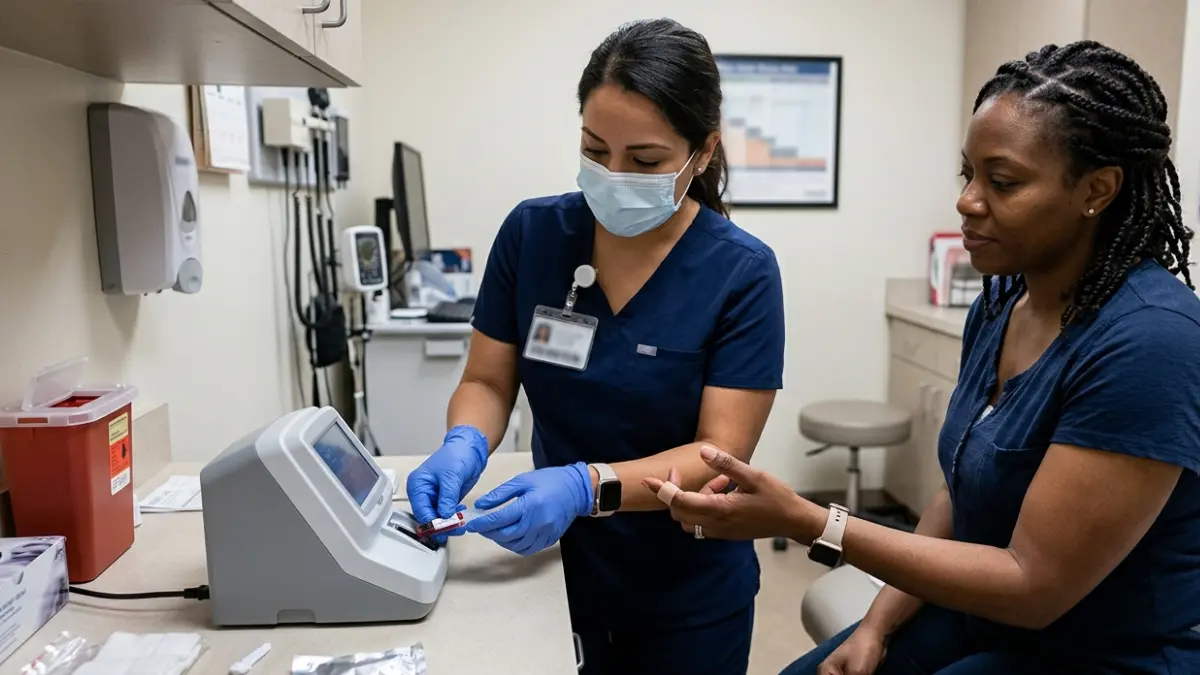
Someone pricked your finger, fed a drop of blood into a small machine, and handed you a number a few minutes later. The question in your head is probably not about the machine. It is whether that number settles anything.
The honest answer depends on something nobody at the counter is likely to have mentioned: not how good the device is, but what that particular device and that particular testing site are each licensed to do. Those are two separate permissions, and a point of care A1C result means different things depending on whether both of them are in place.
If your number came from a health fair, pharmacy or walk-in screening
You are the reader this page is most concerned about. A screening number can be genuinely useful and still not be the end of the process, and the step that closes the loop is in the section on what to ask. Go there first if you read nothing else.
If you already have diabetes and this was a check-up
Your result is very likely doing exactly the job it was designed for. The section on what a fingerstick result can already do is written for you, and it is not a consolation prize.
If you are holding someone else’s printout — a parent’s, a partner’s — the same two permissions apply, but you may not be the person with access to the clinician. There is a paragraph for that situation further down. And if what you actually want is what the number itself means rather than what it is allowed to do, start with how to read an A1C result.
ℹ️ Medical Disclaimer: This article is general health education about how laboratory testing is regulated in the United States: it does not diagnose any condition, does not tell you what your own result means, and cannot tell you what your clinic, pharmacy or employer is certified to do. Decisions about diagnosis, repeat testing, medication and treatment belong to a licensed clinician who can see your full record. If a result is worrying you, contact the clinician who ordered the test.
What a point-of-care A1C actually measures
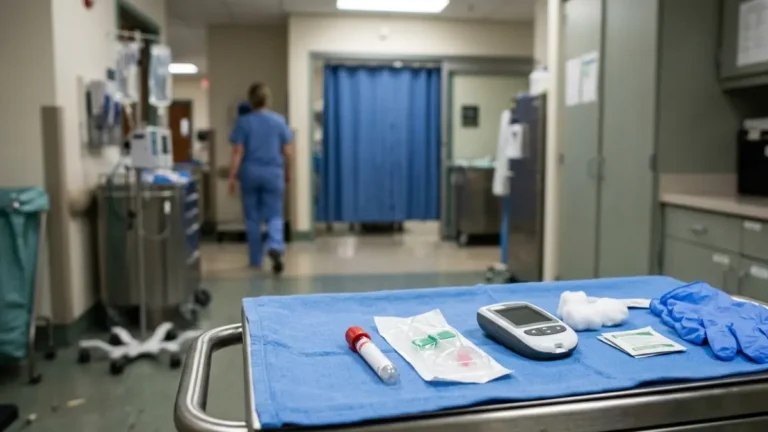
The phrase describes a location, not a lesser test. Point-of-care testing means the sample is analyzed where you are — in the clinic room, at the pharmacy counter, in a mobile screening van — instead of being packed up and driven to a laboratory.
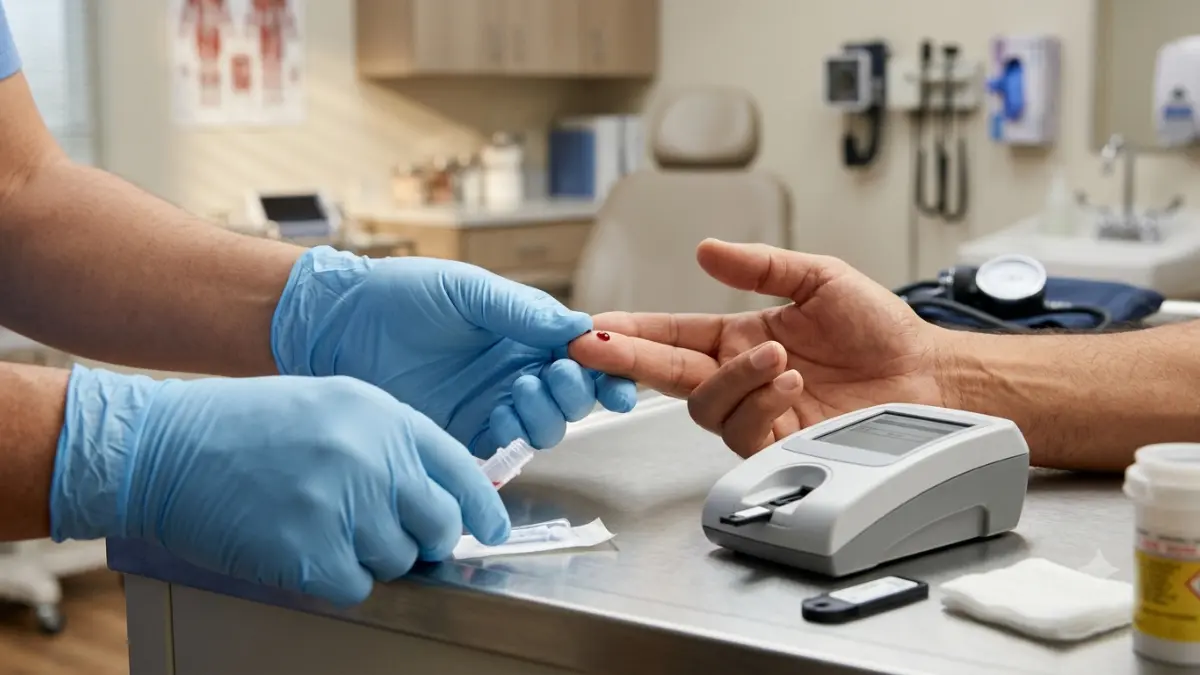
Point of care means the test comes to you, not the other way round
An A1C test measures how much of the hemoglobin in your red blood cells is coated with glucose, which is why it reflects an average rather than a moment. Glucose sticks to hemoglobin for as long as the red blood cell lives, and red blood cells live about three months. That is the same biology whichever building the sample is analyzed in.
🔬 How It Works: Sugar circulating in your blood attaches to hemoglobin, the protein inside red blood cells that carries oxygen. The more glucose there has been in your blood, the more of your hemoglobin ends up coated. Because those cells survive for roughly three months before being replaced, measuring the coated fraction gives an average over that window rather than a reading of this morning.
A fingerstick sample and a vein sample are measuring the same thing
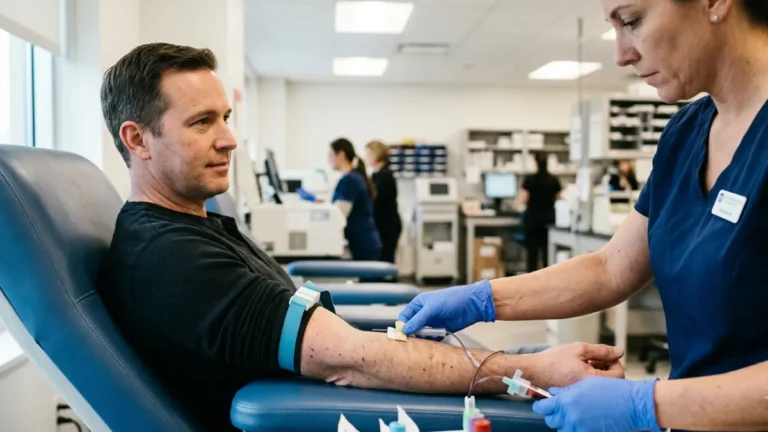
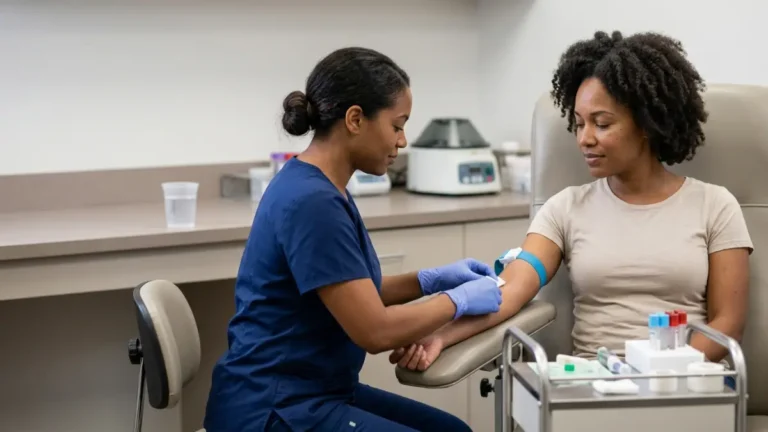
The two routes differ in specimen type, not in the substance being measured. A fingerstick collects capillary blood from the fingertip; a laboratory route collects venous blood from a vein in the arm.
Whether a result is used for diagnosis, though, turns on a separate matter. The federal patient page on A1C describes the diagnostic route specifically as a sample taken from a vein and sent to a laboratory using a certified method.
Why the result can be ready before you leave
Small bench-top and handheld analyzers run the assay on site, which is the entire point of the format: the clinician has the number during the appointment rather than two weeks later. That speed is a real clinical advantage and the next two sections are about the conditions attached to it, not about whether the machine works.
If what you want is the meaning of the number rather than its status, what the A1C numbers themselves mean is the article that covers it.
The rule about diagnosis changed, and not everywhere
Search this question and you will find a flat prohibition: point-of-care A1C cannot be used to diagnose diabetes. That sentence was correct when it was written. It is no longer the whole rule, and the gap between those two facts is a gap between two dates.
What the federal patient page says, and when it was written
The federal patient page on A1C testing states that blood samples analyzed in a doctor’s office or clinic, known as point-of-care tests, should not be used for diagnosis. That page carries a last-reviewed date of April 2018, lists the 2018 edition of the national diabetes standards among its references, and sits on a site that now displays a notice saying its content is not being updated.
None of that makes the page wrong. It restated the guideline that was in force in 2018, accurately, and it is honestly labeled with the date that tells you so.
What the current diabetes guideline says instead
The 2022 edition of the American Diabetes Association’s Standards of Care still said point-of-care A1C assays had not been prospectively studied for diagnosis and were not recommended for it. The current edition restricts point-of-care A1C for screening and diagnosis to devices approved for that use by the Food and Drug Administration, used at laboratories certified under the Clinical Laboratory Improvement Amendments that perform testing of moderate complexity or higher, by trained personnel.
That is a conditional permission rather than a ban. It is also a narrow one, and most testing done in a clinic room or at a pharmacy counter is not performed at that kind of site.
⚠️ Clinical Warning: Do not read this section as permission to treat a screening number as a diagnosis. Under the same standards, any test used to diagnose diabetes requires confirmation with a second measurement unless there are clear symptoms — and that requirement does not disappear because the first number came from a device rather than a laboratory. If your result was high, the section on what to ask exists precisely for you.
Why both statements are honest
One source describes 2018 and says so. The other describes now. Consumer pages copied the older sentence forward without its date, which is how a retired rule ends up circulating with a fresh timestamp attached — and it is why a page updated this year can still print the flat version.
🩺 Physician Note: A common point of confusion is that “can it diagnose?” sounds like a question about accuracy, and it is not. Current guidance treats the question as one of authorization — which device, used where, by whom — and a device can be perfectly capable of producing a correct number in a setting that is not certified to use it for diagnosis. If your question really is about accuracy, what a laboratory has to prove about an A1C result covers that separately.
Two permissions have to line up, not one
Two separate approvals decide whether a result can be used to diagnose, and they are held by two different parties. One belongs to the device. The other belongs to the testing site.
Permission one: what the device is cleared to be used for
A device is cleared by the FDA for particular uses. Under the current standards, point-of-care A1C assays may be certified and cleared for use in monitoring blood sugar management in people who already have diabetes — and separately, only devices approved for diagnosis may be used for that.
Those are not the same clearance, and a machine that holds one does not automatically hold the other.
Permission two: what the testing site is certified to do
Every facility in the United States that tests human specimens for health assessment is regulated under the Clinical Laboratory Improvement Amendments, and that regulation covers testing for diagnosis, prevention and treatment. Sites are certified at different complexity levels. Diagnosis with a point-of-care A1C requires a site certified at moderate complexity or higher, where the standards include documented annual competency assessments and participation three times a year in an approved proficiency testing program.
Why a certificate of waiver is a different thing from a laboratory license
A certificate of waiver covers tests that regulators have judged simple and low-risk. CDC is direct that waived tests are not completely error-proof, and that errors can occur where the manufacturer’s instructions are not followed or personnel are unfamiliar with the test system — a statement about how the category is designed, not about the people working in it. CDC’s own training for waived testing is aimed at physician offices, clinics, pharmacies and other non-laboratory sites, largely at staff without formal laboratory training.
| Permission | What it covers | Who holds it | Key clinical detail |
|---|---|---|---|
| FDA clearance of the device | the uses the device may be marketed and used for | the manufacturer, granted by the FDA | monitoring clearance and diagnosis approval are separate; holding one does not confer the other |
| CLIA certification of the site | the complexity of testing the site may perform | the clinic, pharmacy or laboratory | diagnosis needs moderate complexity or higher, with competency checks and regular proficiency testing |
| Both together | whether a result may be used to diagnose | nobody you can see from the waiting room | the reader holds neither, and cannot resolve this alone — only the site can say what it holds |
Source note: permission structure drawn from CDC’s page on waived laboratory tests and the American Diabetes Association’s current Standards of Care, Section 2.
This is the same framework other point-of-care tests run under, which is why how walk-in testing is regulated describes the same certificate for a different panel. If your next thought is whether a kit bought online is the same thing, how at-home tests compare with a laboratory answers that question directly.
What your fingerstick result can already do
Everything above is about a limit, and a limit is easy to over-read. Your number is not meaningless, and the current guideline says so explicitly rather than by implication.
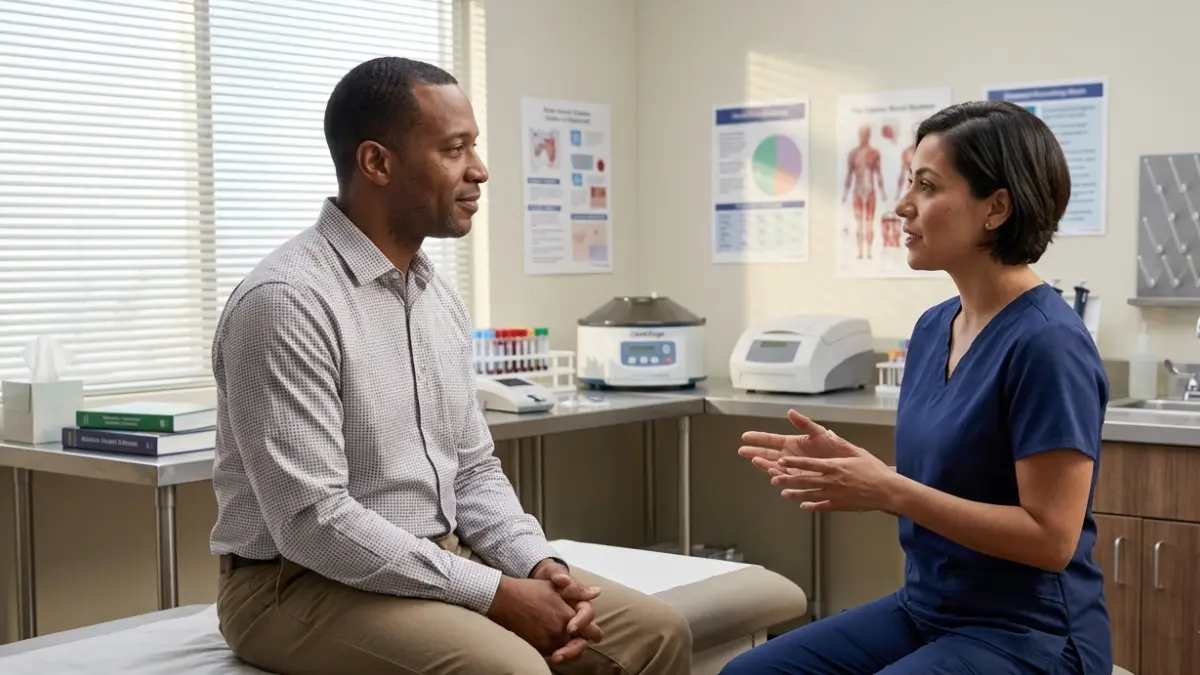
If you already have diabetes, this result is doing its main job
Point-of-care A1C assays may be certified and cleared for monitoring blood sugar management in people with diabetes — and, unlike the diagnosis rule, that use is recognized in both regulated and waived settings. The A1C test is the primary test used for diabetes management, used to set treatment goals, adjust therapy and track how things are going.
If your appointment was a review rather than an investigation, the number in your hand is the number it was meant to produce.
✅ Patient Action: If you are managing diagnosed diabetes, ask the clinician managing it one question at this visit: “Are we using today’s number to make decisions now, or waiting for a laboratory one?” The answer tells you whether anything is pending.
Why a result in the room can change what happens at the appointment
A number available during the visit means the conversation about what to change can happen at the visit. That is the reason the format exists, and it is a real advantage over waiting for a result that arrives once everyone has gone home.
What it can flag even when it cannot conclude
A screening number that comes back high has still done something useful: it has identified a person who should be tested properly. It has not, on its own, told anyone what they have.
If your result looked reassuring and you want to know what that settles, what a normal A1C level actually settles is the article for that. And if you are comparing a glucose figure reported in different units, the blood sugar unit converter will switch between milligrams per deciliter and millimoles per liter.
What to ask before you leave the clinic
This is the part that matters most, and it takes about eight seconds. The worst outcome of reading everything above is understanding it perfectly and then doing nothing with it.
The one question that settles it
Say this to whoever handed you the number:
“Was this result run somewhere it can be used to diagnose, and if not, should I have it repeated at a laboratory?”
That single sentence covers both permissions without you needing to know which one might be missing. It is a question we have written for you from the rule above, not a script issued by any institution — but it asks exactly what the rule turns on. Under the current standards, a diagnosis requires confirmation with a second measurement anyway unless there are clear symptoms, so a repeat is a normal part of the process rather than a sign anybody got anything wrong.
✅ Patient Action: Before you leave, ask the clinician or pharmacist who gave you the result whether it needs repeating at a laboratory, and if the answer is yes, book that appointment before you walk out rather than after. Why a second A1C test is ordered explains what the repeat is actually for.
If you were tested at a pharmacy, health fair or workplace event
CDC’s guidance on getting tested for diabetes is explicit about this route: if you had your blood sugar tested at a health fair or pharmacy, follow up with your doctor, who may want to re-test you to make sure the results are accurate. CDC’s sentence is about blood sugar testing generally rather than the A1C specifically — but the reason it gives, confirming the result, is the same reason the standards require a second measurement before a diagnosis.
If your number landed at or above the diagnostic line, what happens after a result at or above the diagnostic line walks through the sequence.
If you are asking on behalf of a parent or partner
Your difficulty is different: you may be holding the printout without being the person the clinic will speak to. Ask the person you are helping to put the question above to their clinician directly, or ask whether you can be named on their record so you can follow it up. If neither is possible, the practical step is making sure a follow-up appointment exists rather than trying to get the answer yourself.
⚠️ Clinical Warning: If the person you are helping has symptoms that came on quickly — heavy thirst, frequent urination, unexplained weight loss, vomiting or confusion — that is not a situation for a repeat test in a few weeks. Contact their clinician or urgent care the same day, whatever any A1C number said.
What this page cannot tell you about your visit
There are limits to what a national page can know about your appointment, and naming them is more useful than implying otherwise.
We cannot tell you what your clinic or pharmacy is certified for
What we hold is a category rule — the conditions under which a point-of-care result may be used to diagnose. What we do not hold is a list of which sites meet them. Only the site can tell you what certificate it holds, which is why the question in the previous section is addressed to them and not answered here.
Two neighboring questions also belong elsewhere. If your fingerstick number surprised you against your own monitoring, when an A1C and a meter disagree covers that. If you suspect the number itself is off, the causes are usually unrelated to where the sample was run — what can distort an A1C result covers those.
A fingerstick at a clinic is not the same as a kit you buy
A test run on your finger at a counter and a kit that mails a sample to a certified laboratory are different objects under different rules. Collapsing them is the same category error this article exists to correct, so treat anything you read about one as not automatically applying to the other.
We do not link to or recommend any home A1C product on this page, and there is no affiliate arrangement behind anything here. The reason is the article’s own finding. What makes a result usable for diagnosis is an FDA clearance held by a device for that purpose and a CLIA certificate held by a testing site — and neither of those is something a consumer can buy. Selling you a purchase on a page explaining that authorization is not purchasable would contradict the page.
Point-of-care A1C questions people ask
1. Can a point-of-care A1C test diagnose diabetes?
Sometimes, under two conditions. The current diabetes standards restrict a point of care A1C used for screening and diagnosis to devices approved for that purpose by the FDA, at sites certified under CLIA at moderate complexity or higher with trained personnel, and most clinic-room and pharmacy testing is not done at that kind of site. Ask the clinician who ordered it whether yours qualifies.
2. What does point of care mean for a blood test?
It describes where the sample is analyzed, not how good the test is. A point of care A1C is run on a small analyzer at the place you were tested, so the result is ready in minutes, rather than being sent to a laboratory. The substance being measured is identical either way — the difference is location, speed, and the rules attached to each setting.
3. Why did my clinic use a fingerstick instead of drawing blood?
Because the result arrives during your appointment. A point of care A1C run on a fingertip sample lets the clinician discuss what to change while you are still in the room, instead of contacting you two weeks later. Whether that result can also be used to diagnose depends on the device’s clearance and the site’s certification, not on the fingerstick itself.
4. Is a pharmacy A1C result official?
It is a real result, and it may or may not be usable for diagnosis. CDC advises that if you had your blood sugar tested at a health fair or pharmacy, you follow up with your doctor, who may want to re-test you to confirm accuracy — the step that turns a screening number into something your record can act on. Raise it with your primary care clinician.
5. Do I need a second A1C test after a fingerstick one?
Often, yes. Under the current standards any test used to diagnose diabetes requires confirmation with a second measurement unless there are clear symptoms, and that applies regardless of which route produced the first number, so a repeat is routine rather than a sign of a mistake. Ask the clinician who ordered your point of care A1C whether a laboratory repeat is needed.
6. What is a CLIA certificate of waiver?
It is the certification a site holds to perform tests regulators have judged simple and low-risk. CDC notes that waived tests are not completely error-proof and that errors can occur when instructions are not followed or staff are unfamiliar with the system. A waived site is not certified at the moderate-complexity level that a point of care A1C used for diagnosis requires.
7. Can I ask where my A1C was run?
Yes, and it is a reasonable question rather than a challenge. Ask whether your point of care A1C was run somewhere it can be used to diagnose, and whether it should be repeated at a laboratory. The staff who performed the test are the only people who can answer it, because this article can describe the rule but not which certificate any given site holds.
8. Does a point-of-care A1C count for managing diabetes I already have?
Yes. The current standards recognize point of care A1C assays cleared for monitoring blood sugar management in people with diabetes, in both regulated and waived settings, and the A1C test is the primary test used for diabetes management, including setting goals and adjusting therapy. Confirm with the clinician managing your diabetes that today’s number is the one being used.
9. Why does one website say point-of-care A1C can never diagnose?
Because that was the rule, and the page saying it may be older than the change. The most-cited federal patient page states the flat version and carries a last-reviewed date of April 2018, referencing the 2018 standards, while the current standards replaced the flat ban with a conditional permission. Both statements are honest; they describe different years.
10. Is a fingerstick A1C the same as a home test kit?
No. A fingerstick run at a clinic or pharmacy counter is performed by staff at a site holding its own certification, while a kit bought for home use falls under different rules, and a mail-in kit that sends your sample to a certified laboratory is a third thing again. Treat what applies to one as not automatically applying to the others.
11. What should I ask before I leave the clinic?
One question covers it: was this result run somewhere it can be used to diagnose, and if not, should it be repeated at a laboratory? That asks about both the device and the site without needing to know which might be missing, and if the answer is that a repeat is needed, book it before leaving. Direct the question to whoever handed you the result.
What to do with the number you were handed
A point of care A1C is not a lesser test. It is a test whose permitted use depends on two things you cannot see from the waiting room — what the device is cleared for and what the site is certified to do.
If you already have diabetes, your result is very likely doing its job. If your number came from a screening event and was high, it has done something useful without finishing the job.
Either way, the next move is the same, and it is one sentence: “Was this result run somewhere it can be used to diagnose, and if not, should I have it repeated at a laboratory?” Ask it before you leave.
For what the number itself means once its status is settled, what an A1C result can and can’t settle on its own is the place to go next.
About this content
How this article was put together: researched from recognised health sources, drafted with the help of AI tools, and edited by hand, with sources linked throughout.

Sameer Patel is the founder and editor of My Medicine Advisor. He is not a doctor or medical professional — before starting this site he worked in banking,…
Medical disclaimer
The content on MyMedicineAdvisor is provided for general informational and educational purposes only and is not a substitute for professional medical advice, diagnosis, or treatment. Health information on this website should not be used to diagnose, treat, cure, or prevent any condition without guidance from a qualified healthcare professional. Always seek the advice of your doctor, physician, or another licensed healthcare provider with any questions you may have regarding a medical condition, symptoms, medications, or treatment decisions.