
On This Page – Quick Medical Summary
Your A1C and your meter are answering different questions
If your A1C came back at a number your blood glucose meter never showed you, both results can still be correct. Where you are right now decides which part of this page matters most:
- You test once or twice a day, usually before meals — the section on meter averages explains most of the gap.
- You have already checked your technique and the gap is still there — go to when a mismatch is worth raising with your doctor.
- This is your first A1C since you started testing at home — start with what each number measures.
- You are helping a parent or partner compare a logbook against a clinic result — the technique and appointment sections are written for you.
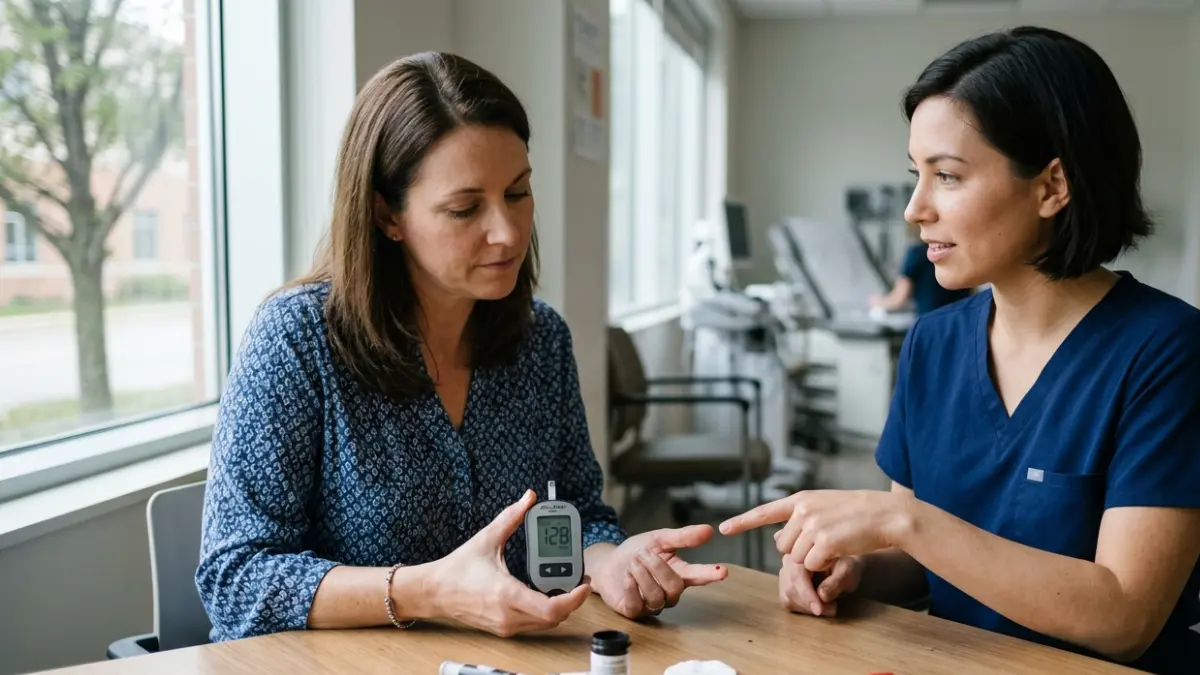
The A1C reflects your average blood glucose over roughly three months. Your meter reports one moment. NIDDK’s patient guidance on the A1C test and diabetes, last reviewed in April 2018, states that the estimated average glucose figure calculated from an A1C will not match daily glucose readings, because one is a long-term average and the other is a single point in time.
That is the short answer, and our main guide to how to read your A1C result covers what the number itself means. The rest of this page is why the gap is usually a particular size and direction, what you can check yourself, and the one situation where the mismatch is worth a conversation.
✅ Patient Action: Write down both numbers — your most recent A1C and your meter’s 14- or 30-day average — and take them to your next appointment together. Both can be accurate at the same time, and a gap that is still there after you have checked your testing routine is worth telling your clinician about, because that discrepancy is itself useful clinical information. Ask your primary care clinician or endocrinologist: “My meter average and my A1C don’t line up — is that worth looking into?”
ℹ️ Medical Disclaimer: This article is general health education about how two different glucose measurements are produced and regulated. It does not diagnose any condition, and it does not tell you how to interpret your own results, adjust any medication or insulin dose, change how often you test, or select a device. Diagnosis of diabetes and prediabetes, medication decisions, target setting, and device selection all require a board-certified physician — usually your primary care clinician or an endocrinologist — working from your full record, and if a blood sugar reading does not match how you feel, contact your care team rather than acting on the number alone.
What each number actually measures
The gap starts with biology, not with error. One test samples a protein that has been recording for months; the other samples a fluid that changes by the minute.
What your A1C is built from
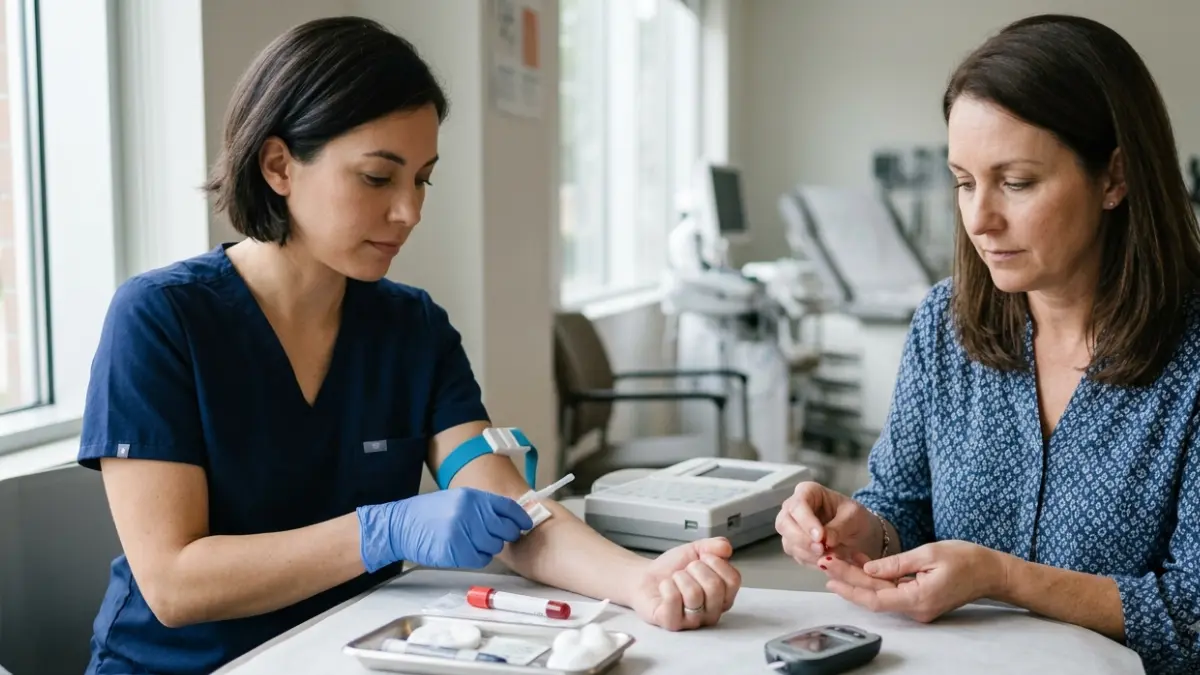
Glucose in your bloodstream attaches to hemoglobin, the protein inside red blood cells that carries oxygen. The higher your glucose has been, the more of your hemoglobin carries glucose along with it. The A1C reports that share as a percentage, and because red blood cells live for months, the figure reflects roughly three months of exposure.
Two details matter for anyone comparing numbers. NIDDK notes that glucose levels in the past 30 days affect the A1C reading more than earlier months, so a recent good stretch counts for more than an old one. And for diagnosis, the sample comes from a vein and goes to a laboratory using a certified method — not from a fingertip.
What your meter is built from
A glucose meter measures glucose in a small sample of blood, usually from a fingertip, and returns a result in seconds. It is a snapshot: accurate for that minute, silent about the hour before and the hour after.
That is not a weakness. It is the entire design purpose — a number you can act on now, which an A1C can never give you.
The conversion your meter runs before it shows you a number
Here is the step almost nobody explains. Your meter draws capillary whole blood, but FDA guidance directs that meters sold in the United States report results in plasma equivalents — the same basis a laboratory uses. The device performs a conversion before the number reaches the display.
🔬 How It Works: Whole blood is a mixture of plasma and cells, and glucose sits in the plasma, so a whole-blood sample and a plasma sample from the same person contain different glucose concentrations by volume. Rather than hand you a number that could not be compared with a lab report, your meter applies a fixed conversion and shows you the plasma-equivalent figure. Two numbers that look like they came from the same measurement have, in fact, already been translated into a common language before you see either one.
If you want the reference points for what a result means, they live on our guide to a normal A1C level and what it settles rather than here — this page is about why two measurements differ, not about where the thresholds sit.
Why a meter average sits below your eAG
If your lab report prints an estimated average glucose in mg/dL and it runs higher than the average on your meter, the most common explanation is not that either device is wrong. It is that the two averages are built from very different numbers of readings, taken at very different times of day.
The number of readings behind the eAG figure
The conversion from A1C to estimated average glucose comes from the A1c-Derived Average Glucose study, published in Diabetes Care in 2008. It enrolled 507 people at ten international centers and followed them for three months.
📊 Clinical Data Point: Each participant in that study contributed approximately 2,700 glucose values over three months — continuous monitoring performed four times, plus seven-point fingerstick testing at least three days a week. That is roughly thirty readings a day, day and night. Source: Nathan DM et al., Diabetes Care 2008;31(8):1473–8 (PMID 18540046), record on PubMed.
Set that beside a typical home routine of one to four checks a day and the difference in sampling is roughly two orders of magnitude. The eAG on your report is an estimate of what that kind of dense, round-the-clock sampling would have found.
When most people actually test
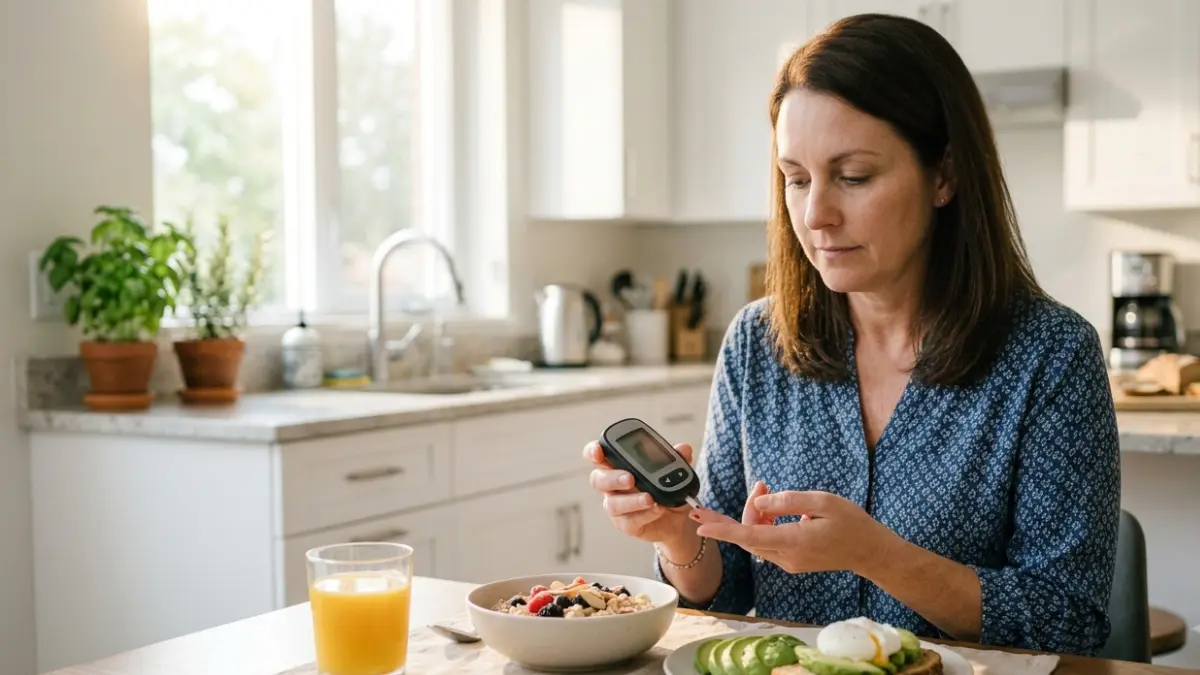
CDC’s guidance on managing blood sugar lists the usual times to check: on waking before eating or drinking, before a meal, two hours after a meal, and at bedtime. Three of those four fall before food or well after it. MedlinePlus, writing for patients, puts it even more simply — the usual times are before meals and at bedtime.
Why that makes a meter average run low
Blood glucose rises after eating and moves with activity. A routine weighted toward pre-meal and overnight checks therefore samples the calmer part of the day and largely skips the peaks.
Average those readings and you get a real number — an honest average of the moments you measured. It is simply not an average of the whole day, which is what the eAG is estimating.
🔬 How It Works: Picture two people measuring the same river: one takes a reading every half hour for three months, including during storms, while the other takes two readings a day, both at dawn when the water is lowest. Neither is lying about what they saw. The second will report a lower average, and the size of that difference depends entirely on when the readings were taken — not on the quality of either instrument.
What this does not mean about your testing
It does not mean you have been testing wrongly. Checking before meals is standard, useful practice, and it is what most care plans ask for, because a pre-meal number is the one that informs the decision in front of you.
It also does not mean the formula was built for someone else. The study reported that the relationship between A1C and average glucose did not differ significantly across age, sex, diabetes type, race or ethnicity, or smoking status.
Glucose reference points are handled separately in our guide to what a normal blood sugar reading looks like, and if your meter and your lab report use different units, our blood sugar converter switches a reading between mg/dL and mmol/L.
Two numbers, two rulebooks
Neither number is the more accurate one. They are held to different standards, by different agencies, because they were built to do different jobs — and the standards themselves are not comparable to each other.
What your lab’s A1C is graded against
Since July 2024, hemoglobin A1c has been a regulated analyte under the CLIA proficiency-testing rules — the federal system that periodically sends laboratories unknown samples and grades what they report. CMS set the acceptance limit for A1c at a target value of ±8%.
CMS explained the reason for the addition plainly: tests such as A1c and cardiac troponins were not routinely performed before 1992, when the original rules were written, so they were never covered. What the lab has to prove about your result — the certification, the traceability, the grading cycle — is covered in detail in our guide to how accurate the A1C test is.
What your meter had to prove to be sold
Your meter did not go through that system at all. It reached the market through FDA clearance under the agency’s guidance for self-monitoring blood glucose test systems for over-the-counter use, issued in September 2020.
That guidance asks manufacturers to show that 95% of results fall within ±15% of a laboratory comparator method across the device’s claimed range, and that 99% fall within ±20%. FDA set those criteria deliberately above the international ISO standard, saying the ISO criteria were not sufficient to protect people using these devices at home — in particular because that standard did not adequately address performance in the low range or across test strip lots.
The same guidance draws a boundary that matters here: it does not cover devices used to screen and diagnose diabetes, such as clinical chemistry analyzers, and it does not cover continuous glucose monitors. FDA issues a separate guidance for meters used in hospitals and clinics, on the reasoning that home users and professional settings are distinct populations needing different device designs.
| Number on your report | What it measures | Who grades it | Against what | Key clinical detail |
|---|---|---|---|---|
| Laboratory A1C | The share of hemoglobin carrying glucose, from a venous sample | CMS, under CLIA proficiency testing | Target value ±8% | Graded on unknown samples sent to the laboratory, not on your blood |
| Home glucose meter | Glucose in a drop of capillary blood, at one moment | FDA, through 510(k) clearance | 95% of results within ±15% of a lab comparator; 99% within ±20% | Cleared as an aid to monitoring a diabetes control program — not to diagnose |
Sources: CMS memorandum QSO-24-15-CLIA (July 8, 2024); FDA, Self-Monitoring Blood Glucose Test Systems for Over-the-Counter Use (September 2020).
⚠️ Clinical Warning: Do not read ±8% and ±15% as a scorecard. They grade different substances, on different scales, in different systems — one measures how a laboratory performs on test samples, the other how a device performed in a clearance study — and neither is an estimate of the error in your own result. Comparing the two figures directly, and concluding your meter is the weaker instrument, is the single most common wrong turn a reader can take from this page.
Where to find your own meter’s real numbers
You do not have to take a general figure on trust, because FDA requires the specific accuracy data for your device to be printed where you can read it: on the outer box, in the test strip package insert, and in the user manual, in language written for a non-specialist.
✅ Patient Action: Find the test strip package insert for the meter you actually own and read its accuracy table — the real figures for your device, not an industry average. Bring it to your next appointment if the numbers surprise you, and ask your diabetes care team: “Given what this device is rated for, how much of the gap between my meter and my A1C should I expect?”
What changes the number your meter shows
Most of what moves a meter reading is ordinary, fixable, and has nothing to do with your diabetes. Working through this list is worth doing before you conclude anything about either number.

Washing and drying your hands, and why it matters
FDA directs manufacturers to tell users to wash thoroughly with soap and water and dry the skin before sampling, because contaminants on the skin can affect results. That is not a hygiene instruction — it is an accuracy instruction. Traces of fruit, juice, or anything sweet on a fingertip go into the drop.
MedlinePlus adds the correction most people need: do not use an alcohol pad or swab instead. Alcohol does not remove sugar residue from skin, so a swab can leave the very contamination the wash was meant to clear.
Testing on your arm instead of your finger
Some meters are cleared for alternative site testing — forearm, upper arm, thigh, calf, or palm. FDA’s labeling guidance is specific about the limitation: when glucose is changing quickly, after a meal, after medication, or during and after exercise, a reading from an alternative site can differ significantly from a fingertip reading, and alternative-site levels may not rise as high or fall as low.
That has a direct bearing on a mismatch. If you have been testing on your forearm after meals, you may have been systematically missing the peaks — which pushes your average down for a reason that has nothing to do with your control.
FDA’s guidance directs that alternative site results should not be relied on when you think your blood sugar is low, when you have hypoglycemia unawareness, when the result does not match how you feel, after a meal, after exercise, during illness, or during periods of stress.
Strips, storage and the conditions in the room
FDA’s own catalog of error sources for these devices includes expired, damaged or contaminated strips, improper storage and handling, an insufficient blood sample, and environmental conditions — temperature, humidity, and altitude. Devices are tested against temperature and humidity extremes and to a minimum of 10,000 feet above sea level, which tells you those conditions matter enough to test for.
MedlinePlus is blunter and more useful for daily practice: do not use strips if the container has been left open or if the strip has gotten wet.
Checking your meter against a control solution
Control solutions exist so you can confirm that your meter and your current batch of strips are working together correctly. FDA recommends that manufacturers advise users to review their technique periodically and to compare a meter result against a laboratory result — which is, in effect, the exercise that brought you to this page.
MedlinePlus states the honest baseline directly: no meter or strip is accurate 100% of the time, and if a value is unexpectedly high or low, you should measure again with a new strip. Full guidance on preparing for the blood draw itself is in our article on what an A1C test asks of you before you arrive.
🩺 Physician Note: Care teams generally treat an isolated surprising reading differently from a pattern. A single unexpected value is usually repeated with a fresh strip before anything is concluded from it, while a consistent shift across many readings is what prompts a closer look at technique, storage, or the device itself. This is why keeping a record with times and circumstances is more useful to a clinician than any single number.
✅ Patient Action: Ask your diabetes educator or the nurse at your next visit to watch you run one test start to finish, and to check a control solution result with you. Say: “Can you watch my technique once and confirm my strips are reading correctly?” It takes a few minutes and it settles the largest and most common source of a mismatch. Read the full guidance on home blood sugar testing from MedlinePlus before you go.
When a mismatch is worth telling your doctor about
Here is the part that reframes the whole question. To a clinician, a persistent gap between an A1C and glucose readings is not a nuisance — it is a recognized signal, and one of the specific things that prompts a closer look.

Why clinicians pay attention to a gap
NIDDK states it directly in its patient guidance: health care professionals may suspect interference — a falsely high or falsely low A1C result — when a person’s A1C and blood glucose test results do not match.
Read that the right way round. The mismatch is not evidence that you have measured badly. It is one of the few outward signs that something may be affecting the A1C measurement itself, and it is information your clinician cannot get any other way, because they are not standing beside you when you test.
What they may check next
Conditions that change the lifespan of red blood cells, and certain inherited hemoglobin variants, can push an A1C higher or lower than a person’s actual glucose exposure would predict. Which conditions, which variants, and what can be done about them is a subject in its own right, covered in our guide to what can make an A1C wrong for you. It is not something to work out from a symptom list at home.
There is one property worth knowing because it touches both numbers at once. Hematocrit — the proportion of your blood made up of red cells, explained in our guide to hematocrit and hemoglobin — can bias a meter reading, and FDA notes that people testing at home generally have no way to determine their own hematocrit status. Red cell biology can therefore pull on the meter and on the A1C at the same time, in ways that are not identical.
That is one reason a clinician looks at both numbers together rather than picking one.
This is also why a diagnosis is never built on a single measurement. NIDDK’s guidance is that any test used to diagnose diabetes requires confirmation with a second measurement unless there are clear symptoms — the reasoning behind that safeguard is set out in our main guide to reading your A1C result and its honest margin.
How to raise it at the appointment
Bring the two numbers and the record behind them, not just the conclusion. MedlinePlus advises taking your meter to your visit so you and your provider can look at the pattern together, and recording the time of day, what you ate, your medication, activity and anything unusual alongside each reading.
Say what you checked before you came. “I’ve washed and dried my hands, my strips are in date, and I test before meals” tells a clinician in one sentence that the ordinary explanations are already ruled out, which is what moves the conversation forward.
🩺 Physician Note: Current patient guidance frames a discrepancy as a prompt for further evaluation rather than as a reason to discard either result. A common point of confusion is the assumption that one number must be declared the winner; in practice a clinician is more likely to use both, plus the pattern over time, to decide whether the A1C is behaving normally for that particular person. Nothing in this page allows you to make that determination yourself.
✅ Patient Action: Bring your meter or your logbook to the appointment — MedlinePlus advises taking the device itself so you and your clinician can look at the pattern together. Say to your primary care clinician or endocrinologist: “My meter readings and my A1C don’t line up even after I checked my technique. Is it worth looking at whether something is affecting the A1C itself?” That single question is the entire point of this page.
What not to do about a gap between the two
Three responses to a mismatch cause real harm, and one of them is what the internet will suggest to you within a day.
Don’t change your medicine or your testing routine on your own
FDA’s labeling requirements for these devices include a specific instruction to users: contact your health care provider if you get results that are not consistent with how you feel, and do not change your medication regimen without provider approval.
⚠️ Clinical Warning: A gap between an A1C and a meter average is never, on its own, a reason to change an insulin dose, alter any diabetes medication, or test less often. For anyone using insulin, reduced self-monitoring carries a far more immediate risk than an unexplained A1C does. If you have concluded from anything on this page that one of your numbers can be ignored, that conclusion is wrong — take both to your prescriber instead.
Don’t discard either number
The A1C tells you about months you cannot otherwise see. The meter tells you about the next hour, which is the only measurement that can inform a decision you are making right now. Neither substitutes for the other, and a gap between them does not disqualify either one.
When a blood test result genuinely does look wrong, there is an established process for repeating it rather than dismissing it — our article on when a blood test result gets repeated covers how that works.
Don’t buy a new meter to settle it
We do not recommend, rank, or link to any glucose meter product on this page, and we earn nothing from any device mentioned here. The reason is in our own cited source: FDA applies the same accuracy criteria to every cleared self-monitoring system, and requires each device’s real study data to be printed on its box and in its strip insert. A page telling you which meter is “more accurate” would be arguing against the regulator it cites, and for most people the meter is determined by which strips their insurance covers rather than by choice.
The same question, asked about other tests, is answered the same way across this site — see our guide to at-home cholesterol test accuracy for the equivalent reasoning on a different panel.
If you use a continuous glucose monitor, its average can also differ from your A1C. That is a related but genuinely different comparison, with its own explanation, and it is not what this page covers. CDC notes that people using a CGM still need to test with a meter to check the sensor’s readings.
Questions people ask about A1C and meter differences
1. Why doesn’t my A1C match my glucose meter readings?
Your A1C reflects roughly three months of average glucose, while your meter reports a single moment. NIDDK states that an estimated average glucose calculated from an A1C will not match daily readings, because one is a long-term average and the other is a point in time. A gap between them is expected rather than a sign that either result is faulty.
2. Is the A1C or the meter more accurate?
Neither is the more accurate one, because they are graded by different agencies against different standards for different jobs. A laboratory A1C sits inside the federal CLIA proficiency-testing system; a home meter reached the market through FDA clearance. The two tolerance figures grade different substances on different scales and cannot be compared directly to decide which device to believe.
3. Why is my meter average lower than my estimated average glucose?
Usually because of when you test, not how well. The conversion behind estimated average glucose came from a study where each participant contributed roughly 2,700 glucose values across three months, day and night. CDC lists the usual checking times as on waking, before meals, two hours after a meal, and at bedtime — a pattern weighted toward the calmer part of the day.
4. How accurate is a home blood glucose meter supposed to be?
FDA’s September 2020 guidance asks manufacturers to show that 95% of results fall within ±15% of a laboratory comparator method, and that 99% fall within ±20%. FDA set those criteria above the international ISO standard deliberately. Your own device’s real study figures must be printed on its box, in the strip insert, and in the user manual.
5. Can a glucose meter be wrong?
MedlinePlus states that no meter or strip is accurate 100% of the time, and advises measuring again with a new strip when a value is unexpectedly high or low. FDA’s own catalog of error sources includes expired or damaged strips, improper storage, an insufficient blood sample, and temperature, humidity or altitude. Most of these are checkable at home in a few minutes.
6. Does washing my hands change my blood sugar reading?
Yes, and FDA treats it as an accuracy instruction rather than a hygiene one — contaminants on the skin can affect results, so manufacturers must tell users to wash with soap and water and dry thoroughly. MedlinePlus adds an important correction: an alcohol swab is not a substitute, because alcohol does not remove sugar residue from skin.
7. Should I test on my arm instead of my finger?
Only if your meter is cleared for it, and not at every moment. FDA’s labeling guidance states that when glucose is changing quickly — after a meal, after medication, during or after exercise — an alternative site reading can differ significantly from a fingertip reading, and may not rise as high or fall as low. Ask your diabetes care team which sites your device supports.
8. When should I tell my doctor my numbers don’t match?
When the gap is still there after you have checked your technique, your strips and your testing times. NIDDK notes that clinicians may suspect interference with the A1C measurement when a person’s A1C and glucose results do not match, so the discrepancy is genuinely useful to report. Bring your meter or logbook and ask whether something may be affecting the A1C itself.
9. Does a mismatch mean my A1C is unreliable for me?
It is one of the signals that prompts a clinician to look, but it is not a conclusion you can reach at home. Conditions affecting red blood cell lifespan and certain inherited hemoglobin variants can shift an A1C in either direction, and identifying that requires clinical assessment. Raise it with your primary care clinician or endocrinologist rather than deciding yourself.
10. Should I buy a more accurate meter?
There is no reason from our sources to expect a different cleared device to resolve the gap, because FDA applies the same accuracy criteria to every cleared self-monitoring system. Your own device’s real performance data is already printed on its packaging, so you can check it rather than guess. For most people the meter is set by which test strips their insurance covers.
My CGM’s average doesn’t match my A1C either — is that the same thing?
It is a related question with a different explanation, and this page does not cover it. A continuous glucose monitor is a separate device class that FDA’s home-meter guidance explicitly excludes from its scope. CDC notes that people using a CGM still need to test with a meter to confirm the sensor’s readings, so ask your care team how to read the two together.
Which number should you trust?
Both — for the things each one is good at. Your meter is the only measurement that can tell you what is happening now, which is the number that informs a decision in front of you. Your A1C is the only measurement that can summarize months you have no other way to see.
A gap between them is normal, and its usual size and direction have an ordinary explanation: two averages built from very different numbers of readings, taken at very different times of day. Work through your technique, your strips and your testing times first, because that resolves most of it.
If the gap survives all of that, you have something worth reporting rather than something to worry about. Take both numbers, and your meter, to your next appointment — and if you want the fuller picture of what a single A1C figure can and cannot settle, start with your A1C result in context.
About this content
How this article was put together: researched from recognised health sources, drafted with the help of AI tools, and edited by hand, with sources linked throughout.

Sameer Patel is the founder and editor of My Medicine Advisor. He is not a doctor or medical professional — before starting this site he worked in banking,…
Medical disclaimer
The content on MyMedicineAdvisor is provided for general informational and educational purposes only and is not a substitute for professional medical advice, diagnosis, or treatment. Health information on this website should not be used to diagnose, treat, cure, or prevent any condition without guidance from a qualified healthcare professional. Always seek the advice of your doctor, physician, or another licensed healthcare provider with any questions you may have regarding a medical condition, symptoms, medications, or treatment decisions.