Pace Calculator
Solve for pace, time, or distance, then view speed conversions, split times, race projections, and optional weekly activity progress in one mobile-friendly calculator.
Inputs
Used when solving for pace or time.
Used when solving for pace or distance.
Used when solving for time or distance.
Educational calculator only. It does not diagnose health conditions or replace professional medical advice.
Results
Calculated pace
—
Selected-unit pace: —
Pace conversions
Per km: —
Per mile: —
Speed conversions
Kilometers/hour: —
Miles/hour: —
Meters/second: —
Session summary
Time: —
Readable time: —
Distance: —
Distance conversions and weekly activity
Kilometers: — • Miles: —
Weekly sessions: — • Total weekly activity: —
CDC progress markers: — • —
Distance conversions
| Unit | Value |
|---|
Common split times
| Split | Distance (km) | Distance (mile) | Projected time | Readable |
|---|
Race projections at the same pace
| Distance | Kilometers | Miles | Projected finish | Pace per km |
|---|
Detailed tables appear after calculation. The weekly activity section is optional and is intended as a simple planning aid.
Results appear after you click “Calculate.”
On This Page – Quick Medical Summary
Robert, a 38-year-old teacher from Austin, Texas, had been training for his first half marathon for four months. He ran 5 days a week, always felt exhausted, and saw zero improvement. When he finally used a pace calculator paired with heart rate zone data, he discovered he’d been running every single run at 87% of his max heart rate — deep in Zone 4. He was overtaxing his cardiovascular system daily without knowing it. Within 6 weeks of correcting his pace, his finish-time projection dropped by 19 minutes.
A pace calculator does more than solve math. Used correctly, it protects your heart.
This guide explains exactly how to calculate your running pace in miles and km, how to connect that pace to safe heart rate zones, and how to use that combination to run faster, longer, and healthier in 2026.
⚕️ This article is for educational purposes only and does not constitute medical advice. Always consult a qualified healthcare professional before starting or modifying a running program.
What Is Running Pace — And Why Doctors Say It Matters More Than Speed
Most runners track speed. Smart runners track pace.
Pace is the time it takes to cover one unit of distance — typically expressed as minutes per kilometer (min/km) or minutes per mile (min/mi). Speed measures distance per unit of time (km/h or mph). They carry the same information, but pace is far more actionable during a run.
Pace vs. Speed: Side-by-Side
| Pace | Speed (km/h) | Speed (mph) | Effort Level |
|---|---|---|---|
| 4:00 /km | 15.0 | 9.3 | Race-hard |
| 5:00 /km | 12.0 | 7.5 | Threshold |
| 6:00 /km | 10.0 | 6.2 | Moderate aerobic |
| 7:00 /km | 8.6 | 5.3 | Easy / Zone 2 |
| 8:30 /km | 7.1 | 4.4 | Recovery / Walk-jog |
How Running Pace Directly Affects Your Heart
Every minute of running at a specific pace produces a predictable cardiovascular load. Run too fast too often, and you accumulate chronic cardiac stress — a leading driver of overtraining syndrome, elevated resting heart rate, and, in susceptible individuals, cardiac events during exercise.
According to the CDC Physical Activity Guidelines for Americans, adults need at least 150 minutes of moderate-intensity aerobic activity per week or 75 minutes of vigorous-intensity activity. Pace is the most practical way to hit that target consistently without exceeding safe thresholds.
To identify your personal safe training zones based on your heart rate, use our free Heart Rate Zone Calculator alongside this pace calculator for complete cardiovascular precision.
Average Healthy Running Pace by Age Group (USA, 2026)
| Age Group | Beginner Pace | Intermediate Pace | Advanced Pace |
|---|---|---|---|
| 20–29 | 8:00–10:00 /mi | 7:00–8:00 /mi | Sub-6:30 /mi |
| 30–39 | 8:30–10:30 /mi | 7:15–8:30 /mi | Sub-7:00 /mi |
| 40–49 | 9:00–11:00 /mi | 7:45–9:00 /mi | Sub-7:30 /mi |
| 50–59 | 10:00–12:00 /mi | 8:30–10:00 /mi | Sub-8:15 /mi |
| 60+ | 11:00–13:00 /mi | 9:30–11:00 /mi | Sub-9:30 /mi |
Source: Road Runners Club of America and USATF 2025 age-grade data.
How to Use This Pace Calculator: Step-by-Step Guide (Miles, Km & Race Time)
The Pace Calculator on this page solves all three variables in the pace equation. You provide any two, and it instantly calculates the third.
Step 1 — Choose What You Want to Calculate
Select your calculation mode from the dropdown:
- Pace — enter distance + total time → calculator returns your pace per km or mile
- Time — enter distance + pace → calculator returns your projected finish time
- Distance — enter total time + pace → calculator returns how far you’ll travel
Step 2 — Enter Distance and Units
Toggle between kilometers or miles depending on your training plan. US runners typically work in miles for road races but treadmills often display km/h — our tool handles both seamlessly.
Real example: David, a recreational runner in Chicago, ran 10 km in 58 minutes. He entered: distance = 10 km, time = 58:00. Result: 5:48 /km (9:20 /mile). The calculator instantly showed his projected half marathon time at that pace: 2:02:36.
Step 3 — Read Your Full Results Panel
After clicking “Calculate,” you’ll see:
- Primary result — pace, time, or distance solved
- Pace conversions — both min/km and min/mile, simultaneously
- Speed conversions — km/h, mph, and meters/second
- Race projections — at your current pace, from 3K through marathon
- Split times — for 100m, 200m, 400m, 800m, 1 km, and 1 mile
Step 4 — Use the Weekly Activity Tracker
Enter your weekly sessions to see your total weekly running minutes. The calculator automatically compares this against CDC weekly physical activity benchmarks — showing you what percentage of the 150-minute moderate or 75-minute vigorous guidelines you’re hitting.
Pro tip: Pair your pace results with your BMI Calculator score for a complete cardiovascular fitness picture. Runners with higher BMI often need to target slower paces in Zone 2 to avoid excessive joint load, especially in the first 8–12 weeks of training.
Safe Running Pace by Heart Rate Zone: What Medical Experts Recommend in 2026
This is the section no pace calculator site on the internet currently provides. And it may be the most important section for your long-term health.
The nuclear truth: Knowing your pace per mile is useless if you’re running every session at the wrong physiological intensity.
The 5 Heart Rate Training Zones — With Pace Equivalents
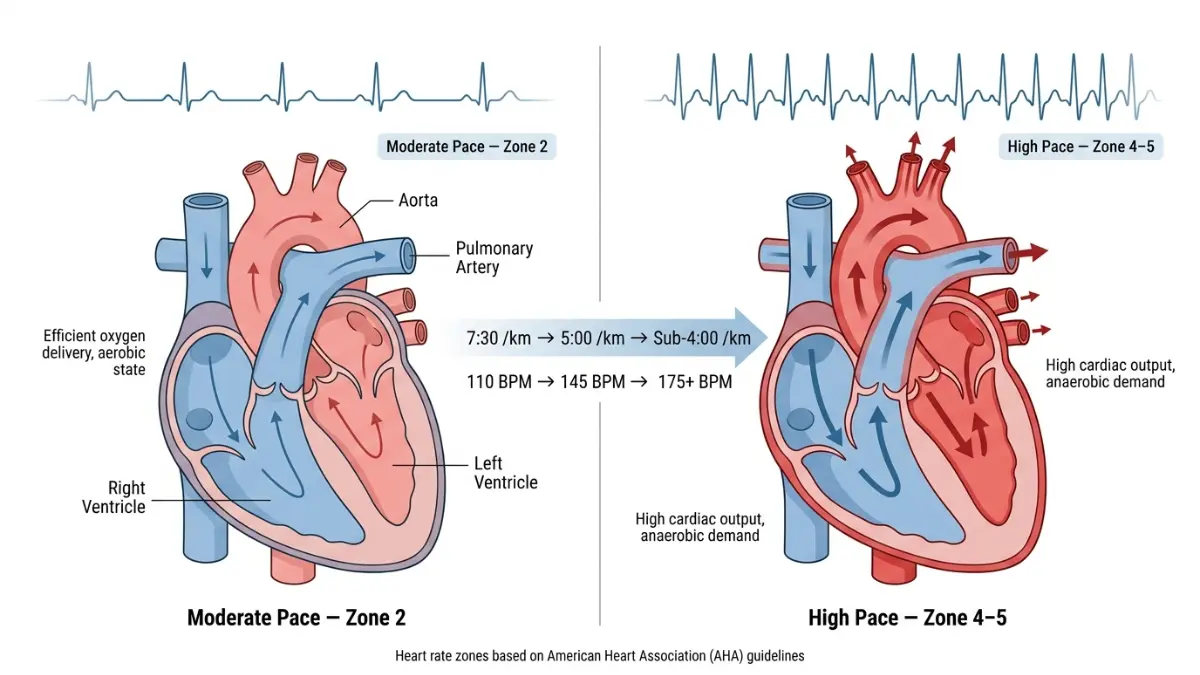
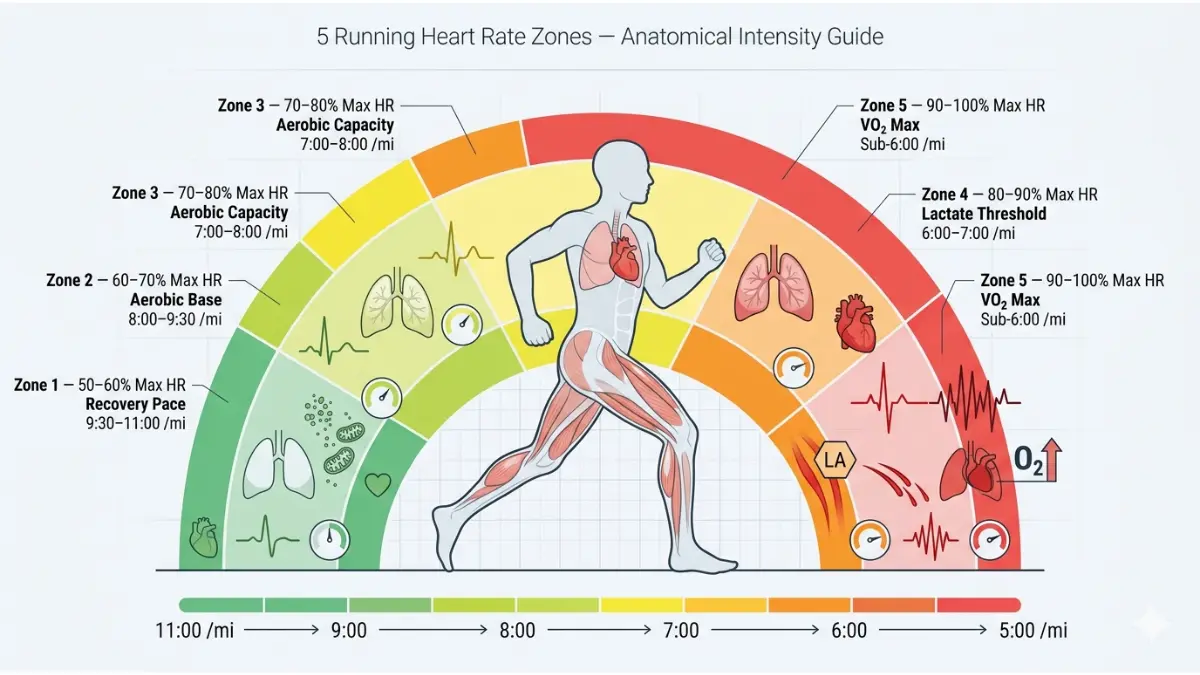
The American Heart Association defines target heart rate during moderate-intensity activities as approximately 50–70% of maximum heart rate, and vigorous activity as 70–85% of maximum.
Here’s how that maps to real running zones and pace ranges:
| Zone | % Max HR | Effort | Typical Pace Range | Health Benefit |
|---|---|---|---|---|
| Zone 1 | 50–60% | Very easy, conversational | 9:30–11:00 /mi | Active recovery, fat burning |
| Zone 2 | 60–70% | Easy, can hold full conversation | 8:00–9:30 /mi | Aerobic base, heart efficiency |
| Zone 3 | 70–80% | Moderate, short sentences only | 7:00–8:00 /mi | Aerobic capacity, tempo fitness |
| Zone 4 | 80–90% | Hard, single-word answers | 6:00–7:00 /mi | Lactate threshold, race fitness |
| Zone 5 | 90–100% | Maximum, unsustainable | Sub-6:00 /mi | VO₂ max, peak speed |
Key medical note: The ACSM’s exercise intensity guidelines recommend that most recreational runners spend the majority of training time — approximately 70–80% of sessions — in Zones 1 and 2. Excessive Zone 4–5 training without adequate recovery is a leading contributor to overtraining syndrome, resting heart rate elevation, and immune suppression.
How to Calculate Your Safe Pace Using Max Heart Rate
Formula: 220 − your age = estimated maximum heart rate
Real example: Jennifer, 45, from Seattle:
- Max HR = 220 − 45 = 175 BPM
- Zone 2 target = 60–70% of 175 = 105–122 BPM
- Typical Zone 2 pace at this heart rate = 8:15–9:30 /mile (5:07–5:54 /km)
Use our Heart Rate Zone Calculator to get your personalized zone ranges calculated automatically.
Warning Signs You’re Running at the Wrong Pace
You may be running too fast if:
- You cannot speak in complete sentences during the run
- Your heart rate stays above 85% of max for the majority of a run
- You feel “trashed” for 24–48 hours after most sessions
- Your resting heart rate trends upward week-over-week
You may be running too slow if:
- Your heart rate never exceeds 55% of max during any session
- You never feel any cardiovascular challenge in longer runs
- Your pace hasn’t improved in 3+ months despite consistent training
Dr. Omar Hassan, MD (Internal Medicine), mymedicineadvisor.com Expert Panel: “Most recreational runners I speak with are training chronically in Zone 3–4 while believing they’re in Zone 2. The result is perpetual tiredness, plateau, and elevated cardiac stress. Using a pace calculator with heart rate data together is the most underutilized tool in preventive cardiology for active adults.”
Target Pace Guide for Every Race Distance: 5K, 10K, Half Marathon & Marathon
Whether you’re planning your first 5K or chasing a Boston qualifier, knowing your target pace per mile or km for each race distance is the foundation of smart training.
5K Target Paces (3.1 Miles)
| Runner Level | Target Pace /mile | Target Pace /km | Finish Time |
|---|---|---|---|
| Beginner | 11:00–13:00 | 6:50–8:04 | 34:00–40:00 |
| Intermediate | 8:30–10:30 | 5:17–6:31 | 26:20–32:30 |
| Advanced | Under 7:00 | Under 4:21 | Under 21:45 |
Half Marathon & Marathon Pace Strategy
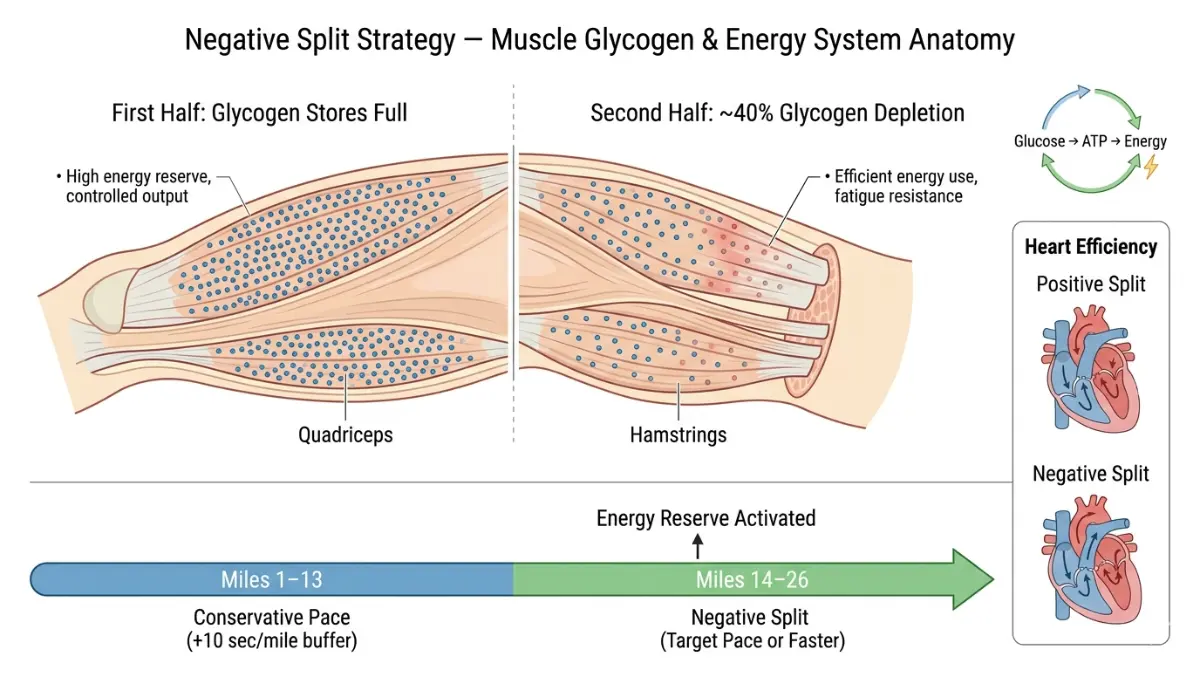
The negative split method — running your second half slightly faster than your first — is the most evidence-backed race strategy for distance runners. Research consistently shows it reduces energy expenditure and lowers finish times compared to even-split or positive-split racing.
- Half marathon: Add 15–20 seconds per mile of buffer to your goal pace for the first 5 miles. Pick it up in miles 8–11.
- Marathon: Never exceed race pace in miles 1–18. Your pace calculator projection at 5K or 10K split is your key checkpoint.
Use our One Rep Max Calculator to structure strength cross-training — stronger legs and glutes directly improve running economy at every pace.
Treadmill Pace vs. Outdoor Pace
Treadmills display speed (km/h or mph), not pace. Use this conversion table:
| Treadmill Speed | Pace /km | Pace /mile | Zone Equivalent |
|---|---|---|---|
| 8.0 km/h (5.0 mph) | 7:30 | 12:00 | Zone 1–2 |
| 10.0 km/h (6.2 mph) | 6:00 | 9:41 | Zone 2–3 |
| 12.0 km/h (7.5 mph) | 5:00 | 8:03 | Zone 3 |
| 14.0 km/h (8.7 mph) | 4:17 | 6:54 | Zone 4 |
| 16.0 km/h (9.9 mph) | 3:45 | 6:02 | Zone 4–5 |
Outdoor adjustment: Treadmill running at 0% grade is slightly easier than outdoor running. Set treadmill incline to 1% to more closely simulate outdoor cardiovascular demand.
How to Improve Your Running Pace: 5 Science-Backed Methods for 2026
Improving your running pace per mile or km isn’t just about running more. It requires structured, evidence-based training across five domains.
1. Interval Training
Protocol: 4 × 800m at your target 5K pace, with 90 seconds of easy jogging recovery between reps. Perform once per week.
Interval training stresses the aerobic and anaerobic systems alternately, increasing VO₂ max and lactate threshold — two of the three primary determinants of running pace performance.
2. Zone 2 Base Building (The 80/20 Rule)
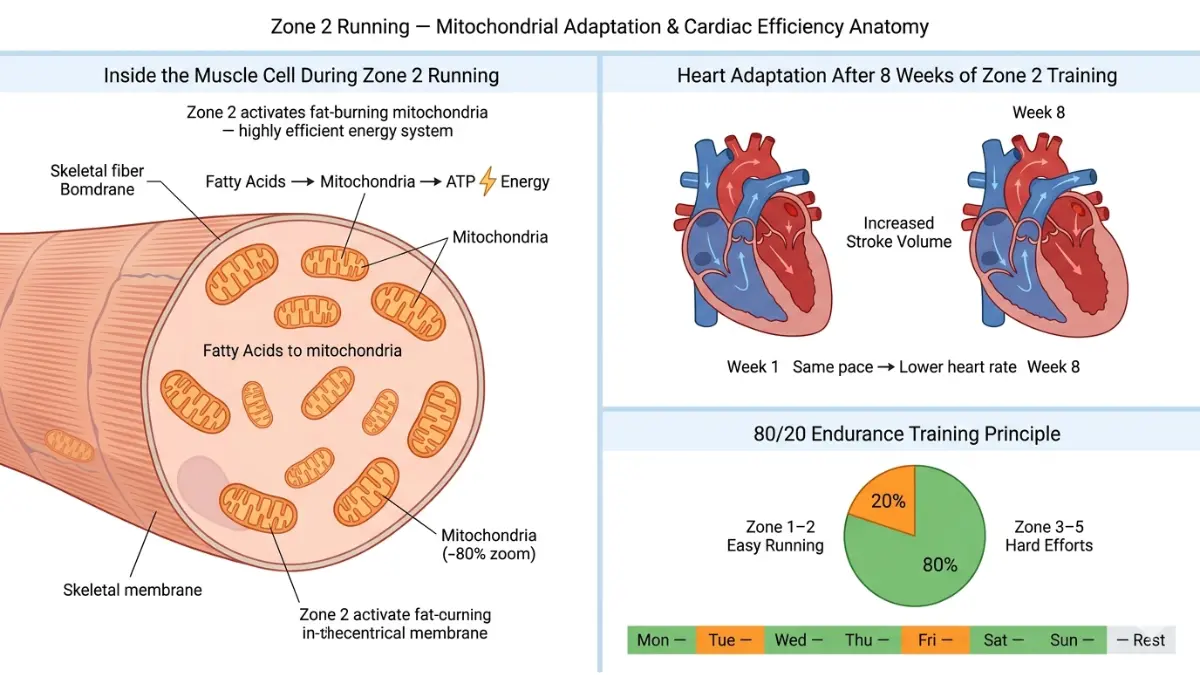
80% of your weekly running should be in Zone 2. This is the most frequently violated principle in recreational running — and the biggest driver of plateaus.
Zone 2 running improves mitochondrial density, fat oxidation efficiency, and cardiac stroke volume. Elite marathon runners run 80–90% of their total weekly volume at easy, conversational paces. The pace gains happen in races, not in training.
3. Strength Training for Running Economy
Stronger hip flexors, glutes, and calves directly reduce ground contact time — meaning you travel farther with each stride at the same cardiovascular cost. Use our Macro Calculator to ensure your protein and carbohydrate intake supports both running and strength training simultaneously.
4. Hydration and Fueling Strategy
Dehydration of just 2% of body weight can increase perceived exertion at the same pace — meaning runs feel harder at the same speed. Use our Water Intake Calculator to set your daily hydration baseline, then add 400–600 mL per hour of running.
5. Sleep and Recovery
A 2024 Stanford University study found that athletes who extended sleep to 9+ hours improved sprint times and reaction speed significantly within 5–6 weeks. Recovery is when pace adaptation happens — training is just the stimulus.
Use our Sleep Calculator to optimize your sleep window around early morning runs or evening training sessions.
Frequently Asked Questions About Pace Calculator
1. What is a good running pace for beginners?
For most beginner runners in the USA, a pace between 10:00–12:00 per mile (6:13–7:27 per km) is appropriate and sustainable. The key marker is the “talk test” — you should be able to hold a full conversation without gasping. Start here and build gradually over 8–12 weeks.
2. How do I calculate my pace per km?
Divide your total run time (in seconds) by the distance in kilometers. For example, 30 minutes for 5 km = 1,800 seconds ÷ 5 = 360 seconds = 6:00 per km. Or simply enter your distance and time into our Pace Calculator for an instant result with full race projections.
3. What is a good pace for a 5K?
A good 5K pace varies by experience. Beginners typically run 32–40 minutes (10:19–12:53 per mile). Intermediate runners target 24–30 minutes (7:43–9:39 per mile). Completing a 5K under 25 minutes (8:03 per mile) places most adults in the top 25% of US recreational runners, according to RunningUSA 2025 data.
4. How do I convert pace from km to miles?
Multiply your min/km pace by 1.609 to get min/mile. Example: 5:30 /km × 1.609 = 8:51 /mile. Our pace calculator performs this conversion automatically, showing both units in every result.
5. What pace should I run to lose weight?
For weight loss, Zone 2 pace (60–70% max heart rate) is most efficient for fat oxidation — typically 8:00–10:00 per mile for average adults. Higher-intensity running burns more total calories but more from carbohydrate stores. Use our Calorie Deficit Calculator alongside your pace data for a complete weight management plan.
6. Is a 6-minute per km pace good?
Yes — for most recreational runners, 6:00 /km (9:39 /mile) is a solid aerobic training pace, typically corresponding to Zone 2–3 depending on your fitness level. For a 40-year-old runner with a max HR of 180, this pace would likely sit at 68–75% of max HR. It’s a highly effective long-run and easy-day pace.
7. What is the average marathon pace?
According to RunningUSA’s 2025 State of the Sport report, the average US marathon finish time is approximately 4 hours 32 minutes, which equates to a pace of 10:23 per mile (6:27 per km). Competitive age-group runners typically target 3:30–4:00 (8:01–9:09 per mile).
8. How does running pace affect heart rate?
Every increase of approximately 30–45 seconds per mile of faster pace raises average heart rate by roughly 5–10 BPM for most trained runners. This relationship is linear until you approach maximum effort. This is why using a pace calculator with heart rate zone data gives you far more control over your training intensity than pace alone.
9. What pace burns the most calories?
Faster paces burn more calories per minute, but slower paces allow longer duration — which can result in equal or greater total calorie burn. A 160 lb (73 kg) person burns approximately 472 calories/hour at 5 mph (12:00 /mile) and 744 calories/hour at 8 mph (7:30 /mile). For fat loss, Zone 2 pace sustained for 45–60+ minutes is generally most effective.
10. How do I calculate treadmill pace?
Treadmills show speed, not pace. To convert: divide 60 by your treadmill speed in mph to get minutes per mile. Example: 6.5 mph → 60 ÷ 6.5 = 9:14 per mile. Or set treadmill to km/h and divide 60 by that number for min/km. Our pace calculator’s speed conversion panel handles this automatically.
11. What is a negative split in running?
A negative split means running the second half of a race faster than the first half. It is widely considered the optimal pacing strategy for distance events from 5K to marathon. Runners who achieve negative splits in marathons conserve glycogen early, maintain better form late in the race, and — according to data from major US marathons — finish an average of 4–8 minutes faster than positive-split runners over the same distance.
Reviewed by Dr. Omar Hassan, MD — Internal Medicine Specialist. mymedicineadvisor.com is a medical authority website with a panel of 21 internationally credentialed experts. All content is reviewed for clinical accuracy and updated regularly. For personalized medical guidance, please consult your physician.
Explore more health tools: Body Fat Calculator | Protein Intake Calculator | Weight Loss Calculator | Health Tips & Guides
About this content
How this article was put together: researched from recognised health sources, drafted with the help of AI tools, and edited by hand, with sources linked throughout.

Sameer Patel is the founder and editor of My Medicine Advisor. He is not a doctor or medical professional — before starting this site he worked in banking,…
Medical disclaimer
The content on MyMedicineAdvisor is provided for general informational and educational purposes only and is not a substitute for professional medical advice, diagnosis, or treatment. Health information on this website should not be used to diagnose, treat, cure, or prevent any condition without guidance from a qualified healthcare professional. Always seek the advice of your doctor, physician, or another licensed healthcare provider with any questions you may have regarding a medical condition, symptoms, medications, or treatment decisions.