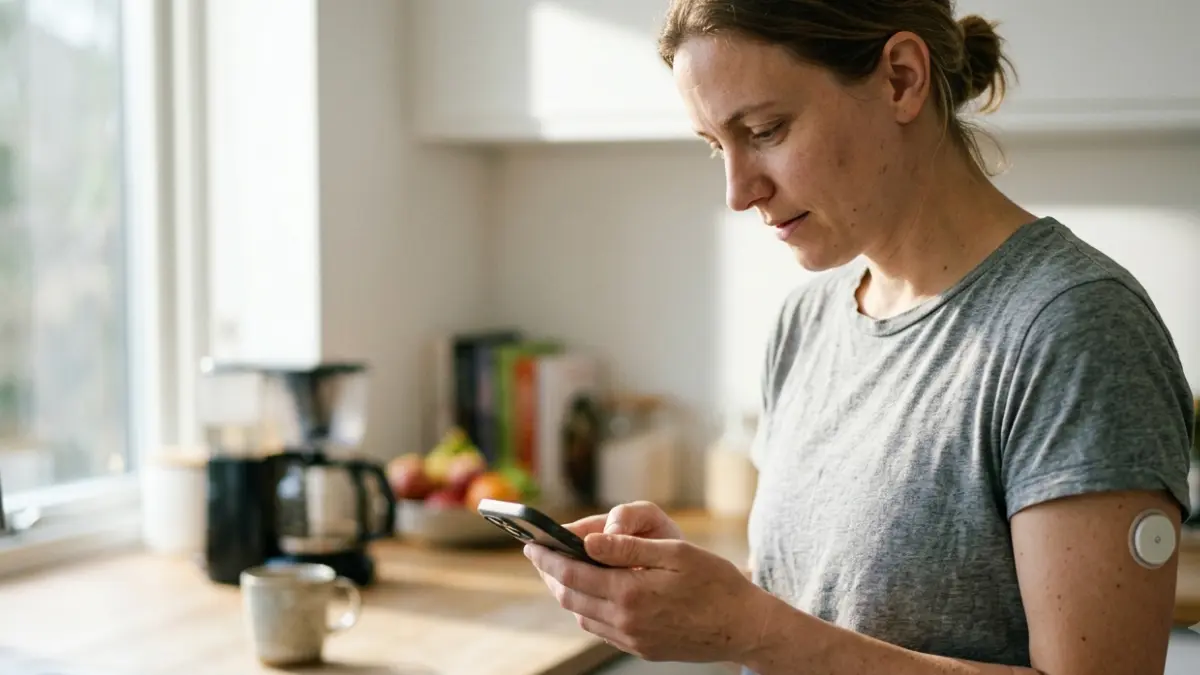

On This Page – Quick Medical Summary
What a CGM shows if you don’t have diabetes
You either saw a number you didn’t like, or you’re deciding whether to buy a sensor. Either way, a continuous glucose monitor answers a narrower question than most people assume.
If a post-meal reading frightened you, start with what normal looks like. If you’re choosing a device, go to the cleared-sensor section. If you want to know whether your readings signal disease, skip to what a CGM cannot diagnose.
This article is built on what the devices disclose to regulators, including what they will not display. For lab context, see what each glucose test result actually means.
ℹ️ Medical Disclaimer: This is health education, not diagnosis, treatment advice, or a medication recommendation. Sensor readings cannot diagnose diabetes or prediabetes, and nothing here should be used to start, stop, or adjust a medication. Consult a board-certified primary care physician or endocrinologist before acting on anything a glucose sensor shows you.
How a glucose sensor reads your body
A CGM does not measure blood.
Interstitial fluid, not blood
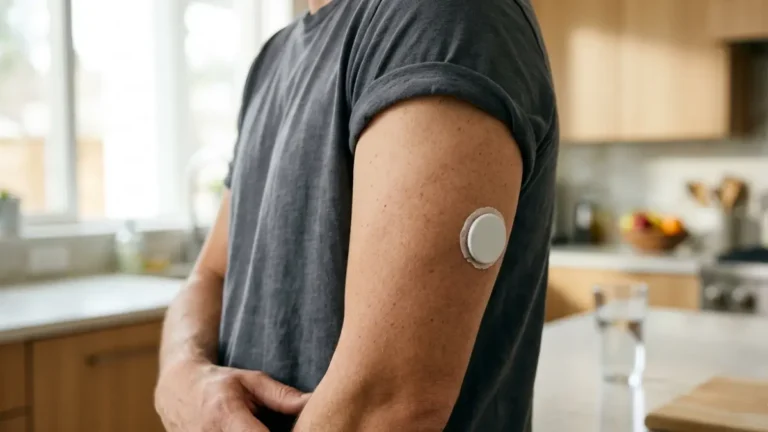
The sensor wire sits in the interstitial fluid under your skin. Glucose has to move out of your bloodstream into that fluid before the sensor sees it, a step described in the FDA decision summaries for both Stelo and Lingo.
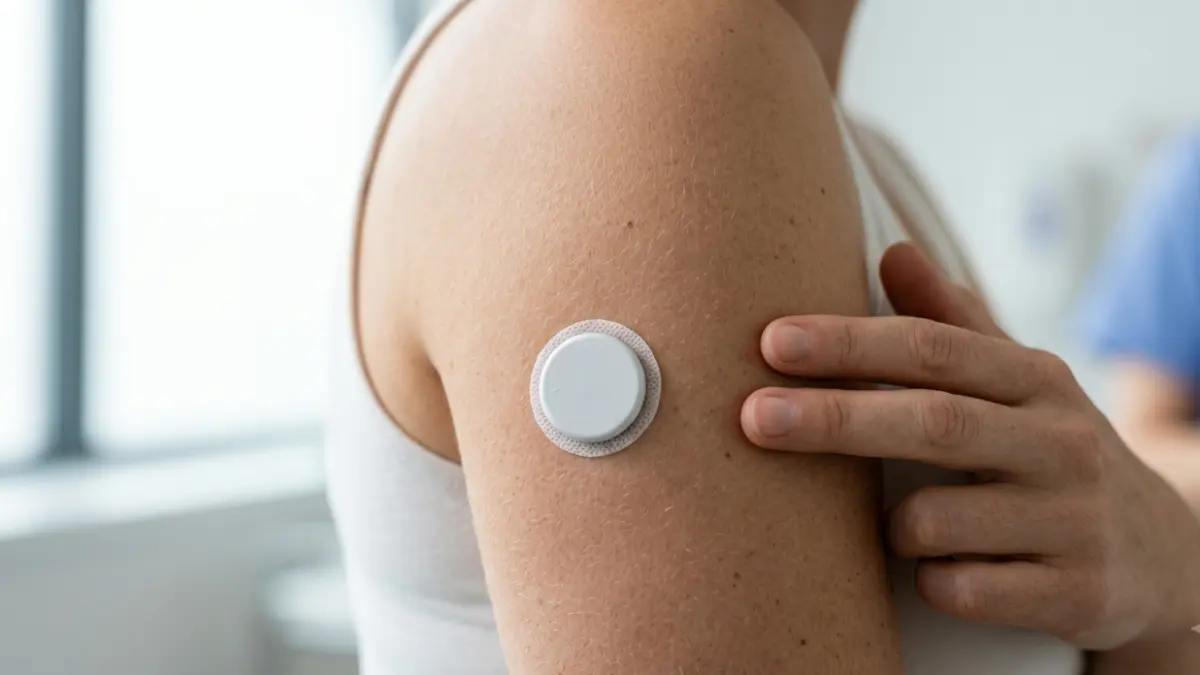
🔬 How It Works: The sensor converts glucose into a small electrical current, and software translates that current into the number on your phone. It is an estimate of blood glucose, not a measurement of it.
Why the number trails what you feel
That diffusion step means readings lag your blood glucose, and the gap widens when glucose moves fast, such as after a meal or during exercise. The FDA’s Stelo notice describes an app showing measurements every 15 minutes, so you are seeing a curve drawn between periodic estimates.
What normal actually looks like on a CGM
Average sensor glucose in healthy adults without diabetes sits near 100 mg/dL, with most of the day spent between 70 and 140 mg/dL. Most is not all, and the gap is where people panic.

The reference numbers from healthy adults
| Study | Participants | Time 70–140 mg/dL | Key clinical detail |
|---|---|---|---|
| Shah et al., 2019 | 153 healthy, non-obese, ages 7–80 | 96% (IQR 93–98) | ~30 min/day above 140 |
| Community cohort, 2025 | >1,000 without diabetes, mean age 58.5 | 87.0% | ~3 hours/day above 140 |
Verified sources: a multicenter study of 153 healthy adults, J Clin Endocrinol Metab 2019;104(10):4356–4364; J Clin Endocrinol Metab 2025;110(4):1128.
Why 70–140 isn’t a pass/fail line
Both leading over-the-counter apps launched with 70–140 mg/dL as the default goal for people without diabetes. That target came from diabetes care, not from a definition of normal, and the arithmetic behind it is in how time in range is calculated.
📊 Clinical Data Point: Adults without diabetes in a cohort of more than 1,000 spent about 12.1% of the day, roughly three hours, above 140 mg/dL. Source: J Clin Endocrinol Metab, 2025.
In a separate 57-person study, people classified as normal by standard diagnostic tests still reached the prediabetic range about 15% of the time.
Which sensors you can buy without a prescription
Three sensors are cleared for prescription-free sale in the US, and they are not interchangeable.
Three cleared sensors, three different jobs
The FDA cleared Dexcom’s Stelo Glucose Biosensor System in March 2024 as the first over-the-counter continuous glucose monitor, for adults 18 and older not using insulin, including people without diabetes. In June 2026 it extended that clearance to people two years and older.
Abbott’s Lingo and Libre Rio followed in June 2024. Lingo is a wellness product for adults not on insulin, not intended to diagnose any disease including diabetes. Libre Rio is for adults with type 2 diabetes who do not use insulin. A full comparison of the three sensors covers cost and wear time.
What none of them do
None alerts you to a high or low reading. Stelo specifically is not for people with problematic hypoglycemia, because it is not designed to warn them.
Why your sensor won’t show a real low or a real high
Your sensor has a ceiling and a floor. Past those limits it stops giving you a number and gives you a label instead.
The reportable range cap
| Device | Reportable range | Past the limit it shows | Key clinical detail |
|---|---|---|---|
| Lingo | 55–200 mg/dL | “< 55” or “> 200 mg/dL” | Narrowest window of the three |
| Stelo | 70–250 mg/dL | “Below 70 mg/dL” at the floor | Cannot display a true hypoglycemic value |
| Dexcom G7 (prescription) | 40–400 mg/dL | “LOW” or “HIGH” | Shown for comparison |
Verified source: FDA 510(k) decision summaries, including the Lingo decision summary, plus K234070 and K213919.
A flat, comfortable-looking trace can therefore be a display limit rather than physiology.
Things that skew the reading
⚠️ Clinical Warning: Stelo’s FDA decision summary states that more than 1 gram of acetaminophen every 6 hours may make readings look higher than they are, and that hydroxyurea also raises readings. Never adjust a medication based on a sensor number.
Sensor and finger-stick values diverge for other reasons too, covered in how sensor and finger-stick readings compare.
A CGM can’t tell you whether you have diabetes
No. A continuous glucose monitor cannot diagnose diabetes or prediabetes, and no over-the-counter sensor is cleared to try.
What actually diagnoses diabetes
Three blood tests can: the A1C test, the fasting plasma glucose test, and the oral glucose tolerance test. MedlinePlus notes that glucose measured from a vein is considered more accurate than a finger-stick reading or a continuous monitor. The CDC describes the tests used to diagnose diabetes, and the types of glucose tests covers how each is run.
🩺 Editor’s Note: The American Diabetes Association’s Standards of Care in Diabetes—2026 states there is presently insufficient evidence to support using CGM to screen for or diagnose prediabetes or diabetes. Its CGM recommendations are written for people who already have diabetes.
What to do if your readings worry you
✅ Patient Action: Ask your primary care physician, “Given my risk factors, should I have an A1C or a fasting plasma glucose test?” Bring the overall pattern, not screenshots of single readings.
When the data starts doing more harm than good
A sensor that makes you afraid of food has stopped being useful.
Chasing a flat line
The reference numbers above mean you will see readings you don’t like. Researchers at the Johns Hopkins Bloomberg School of Public Health have noted that the guidance for interpreting CGM data was developed for people with diabetes, and that it is not established that tracking glucose improves health in people without it. Endocrinologists at Cedars-Sinai have raised the same concern about data volume and anxiety in healthy people.
Who should talk to a clinician first
Abbott’s product information advises consulting a healthcare professional before changing diet or exercise, and specifically for anyone with an eating disorder or a history of one.
✅ Patient Action: If tracking is changing how you eat, tell your clinician: “I’ve been monitoring my glucose continuously and I think it’s affecting my eating. Should I stop?” Taking the sensor off is a reasonable answer.
Common questions about wearing a CGM without diabetes
1. Can you wear a CGM without diabetes?
Yes. The FDA has cleared over-the-counter sensors for adults not using insulin, including people who do not have diabetes.
2. What is a normal CGM reading without diabetes?
Healthy adults in one study averaged 98–99 mg/dL and spent about 96% of the time between 70 and 140 mg/dL.
3. Is a spike to 160 bad if I don’t have diabetes?
Not by itself. Adults without diabetes in a large cohort spent roughly three hours a day above 140 mg/dL.
4. Can a CGM diagnose diabetes or prediabetes?
No. The ADA’s 2026 Standards of Care cite insufficient evidence for CGM in screening or diagnosis. Ask your physician about testing.
5. Do you need a prescription for a CGM?
No longer. Stelo, Lingo and Libre Rio are cleared for over-the-counter sale to adults who do not use insulin.
6. Which OTC CGM is made for people without diabetes?
Lingo is cleared as a wellness product for adults 18 and older and is not intended to diagnose any disease.
7. Why is my CGM reading different from a finger prick?
Sensors measure interstitial fluid rather than blood, so readings lag your actual glucose, especially when it is changing quickly.
8. How accurate are CGMs in people without diabetes?
Less established. Both over-the-counter sensors cap what they display, so extreme values never appear as numbers at all.
9. How long should you wear a CGM without diabetes?
Sensors last roughly two weeks depending on the device. No wear duration is established for people without diabetes.
10. Can wearing a CGM cause anxiety about food?
It can. The manufacturer advises speaking with a clinician first if you have an eating disorder or a history of one.
11. What should I do if my CGM shows high readings?
Book a standard A1C or fasting glucose test rather than acting on sensor data, and review the pattern with your physician.
What to do with what your sensor is telling you
Your sensor is a lifestyle feedback tool with a capped display, not a diagnostic instrument. If your readings worry you, the next step is a standard blood glucose test ordered by your clinician, not more sensor data. Bring a pattern to that appointment, not a screenshot.
About this content
How this article was put together: researched from recognised health sources, drafted with the help of AI tools, and edited by hand, with sources linked throughout.

Sameer Patel is the founder and editor of My Medicine Advisor. He is not a doctor or medical professional — before starting this site he worked in banking,…
Medical disclaimer
The content on MyMedicineAdvisor is provided for general informational and educational purposes only and is not a substitute for professional medical advice, diagnosis, or treatment. Health information on this website should not be used to diagnose, treat, cure, or prevent any condition without guidance from a qualified healthcare professional. Always seek the advice of your doctor, physician, or another licensed healthcare provider with any questions you may have regarding a medical condition, symptoms, medications, or treatment decisions.