
On This Page – Quick Medical Summary
You went to bed with a reasonable number and woke to a higher fasting reading, having eaten nothing for eight hours. That pattern has a name: the dawn phenomenon.
If you were recently diagnosed or have an appointment coming up, start with what happens overnight. If you take insulin and suspect your evening dose is wrong, go to the comparison with an overnight low. If you don’t have diabetes and your sensor is showing a morning climb, the section on who gets it answers that directly. Our main guide covers what your glucose numbers mean across every test.
ℹ️ Medical Disclaimer: This article is health education, not diagnosis, treatment, or a medication instruction. Nothing here should be used to start, stop, or adjust insulin, oral diabetes medication, or any monitoring routine, and nothing here substitutes for the judgment of a clinician who has seen your data. Decisions about diabetes medication, glucose targets, monitoring devices, and insurance coverage for them belong with a board-certified endocrinologist or your prescribing clinician.
What happens in your body between 3 and 8 a.m.
The dawn phenomenon is an early-morning rise in blood glucose, usually between 3 a.m. and 8 a.m., driven by hormones your body releases as it prepares to wake. In people without diabetes, insulin offsets it. In diabetes, it surfaces as fasting hyperglycemia.
Sources define that window slightly differently: the American Diabetes Association describes roughly 3 to 8 a.m., Mayo Clinic 4 to 8 a.m.
Which hormones drive the rise
Four counterregulatory hormones drive it: growth hormone, cortisol, glucagon, and catecholamines such as epinephrine. Each opposes insulin, so glucose climbs without food.
Why your liver releases glucose when you haven’t eaten
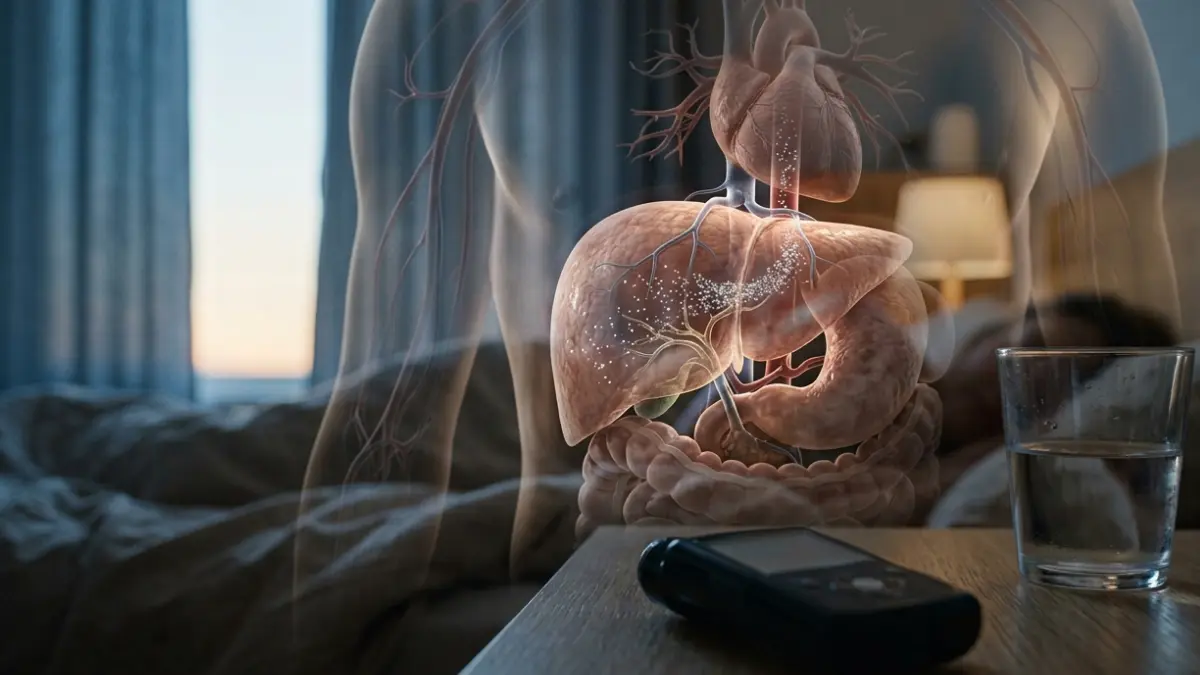
🔬 How It Works: Your liver adds glucose overnight two ways. Glycogenolysis releases glucose it already stores; gluconeogenesis builds new glucose from protein and fat. Hormone signals raise both while your cells respond less to insulin.
By definition, it is not preceded by an overnight low, a point the clinical reference on dawn phenomenon stresses.
Who gets the dawn phenomenon, and who doesn’t
Several patient-facing pages state that this only affects people with diabetes. The research does not support that. The underlying overnight rise was demonstrated in healthy volunteers in the 1980s; most people never see it because their own insulin absorbs it.
Type 1, type 2, and prediabetes
📊 Clinical Data Point: In 81 adults with type 2 diabetes matched for HbA1c and monitored by continuous glucose monitoring, the dawn phenomenon was present in 52% to 70% depending on age group, using a 10 mg/dL rise as the threshold — Source: Monnier et al., Diabetes Care, 2012.
A separate CGM analysis of 173 participants found it in 49% with type 2 diabetes, 36% with prediabetes, and 34% of at-risk participants. That was one predominantly Hispanic and Latino cohort, not a national figure.
Why people without diabetes rarely notice it
Without a sensor there is nothing to see, which is why more people now encounter high blood sugar in people without diabetes as a morning pattern.
Dawn phenomenon or an overnight low? How to tell
One variable settles it: what your glucose did overnight.
- Dawn phenomenon: glucose holds steady or drifts, then rises before you wake. No overnight low.
- Somogyi pattern: glucose drops below range between midnight and 6 a.m., then the morning reading is high.
- Neither: glucose runs high all night, which points to overall control rather than a dawn effect.
The one thing that separates them
A CGM shows the whole night. Without one, a fingerstick between 2 and 3 a.m. gives the trend. Knowing the signs of an overnight low helps you interpret what you find.
What CGM research found about rebound highs
In 4,705 nights across 2,600 people with type 2 diabetes on insulin, fasting glucose was lower after nights with hypoglycemia, not higher. What CGM research found about rebound highs has narrowed the Somogyi effect considerably, though smaller studies still report it.
🩺 Editor’s Note: A large gap between your bedtime and morning readings is something clinicians watch for. Current ADA guidance lists a high bedtime-to-morning glucose differential as a signal to reassess whether basal insulin is doing work that mealtime coverage should be doing.
✅ Patient Action: Ask your endocrinologist or diabetes care and education specialist: “Can we look at my overnight glucose before we change anything about my evening dose?”
How much the dawn phenomenon actually raises your numbers
Most pages explain the mechanism without ever telling you what it costs.
📊 Clinical Data Point: Mean impact of 0.39% on HbA1c and 12.4 mg/dL on 24-hour average glucose, in 248 people with type 2 diabetes not treated with insulin — Source: Monnier et al., Diabetes Care, 2013.
What the research measured
That study quantified the rise as the prebreakfast value minus the overnight glucose nadir. It found the effect present in people managed by diet alone, and not eliminated by any oral medication studied. The figure applies to that population; it has not been shown to transfer to type 1 diabetes. See how a single glucose reading differs from A1C for what a 0.39% shift represents.
Why the numbers you read online disagree
Prevalence estimates move with the cutoff. A 10 mg/dL threshold counts far more people than a 20 mg/dL threshold, which is why “over half” and “about a third” both circulate. The 2013 study that measured its effect on A1C used 20 mg/dL.
A three-night check to run before your next appointment
You can produce the exact data a clinician needs without changing a single dose.
What to record, and when
- Your reading at bedtime.
- A reading between 2 and 3 a.m.
- Your reading on waking, before eating.
Repeat for three nights. If you wear a sensor, export the overnight curve instead. The CDC’s blood sugar monitoring guidance covers meter and sensor basics. If your clinic reports in mmol/L, our blood sugar converter handles the arithmetic.
What the evening-snack advice is actually based on
Advice to eat a bedtime protein snack, exercise after dinner, or eat breakfast regardless of your reading is repeated widely. We found no trials testing those steps specifically against the dawn phenomenon. Treat them as untested rather than established.
✅ Patient Action: Bring the three-night log to your appointment and ask what pattern it shows before any dose is discussed.
When morning highs need a doctor, not a tweak
Why you shouldn’t change your own dose
Raising basal insulin to flatten a morning rise can drive glucose too low earlier in the night, before the dawn rise begins. That trade-off is why dose changes belong to the person who prescribed it.
When to call
⚠️ Clinical Warning: If you are sick and your blood sugar is 240 mg/dL or above, check for ketones with an over-the-counter test. Call your doctor if ketones are high. High ketones can be an early sign of diabetic ketoacidosis, which is a medical emergency.
If the pattern repeats across mornings, NIDDK’s guidance on managing diabetes is to work it through with your care team rather than wait.
Common questions about the dawn phenomenon
1. What is the dawn phenomenon?
An early-morning rise in blood glucose, usually between 3 and 8 a.m., driven by hormones released as your body prepares to wake.
2. Why is my blood sugar high in the morning if I didn’t eat?
Your liver releases stored and newly made glucose overnight while hormones reduce insulin’s effect. Food is not involved in the dawn phenomenon.
3. What time does the dawn phenomenon happen?
Usually between 3 and 8 a.m., though sources differ. The ADA describes 3 to 8 a.m., Mayo Clinic 4 to 8.
4. How do I know if it’s the dawn phenomenon or an overnight low?
Check what glucose did overnight. The dawn phenomenon is not preceded by a low; a Somogyi pattern is. Ask your clinician to review it.
5. Can you have the dawn phenomenon without diabetes?
Yes. The underlying rise was demonstrated in people without diabetes, but their own insulin response usually offsets it before it shows.
6. How much does the dawn phenomenon raise A1C?
About 0.39% in one study of 248 people with type 2 diabetes not using insulin, alongside a 12.4 mg/dL higher 24-hour average.
7. Does a bedtime snack stop the dawn phenomenon?
We found no trials testing bedtime snacks against the dawn phenomenon specifically. Discuss any routine change with your prescribing clinician first.
8. Is the dawn phenomenon dangerous?
Repeated morning highs raise your average glucose. If you are sick and reading 240 mg/dL or above, check ketones and call your doctor.
9. Should I increase my basal insulin for morning highs?
Not on your own. Guidelines flag a large bedtime-to-morning gap as a reason to reassess dosing. Ask your prescriber first.
10. Does the dawn phenomenon go away?
It appears early in type 2 diabetes and was not eliminated by any oral medication in the study that measured its impact.
11. When should I call my doctor about morning highs?
When the pattern repeats rather than appearing once. Bring three nights of overnight readings to that conversation with your care team.
What to do with this
A high morning number is usually biology, not a mistake you made. Spend three nights recording bedtime, 2 to 3 a.m., and waking readings, then take that log to your prescriber and ask what pattern it shows. That single step turns an anxious guess into a conversation with evidence in it.
About this content
How this article was put together: researched from recognised health sources, drafted with the help of AI tools, and edited by hand, with sources linked throughout.

Sameer Patel is the founder and editor of My Medicine Advisor. He is not a doctor or medical professional — before starting this site he worked in banking,…
Medical disclaimer
The content on MyMedicineAdvisor is provided for general informational and educational purposes only and is not a substitute for professional medical advice, diagnosis, or treatment. Health information on this website should not be used to diagnose, treat, cure, or prevent any condition without guidance from a qualified healthcare professional. Always seek the advice of your doctor, physician, or another licensed healthcare provider with any questions you may have regarding a medical condition, symptoms, medications, or treatment decisions.