
On This Page – Quick Medical Summary
What your time in range number actually is
Time in range is the share of your day spent between 70 and 180 mg/dL, and above 70% is the goal for many nonpregnant adults using a continuous glucose monitor. That works out to more than 16 hours and 48 minutes of a 24-hour day.
Where you go next depends on your situation:
- Over 65, at high risk of lows, pregnant, or under 25 — your target is not 70%, and the fifth section below has yours.
- Your sensor number and your lab A1C disagree — start at the third section.
- You have never read a sensor report before — the sixth section walks through it in order.
- You want the wider picture — the full glucose levels chart covers every glucose test, and the NIH explains how continuous glucose monitors work.
ℹ️ Medical Disclaimer: This article covers interpretation of continuous glucose monitoring data, glycemic targets for adults, older adults, pregnancy and people under 25, recognition of hypoglycemia, and the relationship between sensor metrics and laboratory A1C. Every threshold here reflects published clinical guidance and is educational only. It cannot tell you whether your insulin, oral medication, or sensor settings should change, and your own targets depend on your age, diabetes type, pregnancy status, hypoglycemia history, and other conditions. Consult a board-certified physician — primary care, endocrinology, or obstetrics as relevant — before acting on anything here.
The full set of CGM targets, not just 70%
Your sensor report has five target rows, not one. These are the targets for most nonpregnant adults with type 1 or type 2 diabetes.
| Report row | Target | Time per day | Key clinical detail |
|---|---|---|---|
| Time in range, 70–180 mg/dL | Above 70% | More than 16 h 48 min | The headline number |
| Time below 70 mg/dL | Under 4% | Under 1 hour | Level 1 low |
| Time below 54 mg/dL | Under 1% | Under 15 minutes | Level 2 low — the tightest target on the page |
| Time above 180 mg/dL | Under 25% | Under 6 hours | Level 1 high |
| Time above 250 mg/dL | Under 5% | Under 1 h 12 min | Level 2 high |
Source: Clinical Targets for Continuous Glucose Monitoring Data Interpretation, Diabetes Care 2019;42(8):1593–1603 — Table 3, verified. The 70% and below-range rows carry forward into the ADA Standards of Care in Diabetes—2026.

How many hours 70% actually is
Seventy percent of a day is 16 hours and 48 minutes. The consensus panel noted that people often find the hours version more usable than the percentage.
The two above-range targets
Readings above 180 mg/dL and above 250 mg/dL are tracked separately, with a much tighter allowance for the higher band.
Why the below-range rows are split
Below-range time splits at 54 mg/dL for the same reason, and that lower band carries the most clinical weight. If your sensor reports in mmol/L, our blood sugar converter moves these thresholds across.
How time in range lines up with your A1C
Above 70% time in range corresponds to an A1C of approximately 7%.
The per-10-point conversion is less settled than most pages suggest: one analysis of 545 adults with type 1 diabetes found roughly a 0.5% A1C reduction per 10 points gained, while another covering 1,137 people with type 1 or type 2 diabetes found nearer 0.8%.
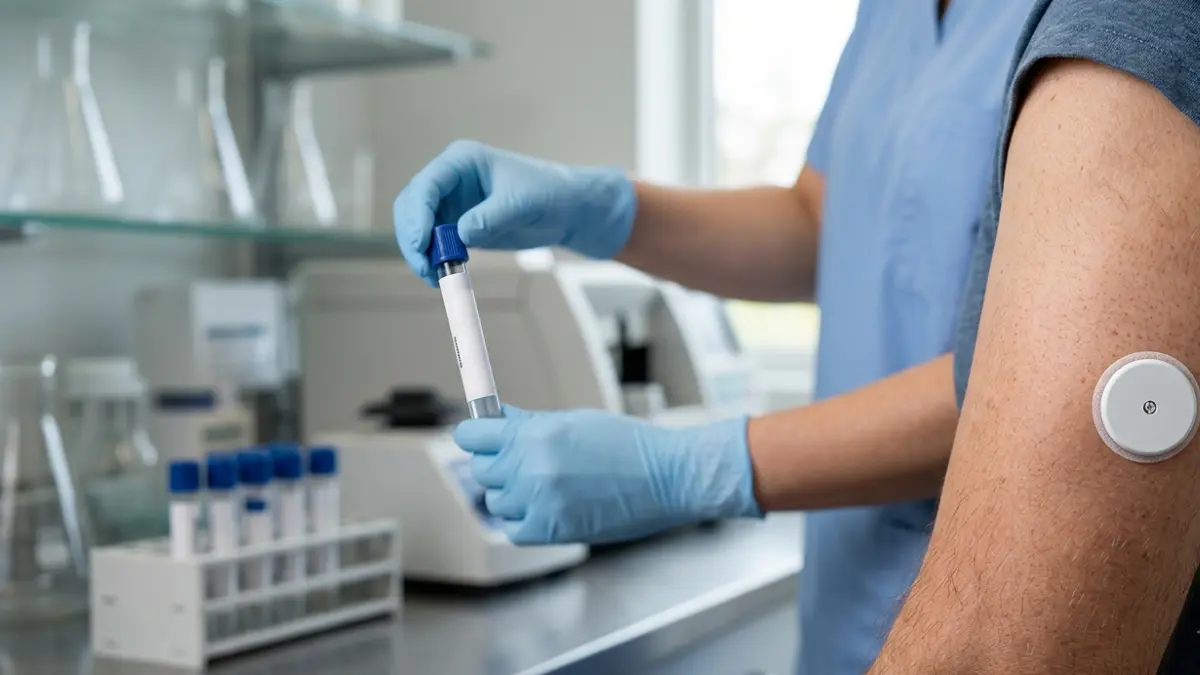
🩺 Editor’s Note: Your glucose management indicator comes from sensor data and is not your laboratory A1C. Published guidance lists them as separate metrics, so a gap between the two is a discussion point rather than an error.
Our full comparison of time in range and A1C covers when each is used.
Why the below-range number matters more than 70%
Most people read the in-range number first. Published guidance treats the below-range rows as the first thing to address.
The under-4% target below 70 mg/dL
Hypoglycemia below 70 mg/dL should occupy under 4% of the day, or under one hour. Matching that figure to what you actually felt is easier once you know the signs of low blood sugar.
The tighter under-1% target below 54 mg/dL
Below 54 mg/dL the allowance drops to 1%, or 15 minutes. A post hoc analysis of DCCT data linked time at both thresholds to later severe hypoglycemic events.
Why lows come first
The consensus sets the order plainly: reduce time below range first, then address time in range and time above range.
⚠️ Clinical Warning: A report can show a reassuring 72% time in range while carrying 6% below 70 mg/dL. The in-range figure alone does not surface that, and the below-range rows are the ones a clinician acts on first.
✅ Patient Action: Bring your exact below-70 and below-54 mg/dL percentages to your endocrinologist or prescribing clinician and ask: “Should my time below range be addressed before anything else?”
When 70% is not your target
The 70% figure is a general adult target. Four groups have different ones, and reading the wrong target can make a good result look like a failure.
Older adults and people at high risk of lows
📊 Clinical Data Point: For older and high-risk adults, the target is time in range above 50% — more than 12 hours a day — with time below 70 mg/dL under 1%, or 15 minutes, and time above 250 mg/dL under 10%. — Source: International Consensus on Time in Range, Diabetes Care 2019, Table 3. The ADA Standards of Care in Diabetes—2026 states the same 50% goal for older adults with complex or intermediate health.
The emphasis shifts deliberately toward preventing lows. Our guide to blood sugar targets after 65 explains the reasoning, and the CDC’s guidance on managing blood sugar sets the wider context.
Pregnancy with type 1 diabetes
The band itself moves down to 63–140 mg/dL, because glucose runs physiologically lower in pregnancy. The targets are above 70% in range, under 4% below 63 mg/dL, under 1% below 54 mg/dL, and under 25% above 140 mg/dL.
Under 25
Where the A1C goal is 7.5%, the corresponding time-in-range target is approximately 60%.
Where the evidence runs out
For pregnancy with type 2 or gestational diabetes, the consensus panel did not set time-in-range percentages, stating the evidence was insufficient. Any page quoting one is borrowing the type 1 figure.
✅ Patient Action: Ask your endocrinologist, or your obstetric diabetes team if you are pregnant: “Which time-in-range target applies to me specifically, and does it change during pregnancy or with age?”
How to read your 14-day CGM report
Check the report is valid before you trust the number on it. A standard ambulatory glucose profile covers 14 days with at least 70% sensor-active data.
Check the wear window first
🔬 How It Works: Your sensor measures glucose in the fluid between cells, not in blood, and samples continuously rather than at set times. The report averages every reading in the window — so if the sensor was only active half the time, the percentages describe half a picture. More than 70% active use across 14 days tracks closely with three months of average glucose, times in ranges, and high-reading metrics.
Correlation is weaker for lows and variability, and about four weeks of data may be needed to assess hypoglycemia exposure properly.
Read the rows in order
- Time below 54 mg/dL, then time below 70 mg/dL.
- Time in range.
- Time above 180 mg/dL, then above 250 mg/dL.
The variability number most people skip
Coefficient of variation, shown as %CV, has a target of 36% or below. Some studies support a tighter figure below 33% for people taking insulin or sulfonylureas. Sensor accuracy standards are described in the FDA’s information on glucose monitoring devices.
What to take to your next appointment
Three numbers make the conversation specific: your time below 54 mg/dL, your time in range, and your sensor-active percentage.
Patterns worth raising sooner
- Repeated time below 54 mg/dL above the 1% target.
- A drop in time in range with no change in routine.
- A report built on low sensor-active time, which makes every other figure unreliable.
✅ Patient Action: Ask your endocrinologist or diabetes care and education specialist: “Are we treating to my sensor’s glucose management indicator or to my lab A1C, and what is my personal time-in-range target?”
Time in range questions people ask
1. What does 70% time in range mean on a CGM?
It means 70% of your readings fall between 70 and 180 mg/dL, the target band for many nonpregnant adults using CGM.
2. How many hours a day is 70% time in range?
Seventy percent of a 24-hour day is 16 hours and 48 minutes spent between 70 and 180 mg/dL.
3. What A1C matches 70% time in range?
Above 70% time in range corresponds to an A1C of approximately 7%. Confirm your own target with your diabetes clinician.
4. How much time below 70 mg/dL is acceptable?
Under 4% of the day, or under one hour, for most adults. Discuss your own below-range figure with your prescribing clinician.
5. How much time below 54 mg/dL is acceptable?
Under 1%, or under 15 minutes a day. This is the tightest target on the report and warrants a conversation with your clinician.
6. What is the time in range goal for older adults?
Above 50%, or more than 12 hours a day, with time below 70 mg/dL under 1%. Ask your clinician which applies to you.
7. Is a 5% increase in time in range worth it?
Yes. Each incremental 5% gain in time in range is associated with clinically significant benefit.
8. How many days of CGM data does my report need?
Fourteen days, with the sensor active for at least 70% of that window. Below that, the percentages are less reliable.
9. Why doesn’t my GMI match my lab A1C?
The glucose management indicator is calculated from sensor data and is a separate metric from laboratory A1C. Raise any gap with your clinician.
10. What is the time in range target in pregnancy?
For type 1 diabetes, above 70% within a lower 63–140 mg/dL band. No percentages were set for type 2 or gestational diabetes. Ask your obstetric team.
11. How much time above 180 mg/dL is allowed?
Under 25% of the day, or under six hours, with a separate under-5% limit for readings above 250 mg/dL.
Your number is a starting point
If your report reads 58%, you are not failing at anything. A 5-point gain is a clinically meaningful move, and the below-range rows are usually where that move starts.
Write down your three numbers before your next appointment. Our Questions for Your Doctor + Blood Sugar Log is free to download and built to be handed across a desk.
About this content
How this article was put together: researched from recognised health sources, drafted with the help of AI tools, and edited by hand, with sources linked throughout.

Sameer Patel is the founder and editor of My Medicine Advisor. He is not a doctor or medical professional — before starting this site he worked in banking,…
Medical disclaimer
The content on MyMedicineAdvisor is provided for general informational and educational purposes only and is not a substitute for professional medical advice, diagnosis, or treatment. Health information on this website should not be used to diagnose, treat, cure, or prevent any condition without guidance from a qualified healthcare professional. Always seek the advice of your doctor, physician, or another licensed healthcare provider with any questions you may have regarding a medical condition, symptoms, medications, or treatment decisions.