On This Page – Quick Medical Summary
Marcus, 31, noticed it first in the shower drain — more hair than usual, every single morning. By the time he saw a dermatologist, his crown had thinned noticeably. The diagnosis was swift: androgenetic alopecia, driven by excess DHT. His doctor recommended a DHT blocker — but which one? That’s where things got complicated.
This guide cuts through the confusion. Below, doctors rank every DHT blocker — natural and prescription — using the latest 2026 clinical evidence, including the December 2025 breakthrough that could change hair loss treatment forever.
Quick Answer: A DHT blocker is any substance that reduces the production of dihydrotestosterone (DHT) or prevents it from binding to hair follicle receptors. DHT blockers can slow or stop androgenetic alopecia in both men and women. The most clinically effective options are prescription medications finasteride and dutasteride. Natural DHT blockers like saw palmetto offer milder results with fewer side effects.
What You’ll Learn:
- Why DHT destroys hair follicles — and who is most at risk
- Every DHT blocker ranked from weakest to strongest (2026 data)
- What no competitor covers: the December 2025 clascoterone trial breakthrough
- DHT blocker options specifically for women (a massively underserved topic)
- Side effects explained transparently, and how to choose the right option
📊 Key Stat: Androgenetic alopecia affects an estimated 50 million men and 30 million women in the United States alone, making it the most common form of hair loss worldwide. (NIH StatPearls)
What Is DHT and How Does It Destroy Hair Follicles?
The DHT–Hair Loss Mechanism
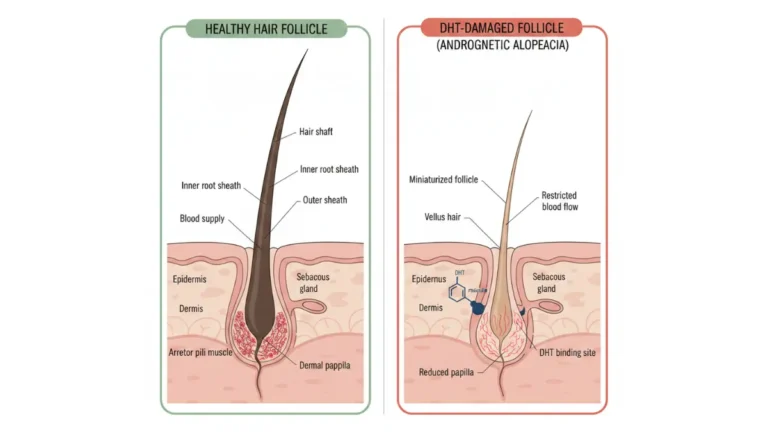
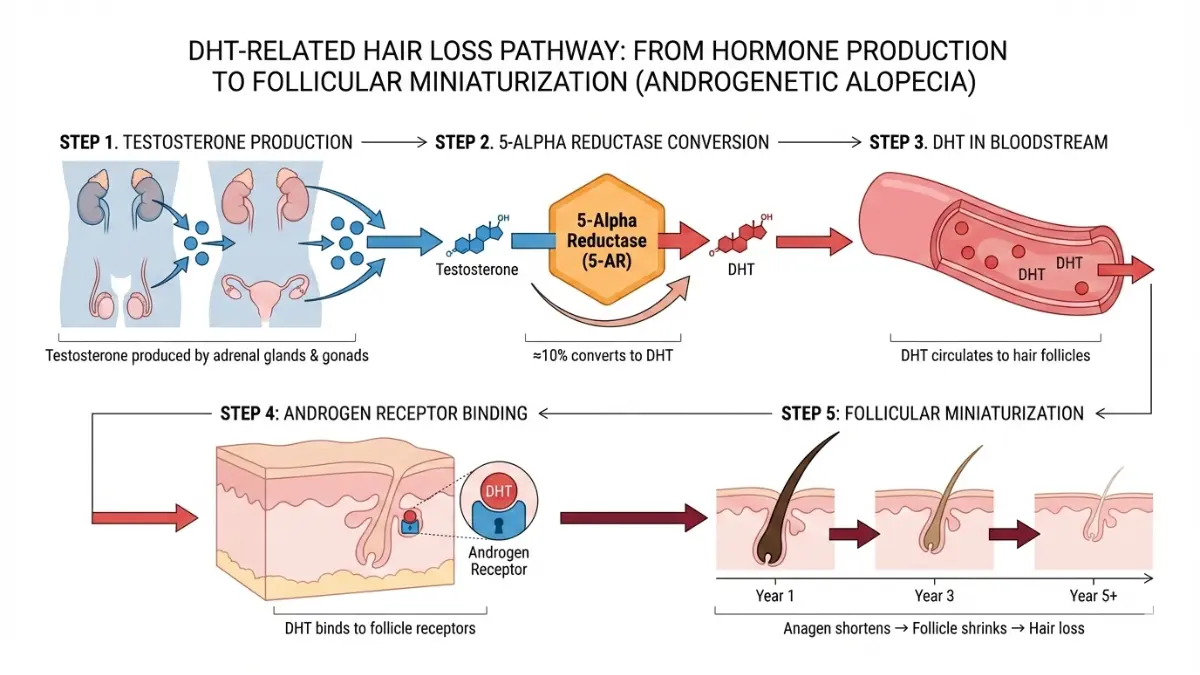
DHT (dihydrotestosterone) is a hormone produced when the enzyme 5-alpha reductase (5-AR) converts testosterone into a more potent form. Your body converts roughly 10% of testosterone into DHT naturally.
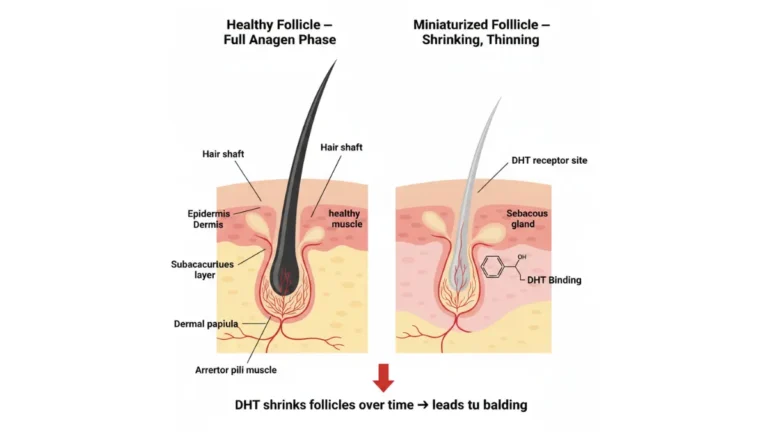
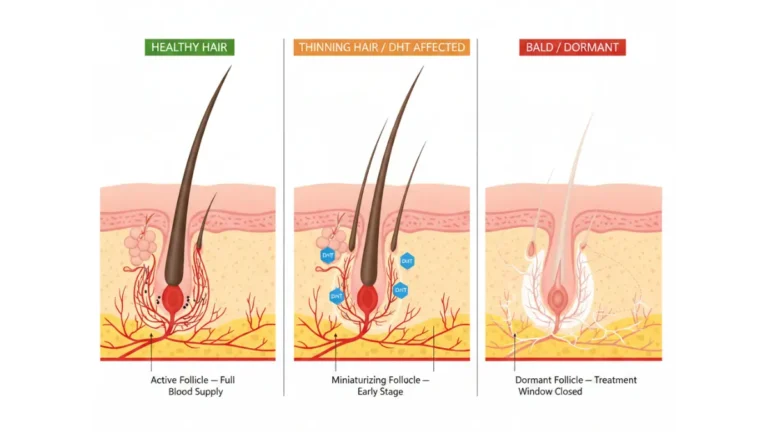
In people with a genetic sensitivity to DHT, the hormone binds to androgen receptors in scalp hair follicles. Once bound, it triggers follicular miniaturization — the progressive shrinking of follicles through repeated hair growth cycles. Over time, these follicles produce thinner, shorter hairs until they stop altogether.
The cascade looks like this:
- Testosterone → (5-alpha reductase enzyme) → DHT
- DHT binds to androgen receptors in hair follicles
- Follicles shrink; the anagen (growth) phase shortens
- Hair becomes finer and shorter each cycle
- Eventually, follicles stop producing visible hair
Individuals with androgenetic alopecia show elevated DHT production, higher 5-AR activity, and more androgen receptors in balding scalp regions, according to peer-reviewed research from the National Institutes of Health.
Who Is Most at Risk?
In Men:
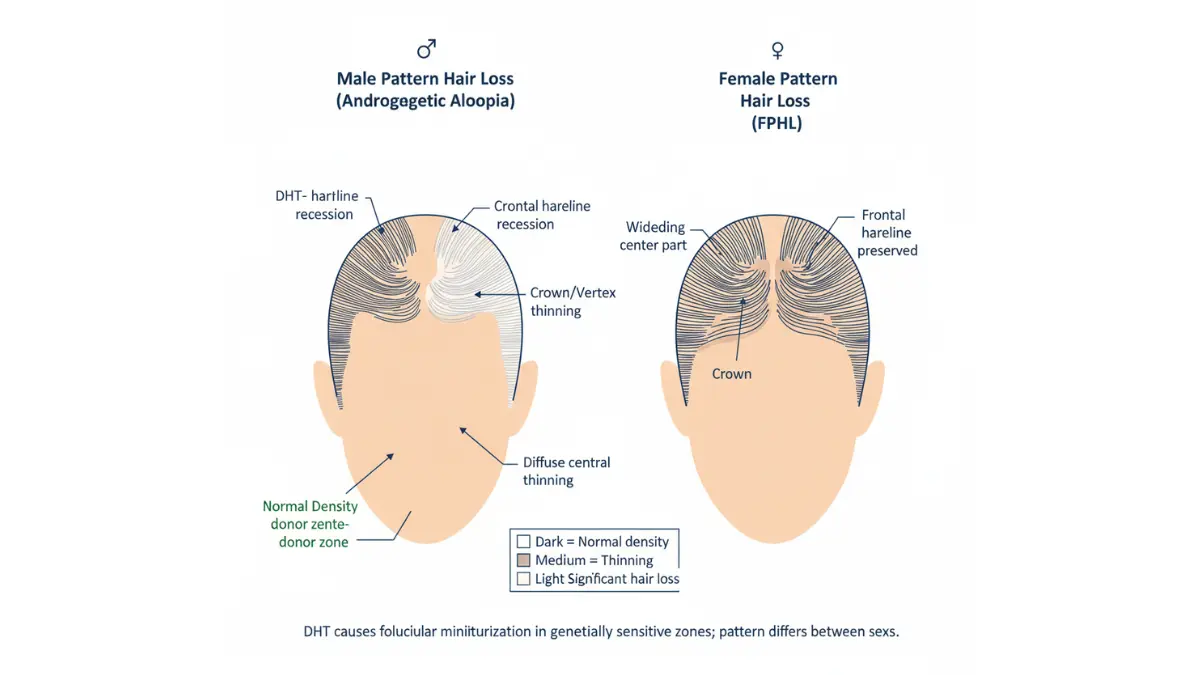
- Hair loss typically starts at the temples and crown
- Sons of bald fathers have 5–6 times higher relative risk
- Over 50% of white men show visible signs by age 50
- The earlier it starts, the more aggressive the progression tends to be
In Women:
- Hair loss presents as diffuse thinning — a widening part, smaller ponytail, overall reduction in density
- The frontal hairline is usually preserved (unlike male pattern)
- Affects women of all ages, especially post-menopause due to declining estrogen
Both sexes can be affected. The genetic predisposition involves the androgen receptor (AR) gene on the X chromosome, which partly explains why maternal family history matters significantly.
If you’re concerned about your genetic predisposition to hormone-related hair loss, the Genetic Risk Assessment Tool at MyMedicineAdvisor can help you assess your risk factors based on your personal and family history.
What This Means For You: DHT-driven hair loss is progressive. Early treatment consistently delivers better outcomes. Waiting does not stabilize the condition — it worsens it.
Every DHT Blocker Ranked — From Strongest to Safest (2026 Evidence)
Not all DHT blockers are equal. Below is a comprehensive ranked comparison based on clinical evidence strength, efficacy, and safety profile — the kind of evidence-based ranking no competitor currently offers.
Master Comparison Table — DHT Blockers 2026
| DHT Blocker | Type | DHT Reduction | Evidence | Side Effect Risk | Best For |
|---|---|---|---|---|---|
| Dutasteride | Prescription oral | 90–94% | ⭐⭐⭐⭐⭐ Strong | Moderate | Severe / resistant hair loss |
| Finasteride | Prescription oral | 70–73% | ⭐⭐⭐⭐⭐ Strong | Low–Moderate | Moderate hair loss in men |
| Clascoterone 5% (investigational) | Topical | Local receptor block | ⭐⭐⭐⭐ Emerging | Very Low | Men wanting zero systemic effects |
| Saw Palmetto | Natural supplement | ~32% (mild) | ⭐⭐⭐ Moderate | Very Low | Mild hair loss, natural preference |
| Pumpkin Seed Oil | Natural oral/topical | Mild | ⭐⭐ Low–Moderate | Very Low | Women, early-stage, adjunct |
| Ketoconazole shampoo | Topical | Scalp-local only | ⭐⭐ Low | Very Low | Adjunct to other treatments |
| DHT blocker foods | Dietary | Very mild | ⭐ Low | None | Lifestyle support |

Finasteride — The Gold Standard DHT Blocker
Finasteride is an FDA-approved oral prescription medication that inhibits type II 5-alpha reductase, reducing serum DHT by 70–73%. It is the most widely studied DHT blocker for male androgenetic alopecia.
Clinical outcomes (2026 data):
- Stops or slows hair loss in approximately 88% of men
- About 66% of men experience some visible hair regrowth
- Effects begin around 3–6 months of consistent daily use
Important side effects to know:
- Sexual side effects (reduced libido, erectile changes) occur in approximately 1.8–3.8% of users
- Post-Finasteride Syndrome (PFS): A small subset of men report persistent sexual and neurological symptoms even after stopping. The FDA has updated its label to reflect this risk. Read the FDA’s official drug safety communication on 5-alpha reductase inhibitors for full detail.
- Pregnant women must not handle crushed or broken finasteride tablets — the drug causes birth defects.
Key Takeaway: Finasteride is highly effective when started early. Most side effects are rare and reversible on discontinuation. Open communication with your doctor is essential before starting.
Dutasteride — The More Powerful Option
Dutasteride blocks both Type I and Type II 5-alpha reductase, achieving a 90–94% reduction in serum DHT — significantly more powerful than finasteride.
2025 network meta-analysis published in peer-reviewed literature ranked oral dutasteride 0.5 mg as the most effective medical therapy for male pattern hair loss, outperforming both finasteride and minoxidil in head-to-head comparisons.
Key facts:
- Approved for benign prostatic hyperplasia (BPH); used off-label for hair loss in the U.S.
- Approved for hair loss in South Korea and Japan
- Approximately 100x more potent than finasteride at inhibiting Type I 5-AR
- Takes 4–6 months for visible results; continue for at least 12 months to evaluate
Side effects mirror finasteride but can be more persistent due to dutasteride’s longer half-life (~5 weeks vs. ~6–8 hours for finasteride).
🚨 Clascoterone 5% — The December 2025 Breakthrough (Exclusively Covered Here)
This is the development your dermatologist may not yet know about — and zero major competitor has covered it.
On December 3, 2025, Cosmo Pharmaceuticals announced breakthrough Phase III results from two massive clinical trials — SCALP-1 and SCALP-2 — the largest Phase III program ever conducted for a topical hair loss treatment.
Trial data:
- 1,465 men enrolled across 51 sites in the U.S. and Europe
- SCALP-1 result: 539% relative improvement in target-area hair count vs. placebo
- SCALP-2 result: 168% relative improvement vs. placebo
- Patient-reported outcomes: statistically significant and positive across both studies
- Safety profile: side effects similar to the vehicle (placebo) — no meaningful systemic hormonal effects
Why this matters: Clascoterone is a topical androgen receptor inhibitor. Unlike oral finasteride or dutasteride that reduce DHT throughout the entire body, clascoterone blocks DHT directly at the hair follicle receptor with negligible systemic absorption. This means the hair benefits without the systemic hormonal side effects.
“For decades, patients have had to choose between available treatment options with limited efficacy or safety issues due to systemic hormonal exposure. These findings show the potential for clascoterone 5% topical solution to change that equation.” — Dr. Maria Hordinsky, MD, Professor of Dermatology, University of Minnesota
Current status: Investigational. Not yet FDA-approved for hair loss. Cosmo plans to complete 12-month safety data in spring 2026 and submit for FDA and EU approval. Potential market availability: 2026–2027.
For broader context on cutting-edge hair loss treatments, see our full hair loss treatments 2026 guide.
Natural DHT Blockers — Saw Palmetto, Pumpkin Seed Oil, EGCG
Natural DHT blockers work via the same 5-AR inhibition mechanism as prescription drugs — just with significantly less potency.
Saw Palmetto (Serenoa repens):
- Most studied natural DHT blocker; standard dose 320 mg/day
- A clinical review found saw palmetto improved hair quality by 60% and raised total hair count by 27% in users with hair loss
- Works by partially inhibiting 5-AR and reducing DHT uptake at the follicle receptor
- Very low side effect profile; safe for long-term use in most adults
Pumpkin Seed Oil:
- A 24-week randomized trial in 76 men showed 40% increase in hair growth (400 mg daily)
- Works by inhibiting 5-AR production of DHT from testosterone
- Also studied for female pattern hair loss with positive early results
Green Tea Extract (EGCG):
- Epigallocatechin gallate (EGCG) partially inhibits 5-AR and protects follicles from DHT-induced cell death
- Evidence is preliminary; supplements have not consistently demonstrated clinical hair regrowth
DHT Blocker Foods (Dietary Support):
- Quercetin-rich foods (onions, apples, berries) inhibit 5-AR in preclinical studies
- Turmeric (curcumin) lowers DHT in animal models
- Green tea consumption supports scalp health
- Treat dietary approaches as supportive, not standalone treatment
Ensuring your overall protein intake supports hair follicle health is equally important — use the free Protein Intake Calculator to ensure you’re meeting your daily needs.
DHT Blockers for Women — What Actually Works
Women’s DHT-driven hair loss is one of the most underserved topics in medical content. Most articles treat this as a footnote. Here, it gets dedicated clinical attention.
How Women’s DHT Hair Loss Differs
Unlike men, women with androgenetic alopecia typically experience:
- Diffuse thinning across the top of the scalp
- A widening center part as the primary early sign
- Preserved frontal hairline (unlike male pattern)
- Thinning that worsens significantly after menopause due to declining estrogen
The American Academy of Dermatology estimates that female pattern hair loss affects millions of American women, with hormonal DHT sensitivity as a primary driver.
DHT Blocker Options for Women
Spironolactone (Aldactone):
- An anti-androgen medication that reduces androgen production broadly
- Studies show effectiveness in approximately 40–43% of women with female pattern hair loss
- Often combined with minoxidil for enhanced outcomes
- Requires a prescription; typically taken at 100–200 mg/day
- Do not use if pregnant — causes birth defects (always use with contraception in women of reproductive age)
Minoxidil for Women:
- FDA-approved at 2% and 5% concentrations for female pattern hair loss
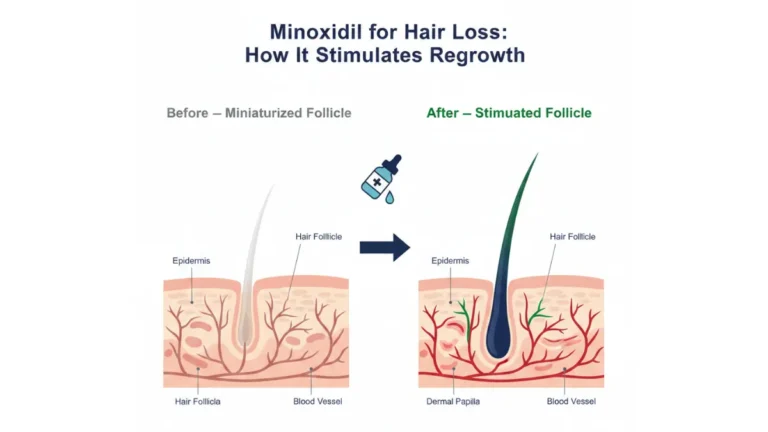
- Not a DHT blocker itself, but effectively supports hair regrowth alongside DHT-reducing treatments
- See our detailed minoxidil for women guide for full dosing and application guidance
Saw Palmetto & Pumpkin Seed Oil:
- Both offer mild DHT inhibition with excellent safety profiles in women
- Preferred by women seeking non-hormonal, natural approaches
- Use consistently for at least 6 months before evaluating results
Finasteride for Women:
- Generally not recommended; not FDA-approved for female hair loss
- Absolutely contraindicated in pregnancy — must not be handled by pregnant women even in tablet form
- May be considered in post-menopausal women in select cases under dermatologist supervision only
⚠️ Critical Safety Warning: DHT Blockers During Pregnancy
Prescription DHT blockers (finasteride, dutasteride, and spironolactone) can cause serious fetal birth defects. Women who are pregnant, planning pregnancy, or breastfeeding must not take or handle these medications. Inform your doctor of any pregnancy possibility before starting any DHT-blocking therapy.
If you are experiencing unexpected symptoms while on any treatment, use the Symptom Checker to document and assess your situation before your next appointment.
Side Effects, Safety & Timelines
How Long Do DHT Blockers Take to Work?
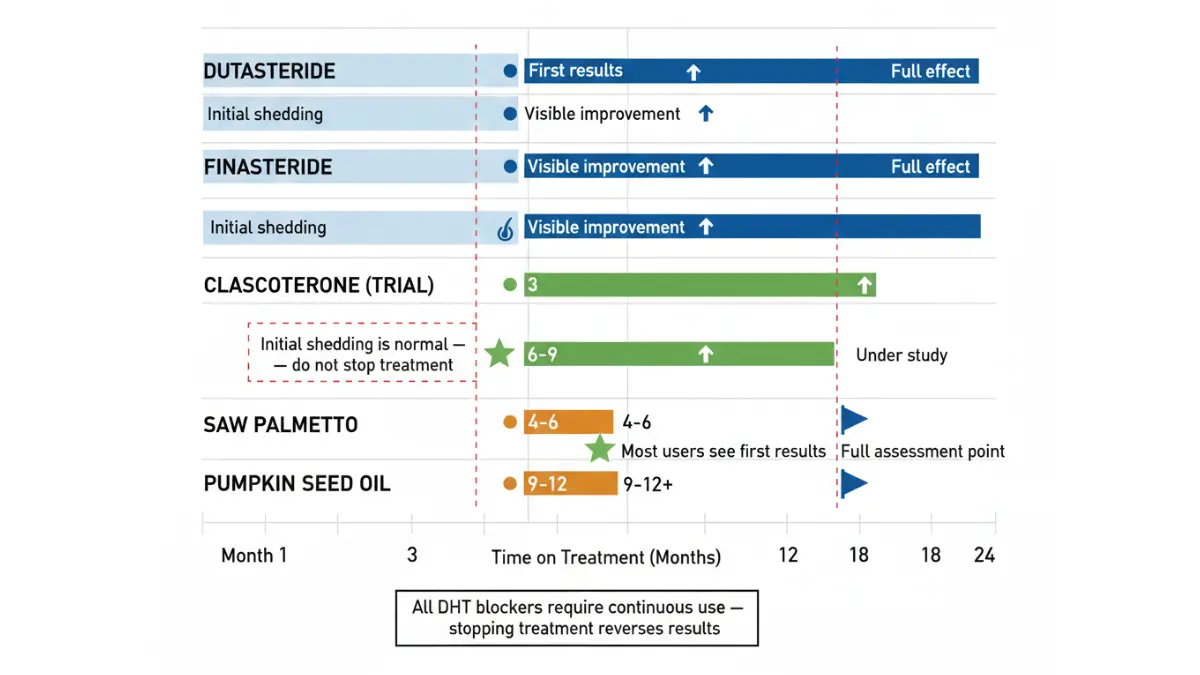
Patience is the hardest part of hair loss treatment. Here is what the evidence shows:
| DHT Blocker | Visible Results Timeline | Full Effect |
|---|---|---|
| Finasteride | 3–6 months | 12–24 months |
| Dutasteride | 3–4 months | 12 months |
| Saw Palmetto | 4–6 months | 6–12 months |
| Pumpkin Seed Oil | 6 months | 6–12 months |
| Clascoterone (trial) | 6 months | Under study |
Post-Finasteride Syndrome — A Transparent Discussion
PFS is a term describing persistent sexual, psychological, and neurological symptoms in a minority of men who took finasteride — symptoms that continue even after stopping the drug.
What the evidence shows:
- Sexual side effects during treatment occur in approximately 1.8–3.8% of users
- The FDA updated its labeling in 2012 to include warnings about persistent symptoms
- The majority of side effects resolve within weeks of discontinuation
- Persistent cases (PFS) are rare but real — men considering finasteride deserve to know this upfront
This level of transparency is what separates evidence-based medical content from promotional fluff. Always discuss your personal risk tolerance with a board-certified dermatologist before starting finasteride.
Can You Combine DHT Blockers?
Yes — and combination strategies often produce superior results:
- Finasteride + Minoxidil: The most evidence-supported combination for men; addresses DHT from two angles (reducing production + stimulating growth)
- Saw Palmetto + Ketoconazole Shampoo: A well-tolerated natural stack for mild-to-moderate loss
- Spironolactone + Minoxidil: Standard protocol for women with hormonal hair loss
- Never combine finasteride + dutasteride without specialist guidance — overlapping mechanisms increase side effect risk without added benefit
Supporting your overall metabolic health alongside any treatment matters. Poor sleep, for instance, elevates cortisol and indirectly worsens DHT imbalance. The Sleep Calculator can help you optimize your sleep schedule for better hormonal balance.
PRP Therapy and Emerging 2026 Treatment Options
Beyond DHT blockers, several adjunct therapies show strong clinical promise for androgenetic alopecia.
Platelet-Rich Plasma (PRP) Therapy:
- Uses your own blood platelets to stimulate follicular growth factors
- Multiple clinical trials show improved hair density after 3–4 sessions
- Not a DHT blocker — works synergistically alongside finasteride or saw palmetto
- See our comprehensive PRP therapy results guide for detailed outcomes data
Low-Level Laser Therapy (LLLT):
- FDA-cleared devices (combs, helmets) emit wavelengths of 630–660 nm
- Evidence supports modest improvements in hair count when used consistently
- Best as an adjunct — not a standalone solution for significant hair loss
Clascoterone (Breezula) — The Horizon:
- If FDA approved following spring 2026 data submission, this could become the first new mechanism for male AGA in over 30 years
- Would be applied topically, twice daily, targeting follicle receptors locally
- No systemic hormonal suppression — a potential game-changer for men who cannot tolerate oral medications
Which DHT Blocker Should You Choose? Expert Verdict
The right DHT blocker depends on your situation. Here is a practical decision framework based on current evidence:
| Your Situation | Recommended Starting Point |
|---|---|
| Mild hair loss, prefer natural approach | Saw palmetto 320mg/day + pumpkin seed oil |
| Moderate hair loss, male, under 50 | Finasteride 1mg/day (with dermatologist) |
| Severe or finasteride-resistant hair loss, male | Dutasteride 0.5mg (off-label, specialist-supervised) |
| Women with hormonal hair thinning | Spironolactone + Minoxidil (prescription) |
| Women preferring natural options | Saw palmetto + pumpkin seed oil stack |
| Want zero systemic side effects, male | Monitor clascoterone FDA progress (expected 2026–2027) |
✅ 3 Things to Do This Week
- Document your hair loss pattern. Take clear photos of your part, crown, and temples in consistent lighting. This baseline is invaluable for tracking treatment response.
- Book a dermatology appointment. Over-the-counter research is a starting point, not a substitute for diagnosis. A dermatologist can rule out non-DHT causes (thyroid, iron deficiency, telogen effluvium).
- Assess your nutrition. Protein, iron, zinc, and vitamin D deficiencies all accelerate hair loss independently of DHT. Optimize your diet alongside any DHT-blocking therapy.
For a broader view of current treatment options beyond DHT blockers, explore our evidence-based regenerative medicine and hair restoration guide.
📌 Medical Disclaimer: This article is for educational and informational purposes only. It does not constitute medical advice, diagnosis, or treatment. DHT blockers — particularly prescription medications — carry real risks. Always consult a board-certified dermatologist or physician before starting, stopping, or changing any hair loss treatment.
Frequently Asked Questions — DHT Blocker
1. What is the most effective DHT blocker available in 2026?
Dutasteride 0.5mg is currently ranked the most effective medical DHT blocker, reducing serum DHT by 90–94%. It outperformed finasteride in a 2025 network meta-analysis for male androgenetic alopecia. It requires a prescription and is used off-label for hair loss in the U.S.
2. How long does it take for a DHT blocker to stop hair loss?
Most prescription DHT blockers show initial results in 3–6 months. Full benefit typically takes 12–24 months of consistent use. Natural options like saw palmetto require at least 4–6 months before meaningful assessment.
3. Can DHT blockers regrow lost hair or just prevent further loss?
Both — but results depend heavily on how early treatment begins. DHT blockers primarily halt progression. Regrowth is possible when follicles are still active (miniaturized but not dead). Long-standing bald areas with scarred follicles do not respond to DHT blockers.
4. Are natural DHT blockers like saw palmetto as effective as finasteride?
No. Finasteride reduces DHT by 70–73%; saw palmetto achieves roughly 32% inhibition in the best studies. Natural blockers are meaningfully weaker but carry far fewer side effects — an appropriate choice for mild hair loss or as a supportive adjunct.
5. What are the side effects of DHT blocker supplements?
Natural supplements (saw palmetto, pumpkin seed oil) have very low side effect profiles. Prescription DHT blockers (finasteride, dutasteride) can cause sexual side effects in a minority of users and, rarely, Post-Finasteride Syndrome. Always discuss risks with your doctor.
6. Is there a DHT blocker safe for women?
Yes. Spironolactone is commonly prescribed for women with hormonal hair loss, with good effectiveness in approximately 40% of patients. Natural options like saw palmetto are also considered safe. Finasteride and dutasteride are not recommended for women of childbearing age due to severe birth defect risks.
7. Can I use a DHT blocker shampoo alongside oral finasteride?
Yes — combining a ketoconazole-based DHT-blocking shampoo with oral finasteride is generally considered safe and may provide complementary scalp-level DHT reduction. Always inform your prescribing doctor of all treatments you are using.
8. What foods are natural DHT blockers?
Foods with the strongest natural DHT-inhibiting potential include: green tea (EGCG), pumpkin seeds, edamame (isoflavones), turmeric (curcumin), and onions (quercetin). These should be viewed as supportive dietary strategies, not standalone treatments.
9. What is clascoterone and when will it be available?
Clascoterone (Breezula) is an investigational topical DHT blocker that works by blocking androgen receptors directly at the hair follicle. Phase III SCALP trials showed 539% improvement in hair count vs. placebo (December 2025). FDA submission is expected after spring 2026 data completion. Potential market availability: 2026–2027.
10. Does blocking DHT affect testosterone levels or fertility?
Finasteride and dutasteride do not directly lower testosterone — they redirect it by blocking conversion to DHT, which means testosterone levels can actually increase slightly (9–15%). Fertility effects are generally temporary and reversible. Discuss specifics with your physician if you are planning fatherhood.
11. What happens if you stop taking a DHT blocker?
Hair loss resumes within months of stopping any DHT blocker. Regrown hair is typically lost within 12 months of discontinuation. This is why treatment requires a long-term commitment — it manages the condition but does not cure the underlying genetic sensitivity.
For more evidence-based health guides reviewed by our international panel of 21 credentialed medical experts, visit MyMedicineAdvisor Health.
About this content
How this article was put together: researched from recognised health sources, drafted with the help of AI tools, and edited by hand, with sources linked throughout.

Sameer Patel is the founder and editor of My Medicine Advisor. He is not a doctor or medical professional — before starting this site he worked in banking,…
Medical disclaimer
The content on MyMedicineAdvisor is provided for general informational and educational purposes only and is not a substitute for professional medical advice, diagnosis, or treatment. Health information on this website should not be used to diagnose, treat, cure, or prevent any condition without guidance from a qualified healthcare professional. Always seek the advice of your doctor, physician, or another licensed healthcare provider with any questions you may have regarding a medical condition, symptoms, medications, or treatment decisions.