
On This Page – Quick Medical Summary
How much a lipid panel costs without insurance
There is no national price for a lipid panel. The same blood draw carries three prices: a cash price you arrange yourself, an insured price your plan negotiated years ago, and a hospital outpatient price billed under different rules again.
This page will not quote a dollar figure. No federal source publishes a price for this test, so every number you have seen online came from a page with something to sell.
Find your situation below and take the federal route attached to it. Uninsured or not using insurance, start at section four; insured, section five; booked at a hospital, section six. Before you pay for the order, it helps to know which numbers a lipid panel actually measures.
ℹ️ Medical Disclaimer: This article explains how laboratory testing is priced and billed in the United States. It does not diagnose any condition, recommend or interpret any test, or advise on treatment, medication, insurance or legal matters. Whether you need a cholesterol test is a decision for a licensed clinician who knows your history; what you owe is a matter for your plan and the billing office that issued the charge.
What you are paying for when a lab runs a lipid panel
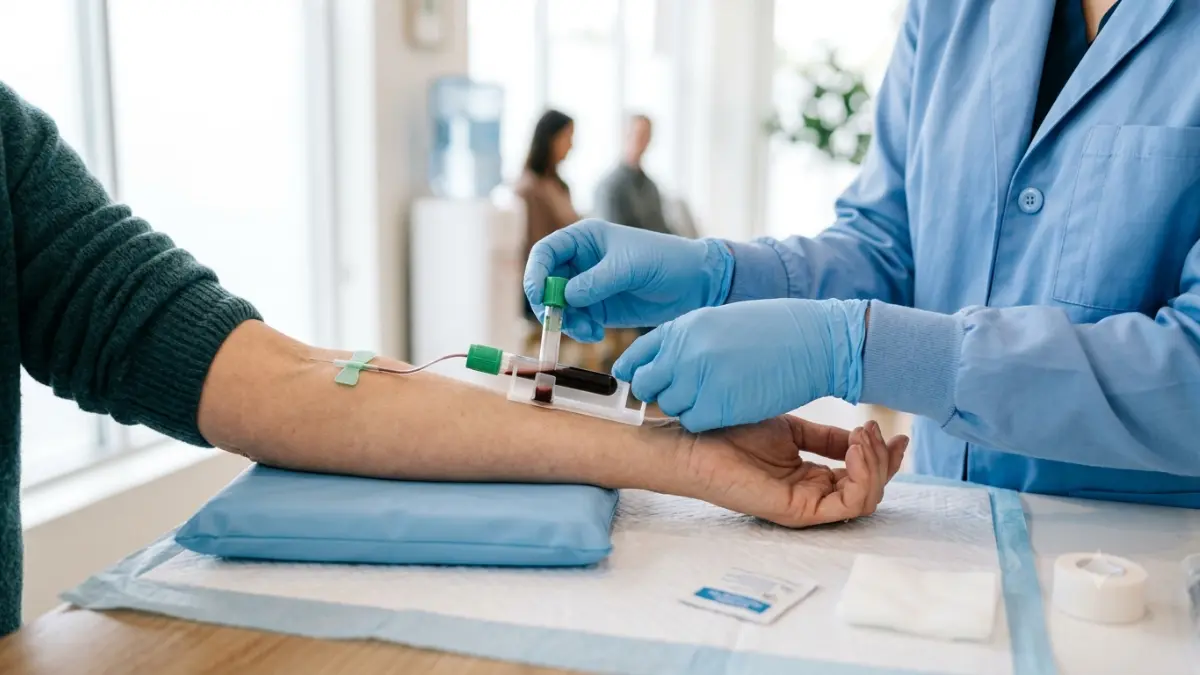
One order, one needle, one specimen. That is the unit being priced, no matter how many lines appear on the report that comes back.
One draw, one order, several numbers
A standard lipid profile directly measures three things: total cholesterol, HDL cholesterol and triglycerides. The other values printed on your report are worked out from those three. A report showing five or six lines does not mean five or six tests were purchased, and a report showing four does not mean something was skipped — see how many tests it counts as for the fuller picture.
Why the calculated numbers are not extra tests
LDL cholesterol is the clearest example. On most reports it is estimated from the three measured values rather than measured on its own, which is why some laboratories print the word “calculated” beside it.
🔬 How It Works: The laboratory runs its analysers once on your specimen and gets total cholesterol, HDL and triglycerides. The remaining values on the report are arithmetic performed on those results — no additional specimen, no additional run. This is what the panel covers as a single order.
Which of the three prices applies to you
Find the row that describes your situation. The last column is the point of the table: it names where your own number comes from, which is the one thing no average can tell you.
The same test, three different transactions
| Your situation | What you are actually paying | What moves the price | Where your own number comes from |
|---|---|---|---|
| Uninsured, or not using insurance | A self-pay price set by the lab or practice | Which facility draws the blood; whether you asked before booking | A written good faith estimate, requested before the draw |
| Insured, ordered as preventive screening | Usually nothing at an in-network provider | Network status; how the order is written | Your plan’s preventive services list, plus the federal list it must cover |
| Insured, ordered to monitor or investigate | Your plan’s normal cost sharing | Deductible met or not; coinsurance rate | Your Summary of Benefits and Coverage document |
| Medicare Part B, screening | No deductible and no copayment for the covered screening | Whether it falls inside the five-year window | Medicare’s cardiovascular screening benefit rules |
| Any payer, hospital outpatient lab | A hospital charge, billed under hospital rules | Site of service, more than any other factor | The hospital’s own posted standard charges |
Sources: CMS and HealthCare.gov consumer guidance, verified July 2026. Routes, not prices — no dollar figures are published by these sources for this test.
Where your own number comes from
Notice what the table does not do: it does not rank the rows. Cheapest in general is not a useful idea when only one row is yours, and the same person can move between rows by changing nothing but the building they walk into. The same three-price pattern appears on a different panel if you want to see it play out on another common blood test.
Getting a price in writing before the blood is drawn
Most readers who searched this question are in row one, which is also the row with the strongest federal protections and the least awareness of them.

Ask for a good faith estimate
The No Surprises Act has been federal law since 1 January 2022. Under it, if you do not have health insurance or are choosing not to use it, providers must usually give you a good faith estimate of what your care will cost, as CMS explains in your rights when you aren’t using insurance. You get one when you schedule care at least three business days in advance, or whenever you ask for it.
The word “usually” is on the federal page, and it belongs in your expectations too. You do not need to say the phrase itself — asking in writing what something will cost is enough. On the phone, one question does most of the work: can this order go to an independent lab, and what is the self-pay price there?
If the bill arrives higher than the estimate
Keep the estimate. If a bill from that provider comes in at least $400 more than their estimate, you may be able to dispute the bill through a federal process, and you have 120 days from the initial bill to start. CMS also runs a free help line for questions and complaints about these rights.
With insurance, when a cholesterol test costs nothing
Two routes end at zero, and each has a condition attached that is worth knowing before you are surprised by a charge.
The preventive list, and what “no cost sharing” actually means
HealthCare.gov publishes the preventive services adult plans must cover without cost sharing. Marketplace plans and many others must cover them without a copayment or coinsurance, even before your yearly deductible is met. Cholesterol screening is on that list, for adults of certain ages or at higher risk — check who the screening guidance applies to against your own history.
The condition is in the government’s own wording: these services are generally covered at no cost from an in-network provider, and $0 cost is not guaranteed in all cases.
Medicare’s cardiovascular screening
Medicare Part B covers a cardiovascular screening blood test — total cholesterol, HDL and triglycerides — for people without apparent signs or symptoms of cardiovascular disease, ordered by their treating physician. CMS states in its guidance on the cardiovascular screening benefit that there is no deductible or copayment for it, and that it is covered once every five years. That interval is a payment rule, not clinical advice; how often you actually need one is a separate question.
Why a preventive test can still produce a bill
The same draw can be billed as screening or as monitoring, depending on why it was ordered, and the two are not priced alike. Ask the ordering office directly: is this preventive screening, or monitoring a condition? If a charge appears anyway, why a preventive test can still generate a bill covers what to check first.
Why the hospital lab charges more for the same blood
Site of service moves the price more than insurance status does, and it is the variable you control most easily.

Same test, different building, different charge
The specimen is identical. The billing is not: hospital outpatient laboratory work is routinely charged at higher rates than the same work at an independent laboratory. When the bill arrives, how to read the line items on a lab bill will tell you whether what you were charged matches what was done.
How to look up a hospital’s posted price
Search the hospital’s name plus “standard charges” or “price transparency,” which reaches the file directly.
📊 Clinical Data Point: Hospitals must post standard charges for at least 300 shoppable services that can be scheduled in advance, laboratory tests among them, in a consumer-friendly display and free of charge — Source: CMS Hospital Price Transparency, consumer guidance, verified July 2026.
Two things in that file matter: the discounted price the hospital will accept directly from a patient paying cash, and the shoppable-services display, which is the readable version. Read what hospitals must publish about their prices before assuming the posted number is the only one available.
What not to do if the price still feels out of reach
There is one decision this article could push you toward that would cost you far more than the test.

Skipping the test is the most expensive option
A cholesterol result is cheap compared with what it is looking for. If money is the obstacle, the answer is a different route to the same draw, not no draw.
⚠️ Clinical Warning: Do not let a price quote become a reason to cancel a screening your clinician has recommended. Cost is negotiable, a delayed cardiovascular risk assessment is not, and the routes that end at $0 exist precisely so that cost does not decide this.
The avoidable extra costs
The most common waste is a repeat draw, which doubles a price you were already worried about. Check whether you need to fast before you travel, not after.
✅ Patient Action: Before the draw, ask the ordering clinician or the practice’s billing staff one question: if cost is the problem, can this be ordered as preventive screening, and can the draw go to an independent lab?
Common questions about lipid panel cost without insurance
1. What if my bill is higher than the estimate?
Keep the estimate and compare it with the bill. If a bill from that provider is at least $400 more than their estimate, you may be able to dispute the bill through a federal process run by CMS. You have 120 days from the initial bill to start, so do not set it aside.
2. Is a cholesterol test free if I have insurance?
Cholesterol screening is on the federal preventive services list. Marketplace plans and many others must cover the listed services without a copayment or coinsurance, even before your yearly deductible is met. The condition is network status: coverage at no cost applies to an in-network provider, and HealthCare.gov states that $0 is not guaranteed in every case.
3. How do I find out what a hospital charges before I go?
Hospitals must publish their standard charges, including the discounted price they will accept directly from a patient paying cash, free of charge and in a consumer-friendly display. Search the hospital’s name together with “standard charges” or “price transparency” to reach the file. Laboratory tests sit among the shoppable services that must be listed there.
Getting your own number, and what to do with the result
One phone call settles this. Call the lab or practice, say you are paying yourself, and ask for the price in writing before you book — then ask whether the order can go to an independent lab instead.
That single question moves more money than any comparison chart, and you are entitled to the answer.
When the result arrives, the price stops mattering and the numbers start. Read what your lipid panel actually measured so the report makes sense, and what changed in 2026 so you know which standards your clinician is reading it against.
About this content
How this article was put together: researched from recognised health sources, drafted with the help of AI tools, and edited by hand, with sources linked throughout.

Sameer Patel is the founder and editor of My Medicine Advisor. He is not a doctor or medical professional — before starting this site he worked in banking,…
Medical disclaimer
The content on MyMedicineAdvisor is provided for general informational and educational purposes only and is not a substitute for professional medical advice, diagnosis, or treatment. Health information on this website should not be used to diagnose, treat, cure, or prevent any condition without guidance from a qualified healthcare professional. Always seek the advice of your doctor, physician, or another licensed healthcare provider with any questions you may have regarding a medical condition, symptoms, medications, or treatment decisions.