On This Page – Quick Medical Summary
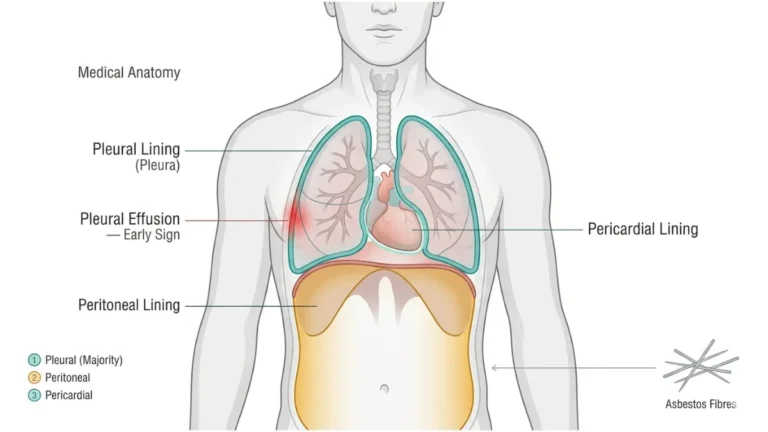
Mesothelioma causes are almost always traced back to one source: asbestos. This rare but aggressive cancer attacks the mesothelium — the thin tissue lining your lungs, abdomen, and heart. According to the CDC, around 3,000 Americans receive this devastating diagnosis every year. The most alarming fact? The asbestos exposure that triggered it likely happened 20 to 60 years ago — long before symptoms ever appeared.
If you’ve worked in construction, served in the military, or lived with someone who worked around asbestos, this guide explains exactly what you need to know — and what steps to take right now.
What Exactly Causes Mesothelioma? The Science Behind Asbestos Cancer
Asbestos exposure is the confirmed primary cause of mesothelioma — classified as a known human carcinogen by the U.S. Department of Health and Human Services, the EPA, and the International Agency for Research on Cancer (IARC).
How Asbestos Fibers Trigger Cancer
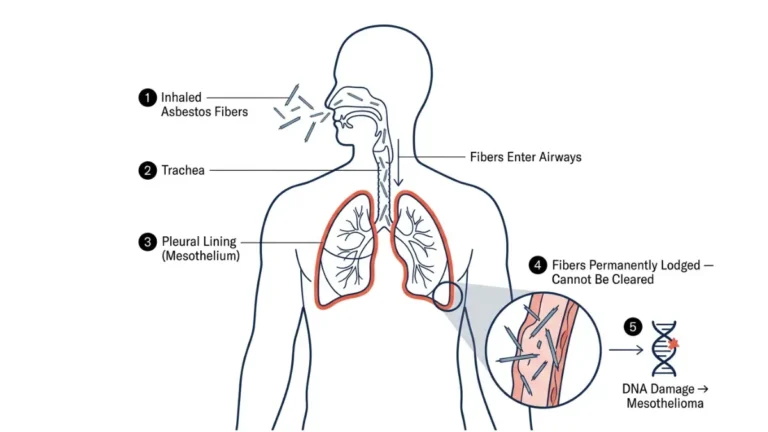
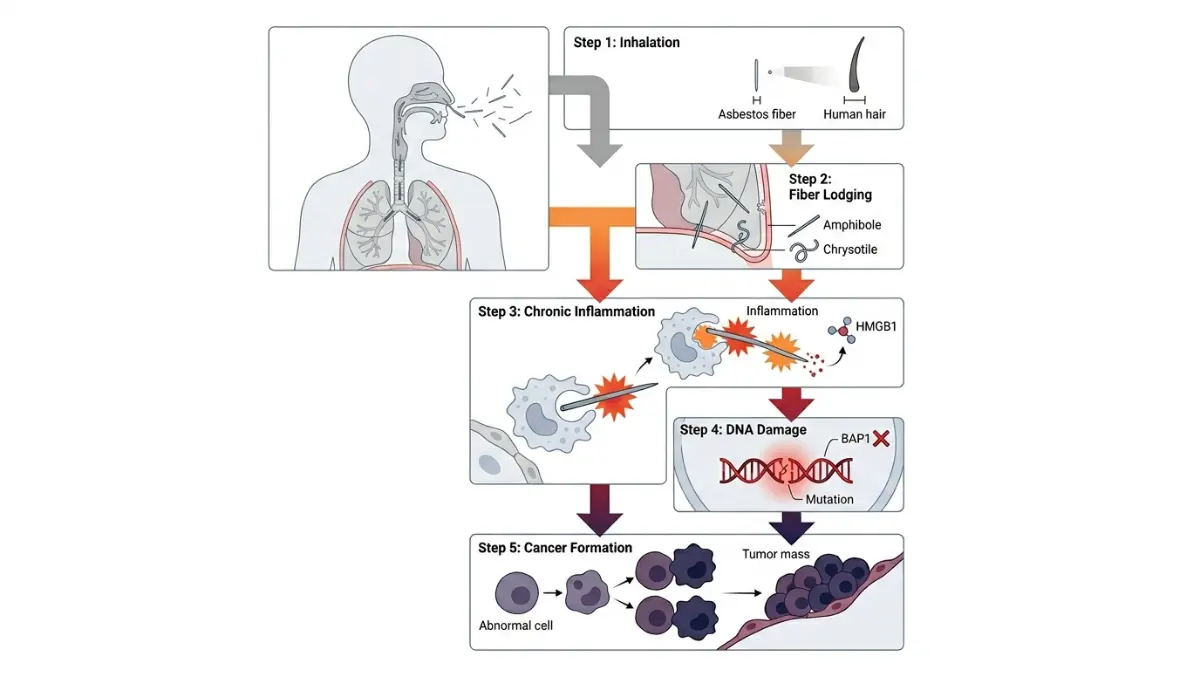
When asbestos-containing materials are disturbed — during demolition, renovation, or manufacturing — microscopic fibers are released into the air. Once inhaled or swallowed, these fibers:
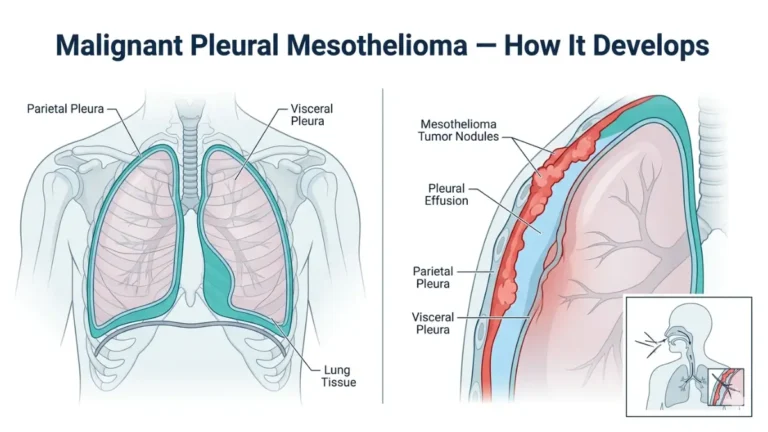
- Lodge permanently in the mesothelium lining the lungs or abdomen
- Trigger chronic inflammation that the body cannot resolve
- Activate HMGB1 protein — a molecular alarm signal that paradoxically promotes cancer cell survival
- Cause DNA mutations in mesothelial cells over years and decades
- Switch on oncogenes (c-Myc, c-Jun) that accelerate uncontrolled cell growth
Think of asbestos fibers as microscopic splinters your body can never expel. The constant, futile immune response eventually corrupts the DNA of surrounding cells — turning healthy tissue into malignant mesothelioma.
Not All Asbestos Is Equal: Fiber Type Comparison
One fact competitors consistently fail to explain clearly: the type of asbestos fiber directly affects how dangerous it is.
| Fiber Type | Group | Carcinogenicity | Current Status (USA 2026) |
|---|---|---|---|
| Chrysotile | Serpentine | Moderate | Still regulated, still imported |
| Crocidolite (Blue) | Amphibole | Very High | Largely banned |
| Amosite (Brown) | Amphibole | High | Largely banned |
| Tremolite | Amphibole | High | Naturally occurring, unregulated |
| Erionite | Non-asbestos mineral | Extremely High | Unregulated in parts of US |
Amphibole fibers are more dangerous because they are rigid, needle-like, and remain in lung tissue for decades longer than the curly chrysotile fibers. This is why shipyard workers and insulation installers — heavily exposed to amphibole types — carry some of the highest mesothelioma rates in the country.
🩺 What This Means For You: If you worked in construction, shipbuilding, or the military before 1990, you may have inhaled asbestos fibers without any warning. Use our free Symptom Checker if you’re experiencing unexplained chest pain, shortness of breath, or persistent cough today.
Who Is Most at Risk for Mesothelioma? Jobs, Veterans, and Families
Mesothelioma risk is not random. It maps directly to where asbestos was used most heavily — and who was closest to it.
High-Risk Occupations
According to OSHA, approximately 1.3 million U.S. construction and general industry workers remain at risk of asbestos exposure today. Historically, the highest-risk professions include:
- Shipyard workers — ships built before 1980 contained asbestos in over 300 components
- Insulation installers — direct daily handling of asbestos insulation boards
- Construction workers — floor tiles, ceiling tiles, pipe insulation, roofing materials
- Plumbers and pipefitters — pipe wrap and joint compound often contained asbestos
- Auto mechanics — brake pads and clutch linings used asbestos until the 1990s
- Electricians — asbestos was used heavily in electrical insulation panels
- Demolition crews — disturbing older buildings releases trapped fibers
- Miners — particularly iron ore, vermiculite, and talc miners
U.S. Veterans: The Forgotten Highest-Risk Group
Military veterans — particularly U.S. Navy veterans — represent one of the most underserved mesothelioma risk groups. Navy ships constructed before 1980 contained asbestos in boiler rooms, engine rooms, sleeping quarters, and mess halls. Sailors who spent years in confined spaces breathed asbestos-laden air daily without knowing.
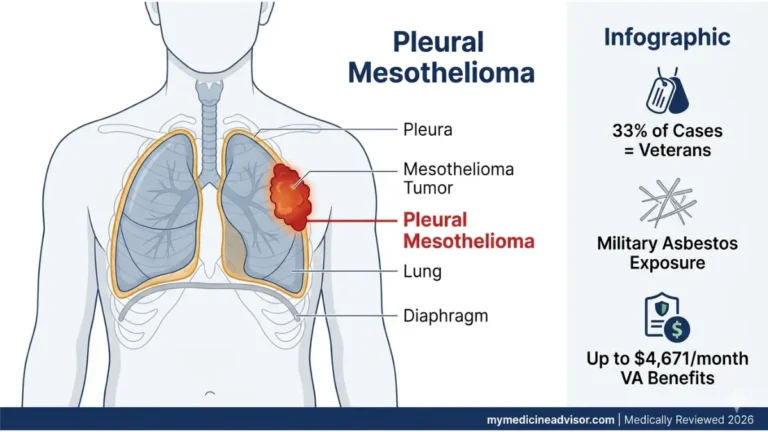
Veterans account for approximately 30% of all mesothelioma diagnoses in the United States. If you or a family member served in the Navy, Army Corps of Engineers, or worked on military bases before 1990, the VA’s asbestos exposure resources can help identify your risk level.
Secondhand (Para-Occupational) Exposure: The Hidden Danger
This is the mesothelioma cause competitors consistently underreport. You do not need to work with asbestos to develop mesothelioma.
Families of asbestos workers have developed mesothelioma from fibers carried home on:
- Work clothing and boots
- Skin and hair of the exposed worker
- Tools and equipment brought home
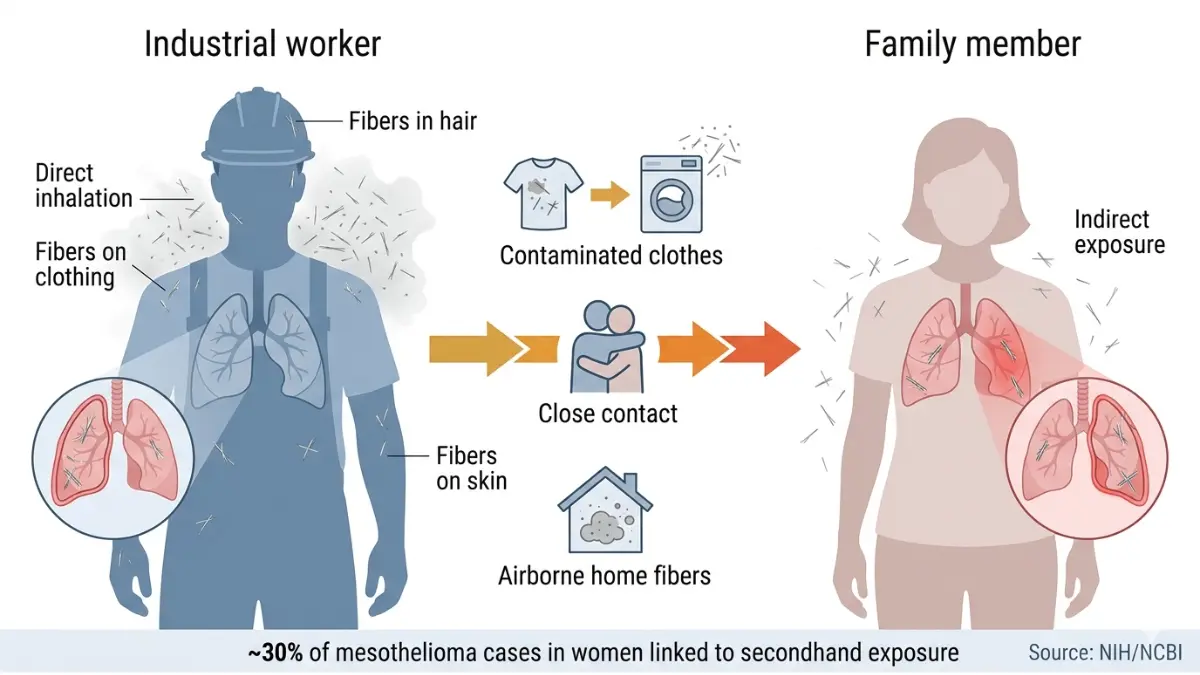
Robert, a retired New Jersey shipyard worker, never developed mesothelioma himself. His wife Patricia, who washed his work clothes for 22 years, was diagnosed with pleural mesothelioma at age 67 — her only known exposure was laundering those dust-covered work clothes.
Cases like Patricia’s are now well-documented by the NIH, which confirmed that para-occupational asbestos exposure is a primary driver of mesothelioma in people with no direct occupational history.
🧬 If you have a family history of asbestos-related illness, use our Genetic Risk Assessment Tool to understand inherited cancer risk factors.
The Silent Killer — How Asbestos Causes Mesothelioma Decades Later
This is the most psychologically difficult aspect of mesothelioma causes for patients to process — and the most important to understand.
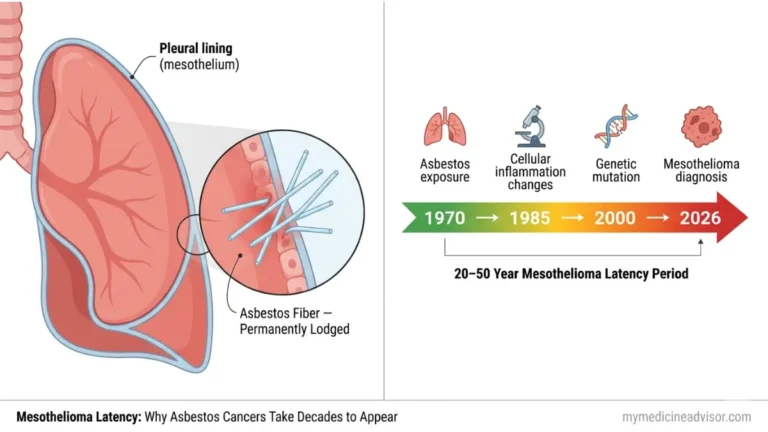
The Latency Period: 20–60 Years of Silent Damage
Mesothelioma has one of the longest latency periods of any cancer. According to NCI data:
- Minimum latency: ~15 years after first exposure
- Average latency: 30–50 years
- Maximum documented: 60+ years
This means a 72-year-old man diagnosed with mesothelioma in 2026 was most likely first exposed to asbestos in the mid-1970s — possibly as a young pipefitter, Navy sailor, or factory worker — decades before any regulation was in place.
The Silent Timeline
1970s → Occupational asbestos exposure begins 1975–1995 → Fibers embed in mesothelial tissue; chronic inflammation begins silently 1990s–2010s → DNA mutations accumulate; pre-cancerous cellular changes develop 2020s → Tumor growth becomes detectable; symptoms finally appear
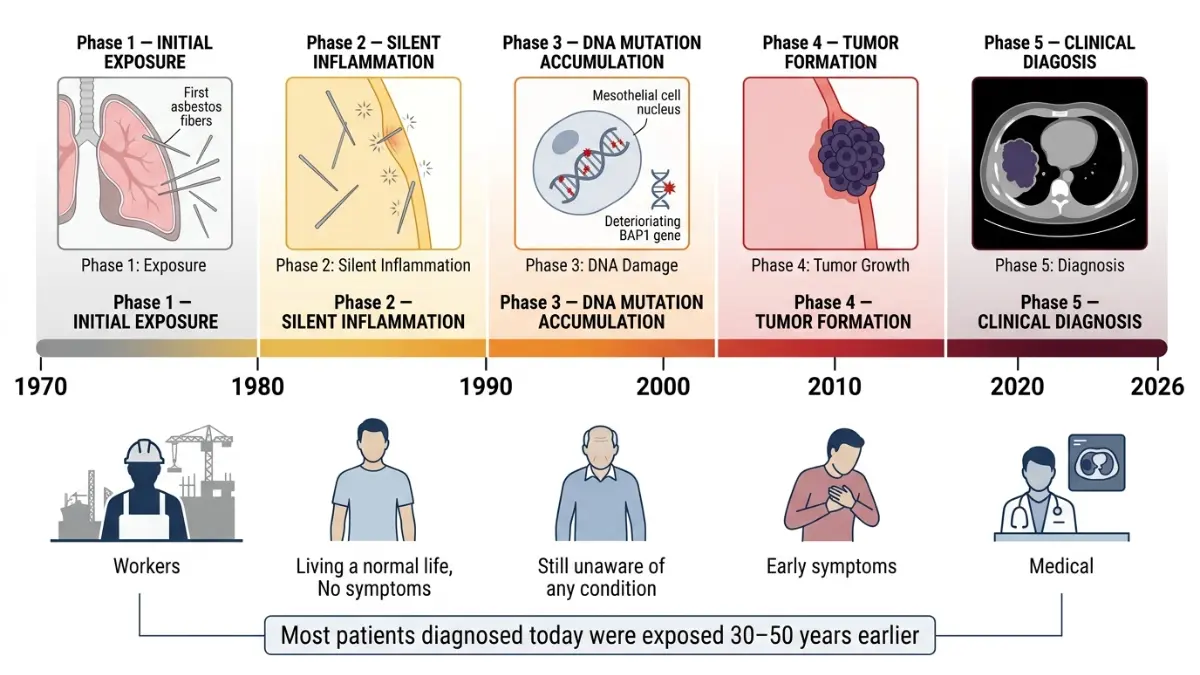
By the time symptoms emerge, mesothelioma is almost always Stage 3 or Stage 4 — which is why early disclosure to your doctor is the most powerful action you can take. You can learn more about how the disease progresses in our detailed guide on pleural mesothelioma stages and types.
What Affects How Quickly Asbestos Causes Damage?
Not everyone exposed to asbestos develops mesothelioma. Risk depends on several factors:
| Factor | Higher Risk | Lower Risk |
|---|---|---|
| Fiber type | Amphibole (crocidolite, amosite) | Chrysotile |
| Duration of exposure | Years of daily exposure | Brief or single exposure |
| Intensity | High-dust environments (shipyards, mines) | Low-level ambient exposure |
| Age at first exposure | Younger age = more years for damage | Older at first exposure |
| Genetic susceptibility | BAP1 mutation carrier | No genetic predisposition |
🔑 Key Takeaway: “Mesothelioma diagnosed today was almost certainly caused by asbestos exposure 30–50 years ago. The disease is silent for decades — which is why every high-risk individual must proactively disclose their exposure history to their doctor.”
The Smoking Distinction (A Critical Nuance Competitors Miss)
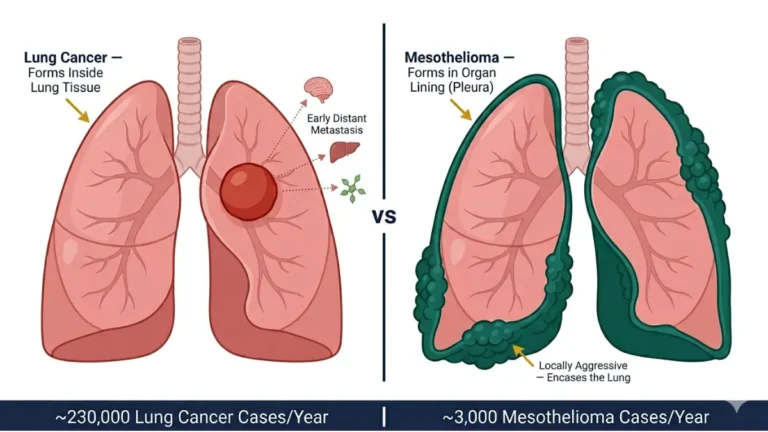
Smoking does NOT cause mesothelioma. However, workers with both asbestos exposure and a smoking history face a dramatically elevated risk of lung cancer — up to 60 times higher than non-exposed, non-smokers. This is a critical distinction between mesothelioma vs. lung cancer that is frequently confused.
If you have asbestos exposure history, quitting smoking is one of the most important steps you can take — not to reduce mesothelioma risk, but to significantly reduce your lung cancer risk.
Can You Get Mesothelioma Without Asbestos Exposure?
This is the most-searched and least-answered question in the entire mesothelioma causes topic. The answer is yes — but it’s rare.
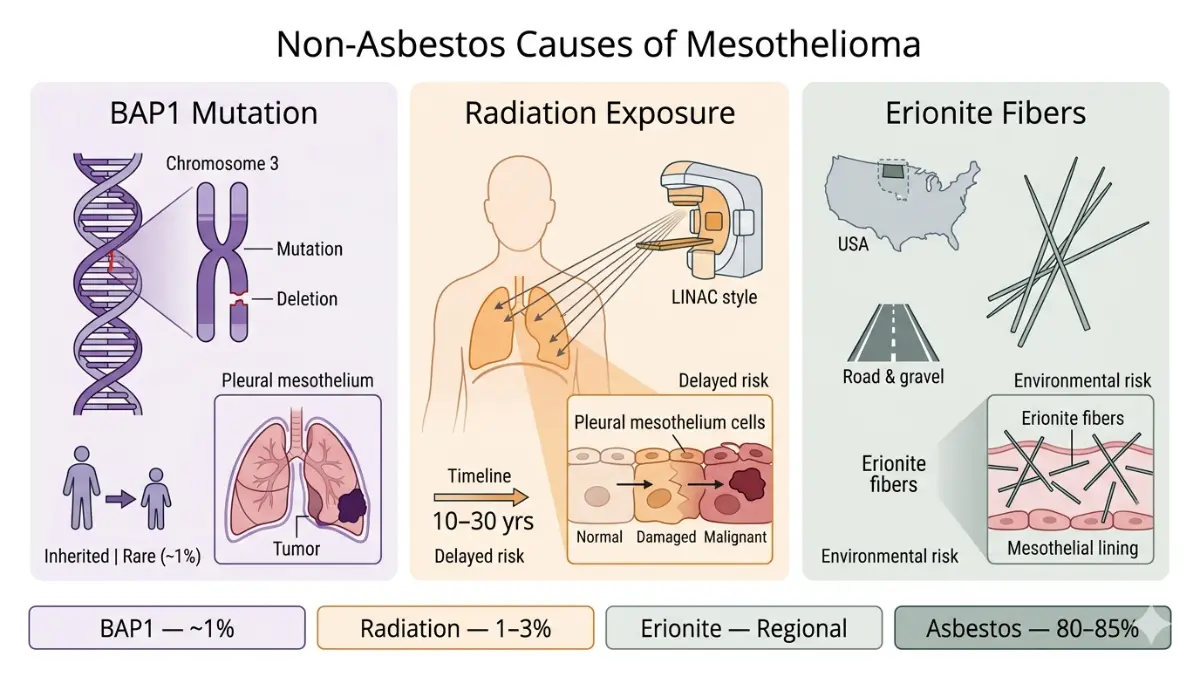
Approximately 15–20% of mesothelioma cases have no confirmed asbestos history. Research now identifies several alternative causes.
BAP1 Gene Mutation: Inherited Mesothelioma Risk
The BRCA1-Associated Protein-1 (BAP1) gene mutation is the most significant non-asbestos cause of mesothelioma confirmed by science. According to NIH research, people carrying a germline BAP1 mutation:
- Have a strongly elevated lifetime risk of mesothelioma
- Are also predisposed to uveal melanoma, renal cell carcinoma, and other cancers
- Can develop mesothelioma with lower levels of asbestos exposure than the general population
- May pass this risk to children (autosomal dominant inheritance)
BAP1-associated mesothelioma is estimated to account for approximately 1% of all cases — but in families where multiple members develop mesothelioma, BAP1 testing is now considered standard of care.
Prior Radiation Therapy
People who received radiation therapy for other cancers — particularly non-Hodgkin lymphoma, testicular cancer, and breast cancer — face a documented elevated mesothelioma risk. Studies reviewed in PubMed found relative risks as high as 30x compared to the general population.
This is not a reason to avoid radiation therapy — its benefits for treating primary cancers far outweigh this rare risk — but it means radiation-treated patients warrant long-term monitoring.
Erionite and Other Unregulated Mineral Fibers
Erionite is a naturally occurring mineral fiber found in North Dakota, parts of the western US, and certain regions of Turkey. It is not classified as asbestos and therefore remains unregulated — yet research shows it is more carcinogenic than most regulated asbestos types.
Communities in North Dakota exposed to erionite-contaminated road gravel have documented elevated mesothelioma rates, providing clear evidence that asbestos is not the only dangerous mineral fiber.
Non-Asbestos Causes: Summary Table
| Cause | Estimated % of Cases | Evidence Strength |
|---|---|---|
| Asbestos exposure | ~80–85% | Confirmed (IARC Group 1) |
| BAP1 gene mutation | ~1% | Confirmed |
| Prior radiation therapy | ~1–3% | Confirmed |
| Erionite/mineral fibers | Regionally elevated | Confirmed |
| Idiopathic (unknown) | ~15–20% | Under investigation |
🔬 If you have a family history of mesothelioma or were treated with radiation for another cancer, discuss genetic counseling and periodic imaging with your doctor. Our Genetic Risk Assessment Tool can help you document and understand your personal cancer risk profile before your appointment.
Mesothelioma Risk Factors — Full 2026 Breakdown
Understanding mesothelioma risk factors is not just academic. It determines whether you should be having proactive screening conversations with your doctor right now.
Complete Risk Factor Table 2026
| Risk Factor | Detail | Risk Level |
|---|---|---|
| Occupational asbestos exposure | Construction, shipbuilding, mining, manufacturing pre-1990 | Very High |
| Military service (Navy pre-1980) | Ship-based asbestos in 300+ components | Very High |
| Secondhand exposure | Family member of asbestos worker | Moderate–High |
| BAP1 gene mutation | Inherited predisposition | High |
| Male gender | ~3:1 male-to-female ratio (historically male-dominated industries) | Elevated |
| Age 65–74 | Peak diagnosis window (SEER registry data) | Elevated |
| Prior radiation therapy | Especially chest/abdominal radiation | Moderate |
| Geographic location | Maine, Montana, industrial Midwest | Elevated |
| Erionite exposure | North Dakota, parts of Turkey | High (regionally) |
The 2026 Asbestos Status: What Most Americans Don’t Know
A critical fact: asbestos is not fully banned in the United States as of 2026.
- The EPA’s 2024 rule banned chrysotile asbestos in most applications — a landmark step forward
- However, legacy asbestos (materials already installed in older buildings, schools, and homes) is explicitly not covered by the ban
- Chrysotile is still imported in small quantities for specific industrial uses
- According to ATSDR data, approximately 1.3 million construction workers remain at risk of exposure from legacy materials
What This Means for DIY Home Renovators
If your home was built before 1980, there is a realistic chance it contains asbestos in:
- Floor tiles and adhesives
- Ceiling tiles
- Pipe insulation wrap
- Attic insulation (vermiculite)
- Roof shingles
- Joint compound (drywall mud)
Do not sand, drill, or demolish these materials yourself. If you suspect asbestos, hire a licensed abatement professional. This is not an area where DIY saves money — it puts your entire family at risk.
Understanding the symptoms of asbestosis — a related asbestos-caused lung disease — can help identify whether you need urgent medical evaluation.
Exposed to Asbestos? What to Do Right Now
If you have a history of asbestos exposure — occupational, military, or secondhand — there are clear steps you can take today to protect your health.
Step-by-Step Action Plan for High-Risk Individuals
Step 1: Tell Your Doctor — In Detail Provide a complete occupational and exposure history. Specify:
- Which industries you worked in
- What years you were exposed
- How often and how intensely you were around asbestos
- Whether family members were also exposed
Many physicians never ask about asbestos history unless prompted. Proactive disclosure can trigger periodic imaging (chest CT scans) that catches mesothelioma at an earlier, more treatable stage.
Step 2: Quit Smoking Immediately If you have asbestos exposure history and you smoke, your lung cancer risk is up to 60 times higher than a non-exposed non-smoker. Quitting smoking is the single most impactful behavioral change you can make.
Step 3: Monitor Symptoms Actively Early mesothelioma symptoms are easily mistaken for pneumonia, pleurisy, or general fatigue. Red flags that warrant immediate medical evaluation include:
- Persistent shortness of breath that is worsening
- Unexplained chest or abdominal pain
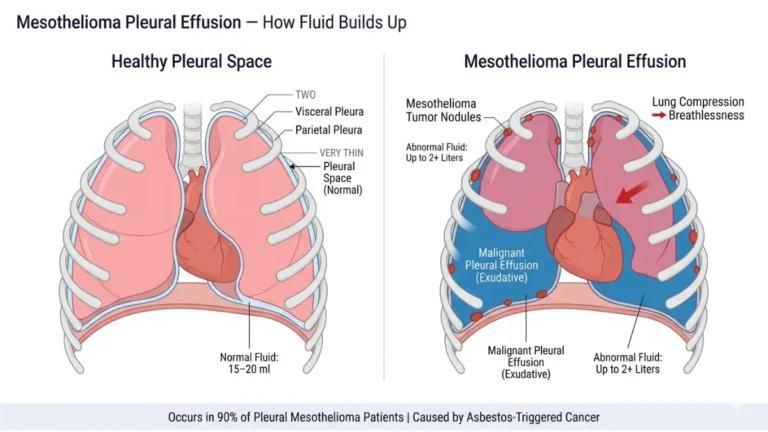
- New fluid accumulation in the chest or abdomen
- Unexplained weight loss
- Persistent dry cough
Use our Symptom Checker to log and review symptoms before your doctor’s appointment.
Step 4: Consider Genetic Testing If multiple family members have had mesothelioma, discuss BAP1 genetic testing with a genetic counselor. Early identification of a BAP1 mutation changes the screening protocol and may enable earlier detection.
Step 5: Do Not Disturb Suspected Asbestos If you live or work in a building constructed before 1980, do not disturb suspected asbestos-containing materials. Contact a certified asbestos inspector before any renovation work. The EPA’s asbestos guidance provides state-by-state contractor certification resources.
How Mesothelioma Is Diagnosed and Treated
Diagnosis typically involves:
- Chest X-ray or CT scan — identifies fluid or abnormal thickening
- PET scan — assesses disease spread
- Biopsy — the only definitive confirmation of mesothelioma
Treatment options in 2026 include surgery, chemotherapy (cisplatin + pemetrexed), immunotherapy (nivolumab + ipilimumab), and clinical trials. Understanding mesothelioma survival rates and life expectancy by stage helps patients and families prepare realistic expectations.
For a complete overview of the disease, our mesothelioma survival rates and symptoms pillar guide covers diagnosis, staging, and treatment in full detail.
🩺 What This Means For You: Asbestos exposure happened — you cannot undo it. But early disclosure to your physician, active symptom monitoring, and eliminating smoking are three steps that can meaningfully change your outcome. The earlier mesothelioma is caught, the more treatment options you have.
Frequently Asked Questions About Mesothelioma Causes
1. What is the main cause of mesothelioma?
Asbestos exposure is the primary cause, responsible for approximately 80–85% of all cases. Inhaled asbestos fibers lodge in the mesothelium and cause DNA-damaging inflammation over decades.
2. How does asbestos cause mesothelioma cancer?
Asbestos fibers become permanently trapped in mesothelial tissue, triggering chronic inflammation, activating the HMGB1 protein pathway, and gradually causing DNA mutations that transform healthy cells into cancer cells.
3. How long after asbestos exposure does mesothelioma develop?
The latency period is typically 20–60 years. Most patients diagnosed today were exposed to asbestos in the 1960s, 1970s, or 1980s.
4. Can you get mesothelioma without asbestos exposure?
Yes, though rarely. Documented non-asbestos causes include BAP1 gene mutations (~1% of cases), prior radiation therapy, and exposure to erionite and other unregulated mineral fibers.
5. What jobs have the highest risk of mesothelioma?
Shipyard workers, Navy veterans, insulation installers, construction workers, plumbers, auto mechanics, and miners who worked before 1990 face the highest occupational risk.
6. Can secondhand asbestos exposure cause mesothelioma?
Yes. Family members of asbestos workers who were exposed through contaminated clothing, hair, or skin have developed mesothelioma. This is called para-occupational or secondhand exposure.
7. Is mesothelioma hereditary?
Not typically. However, people with a BAP1 gene mutation have a significantly elevated inherited risk. If multiple family members have had mesothelioma, genetic counseling is recommended.
8. Does smoking cause mesothelioma?
No. Smoking does not directly cause mesothelioma. However, smokers with asbestos exposure history have a dramatically elevated risk of developing lung cancer — up to 60 times higher than the general population.
9. Is asbestos still used in the US in 2026?
The EPA banned chrysotile asbestos in most new applications in 2024. However, legacy asbestos in older buildings remains widespread and is not covered by the ban. Small quantities are still imported for specific industrial uses.
10. What are the first symptoms of mesothelioma from asbestos exposure?
Early symptoms include persistent shortness of breath, chest or abdominal pain, fluid accumulation, unexplained weight loss, and a persistent dry cough. These symptoms often mimic less serious conditions, causing dangerous diagnostic delays. Review our early mesothelioma symptoms guide for full detail.
11. What should I do if I was exposed to asbestos years ago?
Tell your doctor your complete exposure history immediately. Request periodic chest imaging if your doctor agrees it is appropriate. Quit smoking, monitor symptoms actively, and avoid disturbing any suspected asbestos-containing materials in your home or workplace.
For comprehensive information on this disease, visit our complete mesothelioma cancer recovery guide and our health tips hub.
Medical disclaimer
The content on MyMedicineAdvisor is provided for general informational and educational purposes only and is not a substitute for professional medical advice, diagnosis, or treatment. Health information on this website should not be used to diagnose, treat, cure, or prevent any condition without guidance from a qualified healthcare professional. Always seek the advice of your doctor, physician, or another licensed healthcare provider with any questions you may have regarding a medical condition, symptoms, medications, or treatment decisions.