
On This Page – Quick Medical Summary
Do you fast for an A1C test? The short answer
No. You do not need to fast before an A1C test, and you can eat and drink normally beforehand. The reason is built into what the test measures: it reports your average blood glucose over roughly the past three months, so a meal last night or coffee this morning cannot move it. NIDDK’s page on the A1C test, last reviewed in April 2018, states it plainly: you do not have to fast before having your blood drawn for an A1C, which means blood can be drawn at any time of the day.
That is the whole answer to the question as most people ask it. It is not the whole answer to the situation most people are actually in.
The reason this question is confusing is that you are rarely holding an order for an A1C alone. Fasting rules belong to specific other tests, and those tests are often ordered at the same visit, drawn from the same needle, on the same slip of paper.
No fasting is needed for the A1C itself
Nothing you eat or drink in the hours before your blood draw changes an A1C result. There is no overnight window to observe, no morning appointment to book, no reason to skip breakfast. If the A1C is the only thing on your order, you can arrive whenever the lab is open.
Which of these is you?
- You have one test on your order and it says A1C. You are done — eat normally. If you want to understand the number when it arrives, start with our guide to reading an A1C result and its honest margin.
- You have several tests on one slip. Section three below shows what each of the common ones asks of you, and where to check.
- You already ate, or you already fasted, and the appointment is soon. Skip to section six. There is something specific to say at the desk.
- You are taking someone else — a parent, a partner — and you are the one reading the instructions. Sections six and seven are written with you in mind too.
ℹ️ Medical Disclaimer: This article is general health education about test preparation; it cannot tell you what your specific laboratory order requires, diagnose any condition, or interpret your results. Preparation instructions come from the clinician who ordered your tests or the laboratory performing them, and you should not start, stop, or change any prescription or over-the-counter medication based on anything here. For questions about your order, your medications, or your results, contact the clinician who ordered the test or a board-certified physician.
Why food the night before cannot move your A1C
A single blood glucose reading is a snapshot. It rises after you eat, falls between meals, and looks different at 8am than at 8pm. That is precisely why the tests built around glucose have fasting rules — they are trying to catch you at a standard moment.
The A1C is not measuring a moment. Glycated hemoglobin is what the test actually counts, and it accumulates slowly, over the lifespan of your red blood cells.
What the test is actually measuring
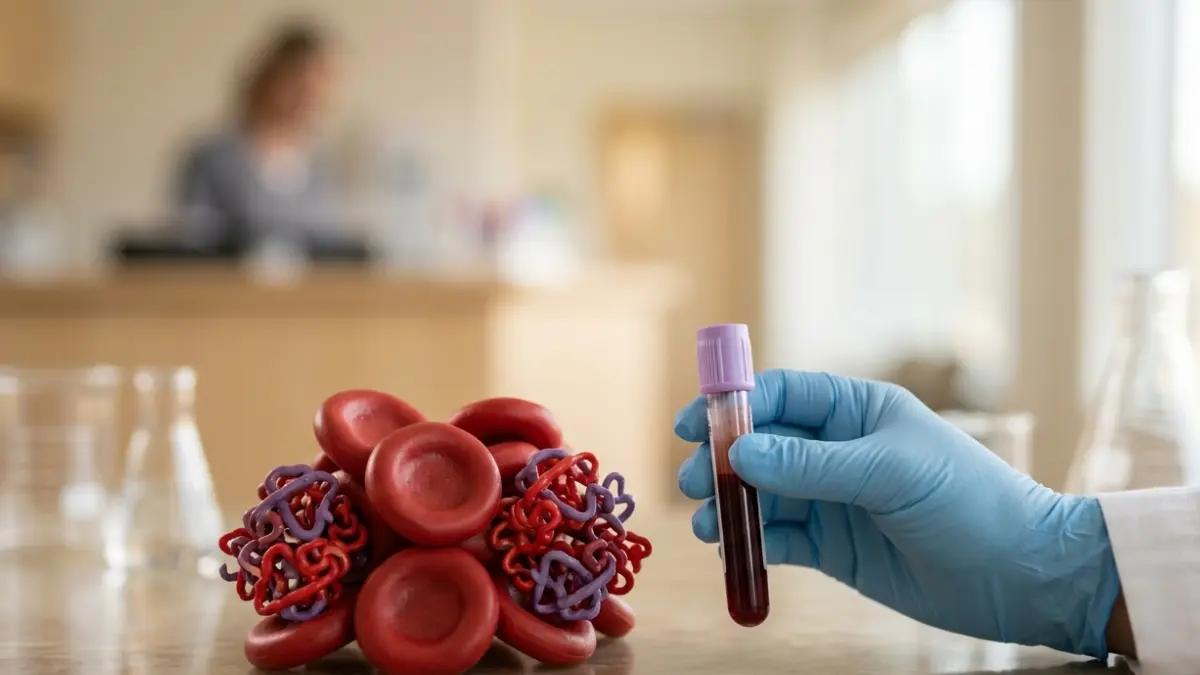
Hemoglobin is the protein in red blood cells that carries oxygen. Glucose circulating in your blood attaches to it, and the more glucose there has been, the more hemoglobin carries it. The A1C reports what percentage of your hemoglobin has glucose attached, which is why MedlinePlus describes it as information about your average blood glucose over the past three months from a single blood sample, with no fast required.
Why a single meal can’t shift a months-long average
Glucose attaching to hemoglobin is a slow, cumulative process, not a reversible one that rises and falls with your last meal. By the time blood is drawn, the fraction of your hemoglobin already carrying glucose was set over weeks — and one breakfast cannot subtract from it or add meaningfully to it.
🔬 How It Works: Think of a glucose meter reading as a photograph and an A1C as a long exposure. The photograph changes completely depending on when you take it. The long exposure averages everything that happened while the shutter was open, so a single bright moment near the end barely registers.
This is also why time of day does not matter for an A1C, and why there is no “best” appointment slot for one.
A separate question — whether something about your body or your laboratory could make an A1C result less reliable — is a real and important one, but it is not a preparation question. We cover it in how accurate the A1C test is and what the lab has to prove.
What each test on your order asks of you
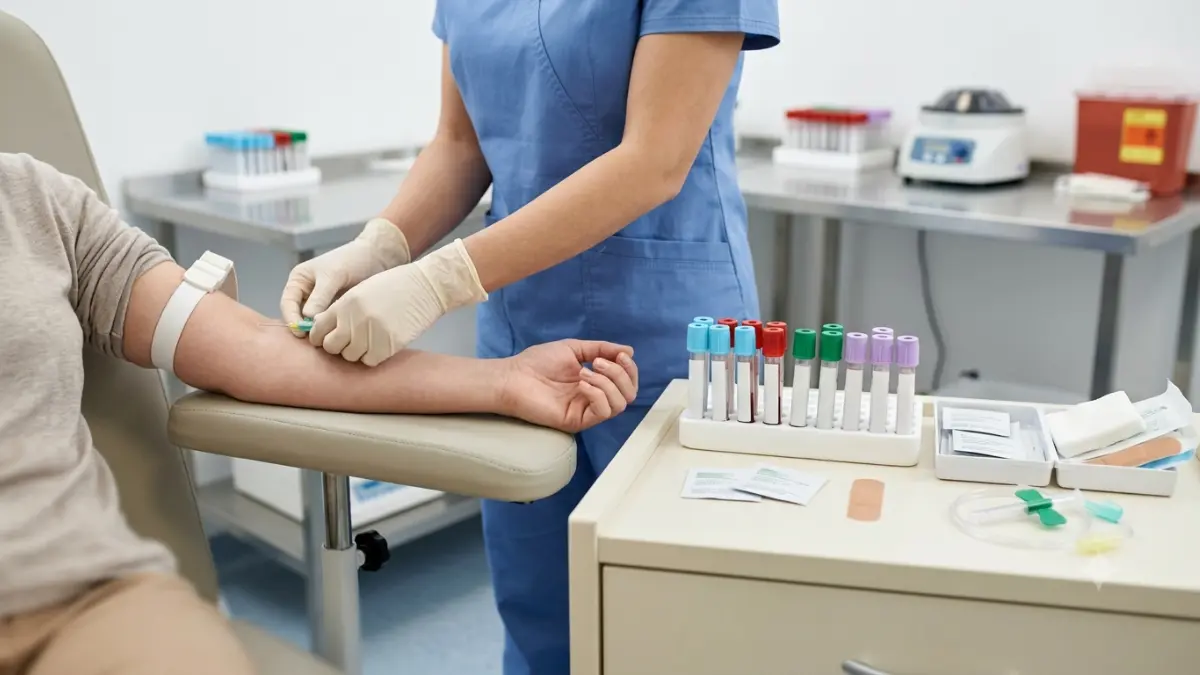
Diabetes blood tests do not all ask the same thing. Some need an overnight fast, some need a sugary drink, and some need you to stay at the lab for a couple of hours. The A1C is the only one on this list that asks for nothing at all.
The table below is drawn entirely from NIDDK’s summary of how each diabetes test is done, last reviewed July 2022.
The five diabetes blood tests, side by side
| Test | Fast beforehand? | What else it asks of you | Key clinical detail |
|---|---|---|---|
| A1C test | No — eat and drink normally | Nothing | One blood sample, any time of day |
| Fasting plasma glucose | Yes — at least 8 hours | Usually a morning appointment | Nothing to eat or drink except sips of water |
| Random plasma glucose | No | Nothing | Can be done at any time; often used when symptoms are present |
| Glucose challenge test | No | A sweet drink, then about a 1-hour wait | Used in pregnancy screening |
| Oral glucose tolerance test | Yes — at least 8 hours | A sweet drink, then about 2 hours at the lab | In pregnancy, blood is drawn every hour for 2 to 3 hours |
Source: NIDDK, Diabetes Tests & Diagnosis, last reviewed July 2022. The number of draws during a tolerance test varies by protocol; MedlinePlus describes samples taken roughly hourly for 2 to 3 hours.
The third column is the one worth planning around. Two of these tests will keep you at the laboratory for one to three hours, which matters more to most people’s morning than the fast itself does.
The panels that often travel with an A1C
An A1C rarely arrives alone on an order. It is commonly grouped with a metabolic panel or a cholesterol panel, and those have their own rules — MedlinePlus notes that if your glucose test is part of a basic or comprehensive metabolic panel, you may need to fast, and that not all glucose tests require fasting.
Because those rules differ by panel and by order, we have answered each one separately:
- Whether a basic metabolic panel needs a fast
- The same question for a comprehensive metabolic panel
- What current guidance says about fasting for a lipid panel
- Whether a complete blood count requires fasting
Why fasting when nobody asked you to can backfire
Here is the part almost nobody is told. If you are unsure whether to fast, the cautious-feeling default is to fast anyway — skip breakfast, drink water, be safe. It feels like the option with no downside.
It is not. The National Library of Medicine’s guidance on fasting before a blood test, updated in August 2025, says the opposite in plain words: you should not fast if your provider has not told you to, because fasting for some blood tests can itself affect your results and give your provider an inaccurate picture of your health.

Fasting you weren’t asked to do can change what your results mean
A glucose value means different things depending on whether you had eaten. Clinicians read a fasting glucose against one set of expectations and a non-fasting glucose against another. If you fasted and nobody recorded that you did, the number arrives labeled as something it is not — and the interpretation goes with it.
How common this is
This is not a hypothetical. The study MedlinePlus cites for its own instruction surveyed 526 adults arriving for outpatient blood work across two health systems.
📊 Clinical Data Point: Of 526 adults surveyed at outpatient blood draws, 330 (62.7%) had fasted — but only 131 of those fasting, about a quarter, had been told to by their care team, and almost half of everyone surveyed (257 of 526) believed fasting mattered for every blood test. Among 89 people who fasted without their care team’s knowledge and had glucose tested, 18 had a prediabetes diagnosis missed and 2 had a diabetes diagnosis missed. Source: DeWaters AL et al., Mayo Clinic Proceedings: Innovations, Quality & Outcomes, 2020; survey conducted September 2016 – April 2017.
Read that carefully, because it cuts against instinct. Fasting without telling anyone did not make the results safer. In that group, it hid the very thing the blood work was screening for.
If you take medication for diabetes
There is a second reason this matters, and it applies to a specific group of readers. In that same study, of 64 participants with diabetes who were taking insulin, 37 — nearly six in ten — fasted for their lab test and took their medication as prescribed.
🩺 Physician Note: Current patient guidance from the National Library of Medicine is explicit on both halves of this. Ask your provider whether it is okay to take your usual prescription and over-the-counter medicines before a fasting test — and do not stop taking your medicines unless your provider tells you to. Those two instructions are not in tension; they mean the decision belongs to your clinician rather than to you or to a web page.
✅ Patient Action: Do not decide this yourself in either direction. Before the appointment, call the office that ordered the test — or the laboratory, if you cannot reach them — and ask one question: “Does anything on this order require me to fast, and if so, what should I do about my medications that morning?” If you take medication for diabetes, say so when you ask.
That single question resolves both risks at once. It stops you fasting for nothing, and it stops you fasting in a way that was never planned for.
If your A1C is high, the next test may need a fast
One more thing worth knowing before you go, because it surprises people later: a test you did not fast for can send you back for one you must.
Why a second test usually follows
A diagnosis is not normally made on a single measurement. NIDDK states that a second test is usually used to confirm diabetes, and that if you do not have symptoms but an A1C shows diabetes or prediabetes, the test should be repeated on a different day — using the A1C again, or one of the other diabetes tests.
That last clause is the one that matters here. In an NIDDK-published expert interview, the point is put directly: a diagnosis should never rest on one test, and the second can be two A1Cs, or an A1C paired with a fasting plasma glucose or two-hour glucose test. If the second test chosen is a glucose test, it comes with the eight-hour fast that the A1C never asked for.
It runs the other way too. NIDDK notes that clinicians sometimes use the A1C to help confirm the result of another blood glucose test.
⚠️ Clinical Warning: A repeat test is routine, not a verdict. Confirmation exists because any single measurement carries a margin — which is the reason a second test is built into the process at all, and why one number is never treated as final. If your result was borderline or high, our pillar guide explains why a diagnosis needs a second measurement before anything is concluded.
The same thing happens in pregnancy
The clearest example is the pregnancy screening pathway, and both of our federal sources describe it the same way: the glucose challenge test needs no fast, so you drink a sweet liquid and blood is taken an hour later. If that result is high, you may be asked to return for an oral glucose tolerance test, this time while fasting. The CDC’s overview of diabetes blood tests, which displays a May 2024 date, describes the same two-step sequence.
If you want to understand where a result sits before that conversation, we cover what the A1C bands actually are, what a result below the prediabetes range settles, and what doctors check next after a borderline A1C.
You fasted, or you ate: what to do now
If you are reading this in a car park with an appointment in twenty minutes, this section is for you. The A1C itself is fine either way. The only thing that needs handling is everything else on the order.

If you ate and you think you shouldn’t have
Say so at the desk, before the blood draw, not after. MedlinePlus is direct about this: tell your provider if you ate or drank before your test, because you may need to reschedule for a time when you can fast so the results are accurate.
That is not a wasted trip in every case. Often the non-fasting tests can be drawn now and only the fasting ones moved. But that decision belongs to the laboratory and the ordering clinician, and they can only make it if they know.
For the record, breaking a fast is broader than eating. MedlinePlus specifies plain water only — no chewing gum, no smoking, no exercise — and warns that flavored or lemon water may contain sugars or sweeteners. Coffee counts as breaking a fast; if you are wondering specifically about that before a cholesterol draw, we answer it in whether coffee before a lipid panel affects the result.
✅ Patient Action: Before the needle goes in, say one sentence to the phlebotomist: “I ate at [time] — I wasn’t sure whether I needed to fast. Does that change anything on this order?” If you are bringing someone else to their appointment, you can say it on their behalf.
If you fasted and nobody asked you to
Say that too, and for the same reason: your fasting status changes how a glucose result is read, and the only way it gets recorded is if you mention it.
Two practical notes from the same MedlinePlus guidance: staying well hydrated with plain water actually helps, because water keeps more fluid in your veins and can make the sample easier to take. It is also common to feel light-headed after a blood test that required fasting, so bringing a snack to eat immediately afterward is sensible. After an oral glucose tolerance test in particular, MedlinePlus notes your provider may suggest arranging for someone to take you home.
⚠️ Clinical Warning: Do not assume a non-fasting glucose result is fine because the A1C is unaffected. Whether a glucose value drawn after eating can still be used depends on what was ordered and why, and that is the ordering clinician’s call — not something to settle in the waiting room. Normal glucose ranges are covered separately in what normal blood sugar results look like.
What to ask before your blood draw
Everything above collapses into three questions. Ask them when the test is ordered, not the night before — MedlinePlus recommends asking at least a full day ahead so there is time to prepare properly.
Three questions worth asking when the test is ordered
- “Does anything on this order require me to fast, and for how long?” This is the question that replaces guessing. It covers every test on the slip at once.
- “Should I take my usual medicines that morning?” Ask it whether or not you have diabetes. The instruction from the National Library of Medicine is to ask — and not to stop any medicine unless your provider tells you to.
- “How long should I expect to be at the lab?” The tests involving a sugary drink are appointments, not errands, and knowing that in advance prevents a rescheduled draw.
These are conversation openers, not a checklist to score yourself against. There is no right combination of answers.
What this page can’t tell you
We cannot see your lab order. That is not a formality — it is the actual limit. Preparation depends on which tests were requested and why, and the only people who can answer that are the office that ordered them or the laboratory running them.
One more thing worth saying plainly, because this question attracts sellers: we do not recommend or link to any at-home A1C product on this page. The feature that makes at-home kits appealing here — that an A1C needs no preparation — is about how easily a sample can be collected, which is a different question from whether a result can be used to diagnose anything. Our own cited sources draw that line clearly, the CDC advising that anyone whose blood sugar was tested at a health fair or pharmacy should follow up with their doctor for a possible re-test, so recommending a product that cuts against them would not be honest.
Common questions about fasting and the A1C test
1. Do you need to fast for an A1C test?
No — you do not fast for an A1C test, and you can eat and drink normally beforehand. NIDDK states that you can eat and drink before this test and that blood can be drawn at any time of day. The only reason to fast on the day of an A1C is if a different test on the same order requires it, so confirm what was ordered.
2. Can eating before the test change my A1C result?
No. The A1C reports your average blood glucose over roughly three months by measuring how much glucose has attached to hemoglobin in your red blood cells, and that accumulates slowly over weeks, so a single meal cannot meaningfully shift it. This is why no fasting window, and no particular appointment time, applies to the A1C test.
3. Which diabetes blood tests do require fasting?
Two of the five common ones require fasting. A fasting plasma glucose test and an oral glucose tolerance test both need at least eight hours without food or drink other than sips of water. The A1C, the random plasma glucose test and the pregnancy glucose challenge test require no fast, though the challenge test involves a sweet drink and about an hour’s wait.
4. How long do you fast before a blood test?
Usually 8 to 12 hours, though the exact window depends on the test your provider ordered. During that time MedlinePlus specifies plain water only, with no chewing gum, no smoking and no exercise, and warns that flavored water may contain sugars or sweeteners. Scheduling the draw early in the morning means most of the fasting happens while you are asleep.
5. Can I drink water or coffee before an A1C test?
Both are fine if the A1C is the only test on your order, because nothing you drink changes an A1C result. If a fasting test is also on the order, the rules tighten to plain water only, and coffee would break that fast. Avoid flavored or lemon water during a fast as well, since it may contain sugars or artificial sweeteners.
6. Should I fast anyway, just to be safe?
No, and this is the most misunderstood part of the question: MedlinePlus states you should not fast if your provider has not told you to, because fasting for some tests can itself affect your results and give an inaccurate picture of your health. Fasting that nobody recorded can cause a glucose value to be read against the wrong expectations. Ask what your order requires instead.
7. I have diabetes — is fasting for a blood test risky for me?
It is a question to raise rather than solve alone. Published patient guidance is to ask your health care provider whether it is okay to take your usual medicines before a fasting test, and never to stop taking a medicine unless your provider tells you to. If you take medication for diabetes, mention that specifically when you call the office that ordered the test.
8. I already ate. Do I need to reschedule?
Not necessarily, but tell the person drawing your blood before the draw rather than after, because your A1C itself is unaffected either way. Whether any other test on the order can still be run, or needs moving to another day, is a decision for the laboratory and the ordering clinician. MedlinePlus notes that rescheduling is sometimes needed so the results stay accurate.
9. If my A1C is high, will the next test need fasting?
It might. NIDDK states that a second test is usually used to confirm a diagnosis, and this confirmatory testing can be another A1C or one of the other diabetes tests. If a fasting plasma glucose or two-hour glucose test is chosen, that one does require an eight-hour fast, so ask which test is planned.
10. Does the time of day matter for an A1C test?
No. Because the A1C reflects an average built up over about three months rather than your glucose at that moment, morning and afternoon draws give the same information, and NIDDK notes blood can be drawn for an A1C at any time of day. Time of day does matter for a fasting glucose test, which is usually done first thing in the morning.
11. Do I need to fast for an A1C during pregnancy?
Not for the A1C itself. Pregnancy screening usually involves the glucose challenge test, which needs no fast but does involve a sweet drink and about an hour’s wait, and if that result is high an oral glucose tolerance test may follow. That one does require fasting beforehand, so ask your prenatal team which test is scheduled and what it needs.
What this means for your next appointment
The A1C asks nothing of you before you arrive. Eat breakfast, drink your coffee, book whatever time suits you.
The rest of your order might ask for something, and the people who wrote that order are the only ones who can tell you what. One phone call settles it — and if nobody has told you to fast, do not fast on your own initiative.
When the result comes back, the next question is what the number actually means, and how much of a margin sits around it. Our pillar guide to reading an A1C result takes it from there.
About this content
How this article was put together: researched from recognised health sources, drafted with the help of AI tools, and edited by hand, with sources linked throughout.

Sameer Patel is the founder and editor of My Medicine Advisor. He is not a doctor or medical professional — before starting this site he worked in banking,…
Medical disclaimer
The content on MyMedicineAdvisor is provided for general informational and educational purposes only and is not a substitute for professional medical advice, diagnosis, or treatment. Health information on this website should not be used to diagnose, treat, cure, or prevent any condition without guidance from a qualified healthcare professional. Always seek the advice of your doctor, physician, or another licensed healthcare provider with any questions you may have regarding a medical condition, symptoms, medications, or treatment decisions.