
On This Page – Quick Medical Summary
You can buy a glucose sensor without a prescription now
Yes. Three over-the-counter CGM systems now have FDA clearance in the US: Dexcom’s Stelo, and Abbott’s Lingo and Libre Rio.
Where you sit decides which one is even cleared for you:
- Type 2 diabetes managed without insulin → Stelo or Libre Rio.
- No diagnosis, just tracking meals and exercise → Stelo or Lingo.
- Using insulin, or a history of severe low blood sugar → none of these; ask about a prescription CGM.
All three are cleared only for people not using insulin. If a fasting glucose of 100–125 sent you looking, start with the ranges these sensors report against.
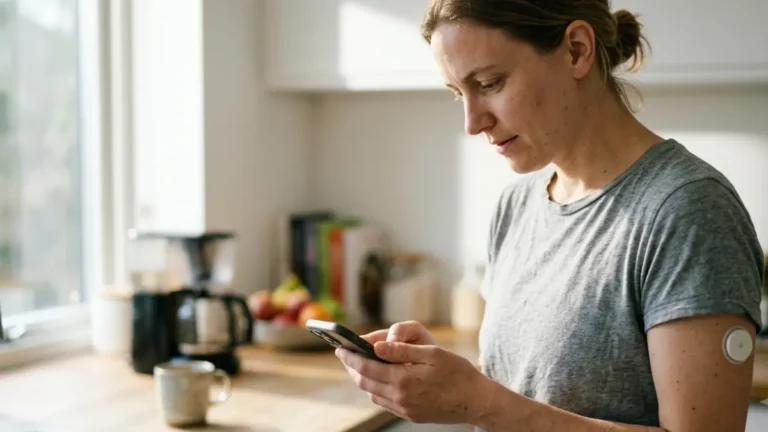
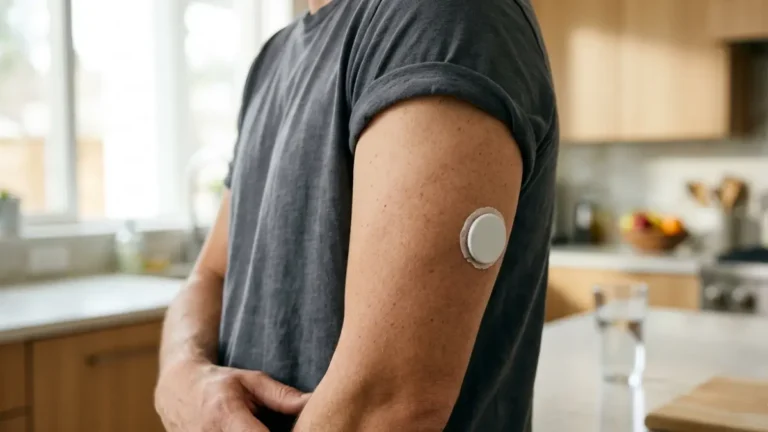
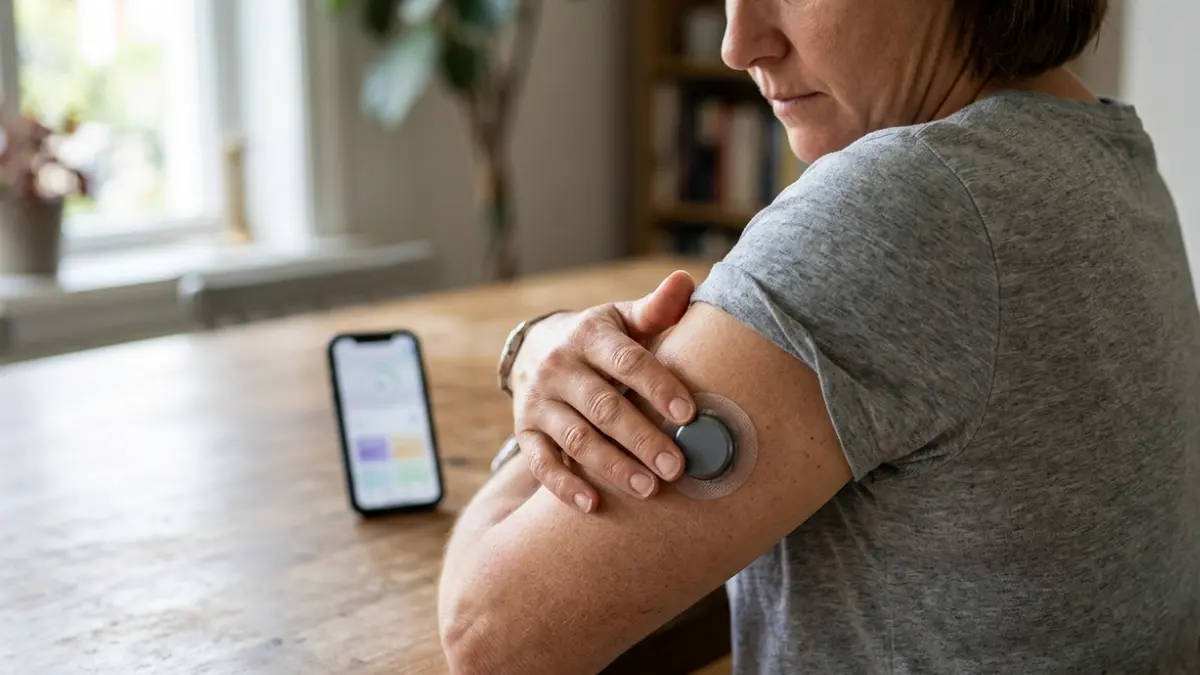
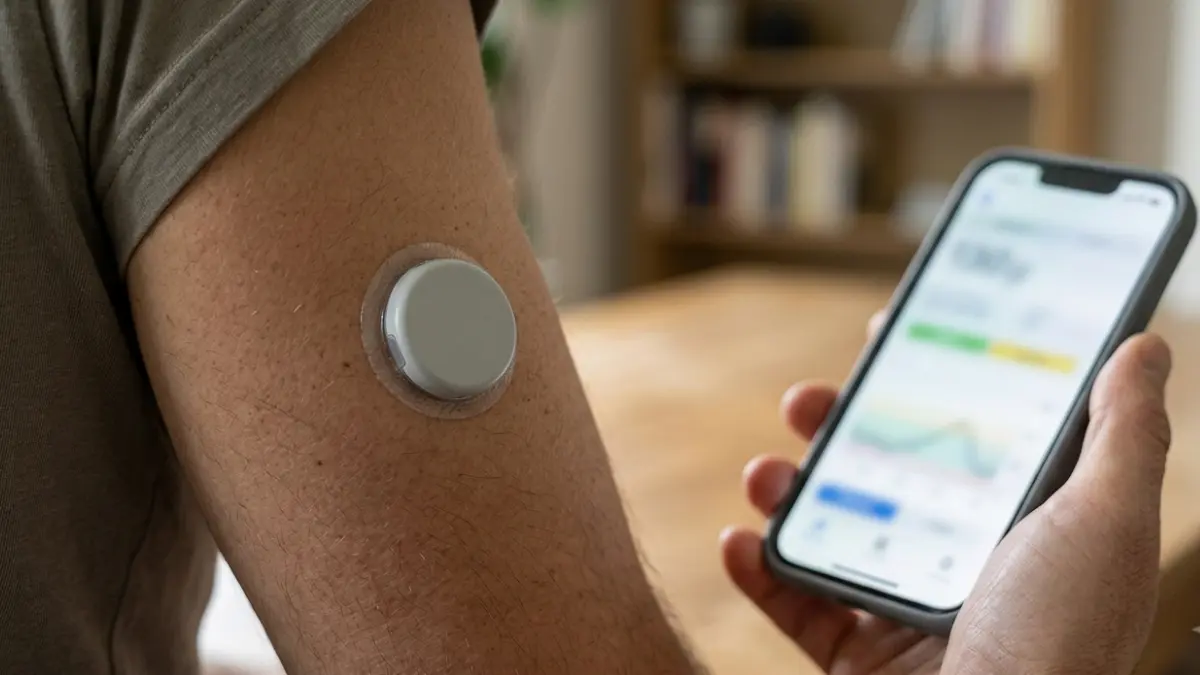
🔬 How It Works: These sensors never touch blood. A filament under the skin of your upper arm reads glucose in interstitial fluid, then sends the number to your phone. Because glucose reaches that fluid minutes after it reaches blood, a sensor reading lags a fingerstick.
ℹ️ Medical Disclaimer: This article explains how three FDA-cleared consumer devices work; it does not diagnose diabetes, prescribe or adjust any medication, recommend a procedure, or advise on insurance coverage. None of these sensors is a diagnostic test. Before starting, stopping, or acting on any glucose reading, consult a board-certified endocrinologist or your primary care physician.
Stelo, Lingo and Libre Rio at a glance
| Device | Cleared for | Wear time | Alarms | Key clinical detail |
|---|---|---|---|---|
| Stelo (Dexcom) | Ages 2+, not on insulin | Up to 15 days, 12-hour grace | None | New reading shown every 15 minutes |
| Lingo (Abbott) | Adults 18+, not on insulin | 14 days | None | Not intended to diagnose any condition, including diabetes |
| Libre Rio (Abbott) | Adults 18+, not on insulin | Reported up to 15 days | None | Cleared as equivalent to FreeStyle Libre 2 |
Source: FDA 510(k) decision summaries K234070, K233655, K233861; FDA pediatric clearance, June 2026.
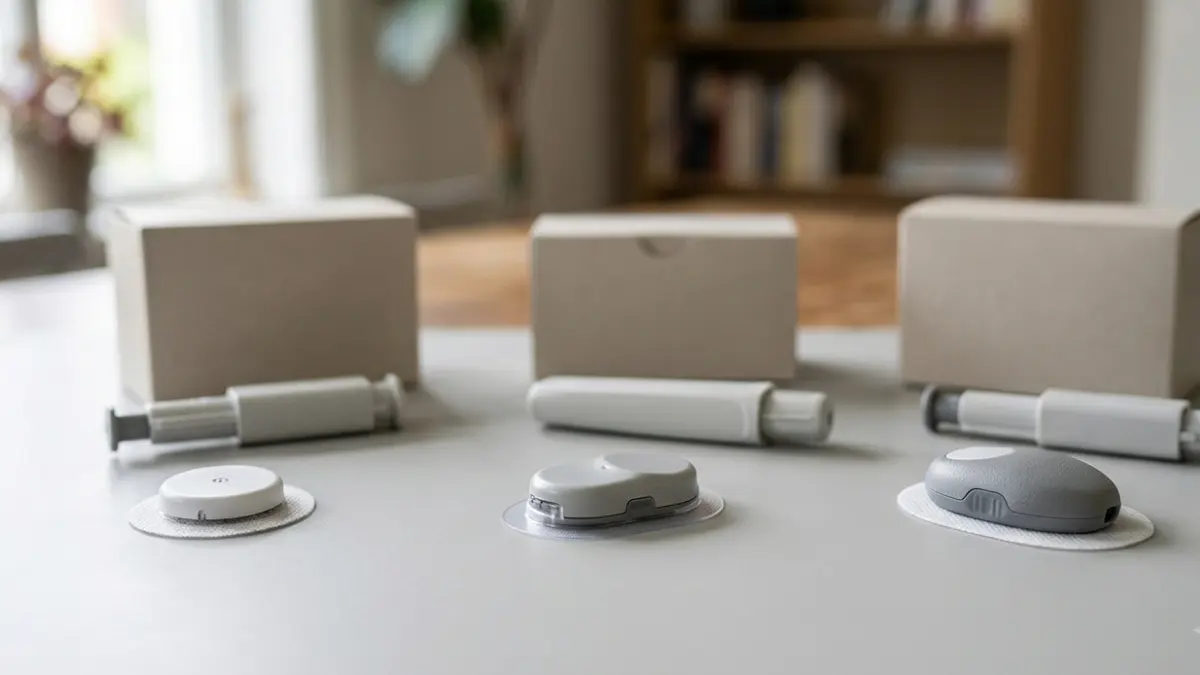
None of the three has a glucose alarm. That is not a cost saving — removing the low and high alarms is precisely what allowed FDA 510(k) clearance as over-the-counter products for people who are not dosing insulin.
Stelo’s clearance was extended to children aged two and older in June 2026. Lingo and Libre Rio remain adult-only.
What number will actually show on your screen
Lingo reports glucose only between 55 and 200 mg/dL. Stelo’s app displays only 70 to 250 mg/dL. Libre Rio covers the full 40 to 400 mg/dL range.
Stelo stops at 70 and 250
The sensor measures 40–400 mg/dL, but Stelo’s FDA clearance summary confirms the app narrows the display to 70–250. Outside that, it reads “Below 70 mg/dL” or “Above 250 mg/dL.” The full range appears afterwards in Dexcom Clarity.
Lingo stops at 55 and 200
Lingo’s FDA clearance summary sets a reportable range of 55–200 mg/dL. Outside it, the app shows “< 55 mg/dL” or “> 200 mg/dL” — never a value.
Libre Rio shows the full range
Libre Rio’s cleared measuring range is 40–400 mg/dL, the widest of the three.
📊 Clinical Data Point: Displayed ranges — Stelo 70–250 mg/dL, Lingo 55–200 mg/dL, Libre Rio 40–400 mg/dL. Source: FDA 510(k) decision summaries K234070, K233655 and K233861 (2024).
🩺 Physician Note: A common point of confusion is that a sensor’s measuring range and its displayed range are the same number. They are not. If recognising a low blood sugar matters clinically for you, that is a conversation about a prescription device with alarms.
Which one fits your situation
If you have type 2 diabetes and don’t use insulin
Both Stelo and Libre Rio are cleared for you. Libre Rio’s wider range means a genuine spike above 250 mg/dL would still appear as a number.
If you’re tracking metabolic health without a diagnosis
Lingo and Stelo both fit. Lingo’s labeling states it is not intended to diagnose any disease, including diabetes — it will not tell you whether you have one.
If you use insulin or have had a serious low
None of these three. A prescription CGM with alarms is the cleared option, and time in range versus A1c is the discussion worth having.
✅ Patient Action: Before buying, ask your primary care physician or endocrinologist: “Given my current medications and history, would a prescription CGM with low-glucose alarms be covered for me?”
How accurate these sensors really are
MARD — mean absolute relative difference — is the standard accuracy measure, and lower is better. In FDA filings, accuracy shifts with both your glucose level and the day of wear.
Accuracy changes with your glucose level
Stelo’s MARD was 8.2% at 70–180 mg/dL and 7.4% at 181–250, but 15.4% below 54 mg/dL. Lingo’s was 9.7% at 70–180 and 10.7% at 181–200.
Accuracy changes with the day of wear
Lingo’s MARD was 11.5% across days one to three, improving to 8.5% by days five to seven. Stelo’s ran 9.1% at the start and 7.3% in the late middle. First-day readings are the least reliable ones you will see.
Sensors don’t always last the session
73.5% of Stelo sensors reached day 15 in its pivotal study; 77.1% of Lingo sensors reached day 14. Libre Rio has no separate accuracy dataset — its clearance leans on FreeStyle Libre 2 data.
📊 Clinical Data Point: Lingo MARD 11.5% on days 1–3 versus 8.5% on days 5–7. Source: FDA 510(k) decision summary K233655 (2024).
Readings outside the US are often reported in mmol/L; a blood sugar converter will translate them.
What you’ll pay, and what you can actually buy
Stelo pricing
Stelo lists at $99 for a two-sensor pack covering roughly 30 days, or $89 per month on subscription, and is HSA/FSA eligible. (List pricing as of August 2026 — confirm at checkout.)
Lingo pricing
Broadly comparable per month. Abbott does not publish an ongoing subscription price the way Dexcom does, so verify the renewal figure before any auto-renew starts.
The Libre Rio problem
Libre Rio’s FDA clearance summary dates to June 2024, but Abbott has announced no price, and there is no confirmed US retail launch as of August 2026. Roundups listing it as purchasable are ahead of the evidence.
Who shouldn’t use one, and what can skew your readings
When not to use an OTC CGM
None of the three is cleared for anyone on dialysis or critically ill. Stelo additionally excludes people with problematic hypoglycemia, because it cannot alert them.
Substances that push readings higher than they are
- Acetaminophen above 1 g every 6 hours, and hydroxyurea at any dose, falsely raise Stelo readings.
- More than 1,000 mg of vitamin C daily may falsely raise Lingo and Libre Rio readings.
Scans, children, and what to check first
Stelo is MR unsafe — remove it before an MRI or diathermy; a CT scan is acceptable if the sensor sits outside the scanned area under a lead apron. Libre Rio must be removed before diathermy. Under the FDA’s June 2026 clearance for children aged two and older, Stelo is used with adult supervision, and the FDA notes that anyone with a history of an eating disorder should speak with their health care provider before use.
⚠️ Clinical Warning: No over-the-counter CGM will alert you to a dangerous low or high. If a reading conflicts with how you feel, confirm it with a standard fingerstick meter before acting on it.
✅ Patient Action: Bring your medication list to your prescribing clinician and ask: “Do any of these interfere with sensor glucose readings?”
Common questions about OTC CGMs
1. Can you buy a CGM without a prescription?
Yes. Three OTC CGM systems are FDA-cleared in the US, all for people not using insulin.
2. What is the difference between Stelo and Lingo?
Stelo runs 15 days showing 70–250 mg/dL; Lingo runs 14 days showing 55–200 mg/dL. Confirm the fit with your clinician.
3. Can you actually buy Libre Rio?
It was cleared in June 2024, but has no announced price and no confirmed US retail launch as of August 2026.
4. Does Stelo show low blood sugar?
No. Below 70 mg/dL it displays “Below 70 mg/dL” with no value and no alarm. Discuss alarm-capable options with your physician.
5. Does Lingo show high blood sugar?
Above 200 mg/dL, Lingo shows “> 200 mg/dL” rather than the real value, leaving genuine spikes unquantified.
6. How accurate is an OTC CGM?
MARD sat near 8–10% mid-range in FDA filings and worsened at very low glucose. Verify unexpected readings with your clinician.
7. When is a CGM sensor least accurate?
Early in wear. Lingo’s MARD was 11.5% across days one to three, improving to 8.5% by days five to seven.
8. Do over-the-counter CGMs have alarms?
No. None of the three has a low or high glucose alarm, and that omission is what enabled OTC clearance.
9. Can children use an OTC CGM?
Stelo was cleared in June 2026 for ages two and older with adult supervision. Confirm suitability with your child’s pediatrician.
10. Can vitamin C affect CGM readings?
Yes. More than 1,000 mg daily may falsely raise Lingo and Libre Rio readings, per their FDA clearance documents.
11. How much does an OTC CGM cost per month?
Stelo lists at $99 per two-sensor pack or $89 by subscription; Lingo’s ongoing price is not published.
Your next step
Choose on what the device will actually display, not on the app design. If you need to see a real low, none of these three will show you one. Check your own numbers against the full glucose reference chart before spending anything.
About this content
How this article was put together: researched from recognised health sources, drafted with the help of AI tools, and edited by hand, with sources linked throughout.

Sameer Patel is the founder and editor of My Medicine Advisor. He is not a doctor or medical professional — before starting this site he worked in banking,…
Medical disclaimer
The content on MyMedicineAdvisor is provided for general informational and educational purposes only and is not a substitute for professional medical advice, diagnosis, or treatment. Health information on this website should not be used to diagnose, treat, cure, or prevent any condition without guidance from a qualified healthcare professional. Always seek the advice of your doctor, physician, or another licensed healthcare provider with any questions you may have regarding a medical condition, symptoms, medications, or treatment decisions.