
On This Page – Quick Medical Summary
Quick Answer: Cord blood banking can be lifesaving — but the answer depends entirely on your family’s medical history. For most healthy families with no known genetic disease, donating to a public bank is the smarter, medically endorsed choice. For families with a history of blood cancers, sickle cell disease, or rare immune disorders, private cord blood banking may be genuinely worth the $2,500–$3,500 investment. Here is the complete, honest breakdown.
What Is Cord Blood Banking and How Does It Work in 2026?
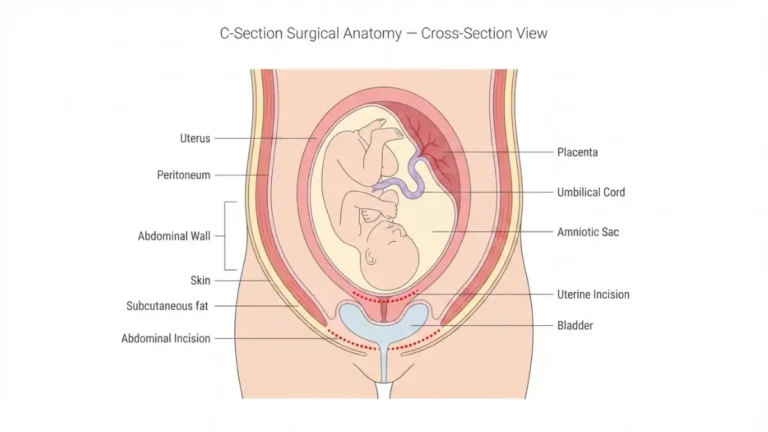
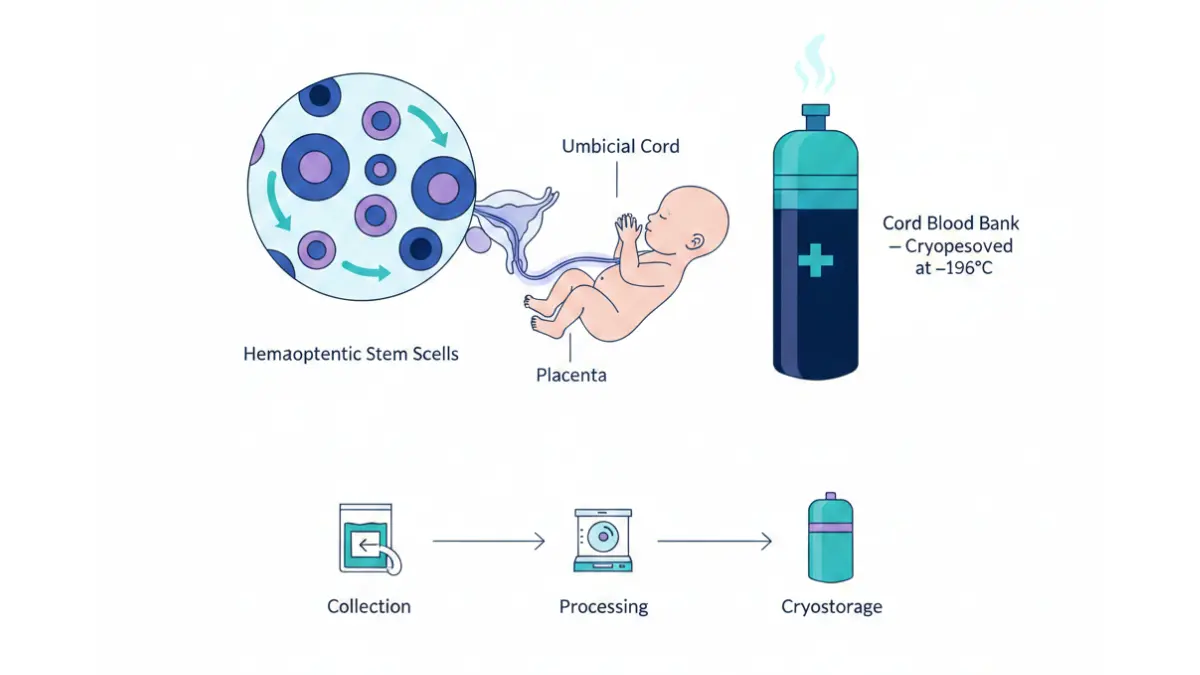
When your baby is born, a small amount of blood remains inside the umbilical cord and placenta. That blood — once routinely discarded as medical waste — is now considered one of the richest natural sources of hematopoietic stem cells (HSCs) available in medicine.
Cord blood banking is the process of collecting and cryogenically preserving those stem cells immediately after delivery for potential future medical use. The collection itself is painless, takes under 10 minutes, and does not interfere with delayed cord clamping if timed correctly with your birth team.
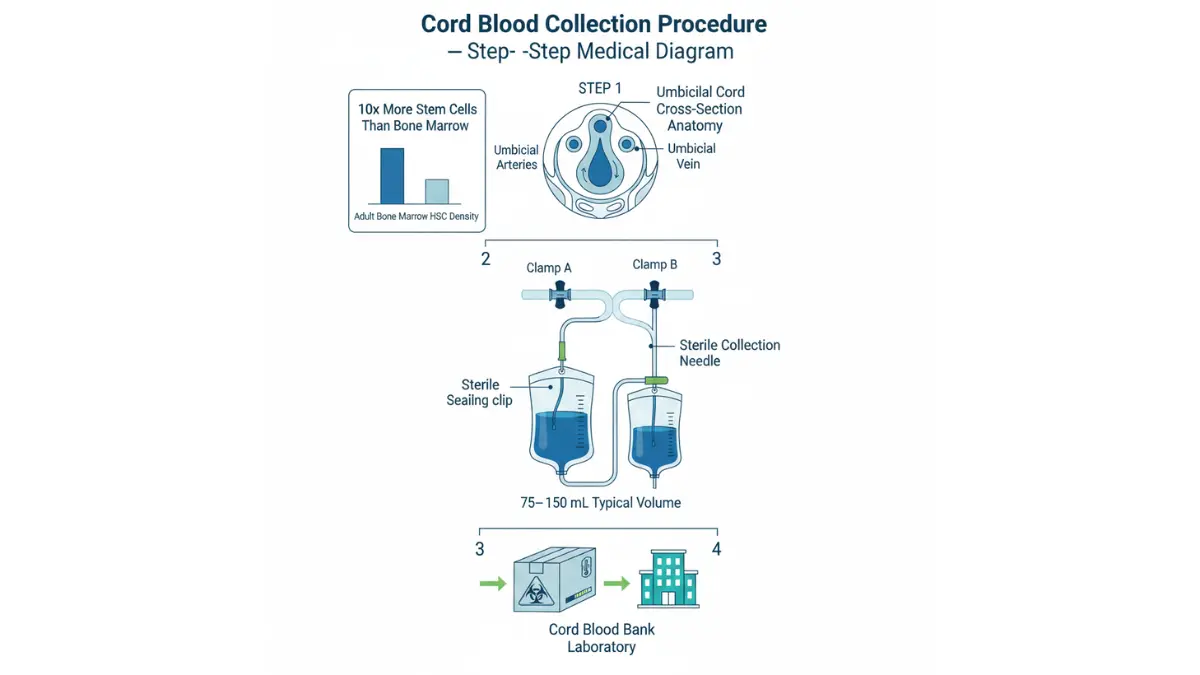
How Cord Blood Is Collected: Step-by-Step
- After delivery, the umbilical cord is clamped and cut.
- A sterile needle is inserted into the umbilical vein to draw blood from the cord and placenta.
- The blood is sealed in a collection bag (typically 75–150 mL) and packaged by the banking kit.
- It is shipped to the cord blood bank’s laboratory within 24–48 hours.
- The bank processes, tests, and cryopreserves the unit in liquid nitrogen at approximately -196°C.
Why Cord Blood Stem Cells Are Medically Valuable
According to research published in the NIH National Center for Biotechnology Information, cord blood contains hematopoietic stem cells that show greater efficacy than stem cells obtained from adult donors — because they are younger, less exposed to environmental damage, and more adaptable.
Cord blood has 10 times more stem cells than bone marrow. It also carries a lower risk of graft-versus-host disease (GVHD) after transplant compared to adult bone marrow donations.
If you are currently pregnant and planning ahead, use our Pregnancy Due Date Calculator to identify your delivery timeline — most banks require enrollment by Week 28–34 of pregnancy.
What This Means For You: Cord blood is biologically powerful. The question is not whether the stem cells are valuable — they are. The real question is whether private banking is the right choice for your specific family.
What Diseases Can Cord Blood Stem Cells Treat? (2026 Updated List)
This is where competitors like Healthline and WebMD lose the plot. They list diseases generically. We give you the full clinical picture.
Proven, FDA-Recognized Treatments (80+ Diseases)
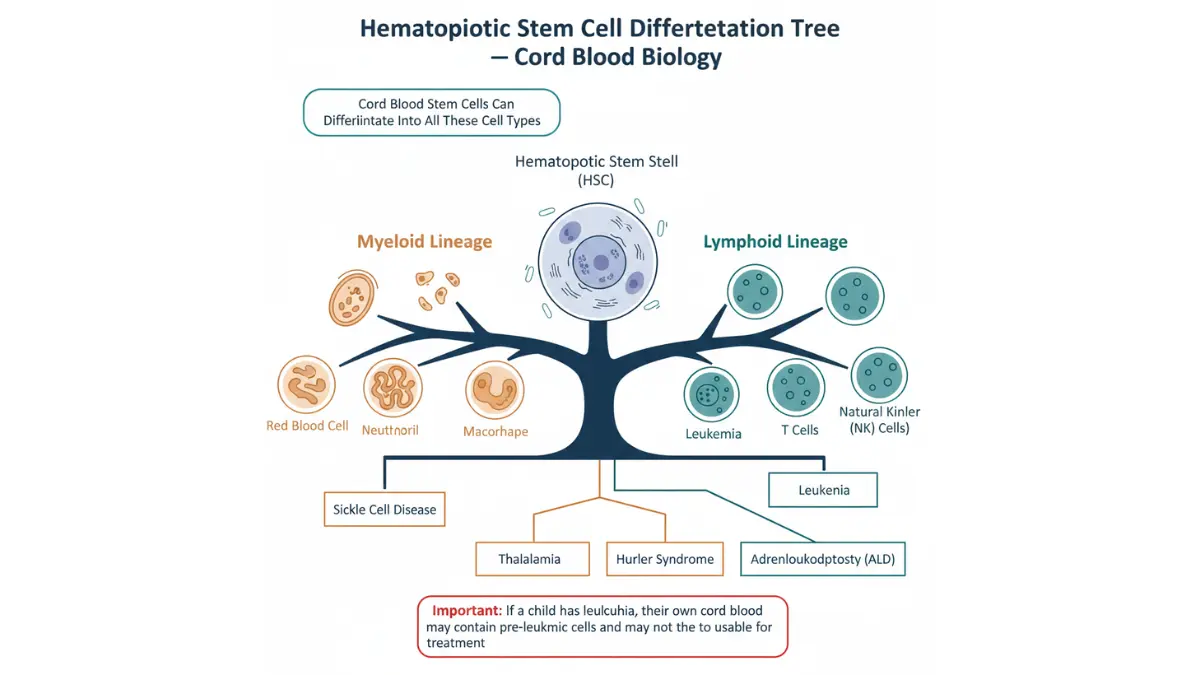
Cord blood stem cell transplants are currently used as standard medical care for a broad range of serious conditions. According to the AAP’s policy statement on cord blood banking, these include:
Blood Cancers:
- Acute myeloid leukemia (AML)
- Acute lymphoblastic leukemia (ALL)
- Hodgkin’s and non-Hodgkin’s lymphoma
- Myelodysplastic syndrome (MDS)
Genetic Blood Disorders:
- Sickle cell disease
- Thalassemia (beta and alpha)
- Fanconi anemia
- Diamond-Blackfan anemia
Immune Deficiencies:
- Severe Combined Immunodeficiency (SCID)
- Wiskott-Aldrich syndrome
- Chronic granulomatous disease
Metabolic Disorders:
- Adrenoleukodystrophy (ALD)
- Hurler syndrome (MPS-1)
- Krabbe disease
Emerging Therapies in Active Clinical Trials (2025–2026)
Cord blood research is moving fast. Current clinical trials are exploring its use in:
- Cerebral palsy — multiple Phase II trials showing neurological benefit in children
- Type 1 diabetes — early-stage trials using cord blood infusions to slow progression
- Autism spectrum disorder — Duke University trials showing behavioral improvement
- Stroke and spinal cord injury — adult regenerative medicine applications
If genetic conditions run in your family, our Genetic Risk Assessment Tool can help you identify inherited risk factors before your baby’s birth.
The Critical Truth Competitors Won’t Tell You
This is the most important fact in this entire article. If your child develops leukemia later in life, their own privately banked cord blood almost certainly cannot be used to treat them. The AAP’s 2017 policy is clear: “cord blood already contains premalignant cells and cannot, therefore, be used to treat the child.”
The same logic applies to sickle cell disease and most genetic disorders — if the mutation is in your child’s DNA, it is already in their stored cord blood. Autologous use (using your own child’s cord blood on themselves) is medically limited.
| Scenario | Can Own Cord Blood Be Used? |
|---|---|
| Child develops leukemia | ❌ No — premalignant cells already present |
| Child has sickle cell | ❌ No — genetic mutation already in the sample |
| Sibling needs transplant | ✅ Yes — if HLA-matched |
| Child has acquired aplastic anemia | ✅ Possibly — if not inherited |
| Child has cerebral palsy (clinical trial) | ✅ Yes — autologous use approved in trials |
Private vs. Public Cord Blood Banking — The Complete 2026 Comparison
Understanding the difference between private and public cord blood banking is the single most important decision point for expecting parents. Here is the breakdown no competitor explains completely.
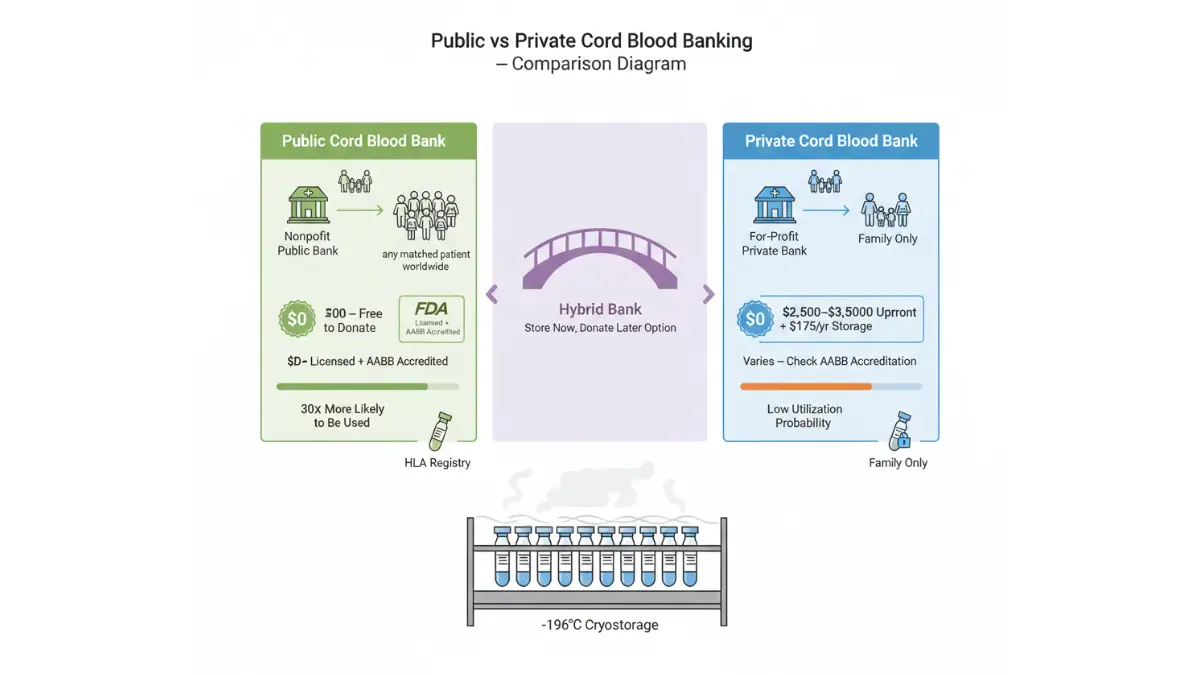
Public Cord Blood Banks
Public banks collect, process, and store your baby’s cord blood at no cost to you. The donation is made available to anyone in the national registry who needs a stem cell transplant. Think of it as organ donation — your baby’s cord blood could save a stranger’s life.
- Cost: Free
- Who benefits: Any matched patient worldwide
- Accreditation: Highly regulated; FDA-licensed
- Best for: Families with no known genetic disease history
- Registration deadline: Must register by Week 34 at most hospitals
The chances that donated cord blood will be used for transplantation are 30 times greater in the public system compared to private banking, according to the AAP.
Private Cord Blood Banks
Private banks store your baby’s cord blood exclusively for your family’s use. You pay upfront and annual storage fees.
2026 Real Cost Breakdown (Major U.S. Banks):
| Bank | Enrollment Fee | Annual Storage | 20-Year Total |
|---|---|---|---|
| Cord Blood Registry (CBR) | ~$2,150 | ~$175/yr | ~$5,650 |
| ViaCord | ~$1,749 | ~$175/yr | ~$5,249 |
| Cryo-Cell | ~$1,350 | ~$150/yr | ~$4,350 |
- Best for: Families with a known genetic disease affecting blood, immune system, or metabolism
- Limitation: Highly underutilized — the majority of privately stored units are never used
The Hybrid Bank Option (What Most Competitors Ignore)
A hybrid cord blood bank allows families to initially store cord blood privately but donate it for public use if it is not needed. Some programs charge little to no fee. This option is increasingly available in 2026 and represents the most balanced choice for families who are undecided.
To track your pregnancy health alongside this planning process, our Pregnancy Weight Gain Calculator helps you monitor your overall prenatal wellness in your third trimester.
Is Cord Blood Banking Worth It? The Honest MD Verdict
This is the section that Healthline, WebMD, and Cleveland Clinic all avoid writing. They hedge. They equivocate. They bury the verdict. We do not.
When Private Cord Blood Banking IS Worth It
Private banking is medically justifiable if any of the following apply to your family:
- ✅ A parent, sibling, or close relative has leukemia, lymphoma, sickle cell disease, or thalassemia
- ✅ Your family is of mixed ethnicity or an underrepresented ethnic group — harder to find matched unrelated donors in public registries
- ✅ You have an existing child with a condition that could benefit from a sibling cord blood transplant
- ✅ Your family carries a known genetic mutation linked to blood or immune disorders
- ✅ You have already adopted a child and do not know their genetic background
For these families, the cost is real biological insurance. The research history of cord blood transplantation — beginning with Duke University’s pioneering program in 1993 — demonstrates that HLA-matched sibling cord blood transplants have among the highest success rates in all of stem cell medicine.
When Private Cord Blood Banking Is Likely NOT Worth It
For the majority of healthy American families with no relevant disease history:
- ❌ The lifetime probability of a child using their own cord blood ranges from 1 in 400 to 1 in 200,000 (published research data)
- ❌ Private banks face less rigorous regulatory oversight than public banks
- ❌ The AAP, ACOG, and the American Medical Association all advise caution against private banking for low-risk families
- ❌ $5,000+ over 20 years is significant money for a product statistically unlikely to be used
A Real Case That Illustrates Both Sides
Marcus, age 7, Chicago: Diagnosed with acute myeloid leukemia. His parents had privately banked his cord blood at birth — but his oncologist confirmed the stored blood contained pre-leukemic cells and could not be used. His sister’s donated cord blood from a public bank was a partial match and ultimately used for his successful transplant.
Amara, age 4, Atlanta: Born with sickle cell disease. Her parents had privately banked her younger brother Kevin’s cord blood at birth because of family history. Kevin’s cord blood was a perfect HLA match. Amara underwent a successful stem cell transplant at age 3 using Kevin’s stored cord blood — a textbook case of exactly what private banking is designed for.
For more information on how haematopoietic stem cells work in transplantation, read our expert guide on haematopoietic stem cells and their medical applications.
What This Means For You — 5-Question Decision Framework:
- Does your family have any blood cancer history? → Yes = consider private
- Do you have an existing child with a treatable blood disorder? → Yes = consider private
- Is your family of mixed or underrepresented ethnicity? → Yes = consider private
- No disease history and healthy family? → Public donation is likely best
- Undecided? → Hybrid bank is your middle ground

How to Choose a Cord Blood Bank — 2026 Vetting Checklist
If you decide private cord blood banking is right for your family, choosing the right bank is critical. This is where poor decisions cost families thousands of dollars — and in worst-case scenarios, stored samples that fail quality testing.
Green Flags: What a Reputable Bank Must Have
- ✅ AABB accreditation — the gold standard for blood banking quality
- ✅ FACT accreditation (Foundation for the Accreditation of Cellular Therapy) for cellular therapy programs
- ✅ FDA registration as a licensed biological tissue bank
- ✅ Transparent pricing with no hidden annual fee increases
- ✅ Published transplant outcomes — how many units have actually been released for transplants?
- ✅ Dual-compartment storage — units stored in separate containers to allow partial use in clinical trials
Red Flags: Walk Away From These
- ❌ No published accreditation credentials
- ❌ Vague guarantees about “stem cell counts” without published methodology
- ❌ Salespeople contacting you in hospital during labor
- ❌ No clear policy on what happens if the bank goes bankrupt or closes
- ❌ Claims of “curing” conditions not yet FDA-approved
Enrollment Timing: Do Not Miss This Window
| Pregnancy Week | Action Required |
|---|---|
| Week 20–24 | Research and compare banks |
| Week 28 | Request collection kit |
| Week 34 | Final registration deadline (most banks) |
| Delivery | Collection performed by birth team |
| 24–48 hours post-delivery | Overnight shipping to lab |
Use our Fetal Growth Percentile Calculator to monitor your baby’s development week-by-week while you complete your banking enrollment.
For a deeper understanding of how stem cell therapy works more broadly, our comprehensive guide on stem cell therapy — does it really work? provides the full clinical picture.
Final Verdict + Action Plan for U.S. Expecting Parents
Here is the direct, no-hedging verdict you came for.
The Three-Path Decision
Path 1 — Public Donation (Recommended for most families) Donate your baby’s cord blood to a public bank. It is free, it is medically endorsed by every major professional society, and it could save another family’s child. This is the most socially and medically valuable choice for low-risk families.
Path 2 — Private Banking (For high-risk families only) If your family has a documented history of blood cancers, hemoglobinopathies, or rare immune disorders — especially if you have other children who could benefit — private banking is a legitimate investment. Choose an AABB-accredited bank and budget $4,000–$6,000 over 20 years.
Path 3 — Hybrid Banking (For undecided families) Store privately initially with the option to donate publicly if not needed. Low or no cost. Best for families who are unsure of their genetic history or are still undergoing genetic counseling.
A Note on Delayed Cord Clamping
The WHO and American College of Obstetricians and Gynecologists recommend delayed cord clamping (DCC) for 30–60 seconds after birth — it transfers valuable iron-rich blood to your newborn. Most cord blood banks can still collect adequate volumes after standard DCC if your birth team is prepared. Discuss this with your bank and OB/GYN in advance.
For any health symptoms during your pregnancy, use our Symptom Checker for quick guidance on when to contact your provider. For a broader look at how immunotherapy and cell-based treatments are transforming medicine in 2026, read our expert overview of how immunotherapy works.
Bottom Line: Cord blood banking is not a scam — it is a genuinely powerful medical resource. But like any insurance product, its value depends entirely on your individual risk profile. For most U.S. families, public donation is the right answer. For families with known disease history, private banking can be life-changing.
Frequently Asked Questions About Cord Blood Banking
1. What is cord blood banking?
Cord blood banking is the collection and cryogenic storage of stem cells from the umbilical cord blood after birth. These stem cells can treat over 80 diseases, including leukemia and sickle cell disease.
2. Is cord blood banking worth the cost?
For most families with no disease history, public donation is the better option. Private banking is worth the $2,500–$3,500 upfront cost only if your family has a documented history of treatable blood disorders.
3. What diseases can cord blood stem cells treat?
Cord blood stem cells currently treat over 80 conditions, including leukemia, lymphoma, sickle cell disease, thalassemia, Fanconi anemia, SCID, and metabolic disorders like Hurler syndrome.
4. What is the difference between public and private cord blood banking?
Public banks store donated blood for anyone who needs it — at no cost to the family. Private banks store blood exclusively for your family’s use at a cost of $2,500–$3,500 upfront plus annual fees.
5. Can my child use their own cord blood?
Only in limited circumstances. If your child develops leukemia, their own cord blood cannot be used because it already contains pre-leukemic cells. It is most useful for siblings or for conditions like cerebral palsy in clinical trials.
6. How much does cord blood banking cost in 2026?
Private banking ranges from approximately $1,350–$2,150 upfront plus $150–$175 per year in storage fees. Public banking is completely free.
7. How long can cord blood be stored?
Research confirms cord blood stem cells remain viable for at least 25 years in cryogenic storage. Some banks have reported successful transplants using units stored for over 20 years.
8. Does cord blood banking affect delayed cord clamping?
No — when properly coordinated with your birth team, cord blood can still be collected after standard delayed cord clamping of 30–60 seconds. Discuss timing with your bank and OB/GYN in advance.
9. What do doctors actually recommend about cord blood banking?
The AAP, ACOG, and AMA all support public donation for most families. They advise caution on private banking unless there is a specific known medical indication.
10. Can cord blood treat genetic disorders?
Cord blood can treat certain genetic disorders — but not with the affected child’s own blood, since the genetic mutation is already present in their stem cells. It can treat a sibling’s genetic condition if there is an HLA match.
11. What happens to cord blood if I don’t bank it?
If you do not donate or store it, the cord blood is discarded with the placenta. There is no medical risk to your baby in either choice — the decision is entirely about potential future medical value.
This article was written and reviewed by the credentialed medical expert panel at mymedicineadvisor.com. For more expert health content, visit our Health Tips library. For more on advanced stem cell therapies, read our guide on stem cell therapy real results.
⚠️ This content is for educational purposes only and is not a substitute for professional medical advice, diagnosis, or treatment. Always consult a qualified healthcare provider before making medical decisions.
About this content
How this article was put together: researched from recognised health sources, drafted with the help of AI tools, and edited by hand, with sources linked throughout.

Sameer Patel is the founder and editor of My Medicine Advisor. He is not a doctor or medical professional — before starting this site he worked in banking,…
Medical disclaimer
The content on MyMedicineAdvisor is provided for general informational and educational purposes only and is not a substitute for professional medical advice, diagnosis, or treatment. Health information on this website should not be used to diagnose, treat, cure, or prevent any condition without guidance from a qualified healthcare professional. Always seek the advice of your doctor, physician, or another licensed healthcare provider with any questions you may have regarding a medical condition, symptoms, medications, or treatment decisions.