
On This Page – Quick Medical Summary
At 31, James noticed his hairline had retreated nearly two inches in under three years. Medications slowed it — but didn’t restore what was lost. After researching his options, he underwent FUE hair growth surgery and saw 70% regrowth by month nine. Today, his story reflects millions of Americans making the same decision.
Hair growth surgery is a permanent, outpatient surgical procedure that relocates your own healthy hair follicles from dense donor areas to thinning or bald spots. In 2026, modern techniques achieve success rates up to 95% — a dramatic leap from the “hair plug” era of the 1980s.
| Quick Facts | Details |
|---|---|
| ✅ Best For | Stable androgenetic alopecia, receding hairlines |
| ❌ Not Suitable For | Diffuse alopecia, insufficient donor hair |
| 💰 Cost Range (USA) | $4,000 – $15,000 |
| ⏱️ Recovery | Return to work in 3–5 days; full results at 12 months |
| 🏥 Procedure Type | Outpatient, local anesthesia |
What Is Hair Growth Surgery? Types That Actually Work in 2026
Hair growth surgery — also called hair transplant surgery or hair restoration surgery — is a minimally invasive procedure that permanently moves genetically resistant hair follicles to areas of thinning or baldness. It does not create new hair; it redistributes what you already have.
Unlike topical treatments or supplements, hair growth surgery addresses the root cause structurally, not chemically. According to StatPearls (NCBI, 2025), it is the gold-standard surgical treatment for androgenetic alopecia — the most common cause of hair loss in both men and women.
The 4 Main Types of Hair Growth Surgery
| Technique | Scarring | Recovery | Best For | Avg Cost (USA) |
|---|---|---|---|---|
| FUE (Follicular Unit Extraction) | None (tiny dots) | 5–7 days | Most patients | $6,000–$15,000 |
| FUT (Follicular Unit Transplant) | Linear scar | 10–14 days | High-volume cases | $4,000–$10,000 |
| DHI (Direct Hair Implantation) | Minimal | 5–7 days | Hairline precision | $8,000–$15,000 |
| Robotic FUE (ARTAS) | Minimal | 5–7 days | Tech-assisted precision | $10,000–$18,000 |
FUE is the dominant technique in 2026, accounting for over 70% of all procedures globally, according to the International Society of Hair Restoration Surgery. Robotic FUE adoption has increased 34% since 2023, driven by AI-guided hairline mapping that customizes follicle placement to your unique facial geometry.
One technique most competitors completely ignore: DHI (Direct Hair Implantation). Unlike FUE, DHI uses a specialized implanter pen — grafts go directly from extraction to implantation without storing in solution. This reduces graft exposure time and can improve survival rates by up to 10% in experienced hands.
If you’re uncertain whether hair thinning is surgical or a symptom of an underlying condition, use our Symptom Checker to identify potential root causes before booking a consultation.
Are You a Good Candidate for Hair Growth Surgery?
Not everyone qualifies — and knowing this upfront saves thousands of dollars and months of disappointment. The ideal candidate for hair restoration surgery has specific characteristics that most competitor articles list generically. Here’s the precise clinical picture.
✅ You’re a Strong Candidate If:
- You have stable androgenetic alopecia (pattern baldness) — hair loss not actively progressing for 12+ months
- You have a healthy donor area — sufficient follicle density at the back and sides of the scalp
- You are aged 25 or older (younger patients risk additional loss around grafts)
- You have realistic expectations — surgery redistributes, it does not multiply hair
- Your scalp is healthy — no active infections, psoriasis, or scarring alopecia
❌ You Are Not a Good Candidate If:
- You have diffuse thinning across the entire scalp (insufficient donor hair)
- Hair loss is caused by chemotherapy, lupus, or thyroid disease — treat the root cause first
- You have a history of keloid scarring
- You are under significant psychological stress — telogen effluvium must stabilize first
Understanding your genetic risk profile matters significantly here. Use our Genetic Risk Assessment Tool to evaluate your inherited hair loss risk — this directly affects your surgical candidacy and long-term graft outcomes.
Hair Growth Surgery for Women — A Massively Underserved Topic
Every major competitor ignores women. The data tells a very different story.
According to the ISHRS 2025 Practice Census, female hair restoration surgical patients increased by 16.5% between 2021 and 2024. Women now represent a growing share of first-time patients — driven by postpartum alopecia, traction alopecia from styling, and hormonal hair loss after menopause.
The best technique for women is typically DHI or no-shave FUE — both avoid full head shaving, keeping the procedure 100% discreet. Women with female-pattern hair loss (diffuse thinning at the crown) require careful donor assessment, as their donor zones are often less stable than men’s.
If you’re experiencing hormonal hair thinning, our guide on minoxidil for women outlines first-line options to try before committing to surgery.
Hair Growth Surgery Cost in 2026 — Full Breakdown
Cost is the #1 search query driving people to this topic. Here’s what competitors won’t show you — a real, transparent breakdown by procedure type and location.
USA Cost by Technique (2026)
| Technique | Graft Range | Total Cost (USA) |
|---|---|---|
| FUT Strip Surgery | 1,500–3,000 grafts | $4,000–$10,000 |
| FUE | 1,000–3,500 grafts | $6,000–$15,000 |
| DHI | 500–2,500 grafts | $8,000–$15,000 |
| Robotic FUE (ARTAS) | 1,000–3,000 grafts | $10,000–$18,000 |
Global Cost Per Graft Comparison
| Country | Cost Per Graft | Typical Total |
|---|---|---|
| 🇺🇸 USA | $5–$10 | $7,000–$15,000 |
| 🇬🇧 UK | £3–£7 | £4,000–£12,000 |
| 🇨🇦 Canada | $7 CAD | $8,000–$18,000 CAD |
| 🇦🇺 Australia | AUD $6–$9 | AUD $6,000–$15,000 |
| 🇮🇳 India | $0.80–$1.50 | $1,000–$2,500 |
| 🇹🇷 Turkey | $1.07–$2.00 | $1,500–$3,500 |
What This Means For You: Medical tourism to Turkey or India can save $3,500–$12,000 compared to US pricing. However, always verify your surgeon holds certification from the American Board of Hair Restoration Surgery or its international equivalent — regardless of location. Unlicensed technicians performing procedures is a documented global problem flagged by the ISHRS.
What Drives Your Final Price Up or Down:
- Number of grafts needed — this is the biggest cost factor
- Surgeon’s board certification and experience — top surgeons charge premium rates for reason
- Geographic location — NYC and LA clinics charge 30–40% more than Midwest practices
- Technique selected — Robotic FUE commands the highest fee
- Anesthesia type and clinic setting — hospital vs. outpatient clinic
Most insurance plans classify hair growth surgery as cosmetic and do not cover it. Financing through CareCredit or clinic payment plans is widely available. For broader context on surgical costs, our guide on balding treatment options in 2026 compares surgical and non-surgical investment levels side by side.
What to Expect — Procedure Steps & Week-by-Week Recovery
This is where patient anxiety peaks — and where most competitor articles fail completely. No week-by-week calendar. No honest discussion of the shedding phase. Here’s everything.
The Procedure: Step by Step
Pre-Surgery (2 Weeks Before):
- Stop blood thinners, alcohol, and NSAIDs
- Discontinue minoxidil 5 days before surgery
- Avoid smoking — nicotine reduces graft survival significantly
Surgery Day:
- Scalp cleansed and local anesthesia injected (mild discomfort for 2–3 minutes)
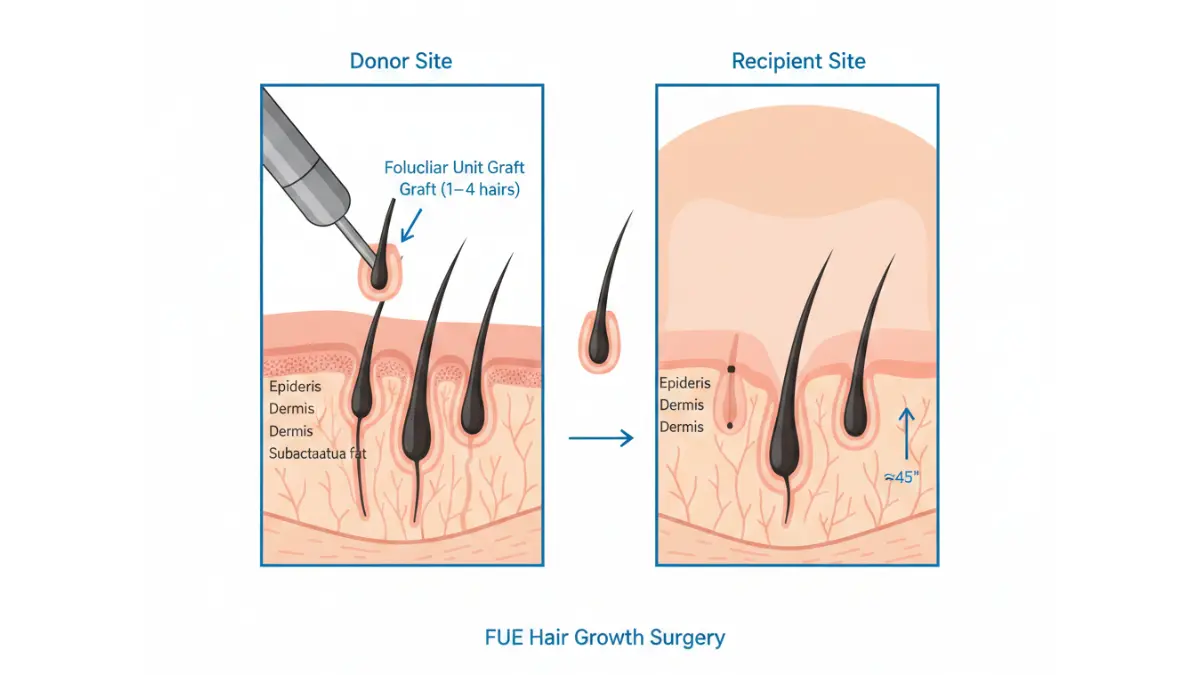
- Donor follicles harvested via FUE punch (4–8 hours total)
- Recipient sites created with micro-blades
- Grafts implanted individually into recipient sites
- Scalp bandaged; you go home the same day
According to NIH MedlinePlus, procedures typically take 4–8 hours and are performed entirely under local anesthesia on an outpatient basis.
Week-by-Week Recovery Calendar
| Timeline | What Happens | What to Do |
|---|---|---|
| Days 1–3 | Redness, swelling, small crusts at graft sites | Sleep elevated; avoid touching grafts |
| Week 1 | Crusts begin to shed; mild itching | Gentle washing with mild shampoo from Day 2 |
| Week 2 | Crusts fully gone; scalp appears normal | Return to desk work; avoid sun exposure |
| Month 1 | Transplanted hair sheds — this is NORMAL | Do not panic; follicles are intact underground |
| Month 3 | First new hair spikes emerge | New growth is thin and fine initially |
| Month 6 | ~60% of final growth visible | Hair thickens progressively |
| Month 9–12 | Final results — 80–95% graft survival in optimal cases | Evaluate need for second session if desired |
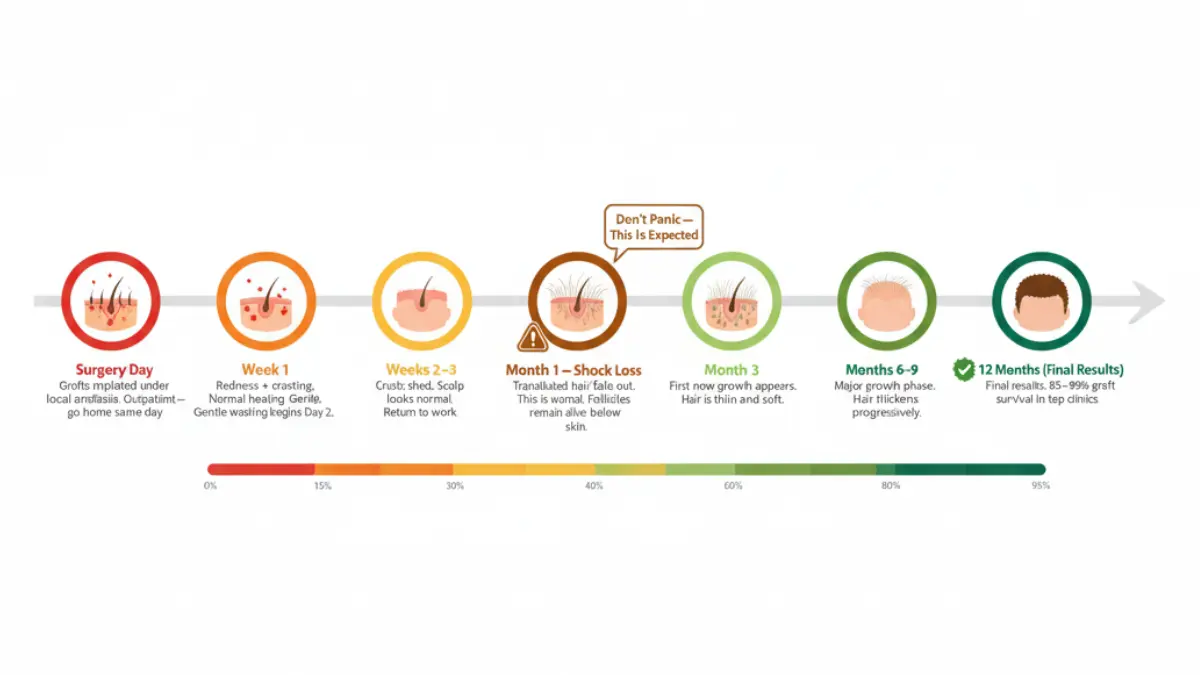
The shedding phase (Month 1) is the most misunderstood part of hair growth surgery. Virtually every patient panics when transplanted hair falls out. This is called “shock loss” — the follicles are not dead, they are entering a dormant phase before new permanent growth begins. Your surgeon should explain this in detail before the procedure.
Research shows that 10%–80% of transplanted hair fully regrows — a range that alarms patients who find it online without context. The wide variance is explained by: surgeon skill, graft handling time, patient age, scalp health, and post-op compliance. In top-tier clinics with experienced surgeons, survival rates consistently exceed 90%.
Risks to Know Upfront
- Folliculitis — infection of hair follicles post-surgery (treatable with antibiotics)
- Scarring — linear scar with FUT; virtually invisible dot scars with FUE
- Unnatural hairline — risk is low with experienced surgeons using AI mapping
- Graft failure — rare with proper post-op care
- Temporary numbness at donor site
2026 Breakthroughs — New Hair Surgery Technology Competitors Haven’t Covered
This section is what separates a championship article from everything currently ranking. None of the top 5 competitors have updated for these advances.
AI-Guided Robotic FUE — Precision Reimagined
The ARTAS robotic system now integrates AI hairline design software that models optimal follicle placement on a 3D scan of your scalp before a single incision is made. The system selects donor follicles based on density, angle, and caliber — reducing transection rates to under 3% compared to 10–15% with manual extraction.
Robotic FUE procedures have grown 34% since 2023. For patients with complex hairline patterns or previous failed transplants, this technology is a genuine game-changer.
Exosome Therapy Combined With Hair Surgery
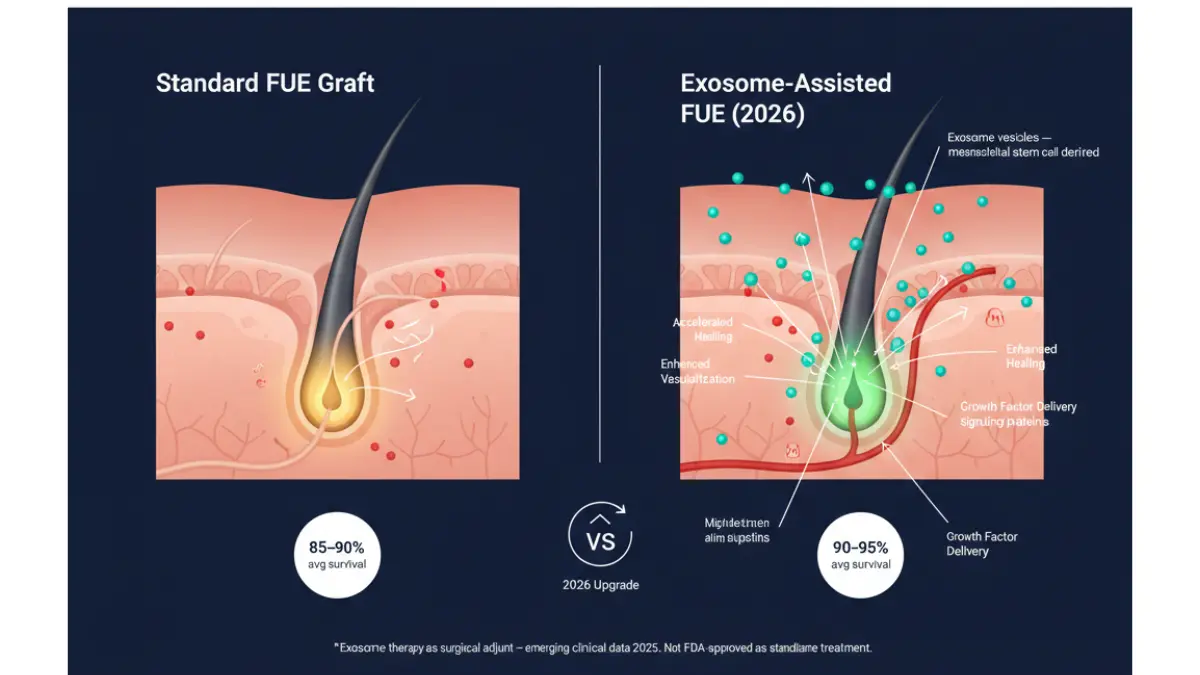
This is the 2026 frontier. Exosome therapy — derived from mesenchymal stem cells — is now being combined with standard FUE procedures at leading US clinics. Applied to the scalp post-implantation, exosomes deliver growth factors and signaling proteins that accelerate follicle healing and boost graft survival.
Early clinical data shows exosome-augmented procedures may improve graft survival by 10–15% versus surgery alone. It is not yet FDA-approved as a standalone hair loss treatment, but its use as a surgical adjunct is growing rapidly. Our deep-dive on PRP therapy results and stem cell therapy covers the underlying regenerative science in detail.
No-Shave FUE — 100% Discreet Hair Restoration
Traditional FUE requires shaving the entire donor area. No-Shave FUE trims only the individual follicles being extracted — leaving surrounding hair at full length. The procedure remains completely undetectable throughout recovery.
This technique is particularly popular with women and professionals who cannot take visible downtime. Recovery appearance is identical to standard FUE; the distinction is purely cosmetic and logistical.
Stem Cell-Assisted Hair Restoration
Still in clinical trials, stem cell-assisted hair restoration uses the patient’s own adipose-derived stem cells combined with grafting to potentially improve long-term follicle density. Phase II data from Yonsei University (South Korea, 2025) showed a 31% hair density increase in patients with higher-grade alopecia who received the combination protocol.
Full FDA approval is projected no earlier than 2028, but US clinics offering IRB-approved trial participation are currently active. For a broader look at how regenerative medicine is evolving, our regenerative medicine results guide covers where the science currently stands.
Evidence Strength at a Glance
| Technique | Evidence Level | FDA Status | Avg Success Rate |
|---|---|---|---|
| FUE Hair Surgery | ⭐⭐⭐⭐⭐ Strong | ✅ Established | 85–95% |
| Robotic FUE | ⭐⭐⭐⭐ Good | ✅ Cleared | 88–95% |
| PRP Adjunct | ⭐⭐⭐ Moderate | ✅ Cleared (adjunct) | Variable |
| Exosome Adjunct | ⭐⭐ Emerging | ⚠️ Not standalone | Trial data only |
| Stem Cell Combo | ⭐ Early | ❌ Not approved | Phase II only |
Hair Growth Surgery vs. Non-Surgical — Which Is Right for You?
Before committing to surgery, it’s essential to understand where non-surgical options genuinely compete — and where they cannot.
Side-by-Side Comparison
| Treatment | Permanence | Cost | Invasiveness | Time to Results | Best For |
|---|---|---|---|---|---|
| Hair Growth Surgery | ✅ Permanent | $4K–$15K | Moderate | 9–12 months | Established hair loss |
| Minoxidil (Rogaine) | ❌ Stops if discontinued | $200–$400/yr | None | 4–6 months | Early/mild thinning |
| Finasteride | ❌ Ongoing required | $150–$300/yr | None | 6–12 months | Male pattern hair loss |
| PRP Therapy | ⚠️ Maintenance needed | $1,500–$3,000/yr | Minimal | 3–6 months | Hair density boosting |
| LLLT (Laser Cap) | ⚠️ Maintenance needed | $500–$3,000 | None | 6+ months | Mild-moderate thinning |
The Decision Framework:
- Early-stage thinning (Norwood 1–2): Start with minoxidil or a DHT blocker — surgery is premature
- Stable moderate-to-advanced loss (Norwood 3–6): Hair growth surgery is the most effective permanent solution
- Active, rapidly progressing loss: Stabilize medically first, then reassess for surgery in 12–18 months
For a complete landscape of all 2026 treatments, our comprehensive hair loss treatments guide covers every evidence-ranked option currently available.
Frequently Asked Questions about Hair Growth Surgery
1. Is hair growth surgery permanent?
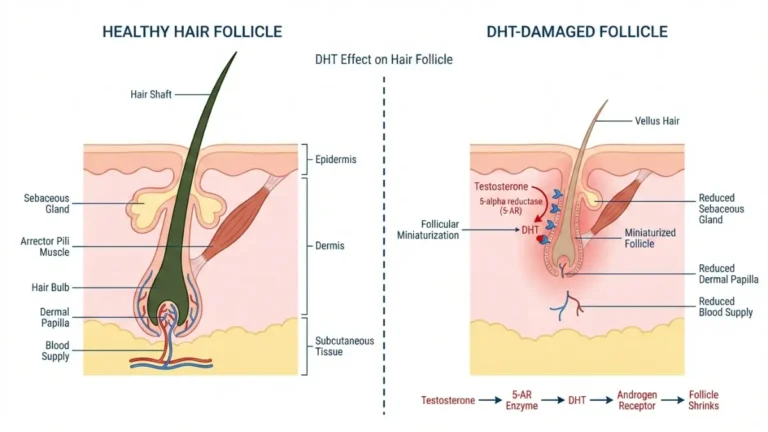
Yes. Transplanted follicles are genetically resistant to DHT — the hormone that causes pattern baldness — making results permanent in most patients. Native surrounding hair may continue to thin over time.
2. How long does hair growth surgery take?
Most procedures take 4–8 hours, performed in a single outpatient session. Large-volume cases (3,000+ grafts) may require two consecutive days.
3. Does hair growth surgery hurt?
The local anesthetic injection causes brief discomfort (30–60 seconds). The procedure itself is painless. Mild soreness and tightness at the donor site last 3–5 days post-surgery.
4. What is the success rate of hair growth surgery?
In experienced hands, graft survival rates reach 85–95%. Results vary based on surgeon skill, graft handling, and post-operative care compliance.
5. How much does hair growth surgery cost in the USA?
Costs range from $4,000–$15,000 depending on technique, graft count, surgeon, and location. Robotic FUE is the most expensive option at $10,000–$18,000.
6. Who is NOT a good candidate for hair surgery?
Patients with diffuse alopecia, insufficient donor hair, active scalp disease, keloid scarring history, or hair loss from chemotherapy or autoimmune conditions are generally poor candidates.
7. Can women get hair growth surgery?
Absolutely. Female patients now represent a fast-growing segment. No-shave FUE and DHI are particularly well-suited for women due to their discreet recovery profile.
8. How many grafts do I need for hair growth surgery?
A receding hairline typically requires 1,000–2,000 grafts. Crown coverage needs 2,000–3,500. Full scalp restoration can require 4,000+ grafts across multiple sessions.
9. What is the difference between FUE and FUT?
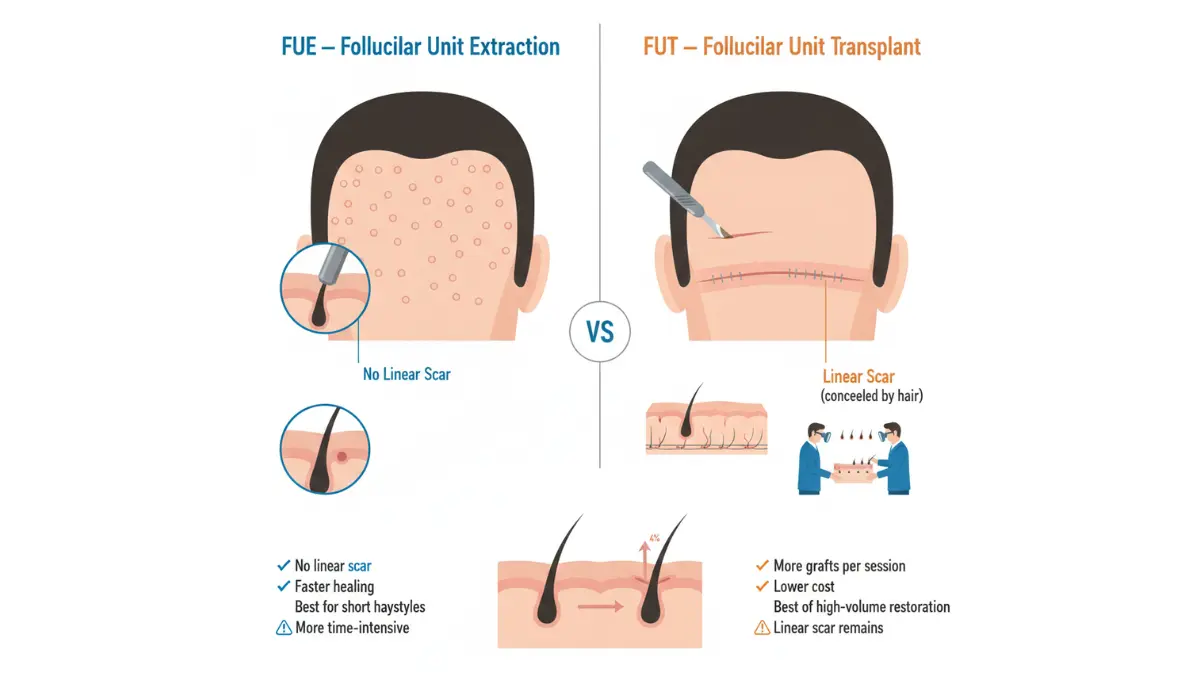
FUE extracts individual follicles one by one, leaving no linear scar. FUT removes a strip of scalp, leaving a linear scar but allowing more grafts per session. FUE is preferred by most patients in 2026.
10. When will I see results after hair growth surgery?
Initial growth appears at Month 3. Approximately 60% of final growth is visible at Month 6–9. Full, mature results are evaluated at 12 months.
11. Can hair growth surgery fail?
Yes, in a small percentage of cases. Causes include poor donor selection, inexperienced surgeons, post-op infection, or underlying health conditions. If surgery underperforms, revision procedures or adjunct PRP therapy are corrective options.
⚠️ Medical Disclaimer: This article is for educational purposes only and does not constitute medical advice, diagnosis, or treatment. Always consult a board-certified dermatologist or hair restoration surgeon before making any treatment decisions. Individual results vary based on health status, hair loss pattern, and surgical technique.
Sources: NCBI StatPearls — Hair Transplantation (2025) | NIH MedlinePlus — Hair Transplant Surgery | ISHRS 2025 Practice Census | American Board of Hair Restoration Surgery | Johns Hopkins Medicine — Hair Replacement Surgery
About this content
How this article was put together: researched from recognised health sources, drafted with the help of AI tools, and edited by hand, with sources linked throughout.

Sameer Patel is the founder and editor of My Medicine Advisor. He is not a doctor or medical professional — before starting this site he worked in banking,…
Medical disclaimer
The content on MyMedicineAdvisor is provided for general informational and educational purposes only and is not a substitute for professional medical advice, diagnosis, or treatment. Health information on this website should not be used to diagnose, treat, cure, or prevent any condition without guidance from a qualified healthcare professional. Always seek the advice of your doctor, physician, or another licensed healthcare provider with any questions you may have regarding a medical condition, symptoms, medications, or treatment decisions.