
On This Page – Quick Medical Summary
What to check before you buy a glucose meter
Most people buy a first blood glucose meter days after a diagnosis, with no idea what separates the boxes.
Seven things to check:
- The accuracy data printed on the box
- What test strips cost, and what your plan covers
- How the meter handles a short blood sample
- Whether the user can read the screen
- Where the readings go afterwards
- Meter, continuous glucose monitor, or both
- Who else will use it
Newly diagnosed, start below. Buying for a parent, read four and seven. Watching cost, go to three. Your meter produces numbers; what they mean is another question.
ℹ️ Medical Disclaimer: This article is general education about choosing a home testing device. It does not diagnose any condition, set a testing frequency, or recommend a treatment, and coverage rules vary by plan and change over time. Decisions about which device suits you, how often to test, and what your readings mean belong with a board-certified endocrinologist, your primary care clinician, or a certified diabetes care and education specialist.
What “accurate” actually means on the box
Every US meter is FDA-cleared, but clearance is not a single accuracy score.
The number FDA recommends
FDA’s September 2020 guidance sets what a manufacturer’s study should show against a laboratory comparator method.
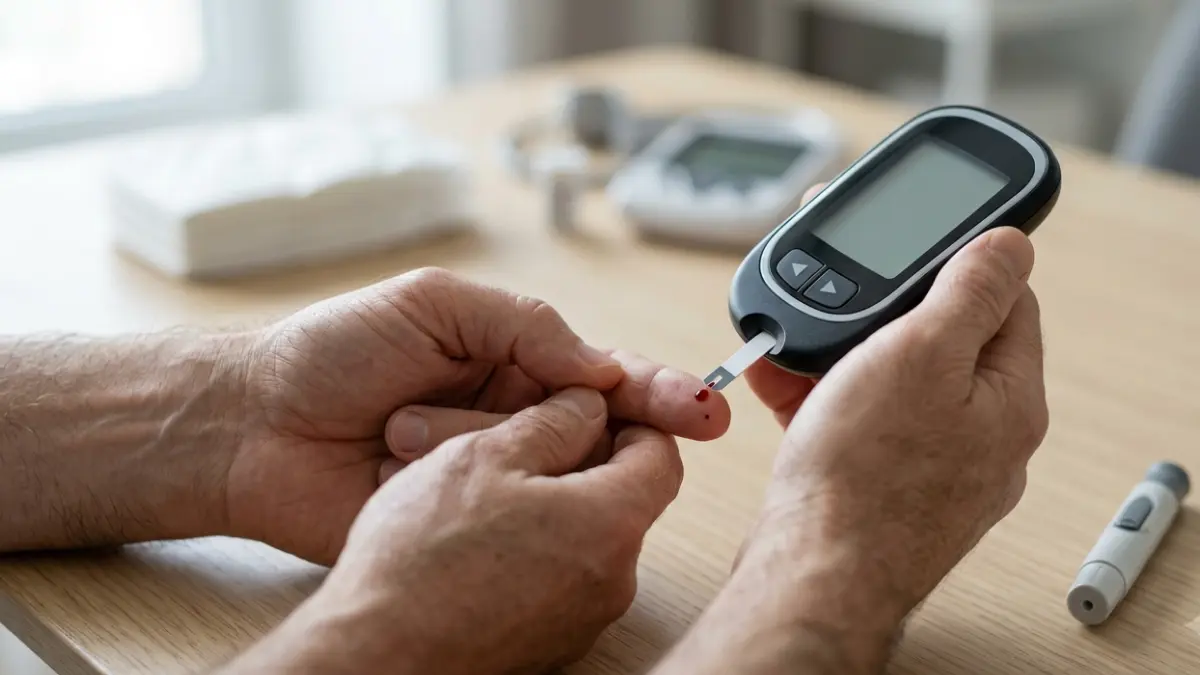
📊 Clinical Data Point: 95% of results within ±15% of a laboratory comparator, 99% within ±20% — Source: FDA, Self-Monitoring Blood Glucose Test Systems for Over-the-Counter Use, September 2020.
Why “meets ISO 15197” is a weaker claim
FDA states ISO 15197’s criteria are not sufficient for home users: that standard does not adequately address the low-glucose range or strip-lot performance.
Guidance is not law; older cleared meters stay on shelves. FDA recommends accuracy results appear on the box, so a box without a chart is itself information. If your meter and lab disagree, that gap has causes.
✅ Patient Action: Ask the pharmacist to show the accuracy chart on two boxes side by side.
The strips cost more than the meter
The meter is the cheap part. Test strips are the purchase you repeat monthly for years, and brands don’t interchange.

What Part B covers
Medicare covers these supplies as durable medical equipment for everyone with diabetes, insulin or not, paying 80% after your deductible.
| Supply | Using insulin | No insulin | Key Clinical Detail |
|---|---|---|---|
| Test strips | 300 per 3 months | 100 per 3 months | Needs documentation |
| Lancets | 300 per 3 months | 100 per 3 months | Device: 1 per 6 months |
Verified against the CMS fact sheet on Medicare coverage of diabetes supplies, February 2026 edition.
What the prescription must say
Your diagnosis, the monitor and why, whether you use insulin, and testing frequency.
✅ Patient Action: Ask any supplier two questions first — are you Medicare-enrolled, and do you accept assignment?
Can you actually use it day to day?
A meter unused in a drawer has an accuracy of nothing.
Short samples
FDA recommends a meter detect a short sample and withhold a result rather than report a wrong one. A refusal is protection.
Reading the screen
FDA recommends accessibility features for visual impairment, and Medicare covers a special monitor when a doctor documents a vision problem.
⚠️ Clinical Warning: Some meters allow alternate site testing on the forearm or palm, which hurts less. FDA warns those results can differ from fingertip results when glucose changes quickly, delaying or missing hypoglycemia. Use a fingertip if you suspect a low — low blood sugar has signs.
Where your readings go afterwards
A reading you cannot retrieve at your appointment did little work.
Memory and logbooks
Meters differ in how many results they store and whether they sync. A paper log you fill in beats an app you never open.
Units on the display
Meters sold for US use report in mg/dL. A device bought abroad may use mmol/L, so converting the units prevents a misreading.
Do you need a meter, a CGM, or both?
Two device classes, two rule books. FDA’s meter guidance explicitly excludes CGM sensors.
What each one measures
🔬 How It Works: A meter reads glucose in a drop of capillary blood at one moment. A CGM sensor sits under the skin and reads interstitial fluid continuously, a different fluid on a delay.
What Medicare covers
Part B covers CGMs when prescribed per FDA indications and the patient is insulin-treated or has a history of problematic hypoglycemia. Neither is an upgrade of the other, and the accuracy comparison cuts both ways.
✅ Patient Action: Ask your endocrinologist or diabetes educator whether continuous readings would change a daily decision.
Two safety rules most buying guides skip
A meter is a single-person device
FDA recommends every meter state it is for one person, and that the box warn multi-patient use can transmit HIV, hepatitis C, or hepatitis B. CDC adds that fingerstick devices must never be used on more than one person. Testing several people needs a device built for professional settings, not a retail meter.
📊 Clinical Data Point: 15 hepatitis B outbreaks in long-term care facilities were reported during 2008–2019 in association with assisted blood glucose monitoring — Source: CDC MMWR, August 2025.
Control solution is not optional
Control solution checks your meter and current strips still work together. FDA recommends two levels per system.
Glucose meter questions people ask before buying
1. Best glucose meter for accuracy?
No brand wins outright. Compare each box’s accuracy chart against FDA’s limits, then confirm with your clinician.
2. How accurate should a meter be?
FDA recommends 95% of results fall within 15% of a laboratory comparator, and 99% within 20%.
3. Does “meets ISO 15197” equal FDA’s criteria?
No. FDA states those criteria are not sufficient for home users, particularly in the low-glucose range.
4. Does Medicare cover the best glucose meter?
Part B covers monitors, strips, lancets and control solution for anyone with diabetes, by category.
5. How many test strips does Medicare cover?
Up to 300 every three months on insulin, 100 if not, plus one lancet device semiannually.
6. Do I need a prescription?
Not over the counter. Medicare coverage needs a prescription naming diagnosis, monitor type and testing frequency.
7. Why do strips cost more than the meter?
The strip is the repeat purchase, so yearly spending on the best glucose meter tracks strips.
8. Can two people share a meter?
No. CDC advises assigning meters to one person, and FDA recommends box labeling warning of transmission.
9. What if a caregiver tests several people?
CDC advises a device built for professional settings rather than a retail meter, disinfected each use.
10. What is control solution for?
It checks that your meter and current strips still work together. FDA recommends two levels be available.
11. Glucose meter or CGM?
Meters read capillary blood once; CGMs read interstitial fluid continuously. Which fits depends on treatment — ask your clinician.
Before you buy
Price the strips before settling on a meter. Look for the accuracy chart. Check the screen with whoever reads it. Buy control solution, and keep it to one user.
✅ Patient Action: Ask your pharmacist which covered strip is cheapest on your plan.
About this content
How this article was put together: researched from recognised health sources, drafted with the help of AI tools, and edited by hand, with sources linked throughout.

Sameer Patel is the founder and editor of My Medicine Advisor. He is not a doctor or medical professional — before starting this site he worked in banking,…
Medical disclaimer
The content on MyMedicineAdvisor is provided for general informational and educational purposes only and is not a substitute for professional medical advice, diagnosis, or treatment. Health information on this website should not be used to diagnose, treat, cure, or prevent any condition without guidance from a qualified healthcare professional. Always seek the advice of your doctor, physician, or another licensed healthcare provider with any questions you may have regarding a medical condition, symptoms, medications, or treatment decisions.