On This Page – Quick Medical Summary
The hard truth: Mesothelioma blood tests cannot confirm a diagnosis on their own. But they can detect cancer-linked proteins in your blood years before symptoms appear — and in 2026, that window is expanding fast.
According to the CDC, approximately 2,669 new mesothelioma cases were reported in the United States in 2022 alone. Median survival sits at roughly one year from diagnosis — because most patients aren’t caught early enough. Mesothelioma blood tests exist specifically to change that equation.
What Do Mesothelioma Blood Tests Actually Measure?
Mesothelioma blood tests don’t search for cancer cells directly. Instead, they detect biomarkers — proteins and biological substances that cancer cells, or the body in response to cancer, produce in unusually high concentrations.
Think of biomarkers as distress signals your body sends out. A mesothelioma blood test listens for those signals even when symptoms haven’t started yet.
The National Cancer Institute identifies soluble mesothelin-related peptides (SMRP) as the primary blood-measured biomarker for mesothelioma. But that’s just one of several being actively studied.
The 5 Key Mesothelioma Biomarkers — 2026 Overview
| Biomarker | Test Name | What It Detects | FDA Status | Sensitivity |
|---|---|---|---|---|
| SMRP (Mesothelin) | MESOMARK® | Mesothelioma-linked protein fragment | ✅ FDA Approved (2007) | 36–67% |
| Fibulin-3 | Fibulin-3 assay | Pleural mesothelioma protein | ❌ Research phase | Variable |
| Osteopontin | Osteopontin test | Asbestos-exposed cell protein | ❌ Investigational | ~67% |
| N-ERC Mesothelin | N-ERC test | Mesothelin isoform | ❌ Investigational | Potentially higher than MESOMARK |
| Calretinin / WT-1 | Tissue markers | Epithelioid mesothelioma type | ❌ Tissue/biopsy only | N/A (not blood-based) |
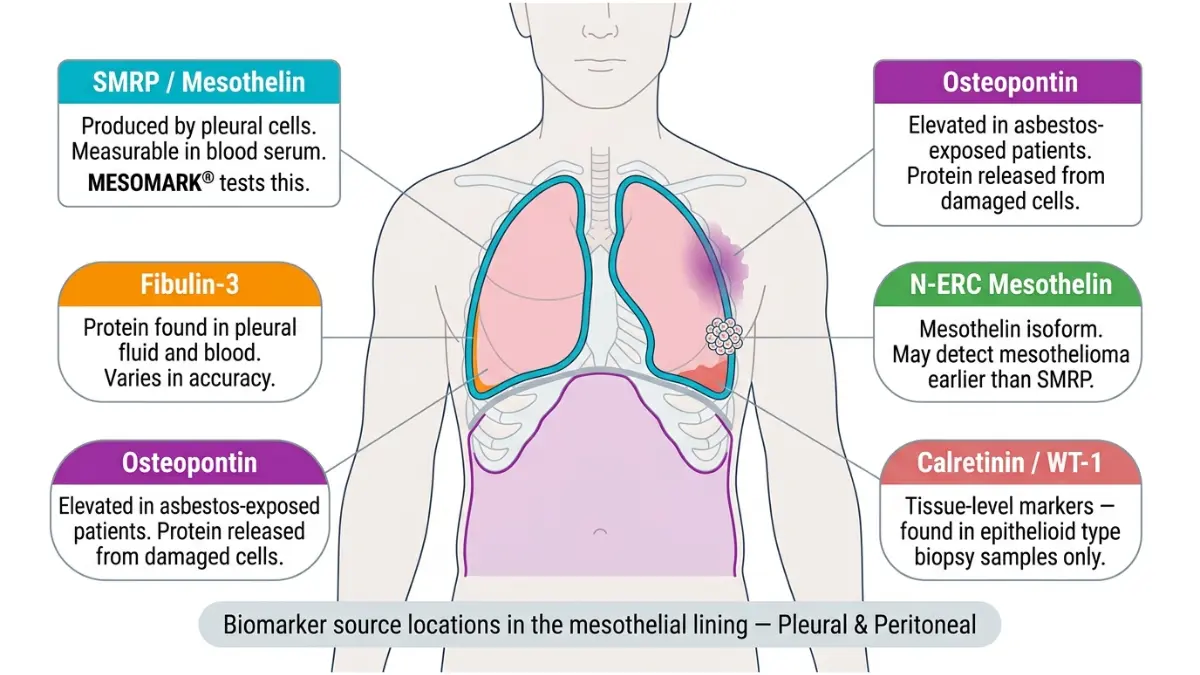
Key Takeaway: No single mesothelioma blood test is accurate enough to stand alone. Doctors use these tests alongside CT scans and biopsies to build a full diagnostic picture. If you’ve noticed symptoms you can’t explain, our Symptom Checker can help you map them before your next doctor’s visit.
MESOMARK — The Only FDA-Approved Mesothelioma Blood Test
MESOMARK is the only blood test for mesothelioma with full U.S. Food and Drug Administration approval. It was cleared in 2007 and measures SMRP (soluble mesothelin-related peptides) — tiny fragments of the protein mesothelin released into the blood by mesothelioma cells.
Here’s the critical biology: both healthy cells and mesothelioma cells produce mesothelin, but mesothelioma cells produce significantly more. The MESOMARK assay measures the excess concentration in your blood serum to flag abnormality.
MESOMARK Accuracy — Honest Numbers
| Performance Metric | MESOMARK Score |
|---|---|
| Sensitivity (early-stage pleural) | 36–67% |
| Specificity | 89–95% |
| Best Clinical Use | Monitoring treatment response |
| Can confirm diagnosis alone? | ❌ No |
SMRP levels can rise years before symptoms appear in high-risk patients — this is its most powerful early detection application. However, MESOMARK is not a general population screening tool. The NCI’s Early Detection Research Network continues to study SMRP’s clinical utility across broader risk populations.
What MESOMARK is currently used for:
- Monitoring known high-risk patients (asbestos-exposed individuals)
- Tracking treatment response in diagnosed patients
- Supporting — not replacing — biopsy-based confirmation
Marcus, a 62-year-old retired Navy shipyard worker from Virginia, had SMRP levels tested annually after his occupational asbestos exposure history was flagged. His elevated SMRP triggered a CT scan referral 14 months before any clinical symptoms appeared — demonstrating exactly how mesothelioma blood tests work within a surveillance system.
If you have a family history of asbestos exposure or cancer susceptibility, our Genetic Risk Assessment Tool can help you understand your inherited risk profile before speaking with a specialist.
The 2026 Breakthrough — Next-Generation Mesothelioma Blood Tests
This is the section no competitor covers adequately — and it changes everything.
The Mayo Clinic Chromosomal Rearrangement Discovery (November 2024)
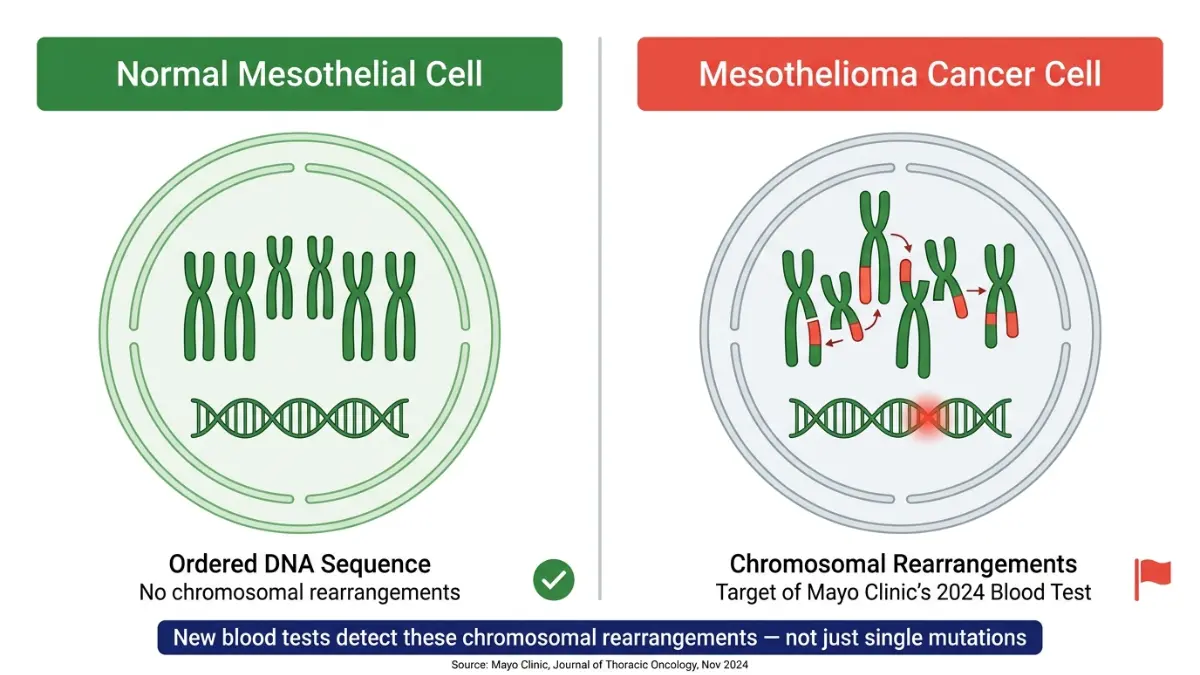
In November 2024, researchers at the Mayo Clinic announced a potentially transformational advance in mesothelioma blood testing. Traditional tests struggle because mesothelioma has very few single-point DNA mutations — the type most cancer blood tests look for.
The Mayo team found a different target: chromosomal rearrangements — sections of DNA that get shuffled or swapped in mesothelioma cells. By detecting these complex DNA patterns in blood using whole genome sequencing, they were able to identify mesothelioma DNA that existing assays routinely miss.
“We’re pushing the frontiers of what’s possible in blood-based monitoring,” — Dr. Aaron Mansfield, M.D., Medical Oncologist, Mayo Clinic Comprehensive Cancer Center.
This approach creates personalized tests — custom DNA primers built from each patient’s tumor — that then hunt for matching chromosomal changes circulating in blood. The implications for early detection and recurrence monitoring are significant.
Other Emerging Mesothelioma Blood Tests in 2026
SOMAmer Proteomic Panel
- Measures a panel of 13 biomarkers simultaneously
- Outperforms single-biomarker tests in distinguishing mesothelioma from other asbestos-related diseases
- Still in clinical validation phase
Liquid Biopsy (ctDNA)
- Detects circulating tumor DNA fragments shed into blood
- An Open Access study noted potential for identifying mesothelial precursor cells before full cancer develops
- Covered in depth in our guide on mesothelioma diagnosis critical tests
8OHdG Biomarker
- Detects DNA damage caused by asbestos fiber exposure
- Higher in asbestos-exposed individuals — a potential pre-cancer early warning signal
- Not yet a standalone diagnostic
Evidence Strength in 2026 (Highest → Lowest):
Chromosomal ctDNA (Mayo) → SOMAmer Panel → MESOMARK/SMRP → Osteopontin → Fibulin-3
For an in-depth look at how the latency period between asbestos exposure and diagnosis affects detection timing, read our article on mesothelioma latency period and asbestos exposure.
Who Should Get Mesothelioma Blood Tests in 2026?
According to the CDC’s mesothelioma overview, anyone concerned about asbestos exposure should discuss regular checkups or tests with their doctor. But not all risk is equal.
Your Mesothelioma Risk Tier — 2026 Framework
| Risk Level | Who You Are | Recommended Action |
|---|---|---|
| High Risk | 20+ years of direct asbestos exposure, male 55+, Navy veteran, construction/shipyard worker | Annual SMRP test + low-dose CT scan |
| Moderate Risk | Secondary household exposure, occasional workplace contact | Baseline SMRP + physician monitoring |
| Genetic Risk | Known BAP1 gene mutation carrier | Genetic counseling + surveillance protocol |
| Low Risk | No known asbestos history, vague symptoms | Symptom tracking + GP referral if persistent |
High-Risk Occupations — Key Groups in the USA
- U.S. Navy veterans (engine rooms, ship insulation)
- Construction workers in pre-1980 buildings
- Auto mechanics (brake pads, gaskets)
- Insulation installers and plumbers
- Industrial plant workers and miners
- Teachers and workers in older school buildings
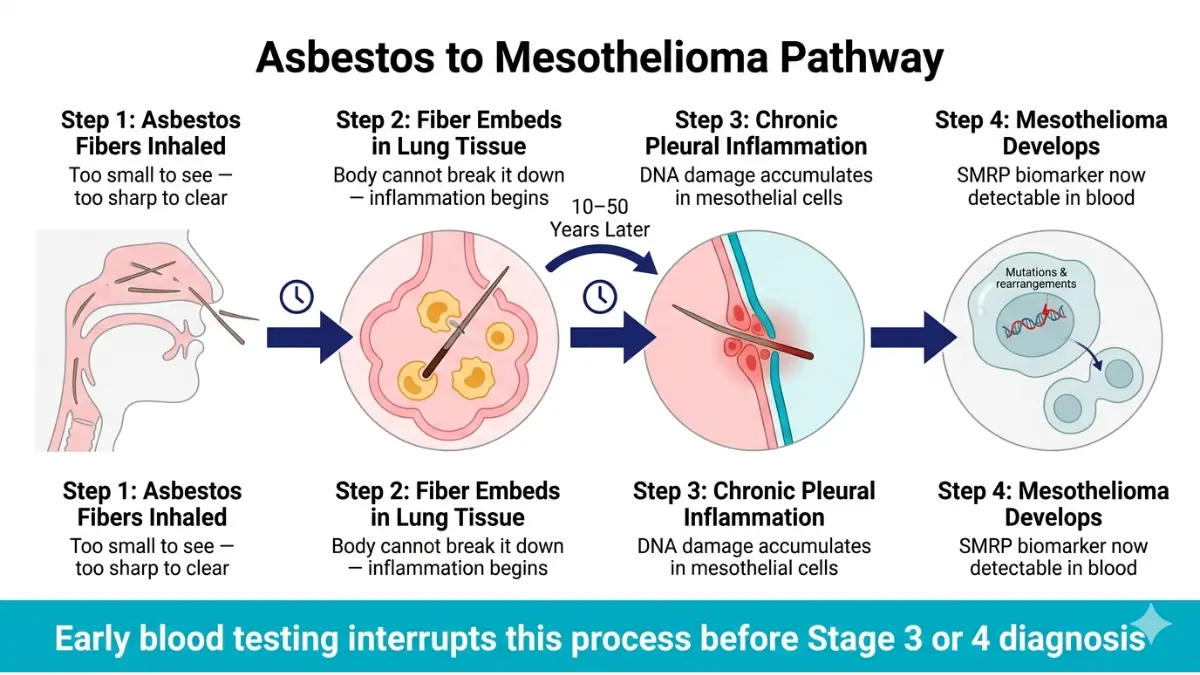
The latency period between first asbestos exposure and mesothelioma symptoms typically spans 20–50 years, per CDC data. This is why a shipyard worker exposed in 1975 may not develop symptoms until 2025 — and why proactive blood testing is critical. Read more about asbestos exposure and mesothelioma risk.
5 Questions to Bring to Your Doctor:
- Have I had known or likely asbestos exposure in my work history?
- Should I have a baseline SMRP or mesothelin blood test?
- Do any of my symptoms warrant a CT scan referral?
- Am I eligible for a mesothelioma clinical trial surveillance program?
- Should I consider BAP1 genetic testing given my exposure history?
Mesothelioma Blood Tests vs. Other Diagnostic Tools
Blood tests don’t work in isolation. Here’s how every diagnostic tool compares — including what most doctors actually use first.
Complete Mesothelioma Diagnostic Comparison — 2026
| Test | Confirms Diagnosis? | Early Detection Potential | Invasiveness | Typical U.S. Cost |
|---|---|---|---|---|
| Blood test (MESOMARK) | ❌ No | ⚠️ Partial | Non-invasive | $200–$500 |
| Biopsy | ✅ Gold standard | ❌ No | Invasive | $1,500–$5,000+ |
| Low-dose CT scan | ⚠️ Suggestive | ✅ Yes | Non-invasive | $500–$2,000 |
| PET scan | ⚠️ Suggestive | ⚠️ Partial | Non-invasive | $3,000–$6,000 |
| Chest X-ray | ❌ No | ❌ Often misses it | Non-invasive | $150–$400 |
| Liquid biopsy (ctDNA) | ⚠️ Emerging | ✅ Promising | Non-invasive | Research phase |
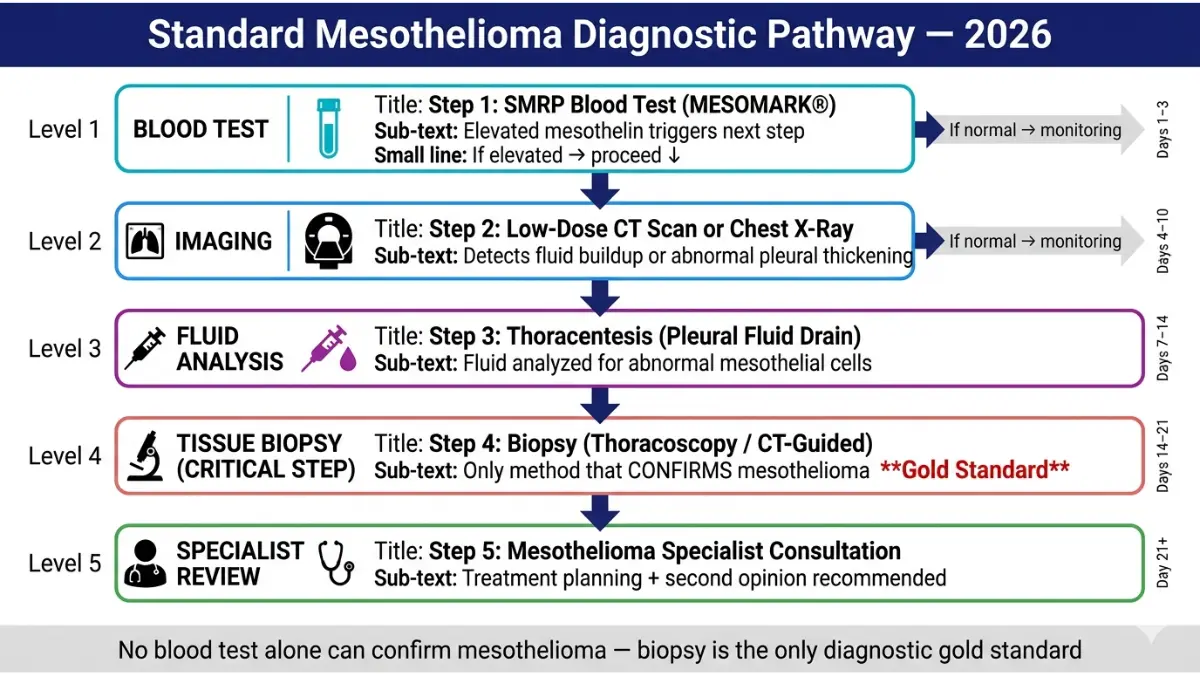
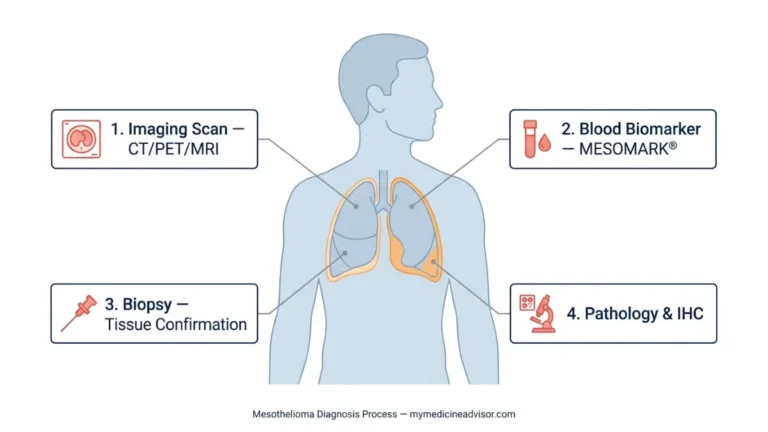
The Standard Diagnostic Pathway — Step by Step
- Blood test (SMRP/MESOMARK) — initial biomarker screening for high-risk patients
- Chest X-ray or low-dose CT scan — imaging to detect abnormalities or fluid buildup
- Thoracentesis or PET scan — fluid analysis or metabolic activity mapping
- Biopsy (thoracoscopy or CT-guided) — the only method that confirms mesothelioma
A biopsy is the definitive test. No mesothelioma blood test can replace it. For a detailed breakdown of how CT and PET scan results are interpreted in this context, see our guide on PET scan SUV chart and decoded results.
The NCI’s complete treatment guide for malignant mesothelioma also recommends biomarker testing specifically to guide immunotherapy decisions — not just for diagnosis. Understanding your pathology results is essential; our guide to biopsy results timelines and reports walks you through exactly what to expect after tissue sampling.
What This Means For You: If your doctor orders only a blood test without imaging, ask specifically about CT scan follow-up. A single SMRP result — elevated or not — is never the final word.
Your 2026 Mesothelioma Blood Test Action Plan
Knowing about these tests means nothing without action. Here’s exactly what to do in 2026 if you have a history of asbestos exposure or unexplained respiratory symptoms.
Step-by-Step Early Detection Roadmap
Step 1 — Document Your Asbestos Exposure History Record every job you held before 1990, where you worked, years of employment, and any building renovation projects you were part of. Write this down before your appointment.
Step 2 — Check Your Symptoms Now Use our Symptom Checker to map your current complaints. Common early-stage signals include unexplained chest pain, shortness of breath, and persistent dry cough — all easy to dismiss as aging or minor illness. Read our breakdown of early mesothelioma symptoms patients miss.
Step 3 — Request a Baseline SMRP Blood Test Ask your primary care physician specifically for a mesothelin/SMRP test, citing your exposure history. If they’re unfamiliar, request a referral to a pulmonologist or oncologist. The NCI’s tumor markers resource confirms SMRP as a recognized mesothelioma biomarker.
Step 4 — If Results Are Elevated, Seek a Specialist Elevated SMRP does not mean you have mesothelioma — it means more testing is needed. Request referral to a thoracic oncologist or mesothelioma specialist, not a general oncologist. Veterans should review our complete guide to veterans mesothelioma and VA claims.
Step 5 — Consider Clinical Trial Enrollment Several active NCI-sponsored clinical trials are currently studying improved blood-based early detection protocols. You can search current trials at clinicaltrials.gov directly.
Retesting Frequency (2026 Recommendation)
- High-risk exposure history: Annually
- Moderate risk: Every 2 years
- Post-treatment monitoring: Every 3–6 months as directed by your oncologist
For complete context on how early detection affects prognosis, see our pillar article: Mesothelioma Survival Rates, Symptoms and Treatment 2026 and our stage-by-stage guide on mesothelioma life expectancy.
Frequently Asked Questions — Mesothelioma Blood Tests 2026
1. Does mesothelioma show up in a routine blood test?
No. Standard CBC, metabolic panel, or routine labs will not detect mesothelioma. Specialized biomarker tests like MESOMARK specifically targeting SMRP are required.
2. What is the MESOMARK blood test?
MESOMARK is the only FDA-approved mesothelioma blood test in the U.S. It measures soluble mesothelin-related peptides (SMRP) in blood serum to flag possible mesothelioma activity.
3. How accurate are mesothelioma blood tests?
MESOMARK has a sensitivity of 36–67% for early-stage pleural mesothelioma and specificity of 89–95%. It cannot confirm a diagnosis alone — a biopsy is always required for that.
4. What biomarkers indicate mesothelioma?
The main mesothelioma biomarkers are SMRP (mesothelin), fibulin-3, and osteopontin. SMRP is the most studied and the only one measured by an FDA-approved test.
5. Can a blood test detect asbestos exposure?
No. No current blood test can detect asbestos fibers. Only tissue biopsy can reveal the presence of asbestos fibers embedded in body tissue.
6. What is the best blood test for mesothelioma early detection in 2026?
Currently, MESOMARK (SMRP assay) is the best available approved test. The Mayo Clinic’s chromosomal rearrangement liquid biopsy, announced in 2024, may soon offer significantly higher detection rates.
7. What is SMRP and how does it relate to mesothelioma?
SMRP stands for soluble mesothelin-related peptide. It’s a protein fragment released by mesothelioma cells in higher concentrations than healthy cells — making it a key early signal.
8. How long does it take to get mesothelioma blood test results?
MESOMARK and similar SMRP tests typically return results within 3–7 business days depending on the laboratory used.
9. Can mesothelioma be caught early with blood tests alone?
Not reliably. Blood tests are one layer of a surveillance system — they’re most effective when combined with low-dose CT scans in high-risk patients monitored over time.
10. What did the Mayo Clinic discover about mesothelioma blood tests in 2024?
Researchers developed a method to detect chromosomal rearrangements — DNA sections shuffled in mesothelioma cells — via a blood test. This targets a different DNA signature than traditional tests, potentially offering earlier and more accurate detection.
11. Who should ask their doctor for a mesothelioma blood test?
Anyone with a history of direct or secondary asbestos exposure, Navy veterans, construction workers from pre-1990 buildings, and individuals with a known BAP1 genetic mutation should discuss baseline SMRP testing with their physician.
Medical disclaimer
The content on MyMedicineAdvisor is provided for general informational and educational purposes only and is not a substitute for professional medical advice, diagnosis, or treatment. Health information on this website should not be used to diagnose, treat, cure, or prevent any condition without guidance from a qualified healthcare professional. Always seek the advice of your doctor, physician, or another licensed healthcare provider with any questions you may have regarding a medical condition, symptoms, medications, or treatment decisions.