
On This Page – Quick Medical Summary
If you are still unwell, this page is not your next step
If you have chest pain, pressure, shortness of breath, or symptoms you think could be a heart attack right now, call 911. Do not read further first. Our guide to how a heart attack can present covers the signs, and it is worth reading later — not instead of calling.
This page is for the person who has already been seen and sent home.
You are holding a discharge summary. It lists a long column of blood tests, and cholesterol is not among them. That feels like something was skipped, especially when cholesterol is the number everyone associates with hearts.
Nothing was skipped. A cholesterol test in the emergency room is uncommon because emergency blood tests and cholesterol tests answer two different questions, and the emergency department was answering the urgent one. Cholesterol belongs to the slower question about long-term risk — which needs a clinician who follows you over years, not hours.
If it helps to start with the test itself, our pillar explains what a lipid panel actually measures.
ℹ️ Medical Disclaimer: This is general health education about laboratory testing — not a diagnosis, treatment plan, medication or procedure recommendation, or insurance guidance. It cannot tell you whether your symptoms were cardiac, whether your results were normal, or whether you need cholesterol-lowering treatment. Discuss your discharge paperwork and any follow-up testing with a board-certified primary care physician or cardiologist before acting on anything here.
What the emergency room was actually testing for
An emergency workup for chest pain is built to answer one question quickly: is heart muscle being damaged right now?
The tests that answer it are an electrocardiogram and a blood test for cardiac troponin, usually alongside a physical examination and basic bloodwork such as kidney function. If your ECG was abnormal, our guide to what an abnormal ECG result means explains the follow-up.

What a troponin test can and cannot settle
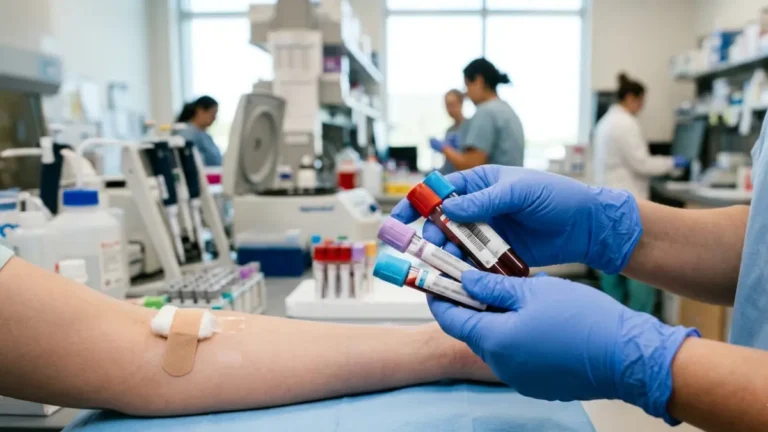
Troponin is a protein that lives inside heart muscle cells and leaks into the blood when those cells are injured. According to MedlinePlus guidance on the troponin test, it is ordered when someone has chest pain or other signs of a heart attack, and it needs no special preparation — no fasting, no timing rules.
🔬 How It Works: Damaged heart muscle releases troponin into the bloodstream within hours, so measuring it detects injury that has already happened. It says nothing about what might happen to your arteries over the next decade — which is what cholesterol testing is for.
You were probably stuck more than once, and that repetition is the point. MedlinePlus notes the test is usually repeated twice more over the following 6 to 24 hours, and that a normal result 12 hours after chest pain began makes a heart attack unlikely. The team was watching a number move, because movement is what reveals injury — and a cholesterol result would not have moved.
Our companion article on why the emergency room runs a metabolic panel covers the other panel you almost certainly did receive.
Why cholesterol answers a different question
Cholesterol testing is preventive medicine, and preventive medicine is not what an emergency department is built to deliver.
The StatPearls chapter on the standard indications for cholesterol screening states plainly that cholesterol screening is an integral part of primary and secondary prevention of atherosclerotic cardiovascular disease. Its list of indications is worth reading closely.
Nothing on that list is an emergency
The chapter’s indications are a family history of premature heart attack in a close relative, inherited high cholesterol or its visible physical signs, conditions likely to benefit from statin therapy such as diabetes or kidney disease, and risk stratification in people who have no known heart disease at all.
Notice what is absent. Not one of the four indications describes an acute event, a symptom, or an emergency — every one describes a planned assessment of somebody’s future.
That absence answers the question you came with: the test was not omitted from your visit, it was never an emergency test. The CDC makes the same point from the other direction, noting on its overview of blood cholesterol that the only way to know whether you have high cholesterol is to have it checked by your health care team.
Does a lipid panel show a heart attack?
No. A lipid profile measures fats in your blood; it does not detect injured heart muscle, and an ordinary result is compatible with a heart attack in progress. This is also why the condition is easy to miss — as high cholesterol symptoms explains, it produces none of its own, and what a lipid panel is designed to answer covers each component.
When a lipid panel does get drawn in hospital
Sometimes it is drawn, and if that happened to you, this article is not telling you it was impossible.
A multicentre trial registration on ClinicalTrials.gov describing a standard chest pain workup — a record whose status was last verified in 2009 — listed the usual emergency blood tests and then added that a lipid panel may be included, depending on physician preference. Ordering practice has changed since, but that discretionary status has not.

It is a judgement call, not a protocol
Published emergency-medicine research finds that only a small minority of chest-pain patients without previously known high cholesterol have a lipid panel drawn during the visit itself. Whether that is a missed opportunity is an open question that emergency physicians are actively studying rather than a settled matter.
Two readers can both be right: most leave without a cholesterol number, some leave with one.
If you were admitted rather than discharged
An overnight cardiac admission is a different situation from a few hours in the emergency department. Lipids are more often measured then, partly to give the team a reference point for later — and Section 5 explains why that reference point needs careful reading.
If you are reading someone else’s paperwork
Look for the panel name rather than individual numbers, since a lipid panel may appear under a billing description instead of a plain-English label. Our guides to helping a parent understand their blood tests and whether a cholesterol test needs fasting cover what comes up next.
✅ Patient Action: Before the follow-up visit, ask the primary care physician directly: “Was a lipid panel drawn during my hospital stay, and if so, should it be repeated now that I have recovered?”
If your hospital results did show a cholesterol number
Here is the part of this article that is not reassuring, and it matters more than the rest.
A cholesterol result measured during an acute illness may not represent your usual level. In its practical recommendations on lipid measurement, the National Lipid Association warns that lipoprotein measurements in hospitalised patients may not accurately reflect baseline lipid levels, and that a heart attack can depress those values — creating a false impression that they were never elevated and played no part in the event.

What that means for reading your result
A normal-looking number from that visit is not proof that cholesterol was not involved. It may simply be a number taken at an unrepresentative moment.
⚠️ Clinical Warning: Do not treat a normal cholesterol result drawn during an emergency visit or hospital admission as an all-clear. Because an acute illness can pull these values below a person’s true baseline, a reassuring hospital number may need repeating once you have recovered. Bring the printed result to your follow-up appointment rather than discarding it.
How much it moves is genuinely disputed
The size of this effect is not agreed on. Older hospital series report substantial falls in total and LDL cholesterol in the days after a heart attack, while a prospective multicentre analysis of patients admitted with acute coronary syndromes found the change over the first few days was not clinically meaningful.
We will not give you a percentage, because the evidence does not support one. What is consistent across the literature is the direction of the concern and the practical consequence: interpret an acutely drawn lipid result cautiously, and with the clinician who ordered it. If you want to understand what each flagged value on the report means in general, see what abnormal lipid panel results indicate.
What the guidelines actually schedule, and when
The clearest evidence that a cholesterol number was not needed on the night is that the relevant guideline does not ask for one then.
Treatment does not wait for the number
The 2025 acute coronary syndromes guideline summary from the American Heart Association and the American College of Cardiology recommends high-intensity statin therapy for all patients with an acute coronary syndrome, with the option of starting ezetimibe alongside it.
🩺 Physician Note: Current guidance recommends that treatment for every acute coronary syndrome patient, with no cholesterol threshold attached. A common point of confusion is assuming the number decides the treatment — for a confirmed event, it does not. That is precisely why measuring it in the first hour would not have changed the plan.
The guideline’s own lipid timing is weeks, not hours
The same summary recommends a fasting lipid panel 4 to 8 weeks after lipid-lowering therapy is started or its dose adjusted, as part of secondary prevention after discharge.
The authority you would most expect to want cholesterol measured on arrival schedules it for over a month later — once the acute illness has resolved and there is something to compare against.
Intervals differ between authorities, so treat this as the acute coronary syndromes guideline’s figure rather than a universal rule. Our article on whether you will be put on a statin covers monitoring after treatment starts, and what the current cholesterol guideline changed covers the wider picture.
✅ Patient Action: Ask your primary care physician or cardiologist: “Given what happened during my visit, when should my baseline lipid panel be done, and should it be fasting?”
What this page cannot tell you
This article can explain why a test was or was not ordered. It cannot tell you whether your symptoms were cardiac, or interpret your results.
Why an at-home kit is not the shortcut here
After an emergency visit, a mail-order cholesterol test is a tempting way to feel proactive. The problem is not accuracy — it is that a number alone is not what you need. Cholesterol becomes useful when a clinician reads it against your history, your risk factors and what happened during that visit; what at-home blood panels can and cannot do covers the trade-offs.
We have not placed a product recommendation on this page, and that is deliberate. Selling a test to someone who has just left an emergency department would substitute a kit for the follow-up appointment that every source above points toward.
Three questions for your follow-up appointment
- Was a lipid panel drawn at any point during my visit, and can I have a copy?
- If one was drawn, should it be repeated now that I have recovered?
- Based on my history, how often should my cholesterol be checked from here?
Common questions about cholesterol testing after an emergency visit
1. Does a lipid panel show a heart attack?
No. A lipid panel measures fats in your blood, not damage to heart muscle, so it cannot confirm or rule out a heart attack. That is what an ECG and repeat troponin blood tests are for, and a normal cholesterol result is fully compatible with a heart attack happening at the same time. This is one reason a cholesterol test in the emergency room is rarely part of the workup.
2. My hospital cholesterol was normal — does that mean cholesterol was not the problem?
Not necessarily. Lipid measurements taken during an acute illness may sit below your usual baseline, so a reassuring hospital number can be misleading. Published lipid-measurement guidance warns this can create a false impression that levels were never raised. Bring the result to your follow-up and ask whether it should be repeated now you have recovered.
3. Who orders a cholesterol test after a hospital visit?
Usually your primary care physician, sometimes a cardiologist if you are under their care. Cholesterol screening is preventive work that belongs with a clinician who follows you over time rather than with an emergency department. The CDC advises having it checked by your health care team and discussing frequency with them. Ask at your next appointment when yours should be done.

What to do next
The emergency department answered the question that could not wait, and left the question about your long-term risk for someone with the time to answer it properly. Those are two different jobs, and a cholesterol test belongs to the second one.
So the next step is not a test. It is an appointment. Book with your primary care physician, take the discharge paperwork with you, and ask the three questions above.
If a cholesterol number does appear on that paperwork, do not throw it away and do not treat it as settled — take it in and have it read properly.
About this content
How this article was put together: researched from recognised health sources, drafted with the help of AI tools, and edited by hand, with sources linked throughout.

Sameer Patel is the founder and editor of My Medicine Advisor. He is not a doctor or medical professional — before starting this site he worked in banking,…
Medical disclaimer
The content on MyMedicineAdvisor is provided for general informational and educational purposes only and is not a substitute for professional medical advice, diagnosis, or treatment. Health information on this website should not be used to diagnose, treat, cure, or prevent any condition without guidance from a qualified healthcare professional. Always seek the advice of your doctor, physician, or another licensed healthcare provider with any questions you may have regarding a medical condition, symptoms, medications, or treatment decisions.