
On This Page – Quick Medical Summary
Why the ER ran a basic metabolic panel
If you left the emergency room and found a basic metabolic panel (BMP) on your paperwork, here is the short answer: the ER runs this blood test on a great many people, because it gives the care team a fast, broad read on your body’s chemistry. Ordering it does not mean the team suspects something catastrophic — it is one of the most common blood tests in emergency medicine, used to check the things that can quietly turn dangerous.
Where you are right now shapes what you need next. If you are holding a result with a value flagged high or low, the section on what an abnormal number does and doesn’t mean is written for you. If you are mainly worried about the bill, our guide to what a BMP typically costs breaks down the charges. If a family member had the test and you are piecing it together for them, the same explanations apply — the panel checks the same eight things regardless of who is in the bed.
This guide walks through what the ER was actually looking for, how fast results come back, and when a result means you should be seen again.
ℹ️ Medical Disclaimer: This article is general health education, not a diagnosis, treatment plan, or medication or insurance advice. A basic metabolic panel can only be interpreted in the context of your full clinical picture, so use this to understand your test — then consult a board-certified physician (an emergency physician during your visit, or your primary-care or internal-medicine clinician afterward) before acting on any result.
What a basic metabolic panel measures
A basic metabolic panel measures eight substances in one small sample of blood, and the emergency team reads them as answers to four practical questions.
According to the National Library of Medicine’s overview of a basic metabolic panel, a BMP gives your care team four answers from a single blood draw:
- Fluid and electrolyte balance — sodium, potassium, chloride, and carbon dioxide (bicarbonate)
- Kidney function — BUN (blood urea nitrogen) and creatinine, two waste products your kidneys clear
- Blood sugar — glucose, your body’s main energy source
- Acid-base balance — how acidic or alkaline your blood is, read mainly from the CO2 and electrolytes
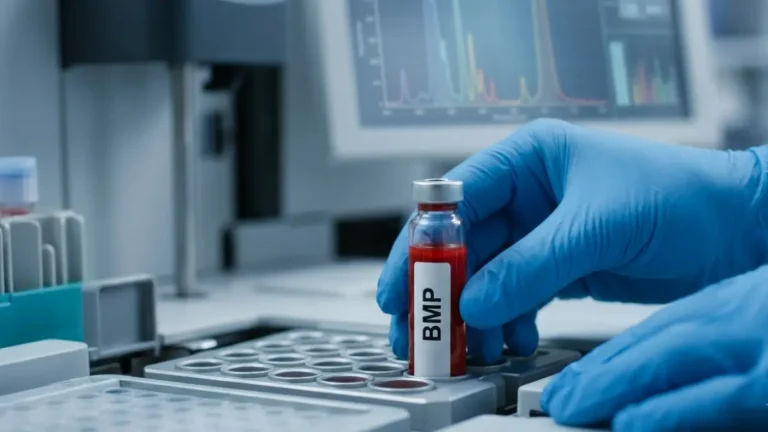
Those eight values are the same ones on a routine physical’s chemistry panel; the ER simply wants them quickly. You may hear staff call it a “chem 7,” an “electrolyte panel,” or a “chemistry screen” — all are other names for the same test. A BMP is also the shorter cousin of the comprehensive metabolic panel (CMP), which adds six liver and protein measures.
For a value-by-value walkthrough, our guide to the panel’s eight blood results breaks down each one.
The emergencies a BMP helps catch fast
The four checks in a basic metabolic panel map onto the acute problems an emergency team most wants to catch — or rule out — quickly. What makes the panel powerful is that the values are read together, not one at a time.

Potassium and your heart rhythm
Potassium is the value most tightly linked to how your heart beats. Peer-reviewed emergency-medicine research indexed by the NIH shows that levels that drift too high or too low can disrupt the heart’s electrical rhythm, which is why an abnormal potassium result draws fast attention.
🔬 How It Works: Your heart muscle contracts on electrical signals, and potassium helps carry them. When blood potassium moves outside its normal band, those signals can misfire and produce an irregular or dangerous rhythm — so bringing it back in range is often urgent.
For a closer look at the potassium blood test and the other electrolytes, our guide to the panel’s electrolytes explains what pushes each one off balance.
Dehydration versus kidney injury
BUN and creatinine are waste products your kidneys filter out, so reading them together helps the team tell simple dehydration apart from a kidney that is struggling. A high reading can mean you are low on fluids — often reassuring and quickly treated — or that your kidneys need a closer look. Our guide to the kidney markers on a chemistry panel explains how the two are interpreted as a pair.
Blood sugar too high or too low
Glucose is checked because both extremes are emergencies. Very low blood sugar can cause confusion, sweating, or a seizure; very high blood sugar, paired with a low CO2 reading, can point toward diabetic ketoacidosis.
🔬 How It Works: In diabetic ketoacidosis, a shortage of insulin forces the body to burn fat for fuel, which floods the blood with acids and drives the CO2 (bicarbonate) down. The NIH’s StatPearls describes it as a critical metabolic emergency — and the pairing of high glucose with a low CO2 on a BMP is one of its fingerprints.
Acid-base balance
The CO2 value, read with the electrolytes, shows whether your blood has turned too acidic — a state called metabolic acidosis with many possible causes the team then works to pin down. You can read more about the CO2 (bicarbonate) blood test and what it reflects.
⚠️ Clinical Warning: A BMP result on its own does not diagnose any of these conditions. The numbers are clues your clinician interprets alongside your symptoms, exam, and other tests — a single out-of-range value is not a verdict.
✅ Patient Action: If a specific value on your report is flagged, ask the emergency physician or your primary-care clinician: “Which of my values were outside the normal range, what could explain that for me, and do I need a repeat test?”
Why your symptoms led the ER to order it
You may be wondering why a blood test was ordered when your reason for the visit felt unrelated. The honest answer is that several everyday symptoms overlap with the chemistry problems a basic metabolic panel checks.
Symptoms that commonly prompt a BMP
The National Library of Medicine lists general symptoms — ongoing fatigue, confusion, breathing trouble, or vomiting that won’t stop — as common reasons a BMP is ordered. Those same symptoms can be early signs of dehydration, an electrolyte imbalance, kidney trouble, or a blood-sugar problem, so the test is a way to rule them in or out rather than a signal the team fears the worst.
For people with diabetes, the CDC’s guidance on the warning signs of diabetic ketoacidosis explains why very high blood sugar is checked urgently. If you want to compare a glucose value between the units labs and home meters use, our blood sugar converter does the math.
Why you probably didn’t have to fast
Most ER blood draws are not fasting draws, because fasting mainly affects the glucose reading — not the electrolytes or kidney values. If you are used to fasting for lab work, our guide on whether you need to fast for a BMP explains when it matters and when it doesn’t.
How fast results come back — and what “critical” means
One reason the ER favors this panel is speed. In an emergency, a basic metabolic panel is usually run on a rush (“STAT”) basis, so results are typically back within about an hour — sometimes faster when the department uses point-of-care testing at the bedside.

How quickly the ER gets your results
While you wait, the sample is processed and the values are sent to your care team’s screen, often before other test results are back. Chemistry panels are prioritized precisely because the team relies on them to guide urgent decisions.
What a critical value is — and what happens next
Some results fall so far outside the safe range that they signal a possibly life-threatening problem. These are called critical values, and U.S. laboratories are required under federal CLIA rules to notify the ordering clinician right away rather than let the result sit in a queue.
🩺 Physician Note: The critical-value system is a safety net most patients never hear about. When a dangerous result comes back, the lab phones it to the care team within minutes — which means the scariest numbers are also the ones acted on fastest.
To see which kinds of results labs typically treat as critical, our guide to critical values on a chemistry panel walks through them.
What an abnormal result does — and doesn’t — mean
If a value on your basic metabolic panel is flagged high or low, it is natural to assume the worst — but a single out-of-range number rarely tells the whole story.
One value out of range isn’t a diagnosis
The National Library of Medicine is explicit that an abnormal result, alone or in combination, can point to several conditions, and that more testing is usually needed to confirm or rule out any one of them. Your clinician reads each value against your symptoms, your history, and the medicines you take — which is why the same number can be routine for one person and worth investigating for another.
How to read your own copy
Normal ranges vary from lab to lab, so the most reliable comparison is against the reference range printed on your own report, not a figure from the internet. Our guide to the panel’s normal ranges explains how the columns are laid out, and our walkthrough on reading your results line by line helps you make sense of each row.
When to head back to the ER
Being discharged does not always mean the situation is fully resolved, so it helps to know which symptoms warrant a return.

Symptoms that mean seek care now
Go back to the emergency room or call 911 if you develop severe or worsening symptoms — persistent confusion, trouble breathing, a fast or irregular heartbeat, or repeated vomiting that keeps you from holding down fluids. For people with diabetes, warning signs of diabetic ketoacidosis — very high blood sugar, fruity-smelling breath, and ongoing vomiting — are reasons to seek care right away.
✅ Patient Action: Before you leave, ask the discharge nurse which specific symptoms should bring you back, and get a copy of your lab results to bring to your follow-up appointment.
Following up after your visit
Even a normal panel is worth discussing with your regular clinician, especially if the visit raised a new question about your kidneys, blood sugar, or blood pressure. If your itemized bill looks off later, our guide to spotting errors on ER lab charges can help you check the coding.
BMP in the ER: frequently asked questions
1. Why did the ER run a BMP on me?
The ER runs a basic metabolic panel because it gives the care team a fast, broad look at your body chemistry — your electrolytes, kidney function, blood sugar, and acid-base balance. It is one of the most common emergency blood tests and is ordered for many different symptoms, so having it done is routine rather than a sign of a specific serious diagnosis.
2. Does a BMP in the ER mean something is seriously wrong?
No. A basic metabolic panel is standard, broad screening that helps the team rule problems out as often as rule them in, so being tested does not mean they expect the worst. That said, the results still matter and are read alongside your exam and history. Ask your clinician what your specific values mean for you.
3. What does a basic metabolic panel check for?
A basic metabolic panel checks eight substances grouped into four areas: fluid and electrolyte balance (sodium, potassium, chloride, and CO2), kidney function (BUN and creatinine), blood sugar (glucose), and acid-base balance. Read together, these values give the emergency team a quick picture of how your body’s chemistry is working.
4. How long do ER BMP results take?
In the emergency room, a basic metabolic panel is usually run STAT, so results are typically back within about an hour — sometimes faster when the department uses bedside point-of-care testing. The exact time depends on how busy the lab is, but chemistry panels are prioritized because the team relies on them to guide urgent decisions.
5. What is a “critical” result on a blood test?
A critical value is a result so far outside the safe range that it signals a possibly life-threatening problem. U.S. laboratories are required under federal CLIA rules to notify the ordering clinician immediately, rather than let it wait — which means the most dangerous results on a BMP are also the ones acted on fastest.
6. Did I need to fast for the BMP in the ER?
Usually not. Most ER blood draws are not fasting draws, because fasting mainly affects the glucose (blood sugar) reading and not the electrolytes or kidney values. If your basic metabolic panel was drawn without fasting, that is normal for emergency care and does not make the electrolyte and kidney results unreliable.
7. What if my ER BMP came back abnormal?
One abnormal value on a basic metabolic panel is not a diagnosis. Results can point to several conditions, and more testing is usually needed to confirm or rule any of them out; your clinician interprets each value alongside your symptoms, history, and medicines. Bring your report to a follow-up appointment to discuss what it means for you.
8. Why did the ER check my potassium?
Potassium is the value most closely tied to your heart’s rhythm, so an emergency team watches it carefully. Levels that are too high or too low can disrupt the heart’s electrical signals, which is why potassium on a BMP gets prompt attention. If your potassium was flagged, ask your clinician what it means for you.
9. Can a BMP detect a heart attack?
No. A basic metabolic panel is not a cardiac test — a heart attack is diagnosed with other tests, such as a troponin blood test and an ECG. A BMP can, however, flag electrolyte problems like abnormal potassium that affect heart rhythm, which is one reason it is often drawn alongside cardiac tests in the ER.
10. Is a BMP the same as a CMP?
Not quite. A basic metabolic panel includes eight tests, while a comprehensive metabolic panel (CMP) adds six more that check liver enzymes and proteins. The ER often chooses a BMP when it wants electrolytes, kidney, and glucose quickly. Our guide to how a BMP and a CMP differ explains when each is used.
11.Will the BMP show up on my ER bill?
Yes — a basic metabolic panel is a billable lab test and will appear on your itemized charges, usually under the code for the panel. What you pay varies widely by where the blood was drawn and by your insurance. If a charge looks wrong, comparing it against the panel’s billing code can help you spot errors.
The bottom line on your ER blood test
A basic metabolic panel in the emergency room is a routine, fast, and broad snapshot of your body chemistry — checking your electrolytes, kidney function, blood sugar, and acid-base balance in a single draw. Having it ordered says the team was being thorough, not that they expected the worst, and any truly dangerous result is flagged and acted on quickly.
The most useful next step is simple: get a copy of your results, compare each value against the reference range printed on your own report, and bring any flagged number to a follow-up with your primary-care clinician. That turns a page of unfamiliar abbreviations into a clear conversation about your health — and puts you, not the worry, in charge of what comes next.
About this content
How this article was put together: researched from recognised health sources, drafted with the help of AI tools, and edited by hand, with sources linked throughout.

Sameer Patel is the founder and editor of My Medicine Advisor. He is not a doctor or medical professional — before starting this site he worked in banking,…
Medical disclaimer
The content on MyMedicineAdvisor is provided for general informational and educational purposes only and is not a substitute for professional medical advice, diagnosis, or treatment. Health information on this website should not be used to diagnose, treat, cure, or prevent any condition without guidance from a qualified healthcare professional. Always seek the advice of your doctor, physician, or another licensed healthcare provider with any questions you may have regarding a medical condition, symptoms, medications, or treatment decisions.